This is a special post for quick takes by Jeremy Gillen. Only they can create top-level comments. Comments here also appear on the Quick Takes page and All Posts page.
Comment Permalink
Algorithmic condensation
I needed a more detailed sketch of algorithmic condensation so I could build on it, so here's what I've got. I've done a proof for two concrete cases of the objectivity theorem, which I find much easier to understand than keeping track of the indices in the fully general proof.
Latent String model
A latent string model is a set of observations
- a mapping from each index
In addition, if
- Each
- The printed contribution function is correct on all given latents. Additionally, it needs to be able to overestimate the contribution of unseen latents. We'll call this overestimating version of the contribution function
Almost perfect
We'll say that this latent string model is an
- (Reconstruction) For all
- If
- If
- (Markov) for all
- If we set up the strings in a directed graph where a node is a child if its contribution is a subset of a parent (so there are never any grandparents, only parents), we have analogous conditional independence properties as a Bayes net, approximately.
- A Bayes net has a local Markov property that each variable is conditionally independent of its non-descendants given its parents.
- A Bayes net has a local Markov property that each variable is conditionally independent of its non-descendants given its parents.
- If we set up the strings in a directed graph where a node is a child if its contribution is a subset of a parent (so there are never any grandparents, only parents), we have analogous conditional independence properties as a Bayes net, approximately.
- (Well-separated) for all distinct
- Any two latents will contribute to sufficiently different observation sets, such that the two latents can be easily distinguished.
- When
Objectivity for almost perfect
Given two models,
For concreteness, let's assume
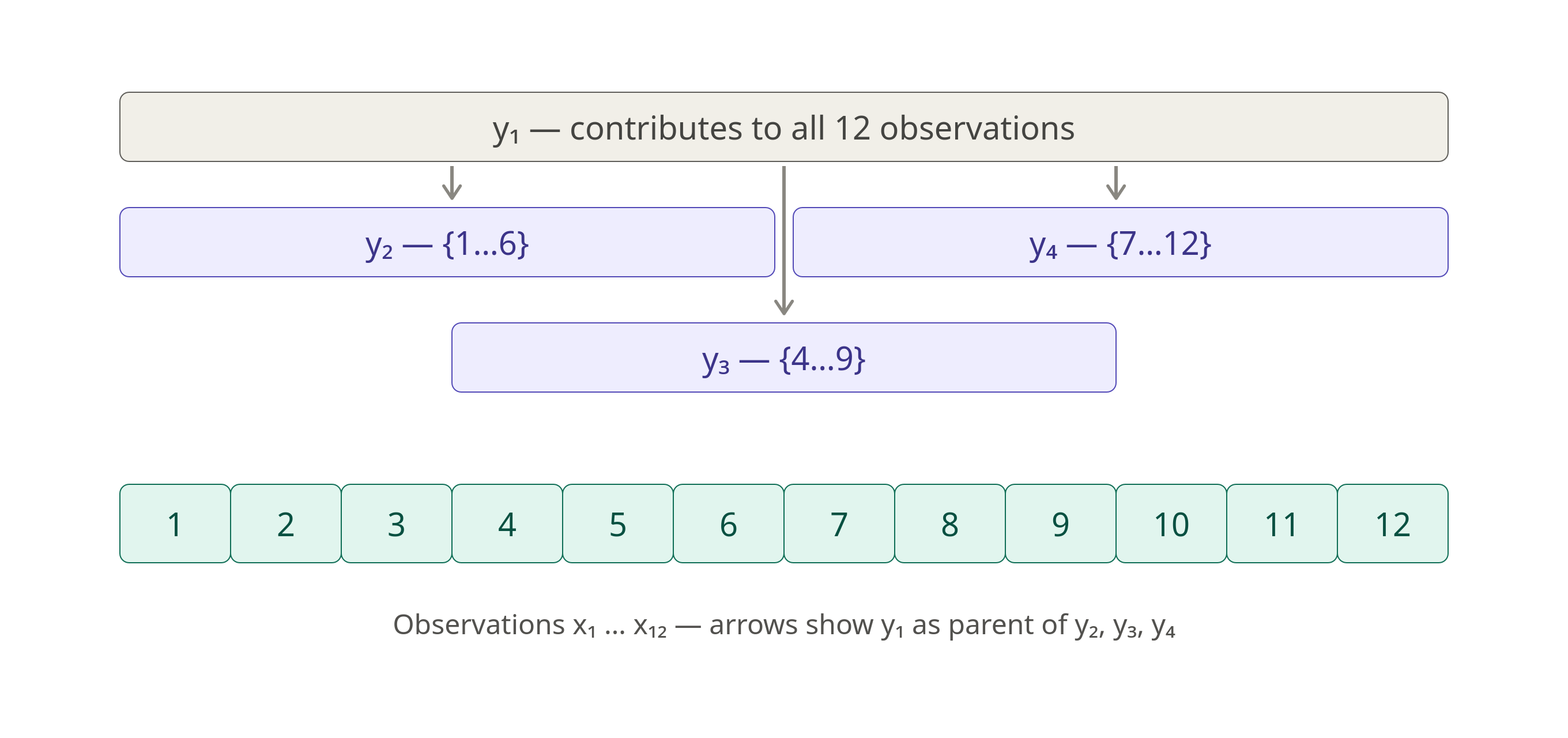
1: {1,2,3,4,5,6,7,8,9,10,11,12}
2,3,4:
{1,2,3,4,5,6},{4,5,6,7,8,9},{7,8,9,10,11,12}
and
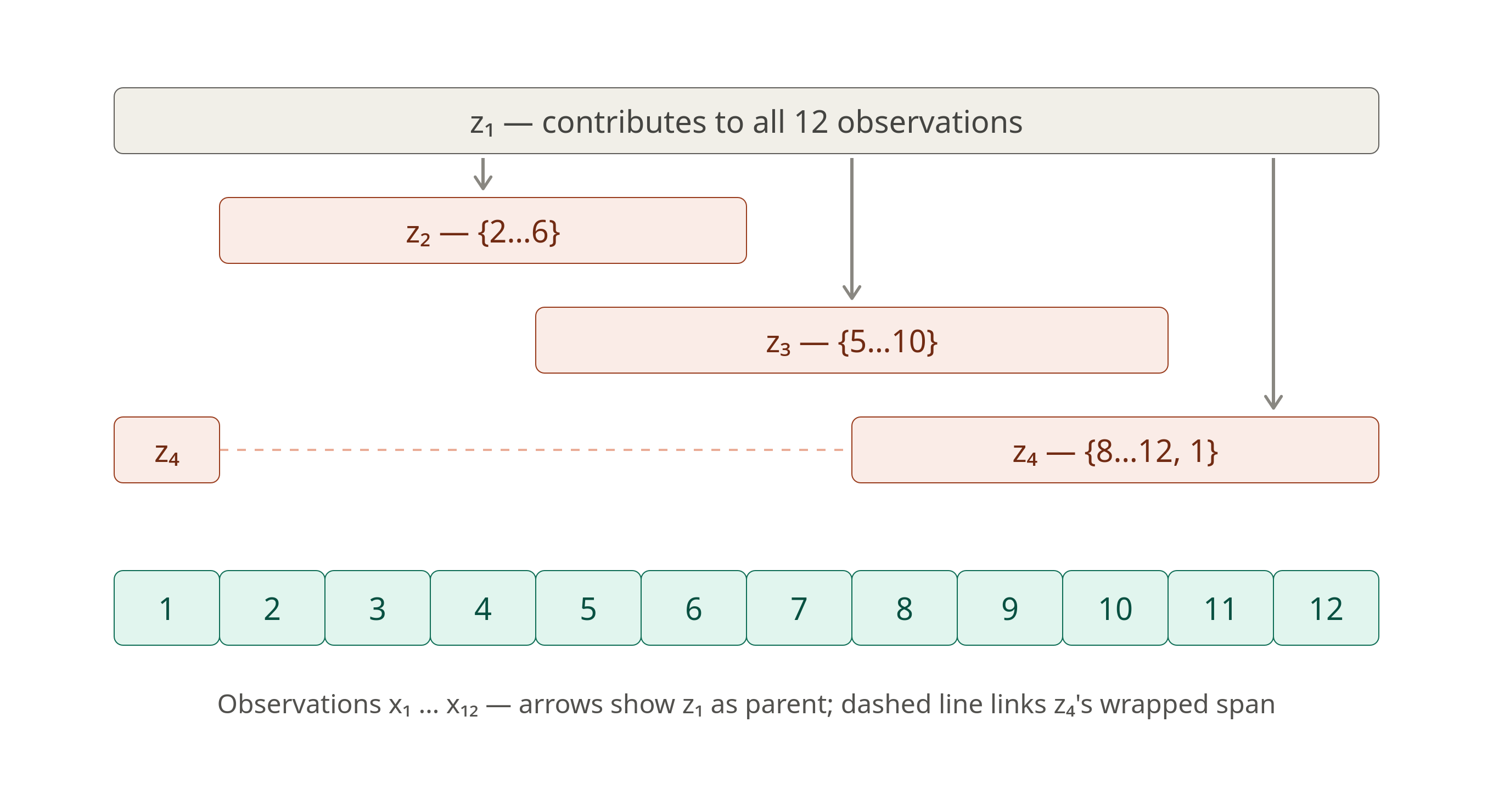
1: {1,2,3,4,5,6,7,8,9,10,11,12}
2,3,4:
{2,3,4,5,6},{5,6,7,8,9,10},{8,9,10,11,12,1}
First let's bound
Here's the proof structure: First we find observation patches outside of each non-
Observation patches are
The relevant latents to each patch are
Applying Lemma 5.4 to the first two:
Then combining that resulting set of
Merging the two equations:
We can immediately bound each of the mutual information terms by
To bound the first K-complexity, we use the definition of latent string model that allows us to recover subsets of observations from subsets of latents.
So overall we have
where
Now let's bound
The same proof structure as above: First we find observation patches outside of each non-
Observation patches:
Relevant
Apply Lemma 5.4:
Now it's slightly trickier to get rid of the K-complexities, because we only have the weaker reconstruction assumption
This uses the bound
This overall leaves us with
Note that the 5 comes from the example and depends on the number of merge steps required, it'll generally scale up with the number of children.
A small modification probably gives us
Proof of Lemma 5.4
On the complexity metric
We're using
We could use
Objectivity theorem
Missing from this document is how this proof generalizes across all latents in
Sam says there's an objectivity theorem that says that if both