This is a linkpost for https://shoshanigans.substack.com/p/it-takes-a-village-to-support-a-marriage
New Comment
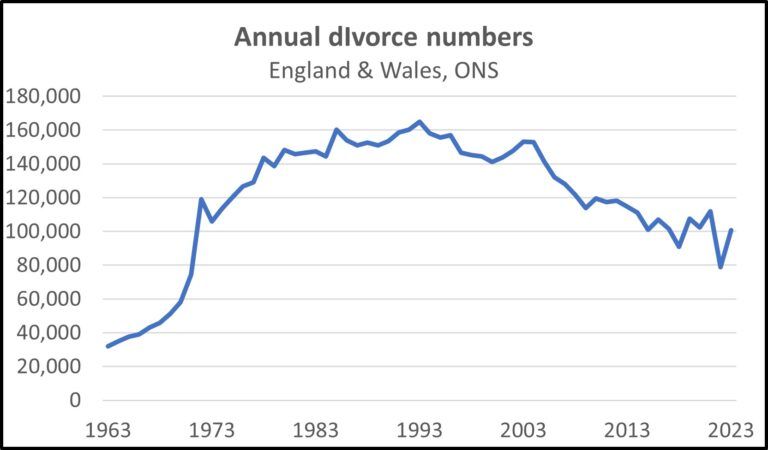
In modern times, divorce rates are massively up.
In my country, divorce rates shot up in the 60s and 70s but have been declining for the past few decades.
a monogamous marriage means most of your needs will have to be met by your spouse.
That sounds like the classic argument for polyamory: Don't put all your needs on one person, have multiple partners.
But in the past we simply had friends. Also relatives and neighbors, who sometimes sucked, but sometimes were supportive. So I wonder how much of polyamory is about sex, and how much about people losing the skill to be good friends. Sex is a glue that keeps marriage together, and apparently now we also need it for friendships.
One way friendships fail is that too many of our friends are online. But an online friend isn't there for you, when you e.g. need babysitting for your child for a while. Or when you need a hug. Or when you need to help with some manual work. Instead we pay for babysitting and manual work... and maybe some of us also for hugs?
But even offline, sometimes having a friend on the opposite side of the city is simply too far.
 1
1
Epistemic status: A hypothesis I want to add your hypothesis space about why divorce rates are up. For people into the literature: how much does this align? For people into testing: Do we see new data anywhere? For everyone: this essay steelmans the case for community stabilizing marriages. Reality is messier than my excited ramble.
People say it takes a village to raise a child, and through much of history we had such villages. The “village” clause refers to a community you feel connected to. That shares your values. That functions as a sort of social insurance in hard times. It pools resources to raise children, specifically in a way that is positive sum for all involved: children get wider diversity of adult care, adults can specialize in the type of work they are good at, and there is strong load balancing from day to day and week to week as the whole social group can compensate for individuals falling ill, falling on hard times, or falling on other things you should really just avoid.
My guess is now that the same is true for marriages.
In modern times, divorce rates are massively up. People tend to point to the rise of feminism and the fall in religion as an explanation. And sure, divorce rates are much lower in the Patriarchy of Faith. But correlation is not causation. And I’m now wondering if the causation is actually lack of community, not lack of commandments on women.
Specifically, nowadays, in secular, feminist societies - which are basically almost all western societies - a monogamous marriage means most of your needs will have to be met by your spouse. Without community, you are less likely to have a web of people willing to pitch in to pay the bills, look after the kids (ok, there it is again), or provide connection when your spouse is going through a hard time.
Basically, the pressure on being a good spouse has skyrocketed as much as the pressure to be a good parent. Wherein a close-knit community, you can get your oxytocin in five different places a week, nowadays your personal Number One is probably your main source. (I recommend supplementing with a dog. Is dog ownership up since community connections are down? Probably not.)
Same for when you or your spouse loses their job, gets sick, or has a crysis in the family. The chance that critical pressure lands on your spouse to keep it together or “fulfill your needs” is much higher than in bygone days. And this leads to higher pressure on the relationship, which in turn may increase the chance of divorce.
That said, I don’t think this will be true for all marriages. Some people find their community no matter what and get all the support they need. Other people don’t need community that much anyway and are fine regardless. And again others are just that emotionally independent or have found such a good match or just got so lucky in life their marriage lasts regardless.
Or, you know, they stay in an unhappy marriage. That category isn’t new either.
But I’d expect the overall effect of far less community to increase divorce rates substantially. And I’d expect this mechanic to correlate heavily with the rise of feminism and the fall of religion.
So how would we test this?
Well, are divorce rates lower in tight-knit feminist, secular communities than in individuals outside any community?
My guess is yes but I don’t know where to look for the data, cause we haven’t been at this whole community building in the new age for very long. Let’s see <3