I believe there is a more general point to be made here. Namely, the effects of most (if not all) psychoactive substances don't decay with their half-life. A more useful framing would be that they don't track blood concentration all that well, and psychoactive effects can last both significantly longer or shorter than looking at the half-life would predict. I don't do theoretical analyses such as yours, because I don't expect getting much insight that is not available through (other people's) empiricism.[1]
Consider a few cases: (half-life numbers found through quick googling)
Caffeine - [2] Looking at your applet, it suggests a ~fourth of (effective, after including paraxantine) the peak concentration after 16 hours. But at the same time, I would predict that taking a bolus caffeine dose after waking up would cause less sleep disturbance than taking a paraxantine dose in the evening to produce the same (effective) blood concentration. I presume you would expect this as well?
Phenibut - half life 5.3 hours. Psychonaut wiki lists the duration of effects as 10-16 hours which basically matches my experience. By any objective/subjective metric I'd predict we'd find the effects to dimish more slowly than with caffeine.
Armodafinil - half life 15 hours. Duration 8-15 hours, which, again, matches my experience. Note, the duration is a bit shorter than with phenibut despite the huge half-life difference.
Nicotine
Nicotine - half life 1-2 hours. Duration (from buccal administration [3]which I use) 0.5-1.5 hours.
Psychedelics (in general) - I believe psychedelic trips are largely inexplicable through any exponential decay model (of psychoactive effects). I can explain, if you don't share this intuition.
I could go on, of course. But my overall point is that regardless of whether one uses receptor affinity and occupancy and dowstream metabolites or more/other variables in one's model, said model will likely still not be accurate enough to predict subjective effects.
- ^
Though I heard about Paraxantine before
- ^
Psychonaut wiki lists duration as 2-5 hours which is proably a bit too short, but not by much.
- ^
Administration can also alter the duration of effects greatly. Way more than looking at plasma concentrations would predict.
- ^
Presumably, there must be research on this?
I understand the general point. Here I wanted to point out a pretty narrow misconception about caffeine specifically. Of course psychological state isn't purely a function of blood concentration since there are other variables that change throughout the day, like adenosine levels. It's also possible that there could be a lag time or complicated mapping from receptor occupancy to psychological effects. But there's a useful intermediate node in the causal graph, effective concentration of receptor antagonists, that looks pretty different depending on whether you model paraxanthine or not.
I would predict that taking a bolus caffeine dose after waking up would cause less sleep disturbance than taking a paraxantine dose in the evening to produce the same (effective) blood concentration. I presume you would expect this as well?
I don't think I would expect that, degree of tolerance held constant.
On further thought I would weakly expect more difficulty getting to sleep from paraxanthine if you took it within an hour of going to bed, since there could be some stuff that has to do with the derivative of effective concentration. If you took it several hours before bed to end up with the same effective concentration at bedtime I don't think I expect a noticeable difference in ability to get to sleep. I also think I'd expect less sleep disturbance overall from paraxanthine, effective concentration at bedtime held constant and barring scenarios where you're taking it within an hour of bedtime, since the effective concentration resulting from paraxanthine will decay faster than that resulting from caffeine.
Apologies for the blunt question - but is this some sort of new finding/theory that paraxanthine can act similar to caffeine in blocking adenosine?
I'm unclear why all I've ever read about caffeine so far (and I've read a fair amount!) always mentions the ~5-6hr half-life for its practical effects on sleep, but never mentions paraxanthine.
The part of this piece that interested me most is the fact that caffeine may be way more unhealthy than we thought - if its long-term adenosine blocking properties are twice what was previously thought.
Maybe you have some guess as to why this isn't talked about?
Are you sure you wanted to write this question as a reply to my comment rather than a top-level comment? All the same:
but is this some sort of new finding/theory that paraxanthine can act similar to caffeine in blocking adenosine?
It is not. You could have easily checked; either by googling or asking an LLM.
The part of this piece that interested me most is the fact that caffeine may be way more unhealthy than we thought - if its long-term adenosine blocking properties are twice what was previously thought.
I am not aware of RCTs showing adverse health effects of caffeine at moderate doses. Quick googling suggests such effects were not found. Assuming you saw such trials, finding out about paraxantine shouldn't change your mind either way.
Are you sure you wanted to write this question as a reply to my comment rather than a top-level comment?
I wanted to write it as a top-level comment. Still figuring LessWrong's UX out, apparently I suck at it. Sorry
It is not.
Right, that's my understanding as well. Hence the confusion as to why it isn't talked about more. I guess I can put my question more directly:
Is the public largely misunderstanding the adenosine/tiredness-blocking effects of paraxanthine, or are they just unaware of it and it remains a niche molecule?
If I understand correctly there is somewhat broad consensus that between two psychoactive substances with comparable mechanism the one with quicker metabolism is generally more addictive, due to a combination of more frequent dosing behavior and sharper decay being a more salient signal.
Wow. Ordered. Looking forward to better sleep.
Where did you get the 100mg version? I could only find 200 and would rather not split them.
Wrt the implications: there are probably more low hanging fruits than you thought. And we're probably more likely to die from AGI than you thought before noticing this important gaps in group epistemics ;)
Thanks so much for figuring this out and sharing.


Anecdotally speaking, I have avoided caffeine for this reason (as hard as it is to do that these days where I am). It lasts way longer than I want it to, and makes me a little compulsive well into the evening and night even when I take it in the morning. Although my internal reasoning was that I must have some genetic thing that makes caffeine last way longer than it’s supposed to. I also thought there might have been second order effects of alertness that are hard to wind down once they get going.
It’s interesting to read that there was always this alternative third explanation that I hadn‘t thought of. That it just works in a different way than what I originally understood. That it might be because it is metabolized into paraxantine which also blocks adenosine receptors.
Thank you for this post.
I'll echo this. I always thought I was particularly sensitive to caffeine and so went without it for years until recently. I'll find that I'm not able to sleep for 12-14 hours after initial administration, and I rarely have more than 50mg in a day. I notice effects mostly wearing off around 20 hours after administration usually.
I do wonder, as some commenters stated, how much the natural accumulation of adenosine throughout the day interplays with this, though, in addition to the dopaminergic and serotonergic effects on mood modulation. I would imagine if one is elevated into a state of higher nervous system arousal, there could be feedback effects long after the direct adenosine receptor antagonism dwindles in efficacy.
Well, there's even another option. Low-hanging fruit (since it's pretty likely anyways), but I'd guess that you have an O blood type? O blood types have the lowest monoamine oxidase activity, which suggests that they will be slow to breakdown catecholamines, such as adrenaline which caffeine stimulates. I'm an O blood type, and anecdotally, coffee could easily interfere with my sleep even when drunk in the morning. I also had paraxanthine for the first time today (which is why I'm here) with a 300mg dose from an Update energy drink, and it doesn't seem to be interfering with sleepiness like caffeine would for me. Not sure what that means.
Did you feel anything from 200mg PX at all?
In an unpublished blind comparison between PX and CA I found 100mg CA in pill form surprisingly weak compared to what I expected from drinking coffee. I ended up increasing the dose to 200mg for both. I rated the peak effects of 200mg PX somewhat weaker on average, and napped more on the PX days.
when you compare caffeine to paraxanthine, are you comparing caffeine pills or coffee? cuz coffee has a bunch of other things in there that could be confounding. its also really hard to isolate eg gut motility, receptor saturation, circadian dynamics in PK, so prolly good to normalize those if comparing.
curious about whether the crash is worse, if anyone caffeine crash prone tries, would be cool to get an update
with respect to caffeine content of coffee pods: Was able to find this (paywalled) study https://journals.sagepub.com/doi/10.1177/0260106018810941#core-collateral-purchase-access
Their method of analysis seems sound, and they find considerable variability across at least this brand of coffee pods. Caffeine content of resulting coffee varied with serving size on the order of 10-20 mg, max-min varied by 40 or 30 mg though for this I'm pretty sure they considered all 4 measurements for a given type of pod (2 measurements for small size and 2 for large), which is not a lot, so the data is pretty noisy, but it's enough to see that the caffeine content on the packaging is not to be trusted (unless your brand of coffee pods uses some weird process that doesnt involve caffeine coming from the beans themselves).
Also a note for their comparisons to manufacturer contents - they compare the All means to listed content, which is weird since people probably consume one of the coffee serving sizes, not both, so it's understating the difference from listed contents.
Not the half life active curve, but people underrate how the curve for decreasing your tolerance as you abstain differes between substances. There isn’t much research into 1. how a substance becomes less effective over time nor 2. How fast you become addicted.
I assume this is 1 reason a lot of people got addicted to nicotine: despite the shorter half life you need a longer time off to reset the effectiveness. Caffiene after 2-7 days your body starts to undo its chemical adaptations and mostly washed out after a few weeks. For nicotine it's closer to a week to start 12 weeks to wash out an addiction.
From Largely Vibes
Adderall: Proscribed for every day, Scott Alexander recommends 5 days on 2 off
Nicotine: once every week? (Alexey Guzey started planning with once every third day, in 2024 self described as a smoker, but smoking what?). Problem one: since half life is only 2h to be stimulated all day you'd ingest several times likely training yourself to reach for it when tired unless you’re counting.
Caffeine: every other day likely keeps the same effect size?
Modafinil: folk wisdom is once per week else it stops working. This is "taking every day will really reduce effects after 90-180 days", unclear if this means it’ll be effective over 5 years.
Alchohol: 14 drinks per week for men or 8 for women makes you an alcoholic and will probably cause an addiction over several years, sooner if higher. But the effect size doesn’t change as much. Compare how "holding your liquor" means tolerating maybe 50% more for your weigh, not nicotines pack a day vs 1 cig for irregular smoker or several cups of coffee being 500mg to not have the effect of 100mg did initially.
I’d be curious if anyone has actually looked into for Nootropics
- What range of dosing schedule maximizes long term usefulness
- What dosing schedule is dangerous and indicates big problems within the next month
I assume this is 1 reason a lot of people got addicted to nicotine: despite the shorter half life you need a longer time off to reset the effectiveness
I think nicotine is a strong behavioral reinforcer (especially when smoked, since it hits the brain immediately).
Caffeine: every other day likely keeps the same effect size?
My guess is that you build half as much tolerance taking X mg every other day compared to taking X mg daily.
My guess is that you build half as much tolerance taking X mg every other day compared to taking X mg daily.
Not my personal experience. Taking 300-400 mg caffeine every other day leads to ~no tolerance, or a very slowly developing one; taking that amount every day maxes out the tolerance very fast. My current schedule is just that, plus a once-a-month stretch where I skip caffeine for three days in a row to wipe out whatever tolerance may have crept up. (But obviously everyone's biochemistry differs significantly, etc.)
My model says that if you took 400mg EOD:
- on the caffeine days you'd feel similar to having taken 200mg in a caffeine-naive state
- on the off days you'd feel similar to abstaining from caffeine after having taken 200mg daily for a while
200mg in a caffeine-naive state would feel pretty stimulating for most people I'd think. Do you feel more tired than a caffeine-naive baseline on the off days?
My model says that if you took 400mg EOD:
Yup, I expect the same regarding both.
200mg in a caffeine-naive state would feel pretty stimulating for most people I'd think
Yup, it is.
Do you feel more tired than a caffeine-naive baseline on the off days?
Hard to say, but probably somewhat.

- Depends on your model of addiction: is it pavlovian conditioning to generate the idea to smoke or a biochemical change which generates cravings you sooth by smoking? The later latter on, the earlier probably some part of causing smoking more.
- All the +400mg/day people I know take it every day. Though I wouldn’t notice 200
Probable “write down your exact dowing schedule and if you feel a craving for more abstain for a long while” works, but how strong a craving do you get? (And doesn’t address reduced efficacy)
Paraxanthine-based stimulants look to me like a pretty darn low-hanging fruit that took forever to be picked; science has known about caffeine metabolism and paraxanthine's adenosine receptor antagonism since at least the early 1980s, yet the paraxanthine supplements only became available a few years ago.[9]
Huh, this seems possibly really important. If there are more insights of a similar or greater level already hidden in the existing literature, it seems worthwhile to put a bunch of effort into finding them. I wonder if existing LLM harnesses would be enough if told to look for the right things, or if we would need a new one to effectively sort through and find them?
From the above we might tentatively guess that paraxanthine is 1.5-2x as potent a stimulant as caffeine, while noting that measurements seem to be all over the place. This is in contrast to my subjective experience so far, where an equal dose of paraxanthine feels similar or weaker than caffeine.
Isn't the point that a dose of caffeine is actually metabolized as a dose of caffeine PLUS paraxanthine metabolites? So you never actually experience caffeine by itself, and can't really compare the two directly, although you can definitely model it modulo the rate of metabolism.
Dynamine (https://en.wikipedia.org/wiki/Methylliberine) has a half life of 90 minutes, best for last minute late night pick me up.
I stopped drinking coffee regularly because I would always get a headache when I forgot to drink coffee, e. g. on weekends. Do you have experience with withdrawl symptoms? Are they better or worse with paraxanthine? If you don't, do you have a guess?
epistemic status: confident in the overall picture, substantial quantitative uncertainty about the relative potency of caffeine and paraxanthine
tldr: The effects of caffeine consumption last longer than many assume. Paraxanthine is sort of like caffeine that behaves the way many mistakenly believe caffeine behaves.
You've probably heard that caffeine exerts its psychostimulatory effects by blocking adenosine receptors. That matches my understanding, having dug into this. I'd also guess that, insofar as you've thought about the duration of caffeine's effects, you've thought of them as decaying with a ~5 hour half-life. I used to think this, and every effect duration calculator I've seen assumes it (even this fancy one based on a complicated model that includes circadian effects). But this part is probably wrong.
Very little circulating caffeine is directly excreted.[1] Instead, it's converted (metabolized) into other similar molecules (primary metabolites), which themselves undergo further steps of metabolism (into secondary, tertiary, etc. metabolites) before reaching a form where they're efficiently excreted.
Importantly, the primary metabolites also block adenosine receptors. In particular, more than 80% of circulating caffeine is metabolized into paraxanthine, which has a comparable[2] binding affinity at adenosine receptors to caffeine itself. Paraxanthine then has its own 3-5 hour half-life as it's metabolized into a handful of other things.
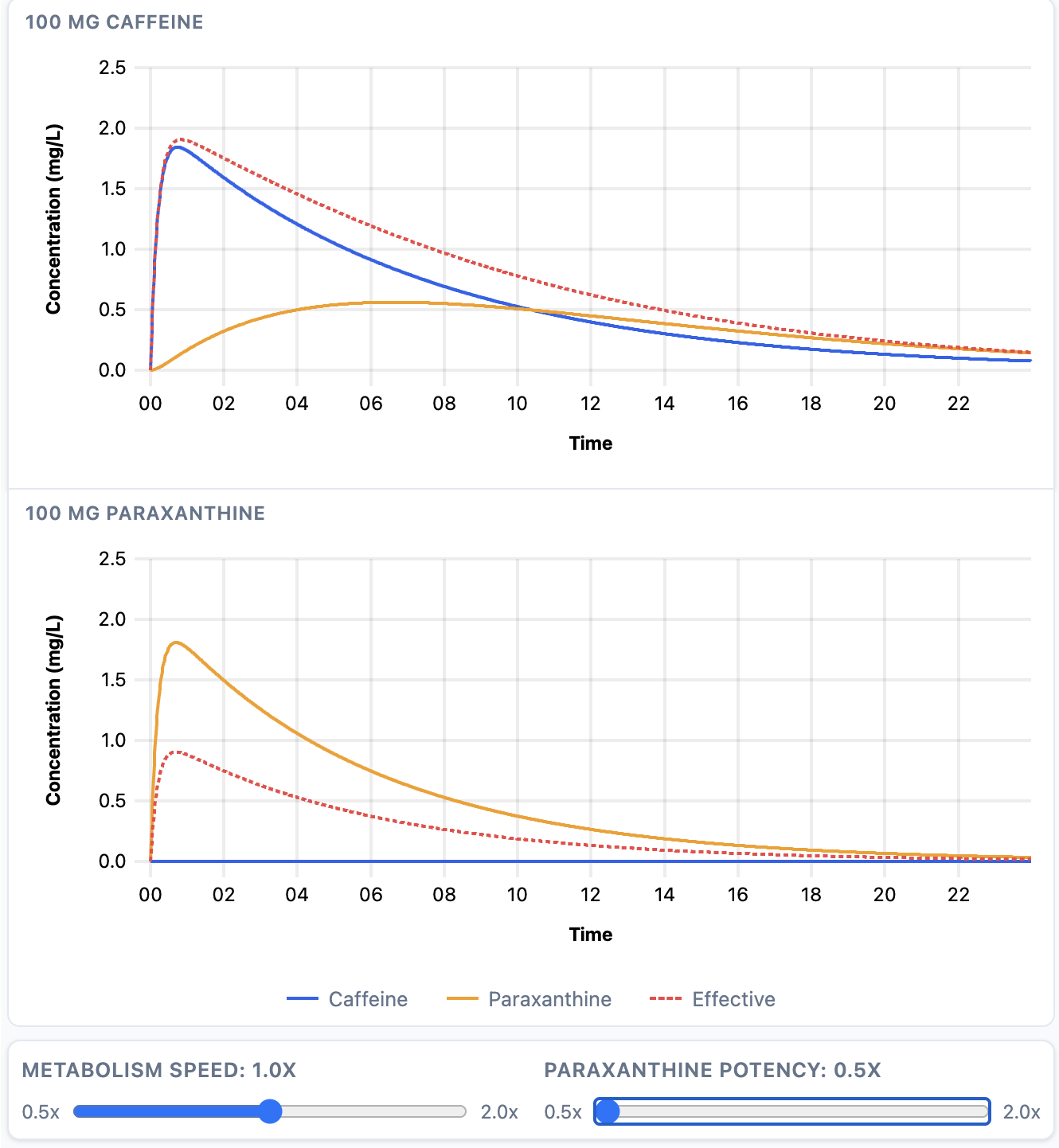
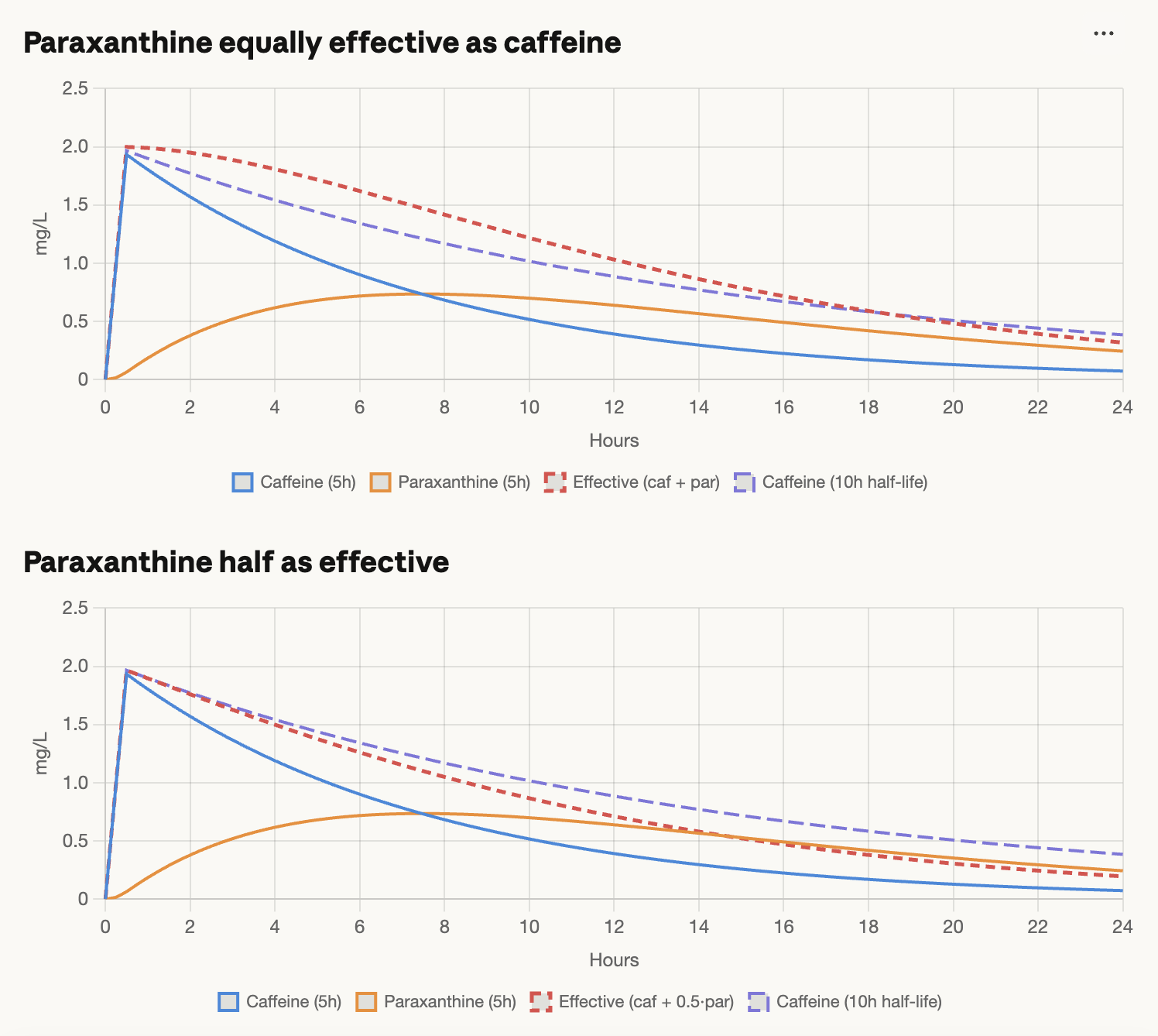
Since paraxanthine is by far the dominant primary metabolite, and its further metabolites are mostly either very short lived or have poor affinity for adenosine receptors, we can fruitfully use a simplified model of Caffeine ⟶ Paraxanthine ⟶ Elimination. The upshot is an effective concentration curve with a broader peak and slower decline -- about twice as long to reach half of peak effective concentration, assuming paraxanthine and caffeine are equipotent -- than that given by the simple elimination model. When I say effective concentration, I mean the concentration of caffeine that would be needed to produce the same effect.
Below is a simulator that models caffeine and paraxanthine metabolism following ingestion of 100mg caffeine or paraxanthine (link to full version). Note that the relative potency of paraxanthine can be adjusted; I am uncertain about how it compares to caffeine within that 4-fold window (see the section on relative potency).
Paraxanthine supplements
If the above model is correct, paraxanthine itself is sort of like caffeine that behaves the way I mistakenly used to believe caffeine behaves. Directly using paraxanthine as a stimulant would have two major differences/advantages compared to caffeine:
(It might also have some other differences, like a somewhat different profile of effects.)
In the US you can buy paraxanthine itself as a supplement (I believe it only became available recently, in 2022). I've been using 100mg capsules intermittently in the last few weeks.[4] Some early impressions:
The supplements sold in the US appear to exclusively use enfinity branded paraxanthine, perhaps due to them holding some very broad patents on the use of paraxanthine as a supplement.[5] On their website they emphasize that paraxanthine has a "cleaner" effect than caffeine, is supposedly safer, and has a somewhat shorter half-life that isn't affected by slow caffeine metabolism.[6] The somewhat shorter half-life undersells this point: it's effectively much shorter due to the lack of active downstream metabolites. They also don't say anything about reduced tolerance on the main page (though it's mentioned in the FAQ).
Exactly how potent is paraxanthine compared to caffeine?
By "how potent", I mean the binding affinity at adenosine receptors. The binding affinity (Ka) is equivalent to the odds ratio that a ligand will be bound to some particular receptor at some point in time, divided by the concentration of the ligand (since the odds ratio is proportional to ligand concentration).[7] If one substance has twice the affinity as another, you only need half as much to get the same receptor occupancy.
There are four subtypes of adenosine receptors: A1, A2A, A2B, A3. The psychostimulatory effects of caffeine are thought to be mediated by the blocking of A1 and A2A receptors. I was surprised to learn that the affinities of caffeine and paraxanthine for human A1 and A2A receptors are not well established in the literature. Below are my takeaways from researching this:
From the above we might tentatively guess that paraxanthine is 1.5-2x as potent a stimulant as caffeine, while noting that measurements seem to be all over the place. This is in contrast to my subjective experience so far, where an equal dose of paraxanthine feels similar or weaker than caffeine.
Note that I'm comparing paraxanthine to coffee, which could be confounded by several things such as other stuff in the coffee having effects, placebo, or the coffee pods I was using having more or less caffeine than claimed. A blind comparison between caffeine and paraxanthine capsules would be much better, and in hindsight I wish I'd done that right away.
Some other hypotheses for what could be going on here:
Concluding thoughts
I recommend trying paraxanthine as a stimulant. For me personally, two use cases stand out so far:
Considering how widely used caffeine is, I was surprised to learn through independent research that paraxanthine considerably extends the duration of its effects, which almost no one seems to understand. I was also surprised by how poorly characterized the interactions of caffeine and paraxanthine with adenosine receptors seem to be. There's probably a civilizational inadequacy story here.
If such an important point about caffeine -- the one ubiquitous nootropic -- was unknown to even the nerds, that's some evidence towards there being other low hanging cognitive enhancement fruit. That is, we expect more low hanging fruit in this world than in the worlds where the nerds already knew about this.
Paraxanthine-based stimulants look to me like a pretty darn low-hanging fruit that took forever to be picked; science has known about caffeine metabolism and paraxanthine's adenosine receptor antagonism since at least the early 1980s, yet the paraxanthine supplements only became available a few years ago.[9]
Caffeine can easily cross between the brain and bloodstream. This means that, because of diffusion, the concentration in the brain (where psychostimulatory effects are mediated) closely tracks the concentration in the bloodstream. When I say "excreted" I mean the molecule is removed from circulation, such that its concentration in the bloodstream (and brain) is reduced. This is mostly done by the kidneys, with the molecules ending up in urine.
Numbers are surprisingly hard to pin down here; see the section on relative potency.
My guess is that equilibrium tolerance is roughly a function of the (per day) area under the curve (AUC) of equilibrium effective concentration.
The label says not to exceed 300mg per day. My guess is this comes from the maximum recommended daily caffeine intake of 400mg, which is metabolized to about 300mg paraxanthine in vivo.
The linked patent seems to claim any use of paraxanthine as a dietary supplement with a dose in the range 2-800mg.
Might not there be slow paraxanthine metabolizers as well? I suppose enfinity isn't incentivized to ask this question.
Note that reported values are usually Ki/Kd, which is the reciprocal of this definition. The meaning of these values is the concentration needed for 50% receptor occupancy by the ligand (i.e. 1:1 odds ratio).
Why such big discrepancies? I don't know. One thought is that, since adenosine receptors are G-coupled protein receptors (GPCRs), it might not be reasonable to summarize a ligand's binding affinity with a single number. This is because GPCRs have two different states, and ligand binding affinities for the states can differ.
This is also evidence that some circumstances recently changed. For example: a regulatory change, or cheap mass production of paraxanthine being enabled by other tech developments.