space per person
Strictly speaking, it's average abode size (as square meters per person). Historically most people lived in blocks of flats ("Dom" is house, "Mieszkanie" apartment/flat):
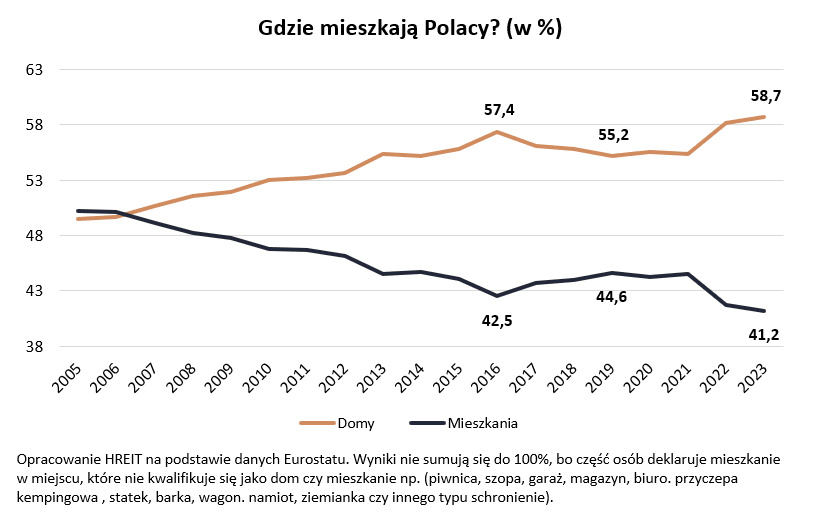
It's much harder to build a house nowadays as opposed to the '90s - now you actually have to ask for permission. Up to 70m^ is basically send a piece of paper to the local council and if they don't reply in a month you can build it. Larger buildings require you to wait up to 2 months and have a proper project drawn up by an architect. This is skipping over some details, but it's generally eminently doable to get permission.
There are other restrictions (min. plot size, distance from water/electricity, it needs to be on land that is classified as building land), but it's easy enough to do that. It's harder to change the classification of a field to building land, but as long as the field isn't a good one, it's often doable (especially if you know the appropriate people, takes up to 3 years, costs something like $10k).
So you have people building houses for their children next door in villages, Suburbia popping up around cities and new block of flats being built everywhere. When I first saw my current flat (around 2015, also Wrocław), there were around 10 new blocks, and then lots of old factories. Now there are a square kilometer or three of new blocks of flats, and the only reason they didn't go further was because there's a river there. My previous flat had a lovely view of a massive oak tree and a kilometer or so of old orchards. Now there are new blocks of flats everywhere.
I reckon it helps a lot that most builders in Europe are Poles (there was a large exodus when Poland joined the EU), so they have lots of experience in actually building things, and have a lot of Ukrainians willing to do the cheap labour required.
Abundance and YIMBY are on the march. Things are looking good. The wins are each small, but every little bit helps. There are lots of different little things you can do. In theory you have to worry about a homeostatic model where solving some problems causes locals to double down on other barriers, but this seems to not be what we see.
There are definitely important exceptions. Los Angeles is not so interested in rebuilding from the fires and backpaddled the moment developers started to actually build 100% affordable housing because somehow that was a bad thing. New York’s democratic party nominated who they nominated. Massachusetts wants to seal eviction records.
Overall, though, it’s hard not to be hopeful right now. Even when we see bad policies, they are couched increasingly in the rhetoric of good goals and policies. In the long term, that leads to wins.
I’ll start with general notes, then take a tour around the nation and world.
Rent Control
At some point a tenant with rent control effectively owns the apartment, but they and their family are forced to live there forever, including for two years before each time the apartment is passed down.
There’s also the crazy part where a subsidized tenant will pay triple the rent a non-subsidized tenant would if the apartment got freed up. And yes, they also put up enough barriers that selling the apartment also is not a practical option.
Thus you get stories like this rent controlled building selling at a 97% discount, or $9,827 per unit. The new buyer is presumably gambling on finding or being given some way to free the building, which I assume will operate at a loss and would be uneconomical to repair properly.
If you are a New York City voter in the coming general election, consider that one candidate in particular wants to double down on this strategy.
Affordable Housing
This term has done so, so much damage. Even if affordable housing was ‘a thing’ in that it was housing that was affordable, ‘non-affordable’ housing would still make all housing more affordable, and some affordable units is always better than no units.
The thing is, it’s often so much worse than that.
The job of affordable housing needs to be to make available housing at a low price point. Remarkably often, the projects do not even do that.
That housing might be many things. It is not affordable. What is happening? Again, lots of different interest groups and demands to meet other goals drive up prices.
Meanwhile, even when you do go ‘100% affordable housing’ near a major transit stop you can still get progressive nonprofits opposing it because it might cast a bit of shadow on a nearby schoolyard, while at least two parents there say ‘our schoolyard nadly needs more shade.’
Even worse is ‘inclusionary zoning’ which as I understand it is purely a requirement that some percentage of new apartments have to be rented at loss. If you think of this as a tax and redistribution scheme, because that is exactly what it is, it is obvious that this makes absolutely no sense as a way of achieving any goal other than preventing housing construction or enabling corruption.
It does make sense to potentially tax new housing construction if and only if you have otherwise already restricted the ability to build in ways that mean that building is highly profitable but the ability to get permission to build is fixed. In that case, if you’re locked into the first half of that decision you might as well collect the fees I guess, but you should just charge them money.
A Vision
Private Equity
Why is it that the term ‘private equity’ makes people lose their minds? Admittedly this is an extreme case, but the less crazy versions aren’t conceptually different.
So let me get this straight. You build a house for every man, woman, and child, far more houses than people want to live in. Then mysterious ‘private equity’ buys them all, and then they charge what, exactly? They all form a conspiracy to set prices at a monopoly level and no one notices? One PE company buys all the nation’s housing stock? Something else?
Home for Rent
Tyler Cowen brings us this job market paper from Felix Barbieri via Quan Le about the impact of institutional ownership on the rental market, with supply effects proving larger than concentration effects:
I noticed I was confused. o3 explained that the average annual rent was $28k but that reduced search frictions and greater choice meant that the overall benefit was ~10% of the rent. That seems like a lot, and reminds me of a lot of economist talk of ‘well you have greater product variety or are forced to buy more [X] so you’re actually fine and totally not poorer.’
It’s not totally impossible the benefits are this big, if the rent market was previously super thin, and before there would be highly slim pickings, especially in the exact right location and size. When I rented in Warwick, there was a clearly best house, and if I’d had to go with my second choice I do think I’d have faced a >10% welfare hit, as in if they’d asked for 10% more rent we’d cheerfully have taken it anyway.
10% still does seem like a lot in general.
By o3’s calculation there are about 30x times as many people renting in a given year as buying that year, so this is a clear net gain, even if you don’t count that often individual sellers pick up that extra $50k that the buyers pay (and they at least partly reclaim it when they sell). So this is good unless you strongly want more people to own on the margin instead of rent, and given mobility concerns my guess is we want more renting than we have in such areas.
Making Housing Worse On Purpose So You Can Click
Here’s another bizarre mind worm, mostly for fun this time:
You see, if the old people consume more house, then that’s good for everyone else’s ability to ‘afford’ houses because those houses are expensive. But if they downsize to less house, thus making more housing available for others, that’s bad, because they took away the cheap houses. Wowie.
The generalization of this is fascinating. There are a lot of people who think:
This covers renovations, and gentrification, and more.
There is actually a great instinct behind this, which is that it would be great if we could allow people on tight budgets to ‘buy less house’ and still have a house, in terms of both quality and quantity. Because those people would be better off buying smaller lower quality houses.
And that’s right about that! Improving houses obviously makes people on net better off, as willingness to pay goes up for a reason, but if quantity of units is fixed those particular people would benefit from the available housing stock staying worse.
The thing is, it would be very easy to give it to them. All you have to do is allow people to choose to build or rent out smaller housing, and crappier housing, if everyone involved wants to do that. Legalize smaller rooms, smaller apartments and single room occupancy. Create a new class of amenities so that some are ‘required’ but others currently required are ‘standard’ such that you have to disclose and put in the rental or sales contract that they’re missing and point this out verbally, but make it legal to waive them if the tenant or buyer wants that.
We could very easily create a world in which those struggling with expenses could make modest but manageable sacrifices and be able to live where they need to live. We choose not to do that.
Open Philanthropy Strikes Again
This seems great.
The Abundance Debate
Aaron Regunberg offered some substantive critiques of the general abundance agenda, Jordan Weissmann delivers continuous knockout blows in return, as the arguments amount to ‘there are various factors [X] and [Y] making things worse, you only deal with [X] not [Y]’ to which the answer is, ‘actually we also are working on [Y] and also [Y] often acts through [X], and also [X] alone would help what is the issue.’
I want to be clear that this is not me picking on Aaron. This is me picking out the best and most substantive critique, because the other critiques are worse.
As the results add up, the vibes are clearly shifting. I am here for it. Daniel’s comment here is Obvious Nonsense. Green New Deal and Socialist rhetoric in general says it is ‘abundance’ because they assert their policies will somehow lead to everyone having all the things except the bad people who shouldn’t have them, except no it is a shame but actually that’s not how the world works. The choice of rhetoric is telling and it is bizarre how everyone can suddenly shift into ‘abundance was always good politics’ mode. In which case, yes, happy to nod.
It is so funny that Zohran is presenting as an abundance candidate while trying to do so many obviously anti-abundance things, especially vast imposition of greater rent controls and other requirements on those who would actually build or rent housing but also many other socialist policies. It is still great progress. I want everyone to have to acknowledge that abundance is the goal, even if they have no intention of doing things that cause abundance. Then it’s on us to point this out.
Yeah, if he gets to be mayor we’re not building all that housing.
Single Staircase Apartment Buildings
It’s happening. No, I don’t think Austin will get tired of all this winning.
It’s not happening in Colorado yet but the governor is calling for it.
There’s also a bill that’s been introduced in DC, which also includes a single exit.
This change alone would solve so many problems. The second stair has never made physical sense, the Europeans and others around the world use single stair with no issues, and now we crunched the numbers and we now the second staircase takes up a huge percentage of the building without making anyone safer.
Put it another way. The second staircase reduces space by 10% and raises costs by 13%. How many people would pay an extra 10% in rent to have a second staircase? It’s hard for me to imagine many making that choice.
Why didn’t it happen sooner? This seems a little harsh, but only a little:
Dublin
It seems Ireland forces only 25% of net growth to go to Dublin and its suburbs, so up to 2040 Dublin is only permitted to grow at 20%-25% total. This is of course exactly the opposite of what would make everyone better off, as evidenced by everyone wanting to move to Dublin, instead its population was lower in 1991 than 1911.
Western Housing Costs
Brian Botter asks what explains this graph, where housing in the West is super unaffordable relative to income.
He rules out lot sizes, and construction cost differences are only moderate. It is clearly supply and demand, people want to move West (and South), the amenity index explains part of why, and demand can’t keep up (the version of this map he has is interactive).
The West has grown in population 27% since 2000 versus 20% for America, despite California’s best efforts, and if not for lack of housing it would have grown a lot more. This is all about inability to build more housing where people want to live, in particular because we are not legally permitting people to do so. That’s it.
Los Angeles
Ah yes, that time the Mayor of Los Angeles, who it seems can Just Do Things, issued an executive directive making it fast and easy to build 100% affordable housing with zero government subsidies, then furiously backpaddled when developers started building.
Meanwhile, LA is forcing Simpsons producer Rick Polizzi to demolish his 24-year-old Simpsons-inspired treehouse after LA demanded it be permitted like a ‘single-family dwelling.’ This happened after the fires.
LA Fire
Meanwhile, LA is making everyone suffer to even rebuild the exact same house that burned down, let alone build something new that is better. They’re torturing them less than they usually torture builders, but that isn’t saying much.
Want to Build Back Better? At least you’re not going with the Biden version, here’s Ezra Klein explaining the 14 steps to apply for that funding, and Jon Stewart slowly realizing how absurd it is, and screaming, among other things, ‘OMFG.’ Bharat Ramamurti claims this is a ‘deeply misleading’ clip, that the process was like this because of GOP sabotage and wasn’t the design intention. Even if fully true, I do not feel it makes things that much better.
It’s amazing that the claim of ‘homes under constructions’ isn’t even obviously literally true, as in it is not clear there are two of them.
San Francisco
The good news is that by all reports San Francisco is turning itself around on crime and quality of life, such as this report of spending a week seeing few homeless and no broken car windows, feeling fully safe.
Except that means:
Instead, they’re taking a bold stance that phone booths require sprinkler systems. Anyone with a rudimentary ability to think about the physical world understands that this is not motivated by worried about fire.
Last year, a Caltrain official built himself an illegal apartment inside a train station for $42k, and now we have pictures. The building already existed, so no even without legal issues you cannot simply build more of these, but yes we want a full explanation.
Each little requirement for apartments seems like a good idea, but add them all up and the costs involved escalate quickly. I wonder if what we should do is actively have a two-class housing structure (yes I know, young adult dystopian writers, eat your hearts out), where you can choose to be in either conforming or non-conforming housing.
Berkeley legalizes middle-housing city-wide, eliminating single-family housing, legalizing duplexes, quadplexes and small apartments.
California
YIMBY and abundance are scoring some impressive wins in California, including making CEQA (their version of NEPA) not apply to a broad range of housing.
This bill passed the Senate by 62-2. I’ve learned that such votes are remarkably not indicative of how close things were, but it still indicates no one is worried to vote yes.
Gavin Newsom is not holding back. On this issue he’s actually been impressive.
(I notice again how absurd the term ‘prevailing wage’ is, if it’s so prevailing why would you need a law to stop them hiring people for less money? Call the thing by its name, and it’s unclear how big a tax this is on projects or how much it will matter.)
I notice that you don’t actually get ‘every building is 84.9 feet tall’ style outcomes. People don’t actually push zoning options to their limits, people don’t optimize as much as they should.
Having CEQA apply to infill housing, or really almost any residential housing, was always a terrible idea. There are neighbors who can sue, so this interferes with ability to build almost anything. But very obviously, the ‘environmental’ impact of infill housing replacing existing low-value construction is mostly a fake concern. Instead, you drive sprawl, with construction going out into places you can actually do environmental damage, plus you discourage density when density helps a lot with carbon emissions as well, even disregarding the economic impacts.
About SB 79, that was introduced by Scott Weiner. It would legalize apartments near mass transit. The standard argument against this is that those new apartments would not be ‘affordable,’ and instead by ‘luxury’ homes. They would be too valuable to the people who live there, who would pay too high a price to reside in them. Oh no.
In the linked thread, Max Dubler makes the argument that they will still be cheaper than buying existing houses. That’s true enough, and if it convinces people, great. But it’s beside the point. The point is that we can build more housing where people want to live, that will be valuable to the people living there, creating lots of value and in turn will drive down rents elsewhere. More housing is good, let people build housing, in the places people want to live, especially where they’ll have access to mass transit.
I do have one worry with such bills. If you say that mass transit causes upzoning, will that cause cities to avoid building mass transit? Given how little mass transit gets built at this point, that’s a risk I am willing to take.
Is 2025 the last chance for California to build housing that lets it retain population for the 2030 redistricting, where it is projected to lose five house seats and thus electoral votes, importantly altering what maps win the presidency? Darrell Owens argues building a house takes five years. My presumption is that actually building by that time won’t have much effect on this scale.
But planning to build future housing does already help. Prices are forward looking and rational. So if more housing is coming, current prices should fall in anticipation, or demand should rise knowing it will be easier to stay in the future, in some combination.
Oregon
On its face, this seems like a very big deal once the rules work their way through?
Montana
This all looks like it will add up to a pretty big deal (within Montana).
Maine
I too had no idea this one was in the works:
Here’s what they changed, the big one is up front but the ADU help is great too:
North Carolina
It still needs to get through the Senate and governor, but North Carolina State House unanimously (107-0) passed HB 369, a ban on parking minimums in new developments statewide. You can just prevent people from stopping you from doing things.
New York City
In new ‘who could have predicted it news,’ it turns out if you change how people pay the market clearing price doesn’t move and maybe the old system had its advantages? Maybe it was actually a stroke of genius to normalize the renter paying the agents, and we didn’t notice because New York City rent is too damn high despite this?
Typical broker fee is 15% of rent, getting rid of that fee on a one year least meant rent went up 15%, wow, who could have predicted this. The average lease lasts 3-4 years, in theory the price should drop back down for future years.
I presume it mostly won’t and tenants are in general a lot worse off now. There is some value in getting that up front payment up front, but it’s clearly not worth the marginal price that has attached. So we had this great trick, and it is gone now. Damn.
Meanwhile, we’ve managed to get rid of parking requirements in the full core, but they alas live on in much of the city, so this is a chart of where you want to live in New York City, be in the blue area, or at least be in yellow. Red doesn’t even count, that’s suburbs.
Also, yes it would help if New York didn’t require all elevators be large enough to let a wheelchair turn around. I get that it’s nice to be able to do that but this actually substantially raises construction costs, and wheelchairs can go backwards.
Massachusetts
No, you fools!
Do not underestimate the effect Rezabek refers to. I remember that ‘ban the box’ rules that prevented checking job applicants for criminal records similarly ended up hurting exactly the groups with criminal records, because of updates on (lack of) evidence. A similar pattern will no doubt happen here, on all correlations, legal or otherwise.
This also likely decreases new constructions outright.
Mostly it increases rents and moves a lot of rental stock off the market. I do expect a substantial impact here. A bad renter is expensive. Now, not only can you not filter out past bad renters, renters know that if they defect they can have their records sealed. So not only do you get negative selection, everyone will behave way worse.
Texas
There’s some great bills passing that would be awesome as national standards.
This is a neutered version of the bill, but it’s still a great start.
It gets better:
Poland
Poland is the latest story of building more houses and housing costs going down.
As usual note the y-axis starts around 12 on the first chart, but this is still a huge decline. The second chart is space per person.