The manufacturer of Ezekiel bread claims that it has a glycemic index of 36. It’s fair to say that the exact details don’t matter, but that’s almost a factor of 2 off from your table. And qualitatively it puts Ezekiel bread firmly in the range of medieval breads on your table.
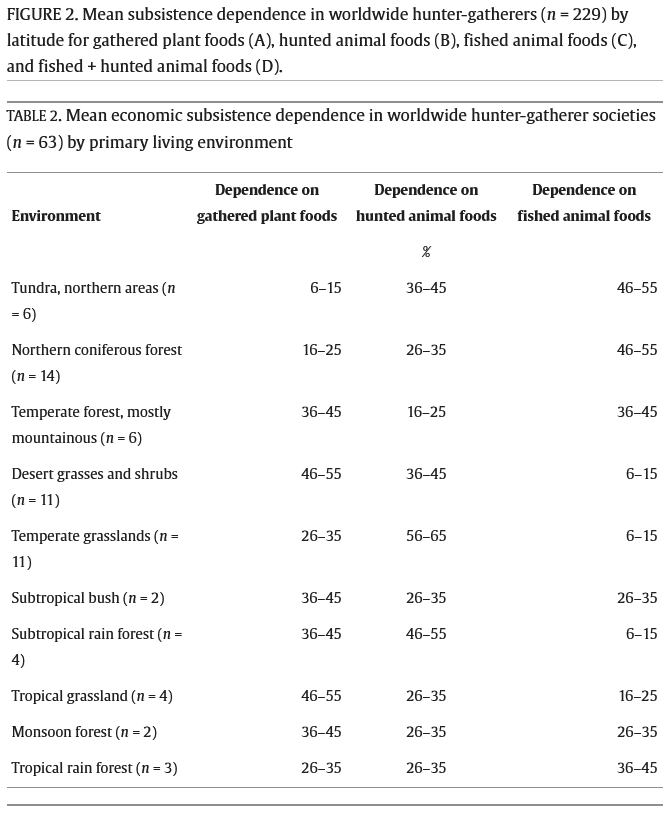
I am amazed how "they" managed to dupe almost everyone with the idea that humans are "made" to eat diets based almost solely on grains and tubers (high glycemic index) and that animal foods (glycemic index = 0) was never meant for us. Some food for thought:
(Source: https://www.sciencedirect.com/science/article/pii/S0002916523070582)

A plausible explanation of your claim that humans are "made" to eat diets based almost solely on grains and tubers (high glycemic index) and that animal foods (glycemic index = 0) was never meant for us is the difficulty of wholesale reproduction of livestock. There is a popular claim that the biomass of an organism is at most 1/10 of what it consumes before reaching maturity. This claim likely explains why feeding livestock during the winter, especially during Russian colder winters, required peasants to make far more effort to, for example, prepare the hay.
An alternate explanation could imply that people who live in the tundra do end up aging faster as a result of actual deficiencies. But this coukd also be unlikely, since these people's biochemistry could have already rewritten itself to adapt to the new environment.
EDIT: The biochemistry of humans who engage with agriculture could have also rewritten itself to adapt to the agricultural environment richer in carbohydrates.
My point was not specifically that people up north eat an animal based diet but that ALL people everywhere do. We have been hunter gatherer for a couple of hundred thousands years, and farmers for a couple of thousands. To me it makes sense to look at what hunter gathers today eat (i know its not a perfect proxy but better than observing what people eat at McDonalds). As you can see, ALL present hunter gatherers eat animal foods, and they eat a lot of it. We need fat and protein, they are essential for us. Carbs are not.
"An alternate explanation could imply that people who live in the tundra do end up aging faster as a result of actual deficiencies."
Do people age faster up north due to deficiencies? What is you source for that?
We have been hunter gatherer for a couple of hundred thousands years, and farmers for a couple of thousands.
I'd be wary of leaning too hard into this kind of argument, because our evolutionary history goes back more than a hundred thousand years.
Homo Habilis are currently believed to have been opportunistic scavengers at best, given that they weren't adapted well enough to running to do persistence hunting.
> [...they were capable of eating a broad range of foods, including some tougher foods like leaves, woody plants, and some animal tissues...](https://humanorigins.si.edu/evidence/human-fossils/species/homo-habilis)
While Australopithecine were straight-up herbivorous:
> [While the researchers cannot completely rule out the possibility of occasional consumption of animal protein sources like eggs or termites, the evidence indicates a diet that was predominantly vegetarian.](https://www.mpic.de/5631022/vor-drei-millionen-jahren-lebten-unsere-vorfahren-vegetarisch#:~:text=The%20team%20of%20researchers%20found,diet%20that%20was%20predominantly%20vegetarian.)
And hominid species earlier in the line were probably frugivores.
So a fuller version of this story would be that we have millions of years of adaptations to eating fruit and tubers, followed by millions of years of adaptation to also eating meat (initially sporadically and opportunistically, and later through more systematic hunting), followed by [at least tens of thousands of years of adaptation](https://www.sciencedirect.com/science/article/pii/S0899900722001150) to eating grains and dairy ([possibly including the genes that cause celiac](https://www.acsh.org/news/2015/07/08/scientists-think-they-have-an-origin-story-for-celiac-disease#:~:text=Furthermore%2C%20evidence%20implicates%20at%20least%2040%20genes,of%20celiacs%20disease%20is%20a%20good%20one.)).
While all the hunter-gathers in your table eat meat, the table also tells you that they all eat carbs whenever they're available in the environment. A large part of our success as a species was our ability to adapt to and thive on many different kinds of diets, from almost vegetarian to almost carnivorous.
The Hadza reportedly get [10-20% of their calories from honey](https://en.wikipedia.org/wiki/Hadza_people), and in interviews with people who have lived with them I've heard that they prioritize honey even over meat ie even while tracking they'll risk losing their prey if they see a beehive. They need the calories to get through the dry season.
I don't think we have any numerical records for the Coast Salish, but their traditional foods seem to be pretty heavy on berries, both as sauces and dried in big cakes.
EDIT I'm not sure why only the first paragraph got parsed as markdown, or how to fix it.
IIUC, evolution is supposed to accelerate greatly during population growth.
Of course hunter gatherers eat/ate carbs, but they did not base their diets on grains and beans. Fruits and berries "wants" to get eaten. But... how long is the fruit and berry season? A few months if you are lucky. The rest of the time animal foods is pretty much the only thing available. Sure you can chew on the occasional root, but how many calories will that give you?
My stance is that more animal foods in peoples diets would reverse some of the damage from the high carb ultraprocessed foods in peoples diets. I live in Sweden. The recommended weekly red meat consumption is 350grams. That is like one or two meals. To me that recommendation is madness when you look a insulin resistance and diabetes numbers. People need to get a bigger share of their energy from protein and fat, not less.
I don't have sources for the alternate explanation. What I meant is that agriculture could have made producing animal-derived foods harder than carb-rich plant-derived foods because animals have to be fed at least an OOM more of plant-derived foods.
In my previous post Traditional Food*, I explained how what we think of as a "traditional" diet is a nationalist propaganda campaign that's making us sick. In this post I'll go into the biological mechanisms.
There are four substances that the body can metabolize: carbohydrates, fats, protein and alcohol. Of these, I'll focus on how modern carbohydrate-heavy foods (like pasta, bread and rice) are related to insulin resistance. This doesn't mean that seed oils are good for you, or that the industrial revolution hasn't changed how people consume meat. Seed oils are bad for you and people today don't eat meats the way peasants did—they ate organs and other stuff that gets fed to animals today. Alcohol is just a poison you can metabolize.
With that out of the way, it's time to learn about insulin resistance.
Insulin & Resistance
Your blood has glucose dissolved in it. Blood glucose is important because your brain relies on glucose to function. If there wasn't glucose in your blood, then you'd die. However, too much blood glucose causes problems too. Precisely what problems hyperglycemia causes isn't important right now. Instead, what matters to this post is that your body has a control system that keeps your blood glucose in its proper range.
When your blood glucose rises, your body releases a hormone called insulin. Insulin binds to insulin receptors in cell membranes. These insulin receptors activate signalling that tells various tissues in your body that it's time to absorb that glucose from the blood and into cells.
Your blood glucose spikes (rises very fast) when you eat foods that release lots of glucose quickly. Foods that quickly release lots of glucose into your bloodstream are said to have high glycemic index. White rice and anything made out of modern flour has a high glycemic index. Sugary drinks have a high glycemic index too. Slower-digested foods like legumes have a low glycemic index.
When you eat foods with a low glycemic index, this system works fine. But when you eat foods with an unnaturally high glycemic index, the system works badly. The unnaturally high glucose spike causes an evolutionarily unprecedented insulin spike. The blood glucose then drops below where it's supposed to be. In this way, eating too much high-glycemic food actually makes you hungrier. That hunger creates a caloric surplus, which leads to obesity.
Even worse, repeated insulin spikes cause the insulin receptors to desensitize (downregulate) themselves. Your body creates more insulin to get the attention of desensitized receptors. This produces a horrible chain reaction where your insulin is chronically high and the cellular response diminishes. This is insulin resistance. Insulin resistance prevents fat burning too, because insulin inhibits fat release. Here are some signs of insulin resistance.
Perhaps this is happening to you and you think it's normal, or just part of getting old. It's not! The reason it might seem normal to you is because most [[1]] Americans—even non-obese Americans—have a sign of metabolic dysfunction like this. 38% meet the much worse criterion of prediabetes. This is historically unprecedented. Ignoring tiny aristocratic minorities, no society before 1800 was like this. If you're eating three meals per day, your energy levels should be mostly decoupled from when you eat. Your hunger should be decoupled from your energy levels too.
Many factors led to this, including exercise patterns (mostly driven by horrific urban planning), stress, and electric lights. But the most important factor is probably diet.
How diet changed
Historically, most of what normal people ate had—by modern standards—a very low glycemic index. Even milk and honey, foods so valuable the Bible uses them to paint a picture of the Promised Land, have only low-to-medium glycemic indices.
[These tables come from ChatGPT because the details aren't important—just the general trends.]
When you look at these tables, you'll notice two major trends.
Historically, insulin resistance was overwhelmingly a disease of the rich (and sometimes monks), because only the rich could afford the tasty foods that cause insulin resistance. Historical societies were so extremely unequal that almost nobody was rich. Consequently, almost nobody got insulin resistance.
Today, modern technology allows everyone to eat like a medieval king. The cheapest bread in your local grocery store has a glycemic index that historically, only the rich could afford.
Epidemiological data shows 10%-15% of Americans as having normal metabolic markers. The exact numbers vary depending on where you put semi-arbitrary cutoffs. If we used a reference class of hunter-gatherers, then American metabolic health would look even worse. Unfortunately, precise data on hunter-gatherers' metabolic markers is much harder to come by. ↩︎