If anything, it seems like higher-dimensional cubes are spiky, not spheres. At the vertex of a square, the figure takes up 1/4 of the local area around the vertex, for a cube vertex it's only 1/8 of the space, for a tesseract only 1/16, in 10 dimensions only 1/1024 etc.
I think they are kinda spiky, symmetrically so.
Like, imagine you are at the surface of a large n-d sphere. What percent of volume of a tiny sphere centered at you is also inside that large sphere? What percent would there be if you make a tiny step away from the big sphere, e.g. 0.1 of the radius of your tiny sphere centered at you?
E.g. big_r = 10, small_r = 1
(gpt5.2 wrote the code, recheck yourself) (and this is rounded for print of course, it's not literally zero)
n=2 P1 = 47%, P2 = 41%
n=3 P1 = 46%, P2 = 39%
n=10 P1 = 44%, P2 = 31%
n=100 P1 = 31%, P2 = 7%
n=1000 P1 = 6%, P2 = 0%
n=10000 P1 = 0%, P2 = 0%
The point is that high n-d sphere, as seen from some point nearby is kinda like a spike pointing at you. And low n-d sphere is more like a wall. And it's true for all points nearby it, which is the unintuitive part.
No?
It's a statement about your small neighborhood when you at the surface of the n-d sphere. And in low n it's like half inside the sphere. In high n it's more like a needle touching your position.
I'm not sure how that ^follows from the fact that most of volume of a high-dimensional sphere is at the outer surface.
If you imagine expanding the large sphere slightly to encompass the entire small sphere, most of the volume of the new large sphere will be outside of the original large sphere.
Well, if you are on the face on n-d cube, half of your neighborhood would be inside, no matter what n. But "most volume in the peel" is true of the n-d cubes too.
Yeah, if you're small enough compared to the surface, they're both flat. In the intermediate regime where r < R but not r << R, the second-order effects of the sphere matter and give you the needle effect whereas the cube pushes all those effects into the edges and corners, so the faces still look flat at intermediate scales.
A number of years ago Numberphile published a video on the behavior of higher dimensional spheres with the title “Strange Spheres in Higher Dimensions”. I'd recommend one watches the video before reading this post, in that video Matt Parker presents a construct where spheres are placed inside a cube pressing against its faces, in the remaining central volume an additional sphere is set with a radius so that it kisses the “padding spheres”, this build is then scaled to higher dimensions where Parker observes that the central sphere increases in size constantly until its surface goes through the face of the cube, an apparently impossible configuration. He then jokingly concludes that the only way to make sense of it is to imagine higher dimensional spheres as “spiky”, so that the spikes can go through the face while the rest of the volume remains confined inside the hypercube.
Recently, for some reason that same video ended up in my feed and I ended up watching it again, I was left rather dissatisfied with the conclusion. I am not a mathematician but I was always fascinated with higher dimensions and when it comes to geometry, I often found that seeing is believing.
Plotting sections of the construct can help us make sense of the problem, we’ll start with the simple 2d version, here the central sphere has a radius of
Fig. 1 not much to see here, everything is visible on the plane
The true solution of the “mystery” is understanding the diagonal of the cube in higher dimensions. The diagonal of the measure polytope in n dimensions is
The diagonal of a face also grows in a similar fashion, since it only has one less dimension that the hypercube, for example in the 9th dimension the diagonal of a face of a unit hypercube is
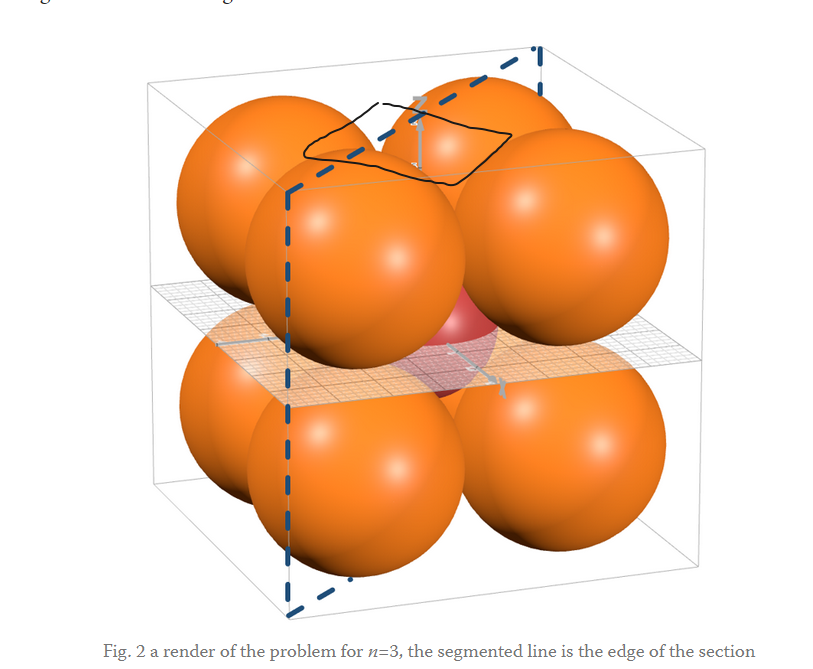
Understanding the 3d version of the problem is not too hard but to keep things simple I will show a 2d section only, to obtain this section we will slice the cube through the diagonal as shown in fig. 2.
Fig. 2 a render of the problem for n=3, the segmented line is the edge of the section
The highlighted section is shown in the next image, notice a gap appears in the center as not all of the padding spheres are touching each other. Also, the padding spheres appear to no longer be contacting all sides of the cube since some of the contact points do not lie in this section.
Fig. 3 The radius of the central sphere has grown, it is now
This method is quite useful, since the plane we chose passes through the centers of both the central and padding spheres, the sections of these objects will always appear as circles with their real radius no matter how many dimensions are we working with. Now let us move to the 4th dimension:
Fig. 4 in 4d the central sphere has now the same radius of the padding spheres, 1
This pattern continues, as the diagonal of the face continues to grow so does the diameter of the central sphere, in 9 dimensions the sphere is now contacting the faces of the hypercube:
Fig. 5 The diagonal of a face is now almost 3 times the side
Due to symmetry the radius of the central sphere is always equal to the distance between the surface of a padding sphere and the closest corner. In 10 dimensions part of the central sphere is now escaping the inner volume entirely:
Fig. 6 The radius of the inner sphere is now
This pattern continues as n increases and more and more of the central sphere escapes the polytope. Higher dimensional spheres are not spiky but the faces of higher dimensional cubes have very large diagonals compared to the side through which the central sphere can escape.