This is very interesting and a lot rings true. I particularly like your examples of how "Embarrassed Cults" are trying to appear, that makes the concepts really click.
I'm curious about why the lines in your graph curve, rather than being firm size limits. I feel like I understand the Robert's Limit... something about how Roberts Rules start breaking in meetings of a dozen without someone "in charge," but can function for larger meetings when someone wields more authority? I could see a similar/opposite point that you don't need structure in small cliques, but with someone 'lightly in charge" you can avoid structure up to 25-30. Either seems reasonable.
I'm more confused about the Dunbar number curving, even in fairly authoritarian systems you should still be able to know and maintain personal relationships with other members of the group. There's also the implication that a Guild could be a reasonable format for 50-100 people if mostly egalitarian, but hits size limits as the leader takes on more authority, which seems the opposite of what I'd expect.
I'm looking forward to the rest of this sequence.
I could see a similar/opposite point that you don't need structure in small cliques, but with someone 'lightly in charge" you can avoid structure up to 25-30.
Yeah, I think this is what I'm getting at. Robert's Rules says there's no real point in formality if the group is about 12 or fewer; this defines the minimum size at which the group will think adopting formal rules is a good idea. More authoritarian groups can postpone that discussion till later.
I'm more confused about the Dunbar number curving, even in fairly authoritarian systems you should still be able to know and maintain personal relationships with other members of the group. There's also the implication that a Guild could be a reasonable format for 50-100 people if mostly egalitarian, but hits size limits as the leader takes on more authority, which seems the opposite of what I'd expect.
My intuition is: That line represents the point at which people start thinking "This bureaucratic structure is too cumbersome to get anything done with this many people; we therefore need strong leaders who can act through personal authority rather than merely bureaucratically-delegated authority." I.e., the guild starts turning into a cult. And the population threshold at which people will give up on the guild structure will be lower the more authoritarian the culture.
Example, but only by analogy since it's not really an "association" in the same sense - Because of their egalitarian culture, towns in New England will maintain an "open town meeting" form of government (which functions like a guild) up to a population of about 6,000 or so, whereas in less egalitarian parts of the country a village will incorporate itself into a town with a mayor (which is sort-of like a cult) at a much lower population threshold.
(Maybe the name is confusing. I'm being a bit cheeky calling the line "Dunbar's Limit", since it's named after its x-intercept, i.e. "Dunbar's Number", which is just the number 150. That is, you can have 150 personal acquaintances regardless of whether you're in a guild or a cult; it's just that 150 is the point at which even the most staunch egalitarians will give up on trying to keep it a guild.)
I'm less sure about what the clique/cult boundary represents. Maybe that's more of a gradual transition.
Yeah, I think this is what I'm getting at. Robert's Rules says there's no real point in formality if the group is about 12 or fewer; this defines the minimum size at which the group will think adopting formal rules is a good idea. More authoritarian groups can postpone that discussion till later.
Valid, this makes sense.
My intuition is: That line represents the point at which people start thinking "This bureaucratic structure is too cumbersome to get anything done with this many people; we therefore need strong leaders who can act through personal authority rather than merely bureaucratically-delegated authority." I.e., the guild starts turning into a cult. And the population threshold at which people will give up on the guild structure will be lower the more authoritarian the culture.
Interesting. I took you to be riffing off of a phase diagram, yes? My intuition was that the Dunbar Curve should slope the other way, at least for part of the range. If a guild of 120 people exists, it likely has more structure and more empowered leadership than a guild of 40. But most organizations that I'd think of as analogous to guilds simply fail if they grow faster than their organizational capabilities. There could be some margin at which surviving organizations necessarily become cults if they get too authoritarian to manage their membership, but I think there are plenty of examples of groups in the ~200 person range that use Robert's Rules type structures, notably committees, to maintain coherence with moderate levels of leadership authority.
I almost want to add another category to the graph, for groups too big and disorganized to still be guilds, but too lacking of leadership to be proper cults. Leaderless mobs? Maybe this is just a special case of cult, though.

Eagerly looking forward to more of your sequence on this. I imagine it will make some of these distinctions more clear.
 1
1How about this as a synthesis:
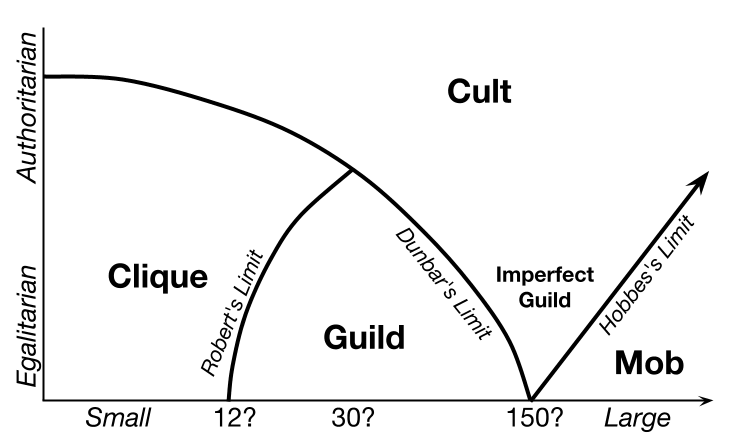
(This is speculative on my part, since I have no personal experience with groups like this.)
A group of type #5 is really no cult at all (since there's no leader), but a "mob" as you say. I was only calling it a "fractious cult" because the most common way to end up there is a large cult suddenly becoming much more egalitarian upon the loss of their leader. But I suppose it could also result from a guild growing too rapidly and carelessly. In any case, a mob is inherently unstable, and will quickly decay into something else.
In a perfect guild, every member carries around a mental model of every other member, which they consult whenever acting on behalf of the group. This can only work up to a size of 150, since it's simply not possible to carry around more mental models than that (hence Dunbar's Number). Therefore it becomes increasingly necessary to delegate broad sweeping authority to "standing committees" (etc.) that are less-than-perfectly accountable to the group, and have to use their own judgement in a lot of cases. Plenary meetings become increasingly rare and performative. In that respect it starts to take on certain culty characteristics, and so it's an "imperfect guild". On the other hand it's not really a cult either; I don't know where that boundary is. It may overlap with #8 somewhat.
The significance of the "phase boundaries" is that it takes a lot of "energy" to pass through them, and so groups will often break up or stagnate rather than do this. This is why the direction of the slope is meaningful. So e.g. when a growing clique approaches Robert's Limit from the left, the more egalitarian-leaning members will believe it's imperative to cross the boundary now (i.e. draw up a guild charter), whereas the more authoritarian-leaning members will think this is unnecessary. Therefore the group will either try to avoid exposing the division by ceasing to grow, or else break up, thus bouncing off the boundary.
Likewise, I imagine that when a growing guild approaches Dunbar's Limit from the left, the authoritarian members will already be exceeding their mental-modeling-capacity and will thus think it's necessary to cross the boundary (by appointing a standing committee or whatever), whereas the egalitarian members will insist on stretching their mental-modeling-capacity as far as possible in order to avoid compromising the "perfection" of the guild.
My intuition is: That line represents the point at which people start thinking "This bureaucratic structure is too cumbersome to get anything done with this many people; we therefore need strong leaders who can act through personal authority rather than merely bureaucratically-delegated authority." I.e., the guild starts turning into a cult.
I wonder how often it would work better for guilds that grow too large to explicitly split apart. My intuition is that there should be a norm that growing guilds should split apart (and, where applicable, appoint representatives to a higher level org. to coordinate---initially a clique but later a guild if the number of base level guilds increases).
Splitting a guild in half may be difficult because some number of close 1:1 connections are going to be broken no matter where the line is drawn. Instead what may end up happening is that the guild undermines its own unifying principle and shatters into dozens of small cliques, and now there are 0 guilds.
The unfortunate reality (and what motivated me to write this post) is that sometimes an organization will find itself constrained by its past choices, with no viable way forward. A guild of 200 may wish it could've been two guilds of 100 instead, but the time to make that decision was when they were contemplating adding their 101st member, not now. (Similarly, a group of 60 may find itself in "embarrassed cult" territory and wish it could become a guild, but really they should've done that a long time ago.)
Maybe the ideal setup for a large community would be something like the "colleges within a university" system, where the university has a rule that each college may not grow beyond a certain size. So, as the existing colleges fill up, there will be a growing population of unaffiliated hangers-on who will eventually be able to form their own college.
(Again, I'm only speculating here since I have no personal experience with groups this large.)
This is the first in a sequence of articles on organizational cultures, inspired largely by my experiences with the LessWrong meetup community.
Clique
A clique is a small, intimate group of friends who all know each other very well. If you're in a clique, you might not know what kind of culture you're in because there might never have been any significant sources of conflict. But if there are, they will be addressed in one of two ways.
#1. "Let's talk this over"
An egalitarian clique will put great effort into resolving conflicts through interpersonal connections in order to keep the group together. This may involve long hours on the metaphorical therapist's couch - NVC, Authentic Relating, etc. - or perhaps, if two friends have a falling-out, a mutual friend of theirs might try to help smooth things over.
#2. "This isn't working out"
In a more authoritarian clique, people will be quicker to concede that their differences are irreconcilable and that the group (at least in its current form) should break up. However, this is seen by all parties as a fairly benign outcome, since there is not much investment in the clique "as such" (rather, the investment is in the individual 1:1 relationships) and it's not hard to start a new one. There is no sense that somebody needs to be "right" and somebody else "wrong".
Guild
#3. "Point of order, Mr. Chairman"
A guild is a medium-sized group where each member may have a few close connections, but will have a much larger number of "weak ties" that are connected to them only indirectly. However, the group is united (and distinguished from the wider society) by a shared institutional identity that makes it "a thing" and not merely a collection of individuals or cliques. This manifests in the use of bureaucratic procedures to resolve conflicts, since the group is too large to expect unanimity, and entrenched enough that schism is seen as more undesirable than having some disagreement over any particular decision.
In my opinion, the guild has become something of a lost art, which ought to be revived. (Future articles will go into this point further.)
Cult
A cult is a group based on personal authority. This authority derives from the inherent virtue of the leader (charisma, strength, wealth, etc.) and not any notion of popular support. A cult's size can exceed Dunbar's Limit because it is held together not by the members' relationships with each other, but by their loyalty to the leader. However, small- and medium-sized cults can also exist, and are perhaps more common than large cults. (Rare is the person who has what it takes to lead a large cult, but you may find yourself at the center of a small cult quite inadvertently.)
#4. "Verily I say unto you"
What the leader says, goes. Members are expected to subordinate their own will and desires to that of the leader. They may advise the leader one way or another, and may bring their disputes to him/her for resolution, but the leader has the ultimate authority and responsibility for the decision.
However, in addition to this "straightforward" kind of cult, there are also various kinds of dysfunctional cults, which (perhaps) give the rest a bad name.
Fractious cults
#5. "This isn't what our Founder would've wanted"
If a cult loses its leader, and if the leader has not raised up a worthy successor, the group will find itself in an unstable zone where its culture is too egalitarian to persist in its super-Dunbar size, because there was never any hierarchy amongst the rank-and-file, only in relation to the leader. Therefore, the group will decay into a more stable configuration (indicated by the dotted arrows), either by someone gaining sufficient personal virtue to become the new leader, or (more likely) splitting into several cliques or guilds, each of which will claim to be the legitimate heir of the original group.
Embarrassed cults
A cult is "embarrassed" when it doesn't want to admit that it's a cult, because the leadership lacks the personal virtue necessary to operate a straightforward cult but still wants to maintain control. They may do this through some combination of pretending that the group's culture is more egalitarian than it actually is, and/or pretending that its size is smaller than it actually is. (This is denoted on the diagram by an arrow with an open circle on its base - the arrowhead is what the group pretends to be, and the base is what the group really is.)
#6. "If you don't like it, you can leave"
"...but we know you're not going to."
The leader of such a group may pretend that they are not claiming any personal authority at all, but "just" observing that the current clique isn't working out (see #2). However, there is an obvious asymmetry in that it is one particular party who is taunting the other one to quit, and not vice-versa. Therefore the subordinate party stands to lose a lot more, and is thus likely to accept a considerable amount of dissatisfaction before they finally decide to leave.
#7. "Yeah, so if you could go ahead and get that done, that'd be great"
In the classic corporate dystopia, HR and management want you to think of your team as a small clique, so that your desire for personal connection will be redirected towards the company. They may ask for your opinion, but have no intention of listening to it. Critics rightly warn young professionals against getting sucked into environments like this, where one is prone to being manipulated into accepting substandard pay and working conditions. The warning usually given is: You should be as loyal to the company as they are to you, i.e. not at all.
#8. "Carried u-... [nervous glances] ...-nanimously"
(Clip 1, clip 2)
A group may put on the trappings of a guild to disguise the fact that it is still exercising top-down authority rather than being a bottom-up enterprise. For example, in a typical homeowner's association (HOA), there was never any point at which a group of homeowners got together and decided they wanted to form an HOA. Rather, what usually happens is that a developer buys a large plot of land, builds a bunch of houses on it, and creates an HOA whose membership attaches to each house, which are then sold one-by-one to buyers who otherwise have no connection to each other. Most of the homeowners thus have no real interest in participating in the HOA, but begrudgingly accede to the edicts of a handful of busybodies who have too much time on their hands.
Evolution of a growing clique
The culture of a clique may at first be ambiguous (A) because there is nothing really at stake. As it grows, however, if it does not simply break up, it will need to either follow the egalitarian path and become a guild (B), or the authoritarian path and become a cult (C). And in the latter case, the cult will inevitably be an embarrassed one, because if there had been someone with the requisite virtues to be a cult leader, the group would never have spent much time as a clique in the first place, but would have been a straightforward cult (D) from the beginning, and maintained its cultiness throughout its growth.
Therefore, as is probably clear by now, I think outcome C is bad and B is better. If a group has landed at C, then it may with great effort be pulled kicking-and-screaming to B - but this is likely to ruffle some feathers.
(I also suspect that there is a tendency for groups to get stuck at the "triple point" with around 30 members, in an uncomfortable equilibrium between all three types because the group cannot decide what it wants to be.)
What's so great about guilds? (Plan of the sequence)
Forthcoming articles in this sequence will lay out a case for why we should want more guild-like organizations to exist. (Links will be added as the articles are posted.)
Other articles (Society is a social construct, pace Arrow; Rubber stamp errors; Anti-civicality) will discuss various norms that are necessary for a guild to function well, but which may seem strange or unintuitive for people who are accustomed to cliques or cults. I will conclude with a reflection (So are you some kind of communist?) on the tension between social and individual moralities.