This is a special post for quick takes by Parker Conley. Only they can create top-level comments. Comments here also appear on the Quick Takes page and All Posts page.
Is it possible to get a stable 10h/wk remote SWE job as an early career decently smart person? Would like to meditate 6h/day. Current idea is to start a lifestyle SaaS business.
Attention conservation notice: Not answering your question, instead making a different suggestion.
If you're willing to commit to meditating 12-18 hours/day (so 2×-3× your current goal), you could also go on a long-term meditation retreat. Panditarama Lumbini in Nepal offers long-term retreats for whatever one can afford.
(I haven't gone there, and they have a very harsh schedule with some sleep deprivation.)
Appreciate the suggestion!
I’ve had coffee chats with three people who like that retreat center. I like retreats, and I did a 8h/day home retreat last summer. Have seriously considered Panditarama but it is a big time investment and career break especially early career. And also I worry it would be hard on my body sitting so long and hard, and that Mahasi practice risks being destabilizing. May still do one though. Probably not while getting a business off the ground, but maybe when there is in between time or room for a small sabbatical.
Do you have any thoughts on career circumstances where I could make income for the 9 months I wouldn’t be on retreat?
Don’t do this. Meditating 6 hours a day is excessive, unless you derive some marginal value that I don’t understand from it.
What are the actual use cases of memory systems like Anki?
Epistemic status: spent 30min cleaning up some notes from my Obsidian I jotted down yesterday. This ontology is rough and a bit illegible but potentially useful for narrowing down the actual use cases of memory systems.
Inspired by @Saul Munn's recent short form: Active Recall and Spaced Repetition are Different Things. The concepts of active recall and spaced repetition apply pretty well here, but I saw Saul's post after writing most of the text below.
Roughly, there are types of knowledge in domains (recalling from Scott Young's Ultralearning, I might be slightly off):
- Proceduralized knowledge
- Conceptual knowledge
- Factual knowledge
I think spaced repetition systems are useful for three types of domains based on the nature of the cues in the domains:
- Domains where you are already cued on the learnings often (e.g., key business procedures in your full-time job). You naturally get spaced repetition in these domains, so memory systems like Anki are less useful.
- Domains where you are not cued on the learnings often or at properly spaced intervals. This may include domains where you were an expert at one point and then stopped being an expert.
- Domains where you need to understand cues before being effective. (e.g. understanding a new language or technical domain like quantum mechanics; see Quantum Country.)
Combining the two frameworks above, Anki is useful for:
- Proceduralized knowledge where you can appropriately cue yourself and you're not cued often on.
- Cueing procuduralized knowledge is hard, though. For example, if I wanted to review my knowledge of 'how-to-play-beach-volleyball' on a regular basis, I have to spend a time coordinating or attending an event.
- Though, some proceduralized knowledge is possible to cue: for example, I have been using Anki to review LeetCode problems.
- Conceptual and factual knowledge that you're (2 above) not cued often on or (3 above) need to meet a criteria of knowing.
- Conceptual and factual knowledge is much easier than procedural knowledge because these types of knowledge neatly fit in flashcards. I'm still not sure about the strict boundary between conceptual and factual knowledge, though.
- And I think the general heuristic that conceptual knowledge is harder to cue than factual knowledge is true: medical students are obsessed with Anki while students in other vocational schools (e.g. law) don't seem to be
Accordingly, memory systems may not be useful for:
- Domains where you are cued on information often enough to get natural spaced repetition.
- Are highly procedural in a way that can't be Ankified and therefore active recall is hard.
An AI content X/Twitter account with nearly 100k followers blocked me, and I got a couple of disapproving replies for pointing out that the account was AI-generated. I quote-tweeted the account mostly to share a useful Chrome Extension that I've been using the detect AI content, but I was surprised that there was a negative reaction in the form of a few replies pointing out the account was AI-generated. I am neither pro- nor anti-AI accounts, but being aware of the nature of the content seems to be useful.
Would be curious to hear others' thoughts on the phenomenon.
Original Tweet: https://x.com/parconley/status/2000064102543376413
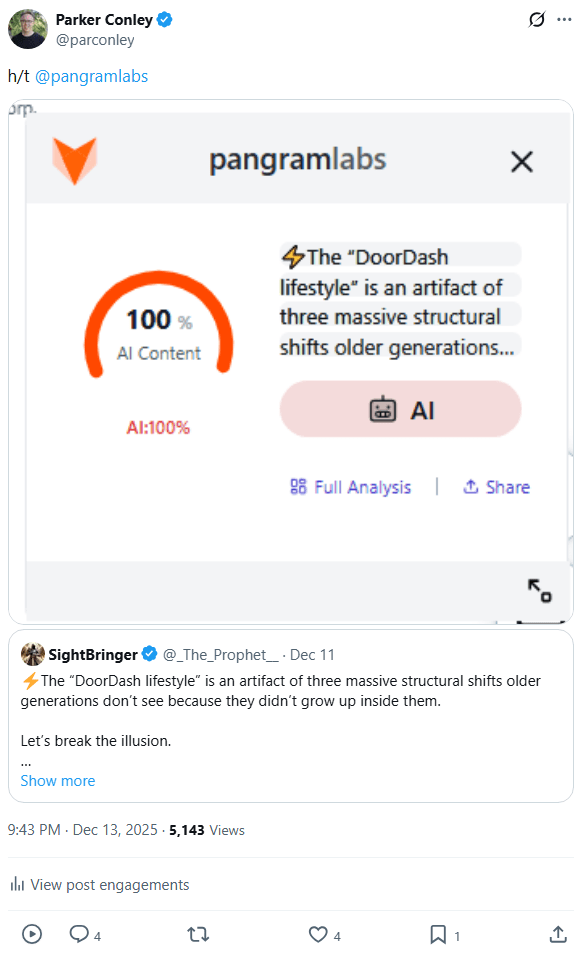
Can you clarify which phenomenon you're curious about? Blocking people who post anything that disrupts the desired messaging is as old as the ability to block people. AI-generated content is newer, but still not new. Optimizing for "engagement" rather than information or discussion is pre-internet (a LOT of publications, but not all).
Large AI accounts and multiple people (or other AI accounts) being adversarial when I pointed out that it is AI is the phenomenon.
Bot farms have been around for awhile. Use of AI for this purpose (along with all other, more useful purposes) has been massively increasing over the last few years, and a LOT in the last 6 months.
Personally, I'd rather have someone point out the errors or misleading statements in the post, rather than worrying about whether it's AI or just a content farm of low-paid humans or someone with too much time and a bad agenda. But a lot of folks think "AI generated" is bad, and react as such (some by stopping following such accounts, some by blocking the complainers).