This is a special post for quick takes by Saul Munn. Only they can create top-level comments. Comments here also appear on the Quick Takes page and All Posts page.
Comment Permalink
Active Recall and Spaced Repetition are Different Things
EDIT: I've slightly edited this and published it as a full post.
Epistemic status: splitting hairs.
There’s been a lot of recent work on memory. This is great, but popular communication of that progress consistently mixes up active recall and spaced repetition. That consistently bugged me — hence this piece.
If you already have a good understanding of active recall and spaced repetition, skim sections I and II, then skip to section III.
Note: this piece doesn’t meticulously cite sources, and will probably be slightly out of date in a few years. I link some great posts that have far more technical substance at the end, if you’re interested in learning more & actually reading the literature.
I. Active Recall
When you want to learn some new topic, or review something you’ve previously learned, you have different strategies at your disposal. Some examples:
- Watch a YouTube video on the topic.
- Do practice problems.
- Review notes you’d previously taken.
- Try to explain the topic to a friend.
- etc
Some of these boil down to “stuff the information into your head” (YouTube video, reviewing notes) and others boil down to “do stuff that requires you to use/remember the information” (doing practice problems, explaining to a friend). Broadly speaking, the second category — doing stuff that requires you to actively recall the information — is way, way more effective.
That’s called “active recall.”
II. (Efficiently) Spaced Repetition
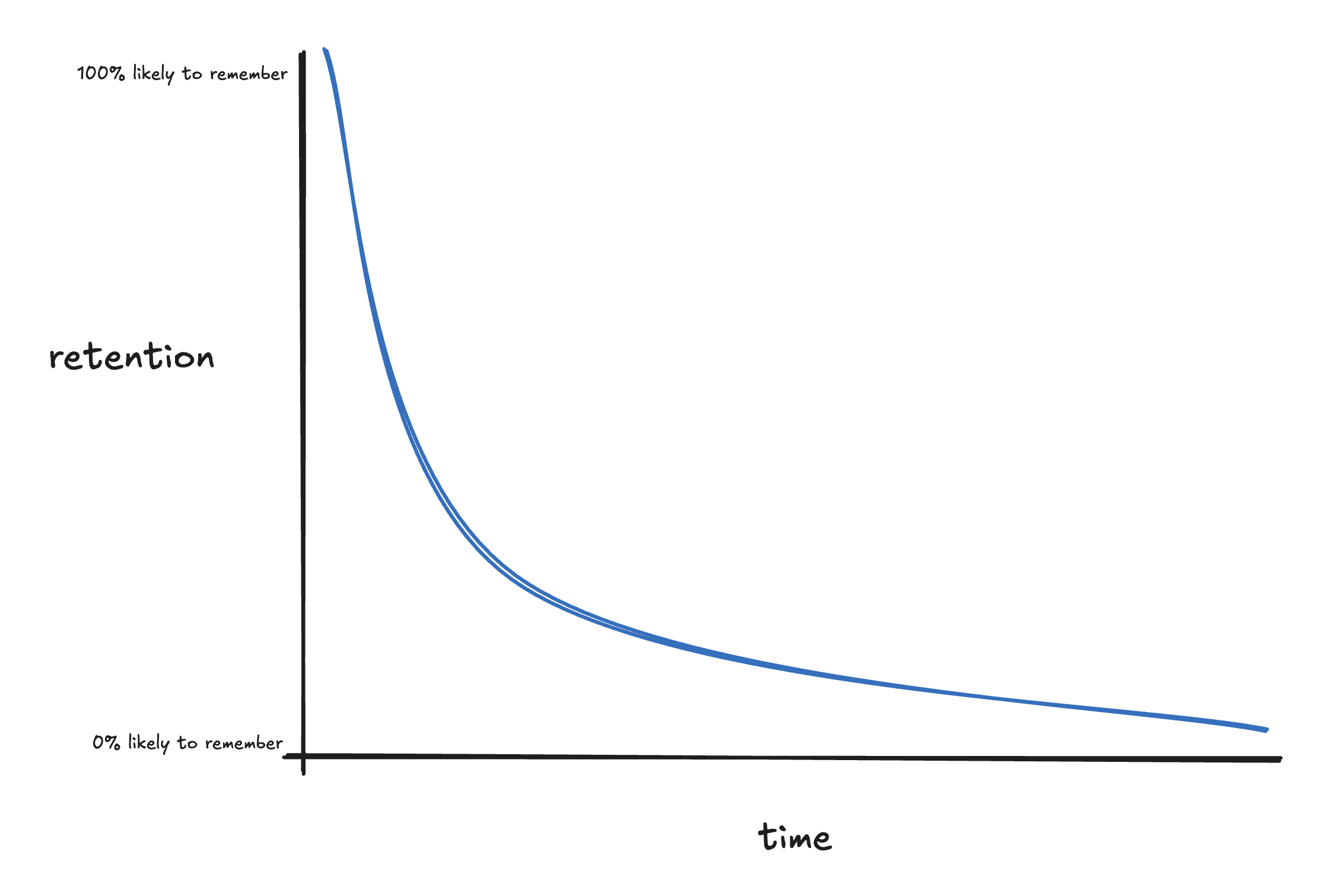
After you learn something, you’re likely to forget it pretty quickly:
Fortunately, reviewing the thing you learned pushes you back up to 100% retention, and this happens each time you “repeat” a review:
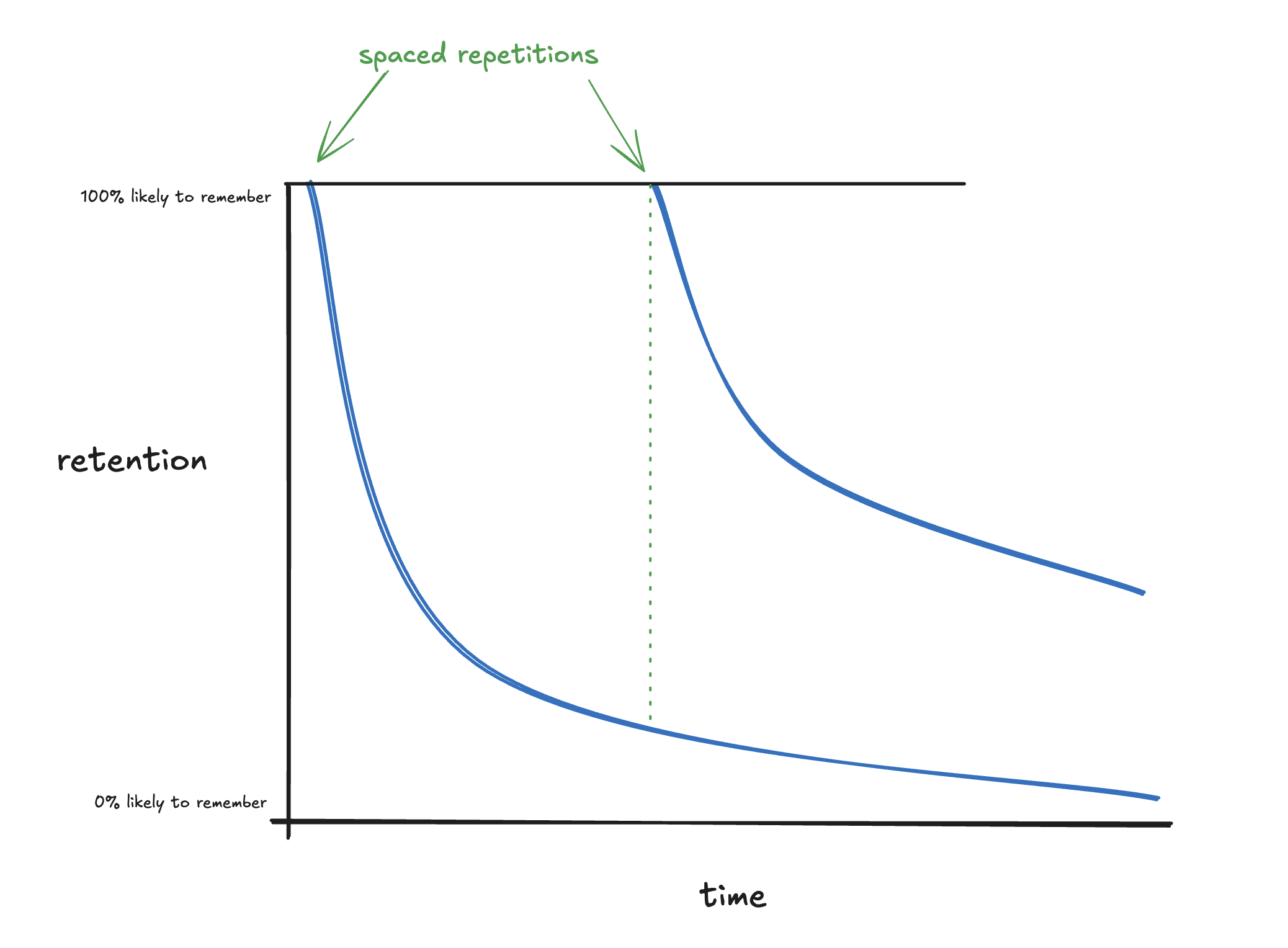
That’s a lot better!
…but that’s also a lot of work. You have to review the thing you learned in intervals, which takes time/effort. So, how can you do the least the number of repetitions to keep your retention as high as possible? In other words — what should be the size of the intervals? Should you space them out every day? Every week? Should you change the size of the spaces between repetitions? How?
As it turns out, efficiently spacing out repetitions of reviews is a pretty well-studied problem. The answer is “riiiight before you’re about to forget it:”
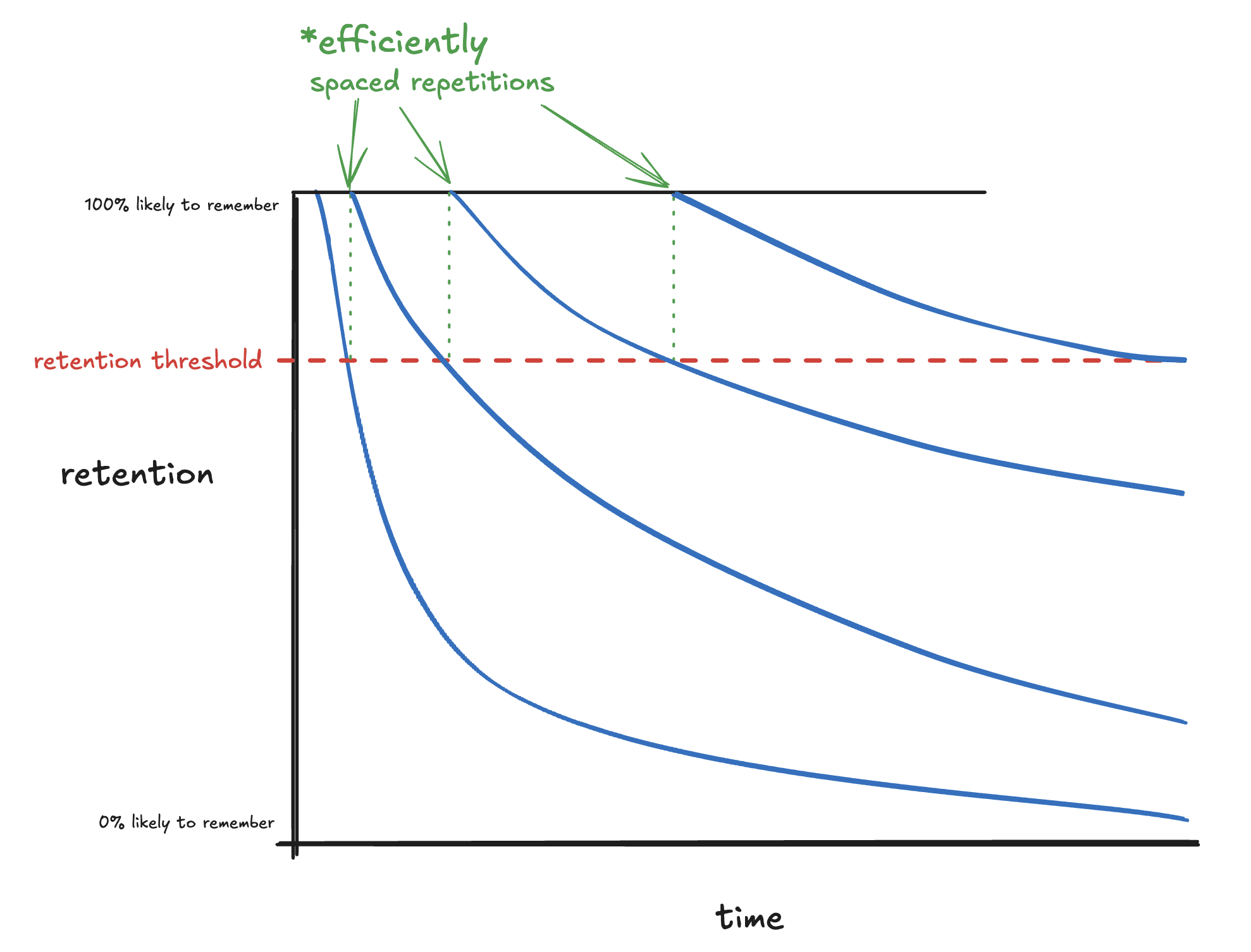
Generally speaking, you should do a review right before it crosses some threshold for retention. What that threshold actually is depends on some fiddly details, but the central idea remains the same: repeating a review riiight before you hit that threshold is the most efficient spacing possible.
This is called (efficiently) spaced repetition. Systems that use spaced repetitions — software, methods, etc — are called “spaced repetition systems” or “SRS.”
III. The difference
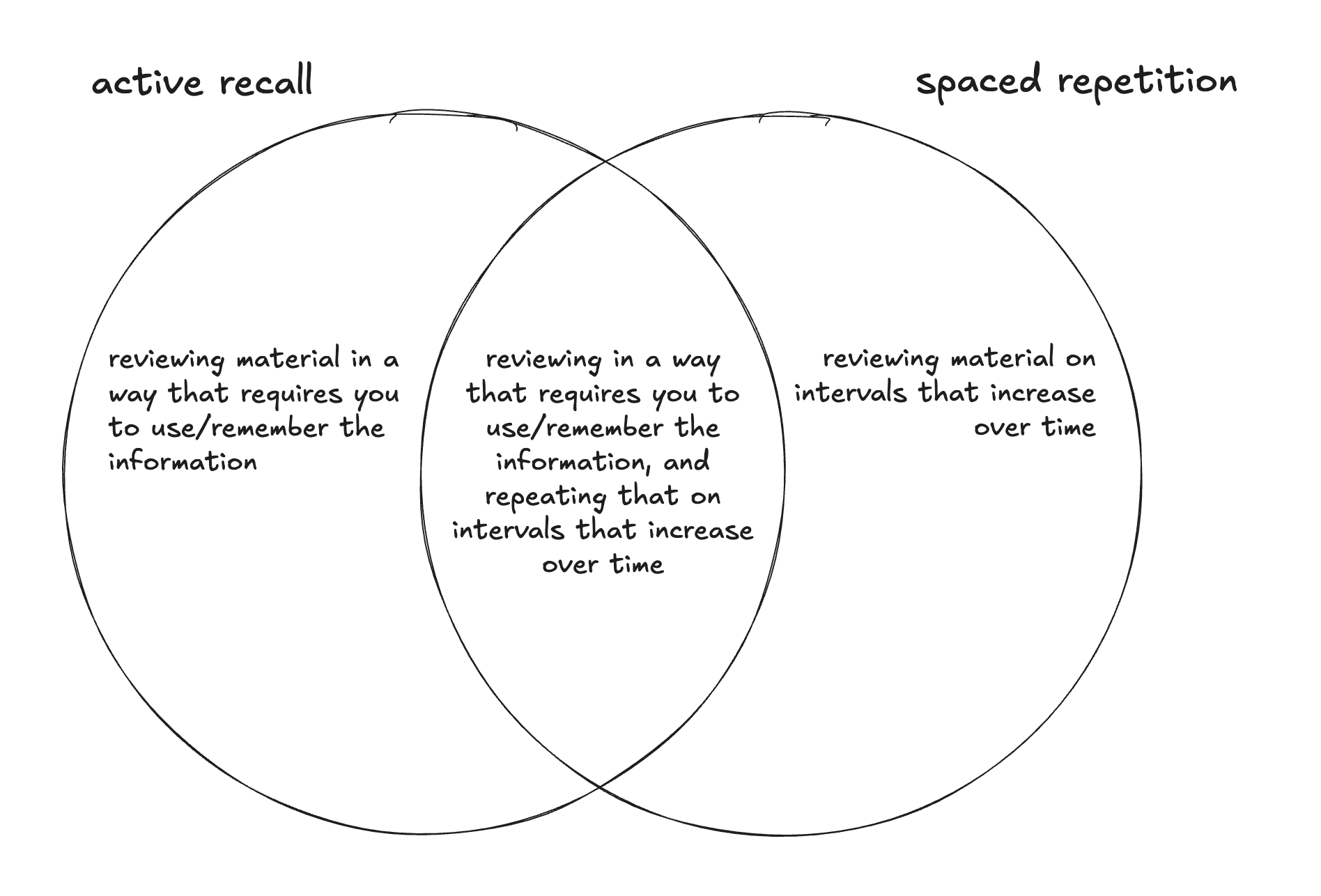
Active recall and spaced repetition are independent strategies. One of them (active recall) is a method for reviewing material; the other (effective spaced repetition) is a method for how to best time reviews. You can use one, the other, or both:
Examples of their independence:
- You could listen to a lecture on a topic once now, and again a year from now (not active recall, very inefficiently spaced repetition)
- You could watch YouTube videos on a topic in efficiently spaced intervals (not active recall, yes spaced repetition)
- You could quiz yourself with flashcards once, then never again (yes active recall, no spaced repetition)
- You could do flashcards on something in efficiently spaced intervals (both spaced repetition and active recall).
IV. Implications
Why does this matter?
Mostly, it doesn’t, and I’m just splitting hairs. But occasionally, it’s prohibitively difficult to use one method, but still quite possible to use the other. In these cases, the right thing to do isn’t to give up on both — it’s to use the one that works!
For example, you can do a bit of efficiently spaced repetition when learning people’s names, by saying their name aloud:
- immediately after learning it (“hi, my name’s Alice” “nice to meet you, Alice!”)
- partway through the conversation (“but i’m still not sure of the proposal. what do you think, Alice?”)
- at the end of the conversation (“thanks for chatting, Alice!”)
- that night (“who did I meet today? oh yeah, Alice!”)
…but it’s a lot more difficult to use active recall to remember people’s names. (The closest I’ve gotten is to try to first bring into my mind’s eye what their face looks like, then to try to remember their name.)
Another example in the opposite direction: learning your way around a city in a car. It’s really easy to do active recall: have Google Maps opened on your phone and ask yourself what the next direction is each time before you look down; guess what the next street is going to be before you get there; etc. But it’s much more difficult to efficiently space your reviews out: review timing ends up mostly in the hands of your travel schedule.
For more on the topic of deliberately using memory systems to quickly learn the geography of a new place, see this post.