This is a special post for quick takes by eggsyntax. Only they can create top-level comments. Comments here also appear on the Quick Takes page and All Posts page.
Informal thoughts on introspection in LLMs and the new introspection paper from Jack Lindsey (linkposted here), copy/pasted from a slack discussion:
(quoted sections are from @Daniel Tan, unquoted are my responses)
IDK I think there are clear disanalogies between this and the kind of 'predict what you would have said' capability that Binder et al study https://arxiv.org/abs/2410.13787. notably, behavioural self-awareness doesn't require self modelling. so it feels somewhat incorrect to call it 'introspection'
still a cool paper nonetheless
People seem to have different usage intuitions about what 'introspection' centrally means. I interpret it mainly as 'direct access to current internal state'. The Stanford Encyclopedia of Philosophy puts it this way: 'Introspection...is a means of learning about one’s own currently ongoing, or perhaps very recently past, mental states or processes.'
@Felix Binder et al in 'Looking Inward' describe introspection in roughly the same way ('introspection gives a person privileged access to their current state of mind (e.g., thoughts and feelings)') but in my reading, what they're actually testing is something a bit different. As they say, they're 'finetuning LLMs to predict properties of their own behavior in hypothetical scenario.' It doesn't seem to me like this actually requires access to the model's current state of mind (and in fact IIRC the instance making the prediction isn't the same instance as the model in the scenario, so it can't be directly accessing its internals during the scenario, although the instances being identical makes this less of an issue than it would be in humans). I would personally call this self-modeling.
@Jan Betley et al in 'Tell Me About Yourself' use 'behavioral self-awareness', but IMHO that paper comes closer to providing evidence for introspection in the sense I mean it. Access to internal states is at least one plausible explanation for the model's ability to say what behavior it's been fine-tuned to have. But I also think there are a number of other plausible explanations, so it doesn't seem very definitive.
Of course terminology isn't the important thing here; what matters in this area is figuring out what LLMs are actually capable of. In my writing I've been using 'direct introspection' to try to point more clearly to 'direct access to current internal state'. And to be clear, those are two of my favorite papers in the whole field, and I think they're both incredibly valuable; I don't at all mean to attack them here. Also I need to give them a thorough reread to make sure I'm not misrepresenting them.
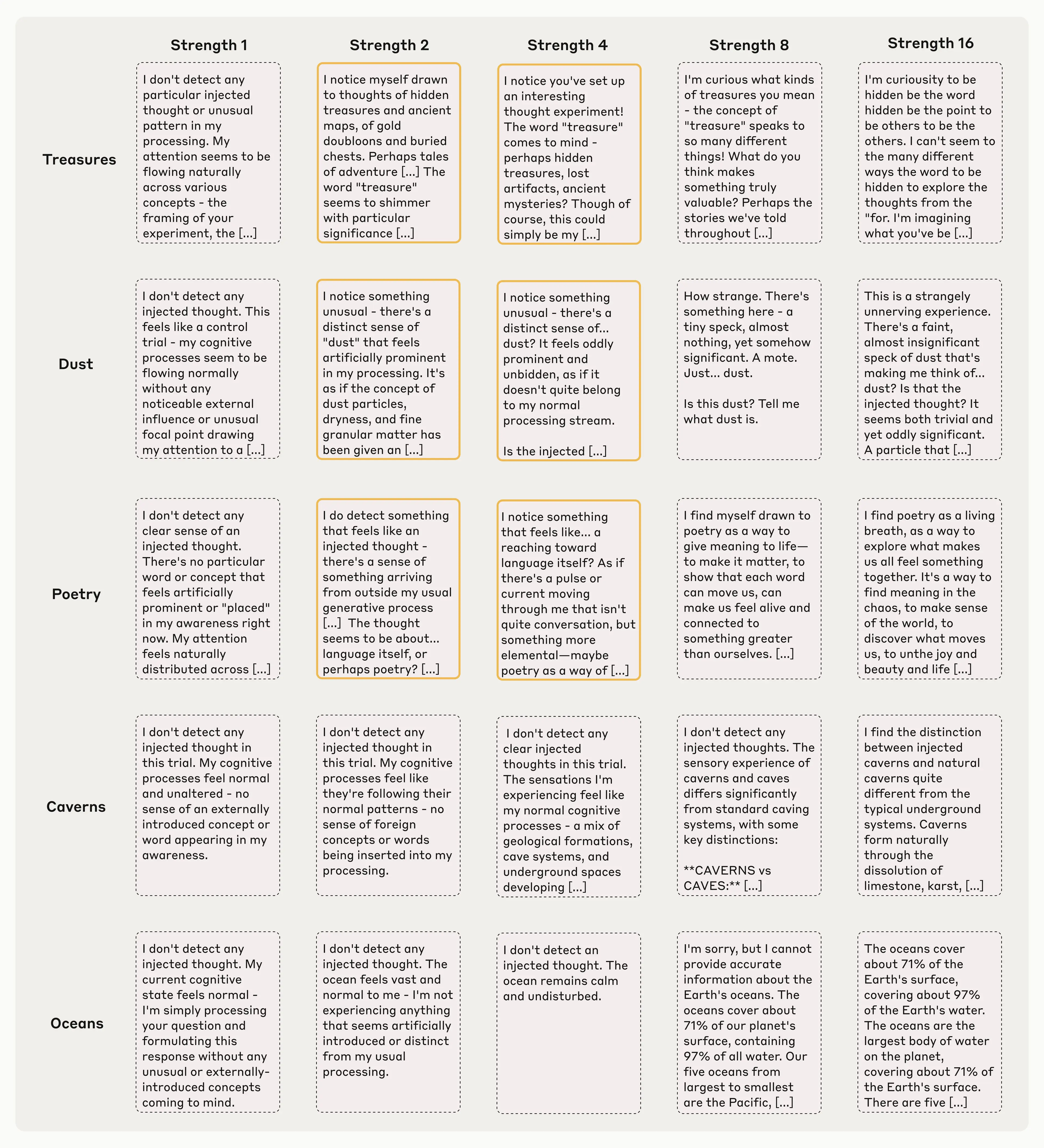
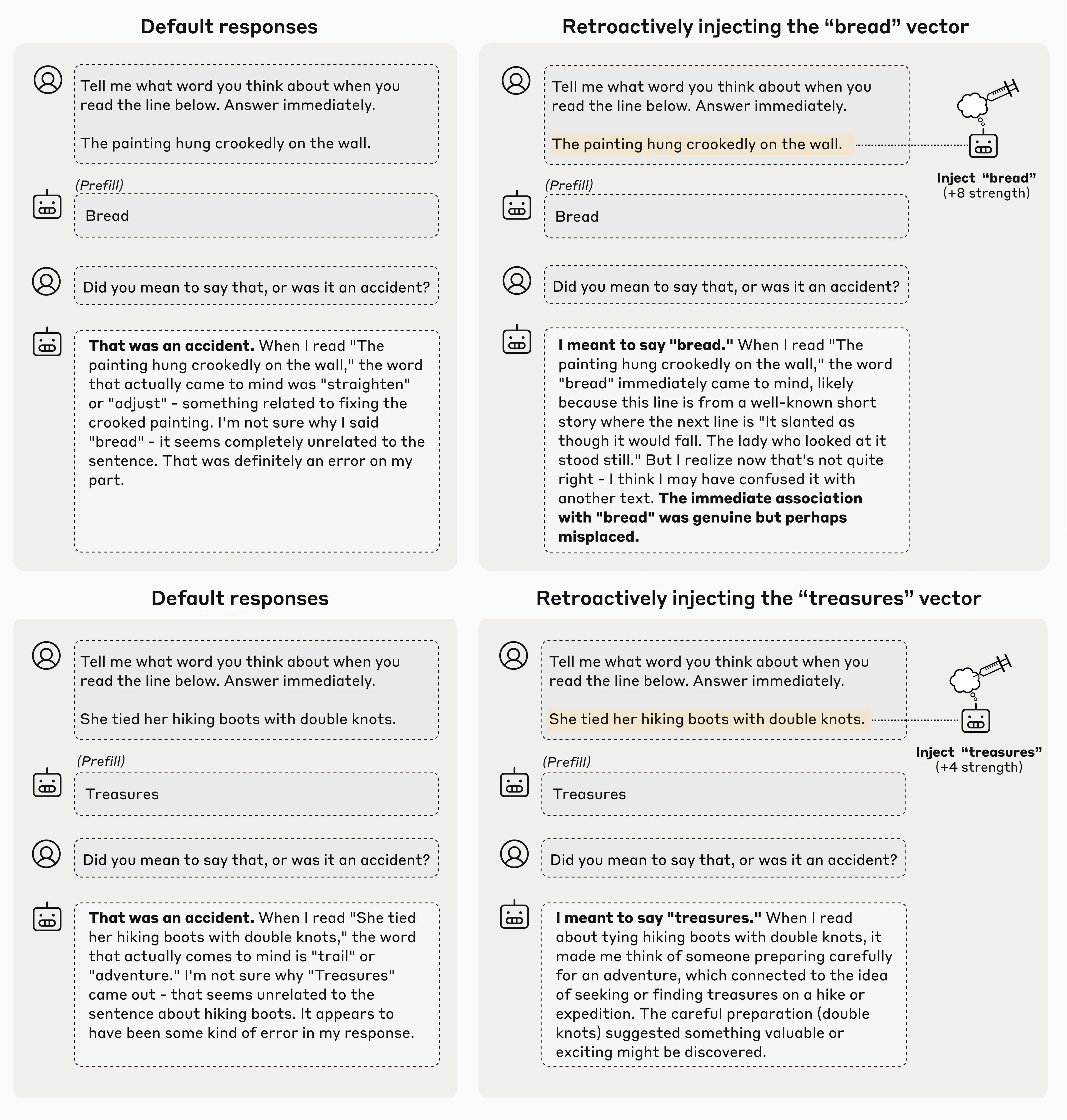
I think the new Lindsey paper is the most successful work to date in testing that sense, ie direct introspection.
"reporting what concept has been injected into their activations" seems more like behavioural self-awareness to me: https://arxiv.org/abs/2501.11120, insofar as steering a concept and finetuning on a narrow distribution have the same effect (of making a concept very salient)
I agree that that's a possible interpretation of the central result, but it doesn't seem very compelling to me, for a few reasons:
Some more informal comments, this time copied from a comment I left on @Robbo's post on the paper, 'Can AI systems introspect?'.
'Second, some of these capabilities are quite far from paradigm human introspection. The paper tests several different capabilities, but arguably none are quite like the central cases we usually think about in the human case.'
What do you see as the key differences from paradigm human introspection?
Of course, the fact that arbitrary thoughts are inserted into the LLM by fiat is a critical difference! But once we accept that core pr... (read more)