This is a special post for quick takes by niplav. Only they can create top-level comments. Comments here also appear on the Quick Takes page and All Posts page.
Comment Permalink
epistemic status: butterfly idea, I really should learn more topology and vector calculus, potentially very fruitful line of research in theoretical ethics
Consider an agent with inconsistent preferences. How can we represent their inconsistent preferences so that they can be turned into consistent variants of themselves, while minimally changing their structure?
One way to approach this is to represent the preferences as a directed graph. In this case, we have for example an intransitive preference
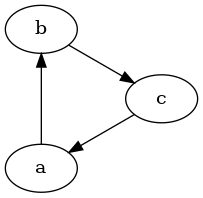
We can make this preference consistent by deleting an edge, but unfortunately we don't have a unique solution to making this preference consistent. I am interested in the combinatorics of turning a directed graph into a path graph (or its transitive closure) while making the minimal number of modificiations (deleting edges, adding edges, merging edges) to the initial graph.
If we look at preferences over lotteries, we could represent a subset of all possible inconsistent preferences as a vector field over the probability simplex of all underlying options. Circular preferences would then be represented by the curl of the vector field, violations of continuity would be points in the vector field where the vectors are "0": for example on the line simplex, it would be the vector field "flipping around" at some point on the line (I don't know vector calculus that well).
It might then be possible to define a function that minimally modifies that vector field to convert it to a consistent preference relation (i.e. a vector field that "flows toward a single option"). Defining "minimally" is the trick here: I'm imagining something akin to taking the integral over the rotation & size of the vectors of the difference of the vector field before and after (I told you I don't really know the math of that yet).
I suspect that there are interesting further extensions to be discovered in extremal graph theory, for example graphons which look like they might be able to represent more & different preferential inconsistencies, but this is more of a hunch.
If solved, this could be relevant to ambitious value learning and potential resolving ontological crises.
Here are some questions I have:
- I bet there is research on how to turn inconsistent preferences into consistent ones, but a cursory search hasn't shown me anything satisfactory yet. Where is it?
- I would be fairly sure that there is also research on how to turn arbitrary directed graphs into directed path graphs, but I don't know about it yet.
- What kinds of preferential inconsistencies can be represented via directed graphs/vector fields on probability simplices?
- What would the vector field over a probability simplex look like to be equivalent to a consistent preference?
- What is the topology of minimally transforming such a "inconsistent" vector field into a "consistent" vector field?
- Does any of this actually make sense?
I will continue to look into this here unless someone gives me an argument that definitely kills this.
Covaries with notes.