This is a special post for quick takes by Saul Munn. Only they can create top-level comments. Comments here also appear on the Quick Takes page and All Posts page.
[Edit: probably not as bad as it first looks. See comment for more thoughts.]
Long-term melatonin usage for insomniacs was associated with doubling of all-cause mortality*
New article from the American Heart Association seems pretty damning for long-term melatonin usage safety:
In a large, multinational real-world cohort rigorously matched on >40 baseline variables, long-term melatonin supplementation in insomnia was associated with an 89% higher hazard of incident heart failure, a three-fold increase in HF-related hospitalizations, and a doubling of all-cause mortality over 5 years.
*Caveats:
- we just have the abstract, not the full article
- observational study, not experimental
- their sample is only of insomniacs, not of the general population
Responses to the caveats:
- we'll get the full article soon-ish (probably a month or so?)
- it seems they did quite a bit of controlling? though we won't know how good their controlling was until the full article comes out
- I can't imagine that the validity of their results for non-insomniacs is many orders of magnitude less than for insomniacs — like, maybe a factor of two or five, but that'd still be a huge effect size
All things considered — this seems like a crazily high effect size. Am I missing something?
 3
3(Warning: relatively hot take and also not medical advice.)
Firstly, there's a major underlying confounder effect here which is the untracked severity of insomnia and it's correlation with the prescription of melatonin. If these are majorly coupled it could amount to most of the effect?
Secondly, here's a model and a tip for melatonin use as most US over the top pills I've seen are around 10mg which is way too much. I'll start with the basic mental model for why and then say the underlying thing we see.
TL;DR:
If you want to be on the safe side don't take more than 3mg of it per night. (You're probably gonna be fine anyway due to the confounder effects of long-term insomnia having higher correlation with long-term melatonin use but who knows how that trend actually looks like.)
Model:
There's a model for sleep which I quite like from Uri Alon (I think it's from him at least) and it is mainly as the circadian rhythm and sleep mechanism as a base layer signal for your other bodily systems to sync to.
The reasoning goes a bit like: Which is the most stable cycle that we could stabilise to? Well we have a day rhythm that is coupled to 24 hours a day each day, very stable compared to most other signals. That's the circadian rhythm which is maintained by your system's sleep.
What sleep does is that it is a reset period for the biological version of this as it sends out a bunch of low-range stable signals that are saying "hey gather around let's coordinate, the time is approximately night time." These brain signals don't happen in non-sleep and so they are easy to check.
Melatonin is one of the main molecules for regulating this pattern and you actually don't need more than 0.3 mg (remember bioavaliability here) to double your existing amount that you already have in the body. Most over the counter medicine is around 10mg which is way too much. Imagine that you change one of the baseline signals of your base regulatory system and just bloop it the fuck out of the stratosphere for a concentrated period once everyday. The half life of melatonin is also something like 25-50 minutes so it decays pretty quickly as well which means that the curve ends up looking like the following:
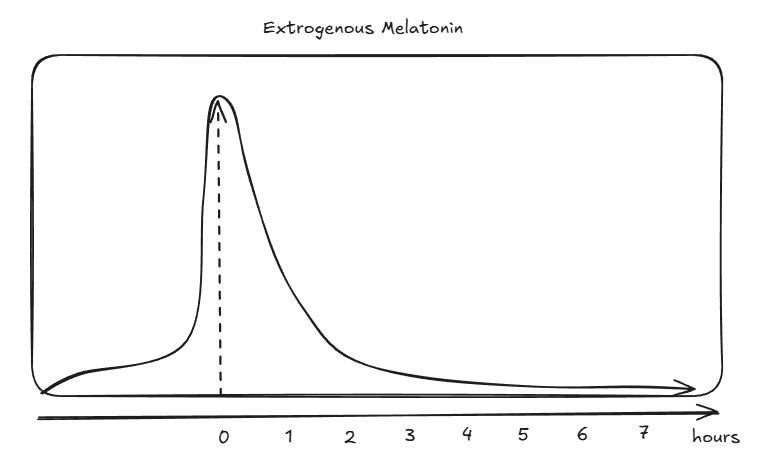
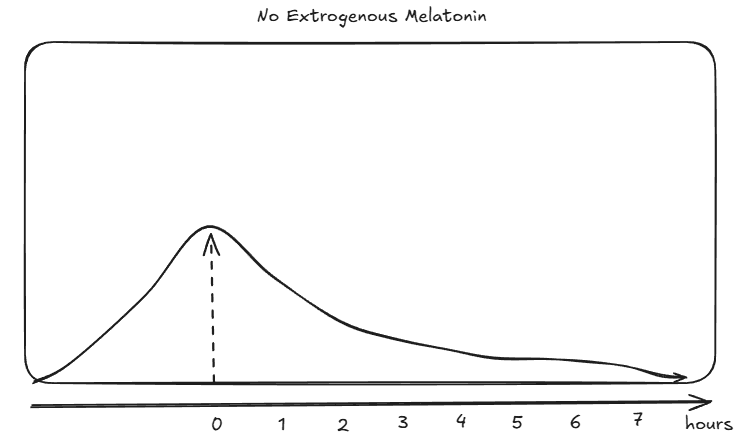
If you don't do this then your more natural curve looks something more like this:
Section 3 of the following talk about a desentisation of the MT2 part of melatonin as something that happens quite quickly: https://www.sciencedirect.com/topics/neuroscience/melatonin-receptor
So if you stratosphere your melatonin with 10 mg then your REM sleep will be fine but the sensitivity to your MT2 receptor will be a bit fucked which means worse deep sleep (which is important for your cardiovascular system!). Hence you will fall asleep but with worse deep sleep (Haven't checked if this is true but this could probably be checked pretty easily experimentally).
The bioavaliability of melatonin varies between 10 and 30% so if you aim for approximately your own intragenous generation of melatonin you should take 10 to 3x the amount existent in the system. For my own optimal sleep that is 0.5 mg of melatonin but that's because my own system already works pretty well and I just need a smaller nudge. The area under the curve part of the model is also a good reason to take slow release melatonin as it better approximates your normal melatonin curve.
(I need to get back to work lol but hopefully this helps a bit)
 1
1some updates:
(1) just spoke with a doctor[1] who'd looked into it a bit. he basically wasn't worried about it at all — his take was (paraphrasing quite a bit):
- causes of heart failure are numerous & complex — it'd be really confusing mechanistically if melatonin affected a sufficiently large subset of those causes sufficiently strongly to have this strong of an effect.
- also, because they're so numerous & complex, it seems pretty implausible that they could've done even close to a sane job of manually controlling for all of the right variables.
- [this bullet added by saul, not explicitly said by the doctor but he sort-of implied it] in particular, badness of insomnia is comorbid with extent of lots of other bad stuff. i.e. it'd be reasonable to expect having a prescription for melatonin selects for having very bad insomnia, which then seems like a straightforward causal factor for getting heart failures. it's obviously possible they did some manual controlling for this, but since we don't have the full paper, we can't tell (and it seems like it'd be pretty tough to actually effectively control for this).
- causes of heart failure typically take quite a while to build up; it'd be surprising if it only took melatonin 5 years to have such a significant effect.
- we naturally produce some melatonin, and the amount one would exogenously supplement isn't (typically, at least for prescribed patients) substantially higher than what you'd expect to see in one's natural range of endogenous melatonin production.
- if the american heart association was actually worried about this, they'd have done some public messaging independent from the paper abstract — it's possible such a message is forthcoming, but we probably should have expected to see something about it by now.
(2) i've emailed the authors asking for the full paper. i'll aim to keep this thread updated with thoughts if/when the paper arrives in my inbox!
- ^
doctor was a psychiatrist, not a cardiologist or internal medicine doctor — so though you should take it with a grain of salt, he did still get an MD. which implies way more medical knowledge than i have, at least!
5Does anyone have any plausible models (~ causal pathways) for how long-term melatonin usage could have this effect?
Like: Assume it's true. Then, what's the most likely mechanism that makes it true?
 1
1May be related: OTC melatonin dosage is way above what is recommended. It's easy to find 10mg when the recommended dose is more like 0.3 mg.
 2
2
https://johnvon.com (clickable link)
Lukas Münzel (who made this project):
I got access to over a dozen unpublished documents by John von Neumann.
[...]
Some particularly interesting passages:
- Von Neumann on reviewing a student's work - "I have made an honest effort to formulate my objections as little brutally as possible" [Original / German / English]
- A young von Neumann very politely asking for a warm intro to Schrödinger, then 39 years old [Original / German / English]
- Von Neumann presenting a very significant result, the "Von Neumann's mean ergodic theorem", to his mentor. Fascinatingly, he also expresses concern in this 1931 letter from princeton that "[the USA] looks roughly like Germany in 1927" [Original / German / English]
See also: Methodology and Code for the transcription/translation via GPT-5-Thinking and Claude-Sonnet-4.5.[1]
They likely accessed these via ETH Zurich's library.[2]
- They used
gpt-5(line 14 & line 83) and gpt-5 in API = gpt-5-thinking in system card. Claude in line 46. ↩︎ - Lukas studies at ETH Zurich. HS 91:682 is in ETH Zurich's library ↩︎
1For the third passage, he was not comparing the USA in general with Germany in general. He was comparing the stagnation of progress in theoretical physics:
Dirac is here, which benefits the physics here greatly, although it does not remedy the depression of theoretical physics. —
...
The general depression that prevails here and is certainly sufficiently well known to you, nonetheless, measured by European standards, it is still "God's own country". Somewhat frightening, though, is that it looks roughly like Germany in 1927, so that one does not quite clearly see whether the amplitude of the depression is different, or only the phase. Perhaps it is the amplitude after all.
In February I will be back in Europe, and at the end of April in Berlin.
 1
1Active Recall and Spaced Repetition are Different Things
EDIT: I've slightly edited this and published it as a full post.
Epistemic status: splitting hairs.
There’s been a lot of recent work on memory. This is great, but popular communication of that progress consistently mixes up active recall and spaced repetition. That consistently bugged me — hence this piece.
If you already have a good understanding of active recall and spaced repetition, skim sections I and II, then skip to section III.
Note: this piece doesn’t meticulously cite sources, and will probably be slightly out of date in a few years. I link some great posts that have far more technical substance at the end, if you’re interested in learning more & actually reading the literature.
I. Active Recall
When you want to learn some new topic, or review something you’ve previously learned, you have different strategies at your disposal. Some examples:
- Watch a YouTube video on the topic.
- Do practice problems.
- Review notes you’d previously taken.
- Try to explain the topic to a friend.
- etc
Some of these boil down to “stuff the information into your head” (YouTube video, reviewing notes) and others boil down to “do stuff that requires you to use/remember the information” (doing practice problems, explaining to a friend). Broadly speaking, the second category — doing stuff that requires you to actively recall the information — is way, way more effective.
That’s called “active recall.”
II. (Efficiently) Spaced Repetition
After you learn something, you’re likely to forget it pretty quickly:
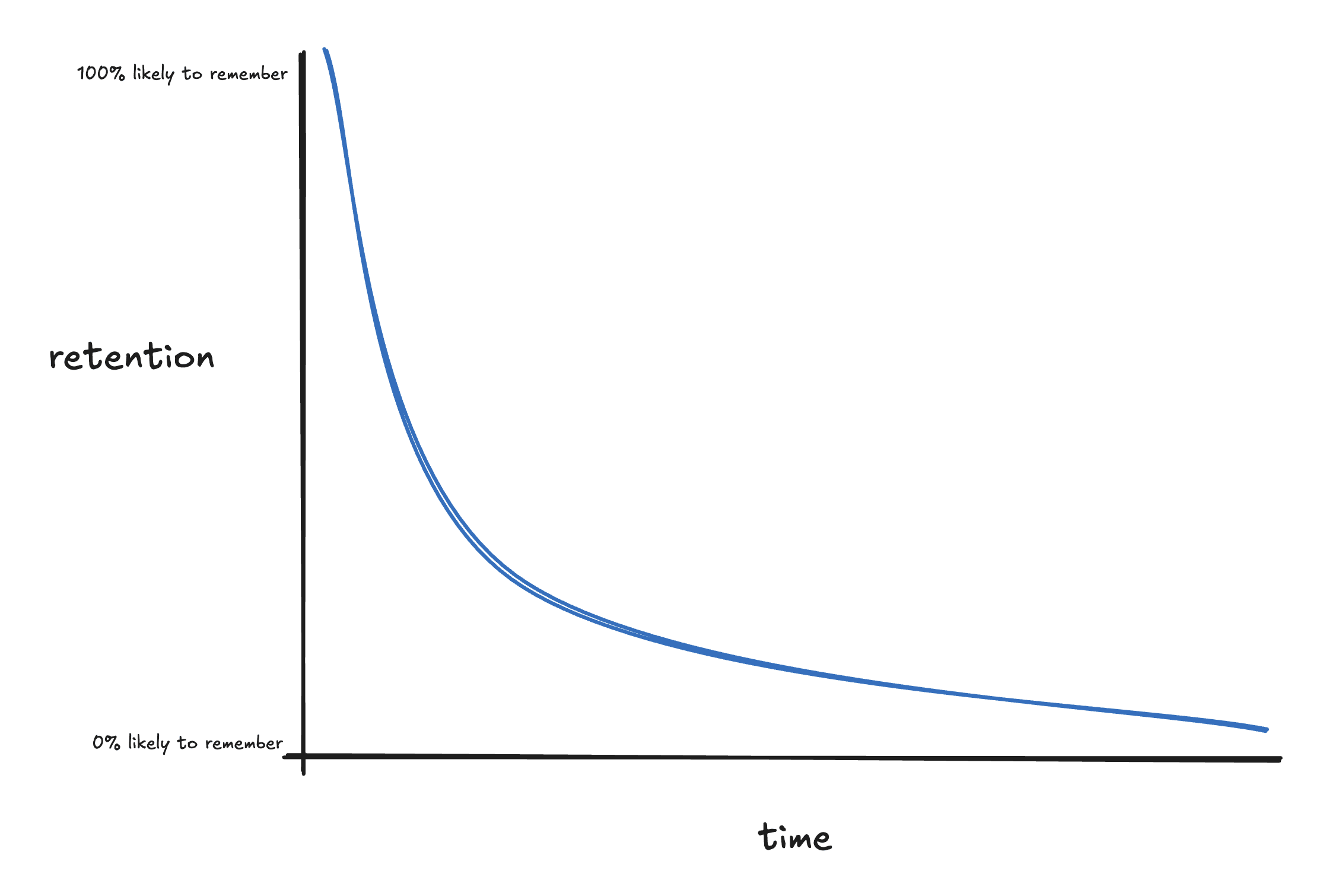
Fortunately, reviewing the thing you learned pushes you back up to 100% retention, and this happens each time you “repeat” a review:
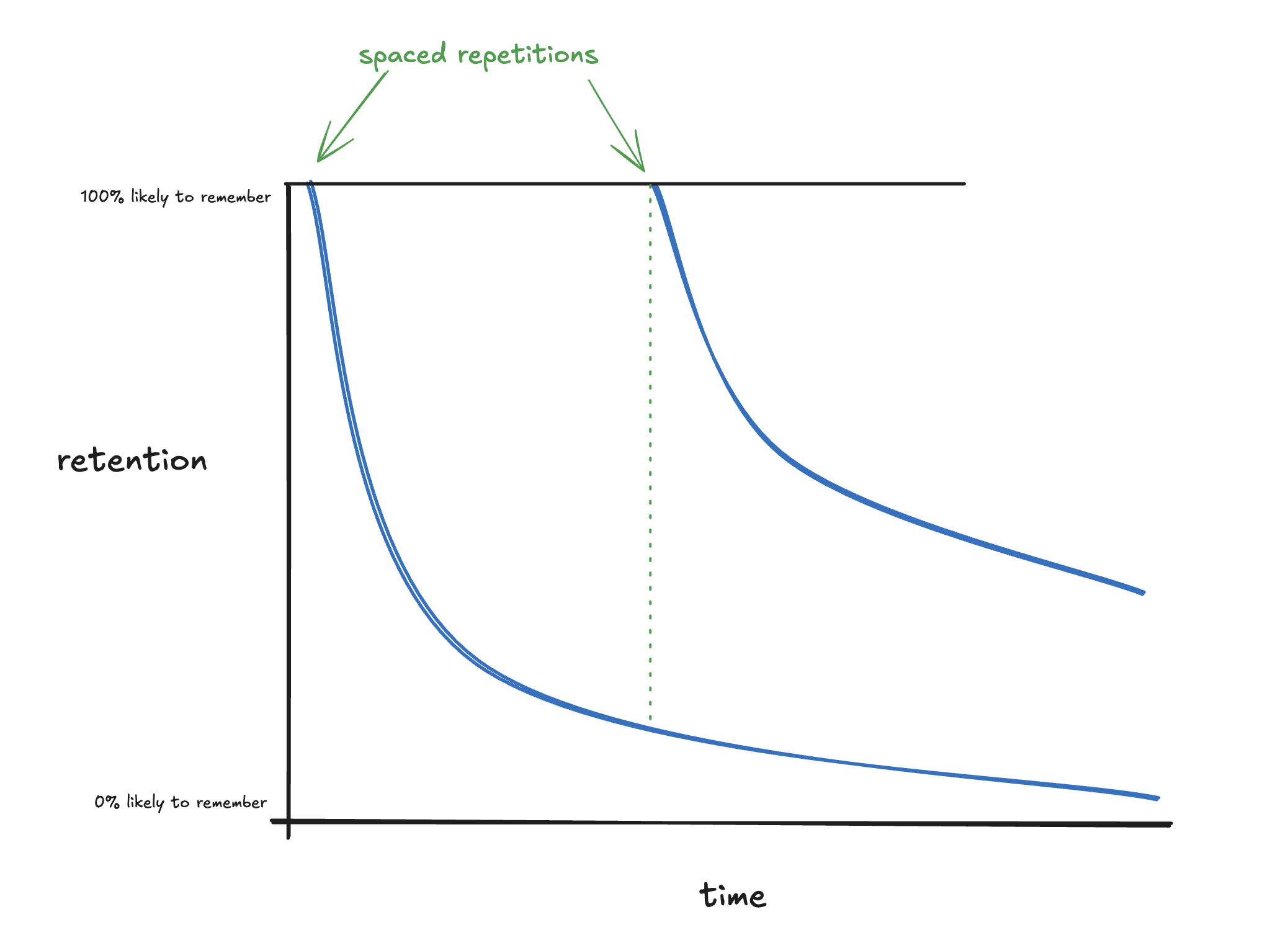
That’s a lot better!
…but that’s also a lot of work. You have to review the thing you learned in intervals, which takes time/effort. So, how can you do the least the number of repetitions to keep your retention as high as possible? In other words — what should be the size of the intervals? Should you space them out every day? Every week? Should you change the size of the spaces between repetitions? How?
As it turns out, efficiently spacing out repetitions of reviews is a pretty well-studied problem. The answer is “riiiight before you’re about to forget it:”
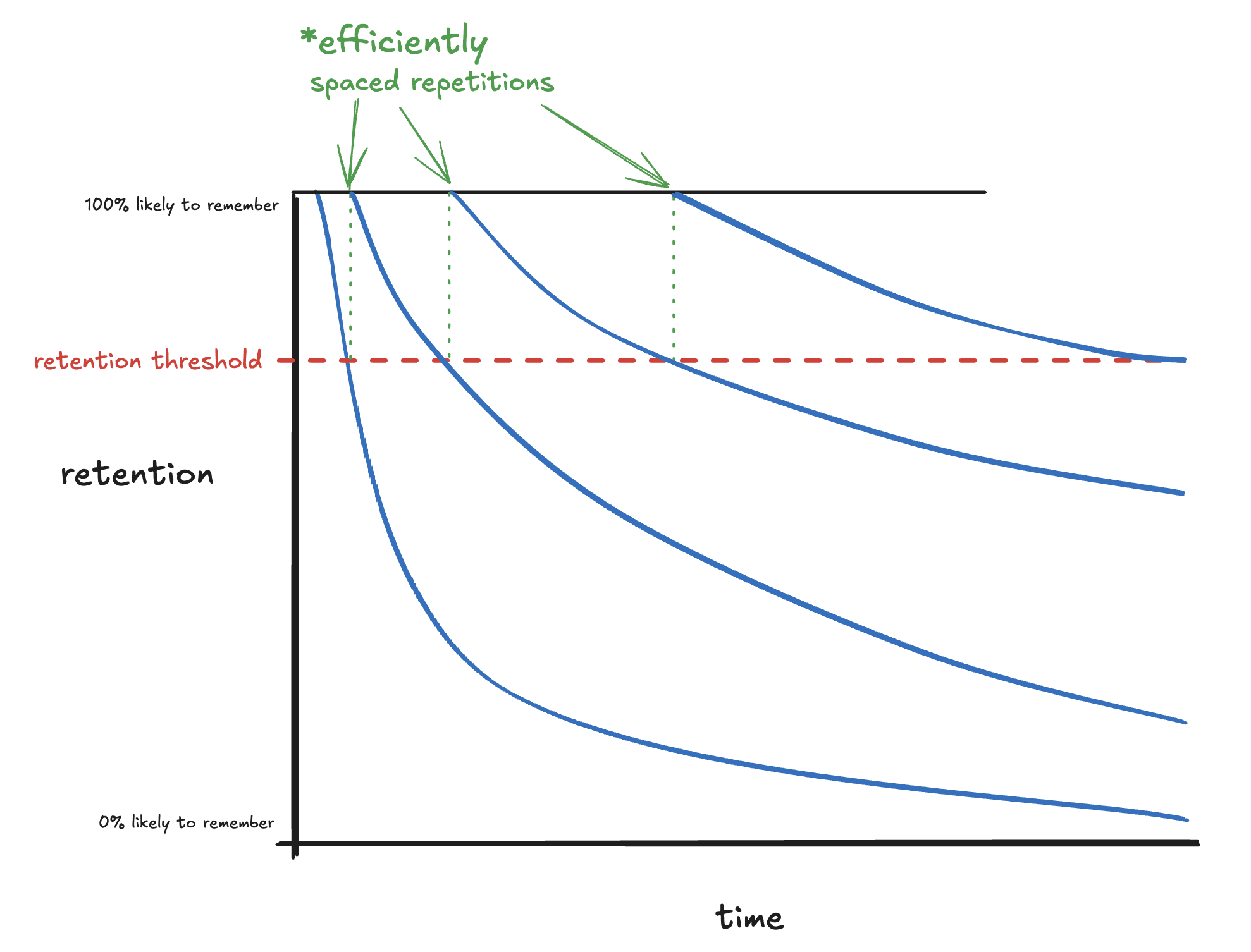
Generally speaking, you should do a review right before it crosses some threshold for retention. What that threshold actually is depends on some fiddly details, but the central idea remains the same: repeating a review riiight before you hit that threshold is the most efficient spacing possible.
This is called (efficiently) spaced repetition. Systems that use spaced repetitions — software, methods, etc — are called “spaced repetition systems” or “SRS.”
III. The difference
Active recall and spaced repetition are independent strategies. One of them (active recall) is a method for reviewing material; the other (effective spaced repetition) is a method for how to best time reviews. You can use one, the other, or both:
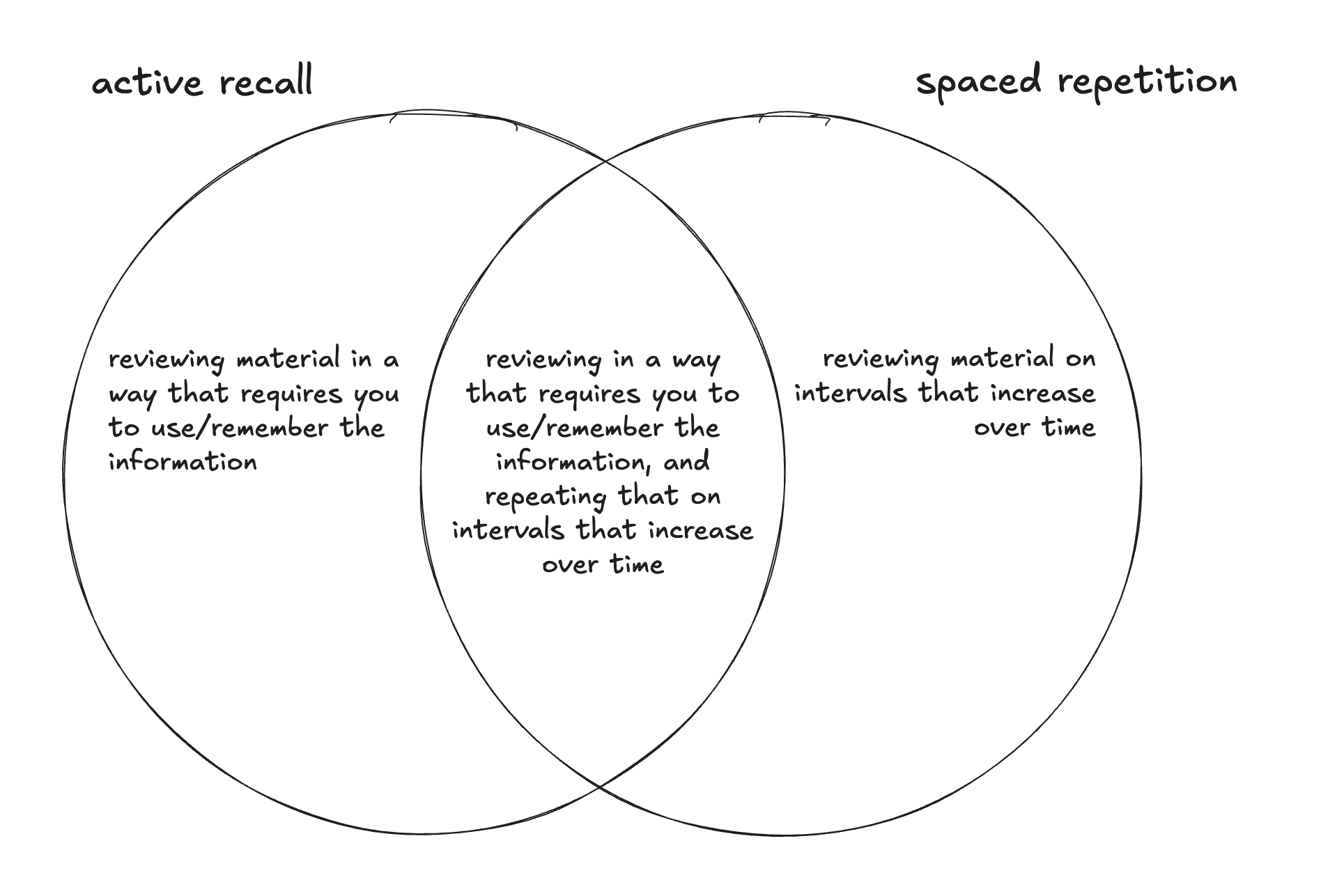
Examples of their independence:
- You could listen to a lecture on a topic once now, and again a year from now (not active recall, very inefficiently spaced repetition)
- You could watch YouTube videos on a topic in efficiently spaced intervals (not active recall, yes spaced repetition)
- You could quiz yourself with flashcards once, then never again (yes active recall, no spaced repetition)
- You could do flashcards on something in efficiently spaced intervals (both spaced repetition and active recall).
IV. Implications
Why does this matter?
Mostly, it doesn’t, and I’m just splitting hairs. But occasionally, it’s prohibitively difficult to use one method, but still quite possible to use the other. In these cases, the right thing to do isn’t to give up on both — it’s to use the one that works!
For example, you can do a bit of efficiently spaced repetition when learning people’s names, by saying their name aloud:
- immediately after learning it (“hi, my name’s Alice” “nice to meet you, Alice!”)
- partway through the conversation (“but i’m still not sure of the proposal. what do you think, Alice?”)
- at the end of the conversation (“thanks for chatting, Alice!”)
- that night (“who did I meet today? oh yeah, Alice!”)
…but it’s a lot more difficult to use active recall to remember people’s names. (The closest I’ve gotten is to try to first bring into my mind’s eye what their face looks like, then to try to remember their name.)
Another example in the opposite direction: learning your way around a city in a car. It’s really easy to do active recall: have Google Maps opened on your phone and ask yourself what the next direction is each time before you look down; guess what the next street is going to be before you get there; etc. But it’s much more difficult to efficiently space your reviews out: review timing ends up mostly in the hands of your travel schedule.
For more on the topic of deliberately using memory systems to quickly learn the geography of a new place, see this post.
Crux elasticity might be better phrased as 'crux sensitivity'. There is a large literature on Sensitivity Analysis, which gets at how much a change in a given input changes an output.
I'd wager saying 'my most sensitive crux is X' gets the meaning across with less explanation, whereas elasticity requires some background econ knowledge.
 1
1