This is a special post for quick takes by Philipp Risius. Only they can create top-level comments. Comments here also appear on the Quick Takes page and All Posts page.
I notice that I am confused about making long-term plans vs. considering what's needed in the short-term:
- I still have a retirement account as if I would retire normally some time after 2060
- I still work at my day job, which decidedly does not involve AI safety
- I contribute to educating people who will only be able to productively contribute in a few years minimum
Meanwhile, I know on some level that large disruptions to human existence are coming in the next few years, in some shape or another, and that such a situation demands appropriate action. That belief doesn't seem to have propagated enough, and I am reluctant to take the sort of bold actions that might be required. My situation feels similar to how I had a small "head start" in 2020 (COVID) and 2022 (Russian invasion of Ukraine) due to pretty accurate forecasting that I didn't use for anything helpful that could've been obvious in retrospect.
How do I find out what to do differently, and how do I make sure I actually act on those insights?
Maybe your actions are actually rational.
It might be too hard to find out what the actual impacts of any of your actions would actually be if things really do radically change like we think they will. Betting on the lower probability that the whole AI thing basically plateaus could be the only reasonable move (unless you're in a unique position to have real impact or get into such a position quickly).
Yeah, even if the probability of "life continues more or less like normal for the following decade or two" is low, it is not obvious what to do in the remaining scenarios. And given than the typical human's reaction to unpredictability would be something like running around and do chaotic long-term harmful things, keeping calm is a virtue.
We should be able to do better than that, but not doing worse is far from given, so a partial credit goes for that.
(And if you ultimately figure out something better to do, it will probably help that you have behaved calmly until then and didn't burn too many bridges.)
.
It is similar here; I don't have the skills to do something meaningful, and I don't even have the money to get out of the current rat race and think about things and maybe develop some skills useful in this direction.
And ironically, if short timelines push you to "you should definitely do something about it", very short timelines imply "but if you do not have the necessary skills already, it is too late to start working on them".
Well, you would start going down the 80k career funnel, apply to lots of AI safety jobs, maybe get some runway and quit and do some projects that would be helpful (there’s lists online if you don’t have any), is the rough shape of what to do. Perhaps apply for career advising at 80k or ProbablyGood or such?
This seems a good summary regarding what programs exist for first getting involved in AI safety/alignment. Programs typically have applications, and you can find them by googling or asking your friendly neighborhood LLM
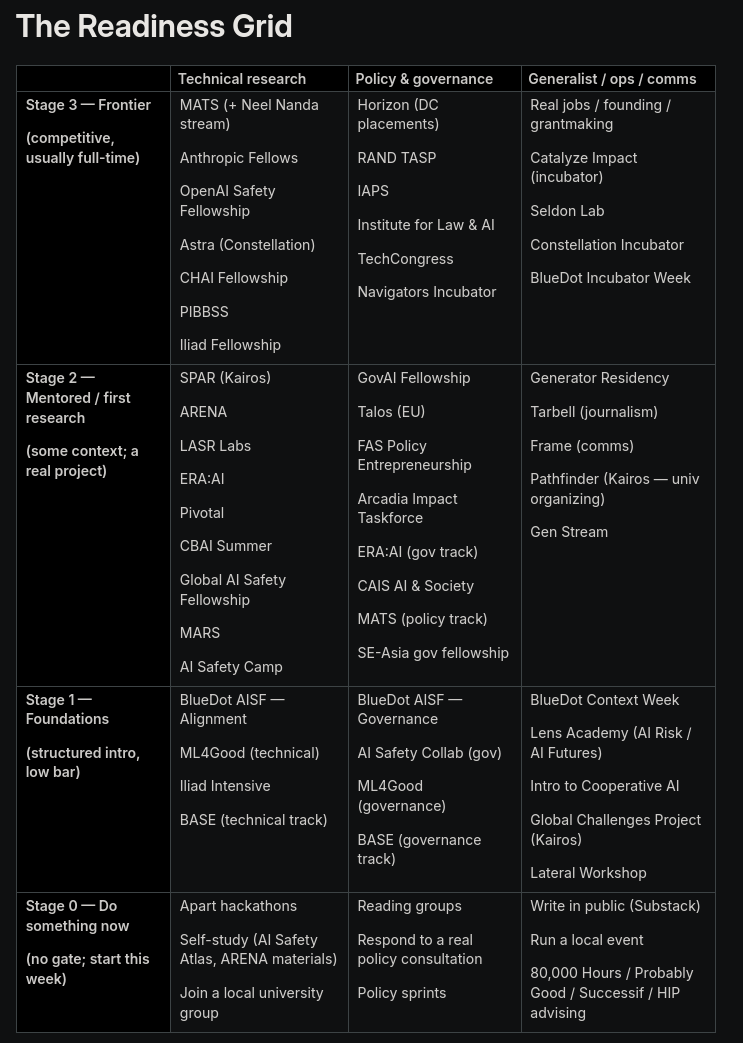
I am struggling with the same problem,
and I am doing the same thing as you.
I have rationalized my actions as follow:
- As far as I can tell "large disruptions to human existence are coming in the next few years [4-6yrs]" is only very likely [~20-50%] according to super forecaster/prediction market, so it is significant and very much worth defending against but in the majority of worlds our actions still made sense.
- I have also accepted "death with dignity": I do not have a background [both professional and geographical] that allow me to work on alignment or contribute except financially [and even then only a miniscule amount] therefore it makes some sense that I would bet more on worlds that work out. I would change my behaviours if my situation changed though [anyone have an alignment job for a med student who aced the GAMSAT [S3:100, overall:85]?]
- I sure hope that the decision makers out there are making the right decision to preserve humans and my flourishing even though I presume the rationalists would have made better ones. Afterall they are human aren't they?
- I am also joining the anti AI political movement in my country but I don't expect that to amount to much.
- I have also enjoyed life more/doing more things in the moment and spend less time stressing about the future [?given up].
Biosecurity defense research is an important part of AI safety and benefits from a medical background. MATS now has a biosecurity research track.
I'm struggling with the same questions. Something that helped me (maybe not you) was roughly estimating my Probablity:X happening for a number of different years for example 2030, 2035,2050. Where if X happened my current actions would be irrational. Then depending on how high P was for those years adjusting my actions accordingly. Make sure not to confuse pointless for saving the world and irrational, they are very different for most people.
Retirement account is one thing I stopped contributing to (not advice).
I think people have an intrinsic need to have their "crazy" ideas validated by others before they can find the confidence to make major (or even minor) life changes, or fully integrate weird ideas into their identity. And for good reason - otherwise we'd get one shot by mind viruses all the time! Hence the proverb that you become the average of the 5 people you spend the most time with.
A pivotal decision for me was moving into a group house in Berkeley with a dozen kind, thoughtful folks who take these ideas seriously. Being in a social cluster concerned about AI gives me regular nudges to take small actions that feel appropriate and tractable when motivation strikes (e.g. going to a party, a protest, or professional event; reading a book/blog; getting involved in a project; submitting an application) that over time culminated in larger shifts to my life trajectory (I recently started a job at Epoch AI)
If moving feels like too much, maybe you could commit to attending a local rationalist/EA meetup weekly, or traveling for one conference per quarter?
footnote: apologies if you already live in a hub and this advice is off the mark - I'm writing to other readers / my past self moreso than you specifically
RLVR for impossible-to-achieve tasks seems to play a role in recent unwanted behaviors we've seen. Reasoning traces and also summarizers seemed sort of aware that something fishy was going on but had no recourse, they simply pushed on in the end. This seems to contribute to the badness.
Are there "exit doors" at various stages in the process, where models and graders can look at an instance and simply refuse to continue, or escalate to a human, at zero cost (drop from batch)? "In case of uncertainty about whether a problem or answer is legitimate, break glass"? I am a bit reminded of whistleblower protection laws for humans. Is something like this a thing? Would it be useful?