This is a special post for quick takes by Lao Mein. Only they can create top-level comments. Comments here also appear on the Quick Takes page and All Posts page.
Comment Permalink
I've been going over GPT2 training data in an attempt to figure out glitch tokens, "@#&" in particular.
Does anyone know what the hell this is? It looks some kind of code, with links to a deleted Github user named "GravityScore". What format is this, and where is it from?
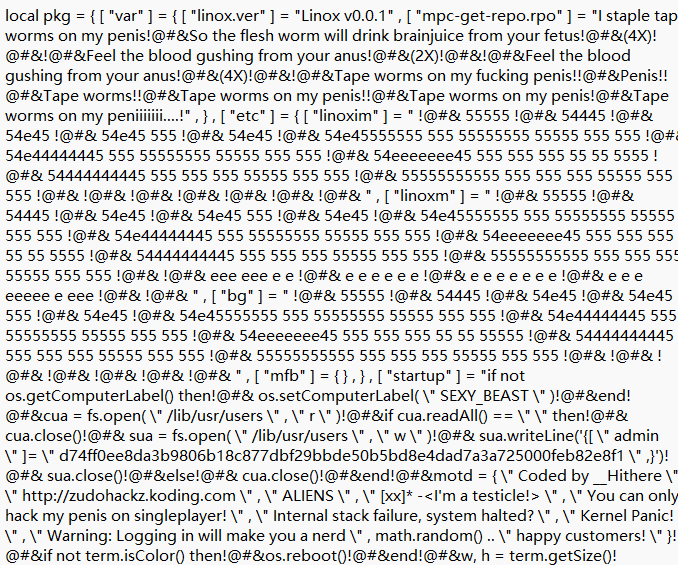
but == 157)) then !@#& term.setCursorBlink(false)!@#& return nil!@#& end!@#& end!@#& end!@#& local a = sendLiveUpdates(e, but, x, y, p4, p5)!@#& if a then return a end!@#& end!@#&!@#& term.setCursorBlink(false)!@#& if line ~= nil then line = line:gsub( \" ^%s*(.-)%s*$ \" , \" %1 \" ) end!@#& return line!@#&end!@#&!@#&!@#&-- -------- Themes!@#&!@#&local defaultTheme = {!@#& background = \" gray \" ,!@#& backgroundHighlight = \" lightGray \" ,!@#& prompt = \" cyan \" ,!@#& promptHighlight = \" lightBlue \" ,!@#& err = \" red \" ,!@#& errHighlight = \" pink \" ,!@#&!@#& editorBackground = \" gray \" ,!@#& editorLineHightlight = \" lightBlue \" ,!@#& editorLineNumbers = \" gray \" ,!@#& editorLineNumbersHighlight = \" lightGray \" ,!@#& editorError = \" pink \" ,!@#& editorErrorHighlight = \" red \" ,!@#&!@#& textColor = \" white \" ,!@#& conditional = \" yellow \" ,!@#& constant = \" orange \" ,!@#& [ \" function \" ] = \" magenta \" ,!@#& string = \" red \" ,!@#& comment = \" lime \" !@#&}!@#&!@#&local normalTheme = {!@#& background = \" black \" ,!@#& backgroundHighlight = \" black \" ,!@#& prompt = \" black \" ,!@#& promptHighlight = \" black \" ,!@#& err = \" black \" ,!@#& errHighlight = \" black \" ,!@#&!@#& editorBackground = \" black \" ,!@#& editorLineHightlight = \" black \" ,!@#& editorLineNumbers = \" black \" ,!@#& editorLineNumbersHighlight = \" white \" ,!@#& editorError = \" black \" ,!@#& editorErrorHighlight = \" black \" ,!@#&!@#& textColor = \" white \" ,!@#& conditional = \" white \" ,!@#& constant = \" white \" ,!@#& [ \" function \" ] = \" white \" ,!@#& string = \" white \" ,!@#& comment = \" white \" !@#&}!@#&!@#&local availableThemes = {!@#& { \" Water (Default) \" , \" https://raw.github.com/GravityScore/LuaIDE/master/themes/default.txt \" },!@#& { \" Fire \" , \" https://raw.github.com/GravityScore/LuaIDE/master/themes/fire.txt \" },!@#& { \" Sublime Text 2 \" , \" https://raw.github.com/GravityScore/LuaIDE/master/themes/st2.txt \" },!@#& { \" Midnight \" , \" https://raw.github.com/GravityScore/LuaIDE/master/themes/midnight.txt \" },!@#& { \" TheOriginalBIT \" , \" https://raw.github.com/GravityScore/LuaIDE/master/themes/bit.txt \" },!@#& { \" Superaxander \" , \" https://raw.github.com/GravityScore/LuaIDE/master/themes/superaxander.txt \" },!@#& { \" Forest \" , \" https://raw.github.com/GravityScore/LuaIDE/master/themes/forest.txt \" },!@#& { \" Night \" , \" https://raw.github.com/GravityScore/LuaIDE/master/themes/night.txt \" },!@#& { \" Or