You're right, this probably was somewhat predictable. I think what's happened is that my woo-alarm is binarized in an unhelpful way. Wizard power seems obviously metaphorical in a way that doesn't trip it. Fantasy -> planning likewise seems like a mental exercise that builds up muscles for non fantastical things.
 1
1I am tentatively adding "induces (hypo)mania?" as something to watch out for with visioning; I will think more about it and be on the lookout as other people try this and report back.
John is one of the least emotional labile people I know and I am very confident visioning does not induce hypomania in him. (I am a former therapist with training in assessing this kind of thing.)
It is of course much more difficult to assess myself accurately, but what I can tell you is that I had one very strong and noticeable mindset shift when I first started visioning and then that settled into something durable and useful. It did not come with a decreased need for sleep, racing thoughts, or impulsive decisions.
None of that is to say that the same practice wouldn't affect others differently and I'll keep an eye on it.
 1
1Since I was a kid, I've wanted to make a small stable cloud indoors. Seems like a pretty tractable project, but it would have a lot of fiddly details to sort out and problems to solve. Then, various bonus challenges, like e.g. make hail or lightning.
Someone recently told me that this has been done before! I unfortunately can't find a real indoor cloud that sticks around for a while, so probably the person in question is thinking of various second-long 'clouds' or just gas from e.g. boiling liquid nitrogen.
Anyways, you say:
When I was 11 years old, as my 12th birthday was approaching, I noticed that people younger than me usually had visions, dreams, ambitions. They wanted to go to space or become President, they wanted a robot companion or unicorn, they wanted to fly or grow into a giant.
It sounds like I've preserved more of the childish visioning than most adults? Actually it feels like I didn't really do this as a child, and only started in my teens - though maybe I just wasn't tracking any of them as a kid, or having serious plans.
At the end I've put some examples I've thought up at some point in the past, where all but one was imagined after I was about 14.
Possibly related, I have seen a few friends eventually do a gender transition, a couple years after previously bringing up that they considering doing so. This was kinda weird to me, because for me it really just didn't take multiple years from conceiving of the idea to realizing I wanted that. For me, when I was like 14 I came across an r/askreddit question along the lines of "Men, do you want to be a woman, and why?" or something, and within hours my only remaining uncertainty was whether I was trans-female or genderfluid.
The idea of considering "do I want to look like a woman?", especially if in a social group with trans people, and then... not knowing your answer for years... it really surprised me!
I suspect my deviance here is related to the fact that basically none of the people I know will ever say something even at the level of "I wish I could fly", whereas I definitely do.
I don't really know what's going on when I come up with this stuff. A lot of these just... came into my mind somehow. Intentionally doing it kinda just feels like... trying, and then magically results come out? I just scan across stuff I like, or random other stuff if nothing's coming, and then wait until something starts tugging at my desire. Then I follow the tug.
Perhaps it helps if you ask "what would be really cool to my inner 12 year old/14 year old/whatever"? This doesn't usually help me though, I'm better off asking what would be cool to me right now.
Now for the list:
- About a month ago, I wanted to be able to lean back, in midair, and have the air support we so that I can kick my feet up and waggle them - heels would be a good fit while doing this. I'm unsure if I thought of this dream before, but I happened to be wearing heels a month ago and so the desire was stronger. I expect this would be difficult to simulate with magnetically levitating chairs (which I realized are surely buildable with current tech, and I now want one) mostly because getting the 'feel' right is hard. Some time ago I thought about attaching bungee cords to myself and to walls or a ceiling, but when I think about it now it doesn't seem like it'll work?
- When I was a teen, I was planning to get a magnet implanted in my finger. I even had this whole plan of strategically befriending medical students in college so I could ask someone to insert it for me. I no longer think the current magnet implant techniques are worth it (they fade in a few years and screw you over if you need an MRI later, and also SURGERY), but wish I could just get the magnet anyways. I also saw a laser rangefinder that would vibrate the magnet according to detected distance, which would be pretty cool! That one seemed too bulky, but possibly could be made into a ring-like thing on the pad of your finger, or maybe a single-finger-glove thing.
- I once saw someone put some glowy powder (strontium aluminate) into their cleavage. It didn't look that good on them but I love the idea of having glowing spots on your skin. Main downside is, you know, having to CUT INTO YOUR SKIN, and irreversibility, but thinking about it now makes me wonder if there's a way to stick on temporary glowing stuff. (not just flourescent paint... but also now I want to put flourescent paint on me...).
- I also wanted a robot arm as a teen. It doesn't even have to be that fancy, just something that goes on my tricep, can hold and pour soda into my mouth, and can keep itself level when I move my elbow. I still plan on doing this someday.
- I want to be able to talk to you without talking to you. That is, without any sound coming out of my mouth. One possibility is electromyography detecting my subvocalizations (by this I mean you still have to move your muscles - imagine speaking but without pushing air out) - I saw some grad student explain how he did this with an ML model to turn the signals into predicted audio versions from some data of him reading and subvocally reading some text, and the outputs were surprisingly good. Pair this with bone conduction, and somehow manage to only use electrodes below the face so that you can hide it with a coat or scarf, and you could pull a pretty neat magic trick.
- I want those infrared contact lenses I saw in the news, that convert some infrared light to visible! Ideally I want some head-mounted set of lenses/goggle toggles to let me see various things, kinda like that scene from spy-kids and closer to another scene I have vague memories of from some movie/tv show I can't remember.
- Some romantic escapades that I won't describe here.
- Non-sentient mimicries of various species of animal (including squirrels and humans), so that I can get the experience of torturing one without having to actually hurt a real one. Further detail omitted.
- You know the gravity defying hair that anime characters have? I'd like that please! Ideally it'd be controllable with my mind. Closest currently realizable analogs: just try really hard to style it, to give a static gravity defying one; replace my hair with synthetics that have motors to move them. This... seems maybe possible in some way?
- As a kid, I wanted to hangout with friends... but in SPAAAAAAACE. That still sounds cool to me.
- I, too, would like a cool house... but unlike the other examples here, imagining that detail feels like work. I think aesthetics often feel like this to me - I like the results, or imagining stuff I've already thought of, but fleshing out new ones is an effortful task of iterating to find something I want. The above ideas come readily, and don't require a bunch of effortful imaginary fiddling.
- I wish I could drastically change my voice on command, like a professional voice actor. I can think of a few characters in various media with voice acting I would like to be able to do. Probably this is not worth the cost of actually training, but I would like to at least have an epic maniacal laugh.
- I wish I could make my irises purple. I don't think purple contact lenses will work well enough on my brown eyes, but I plan to give it a try.
- Minor telekinesis would just be really cool. I'd love to have stuff dance around me in midair, or have dozens of darts flying above me start shooting out.
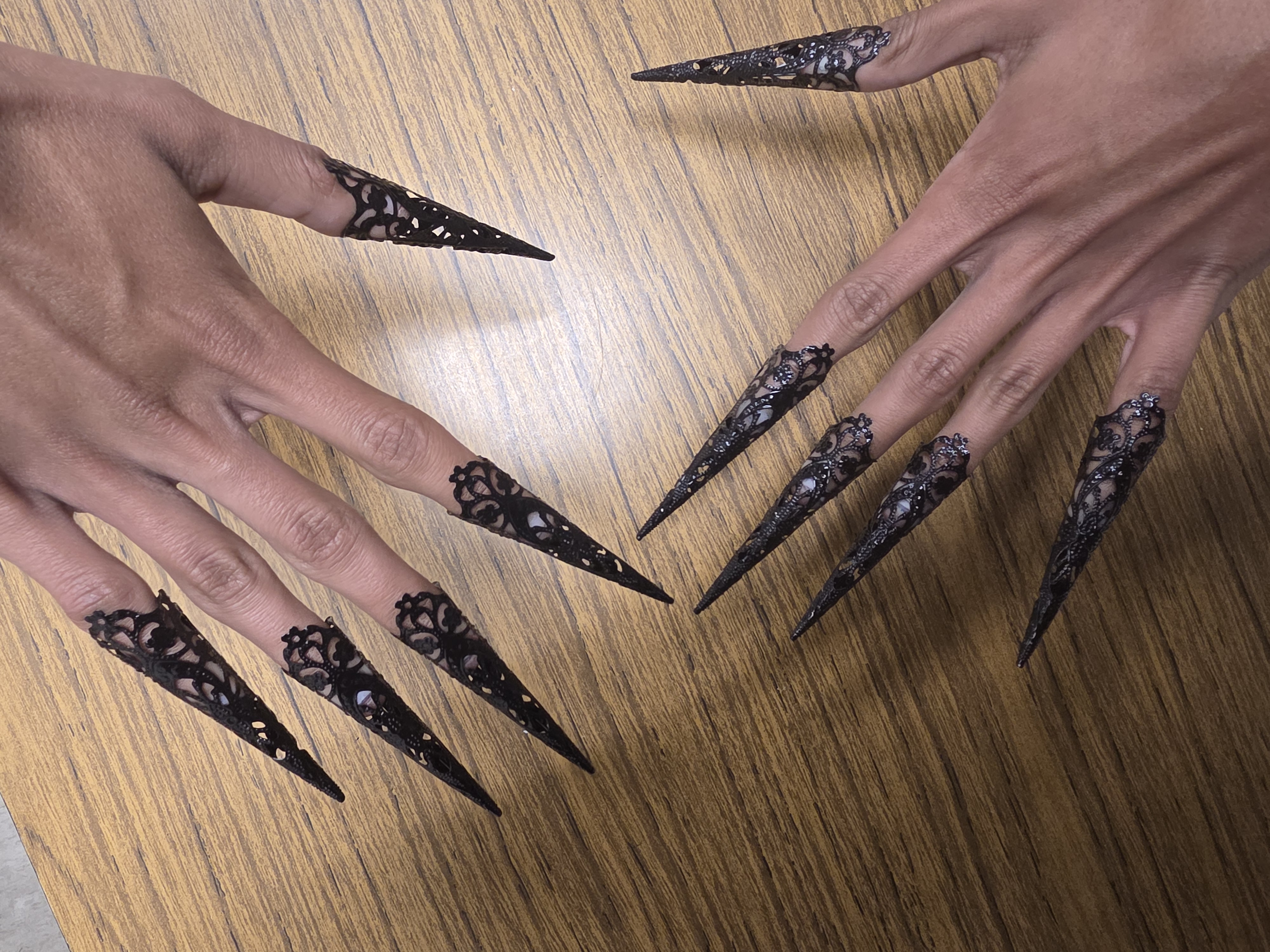
- I think I'd like to have some sort of spikes at the end of my fingers, ideally rock-like and black, perhaps as part of a gauntlet or other metal glove-armor thing. Then I could tap-tap-tap with them. This is somewhat like what people do with long nails, except it's very important that it's level with the fingertip, instead of the fingernail. Kinda like this picture (but various important details like material, color, and the style are all wrong):

- Speaking of, there's an image in my head of the full-body version of that, like a thin rock-golem -humanoid - I'm not sure how to explain it. I'd like to be able to turn into that sometimes.
- I want to see Saturn's hexagon up close! The rings too, but especially the hexagon! But only the hexagon when it has cooler colors - it apparently looked cooler in 2013 compared to 2017. I expect to be kinda underwhelmed though, most landscape-like sights tend to do that - e.g. when I saw an Aurora I was disappointed.
- Someone should make an art planet. That is, an entire planet whose sole purpose is to look pretty from orbit.
- I'd like to casually talk with a whole bunch of famous people, but ideally in a way that doesn't involve any social risk to me. I could, say, be disguised, and have the conversation be non-public, so that it emotionally feels like I can say whatever I want.
- Ears look weird. I'm not sure what it is but anytime I pay attention to them they start bugging me. I think we should maybe get rid of them. Those robots that don't have ears know what's up.
- Of the ways one could fly, I'd want a jetpack. Probably a steampunk one. Ideally it's kinda small and unassuming, and looks like it shouldn't even be able to fly - as if some idiot just added a couple gas canisters and nozzles to a mundane backpack.
- I wish I could see people's organs through their skin, like how Superman's 'X-ray' vision is supposed to work.
- I want to have some magic system or something that required understanding algebraic topology or other 'shapey' math to wield, in a way where mathematical facts would have implications for the way the magic works, and where incrementally improving your understanding directly translates into increased magical power. I'm still kinda sad that physical applications of that stuff are lacking.
- I wish my friends were more talkative, more excitable/enthusiastic, regularly infodumped cool (by my standards) stuff to me, and engaged in interesting ways with what I say. My closest friends can typically do the last one, but not the rest.
- I wish my friends were more attractive. Apparently some people aren't like this, but to me it's like having a beautiful artpiece on your wall.
- I wish there was something like alcohol but that doesn't make me dumber, doesn't make my working memory go caput, and where a certain sort of perceptual effect (which is what seems to be much of the cause of drunken stumbling) could be dialed down at will.
- I wish I had a small and lightweight flask attached to my clothing that could somehow still store multiple liters of water, like a decanter of endless water. That'd be so nice! I really wish water wasn't so heavy and didn't take up so much space.
- I'd like a piece of quartz on a necklace, along with a little spring hammer (like in a hinge-pin remover) and an LED in hopes of using the piezoelectric effect to light it up. Even better if it can make a spark capable of setting stuff on fire. I plan on making this someday.
- A couple piercings that I worry would be too painful or too inconvenient to actually get, like one on my tongue, lip, and nose.
6 3
3 2
2The only downsides of fingerspikes are the obvious impracticalities, which aren't worse than I expected (hard to use objects, they hurt a little to wear for a long period unless you don't secure them that well, they take more than zero seconds to put on). They are otherwise quite cool! If the idea of fingerspikes seems obviously appealing to you and you have ten bucks, I recommend them: https://www.amazon.com/dp/B0F434WTR7. As typical for my experience with cheap amazon purchases, they look worse than in the advertising, but still look quite good in person.
That link appears to be dead now, do you have other descriptors (brand? name?) about the product?
The problem with just adding more primary colors to a display is that my eyes are still using only three types of cones. Adding extra primaries will at best let you explore a bit more of the region of colors than a normal monitor can. The advantage of converting other spectra to the visible is so that I can see it at all, even if it looks identical to a normal color - basically, false-color for my eyes.
 1
1These are great, thank you so much!
 1
1
Glad you found this!
I suspect I already do this thing when I am not too tired. It shows up in two forms:
-
Building dreams: when I am not so tired that I fall asleep quickly, I actually build and explore dreams that I enjoy. They fuse with my thoughts and so are often iterative about solving problems in my life or improving things, but just in any way possible. I also experience this after sleeping if I keep dozing. My understanding is that this is hypnogogic processing, and for me subjectively it is my ‘strongest’ thinking mode - both analytically and generatively (creatively)
-
Problem solving: I tend to really enjoy brainstorming without any fences or limits. I enjoy challenging myself to come up with the ‘weirdest’ or ‘most brilliant’ or ‘least likely’ or ‘most astounding’ idea. Much of that process leans on fantasy injection and then iterating back to reality. It is super fun! 🥰❤️
Anyway, not sure if I missed your point but my intuition is that I similar to John in the ‘I just never stopped imagining things’ department ❤️
1
When John told me (Gretta) his practice of “visioning,” I was skeptical at first. I gave it a try, a little bit out of spite, to show him I was capable of it.
It blew me away.
Here’s what I told him about it a few days later, edited for brevity and clarity.
I started visioning four months ago and I do still think it was a breakthrough. I’d resolve that market YES.
What is visioning?
Visioning is concretely imagining amazing, detailed fantasies, usually of the future or of a better way the world could be. The fantasies are often completely unrealistic.
A John-vision:
Visioning is not necessarily about changing your life directly. It’s not about visualizing outcomes and then figuring out a step-by-step plan to get there (though it can sometimes be that). It’s about thinking much bigger than that, not settling for less, breaking free of local maxima and naming an absolutely amazing thing you would want, if you could have anything at all.
What visioning does for us
We think visioning (or something like it) is a pretty big deal for being a whole, agentic person and living your best life by staying in touch with what your heart wants.
If you’ve become a corporate climber or family builder or effective altruist who’s living their principles in a detached, dead-inside kind of way, we think visioning might help you find yourself again.
When we vision, we’re more creative. We have more fun. We get more of what we want, and not by taking more in zero-sum games, just by having better ideas. If anything, the people around us are also getting more of what they want, because we’re doing more and generating more.
Some example John-visions
Some example Gretta-visions
I actually did most of that last one, all but the dancing part. We have monkey bars on the ceiling instead of the tunnel. It was a huge amount of work but it makes me and my kids extremely happy.
John’s history with visioning
I think most children do a lot of visioning by default. It’s part of their usual play and imagination. I just… chose not to stop.
When I was 11 years old, as my 12th birthday was approaching, I noticed that people younger than me usually had visions, dreams, ambitions. They wanted to go to space or become President, they wanted a robot companion or unicorn, they wanted to fly or grow into a giant. But the people older than me generally did not have such dreams. Clearly something happened to nearly everyone as they got older, such that they gave up on their dreams and decided to get married, buy a house and have 2.5 kids instead. I was terrified that would happen to me.
So I swore very hard not to do that, not to forget the dreams and visions, not to stop generating them. And that basically worked. I didn’t learn visioning; I just never stopped doing it.
Gretta’s history with visioning
John got me into visioning. We stumbled across it in conversation when he typical-minded and assumed I was already doing it, but I was not.
I had many of the puzzle pieces: operationalization of ambitious goals, correctly predicting what my future self would want, getting quiet and hearing my inner voice.
But I was overly focused on pragmatically forward-chaining into achievable futures. And because I am so good at executive function, I often tried to manage multi-person systems by calculating the win/win for everyone and making it happen. I often forgot to be selfish enough: I was catering to my kids or my partners at times when they didn’t need to be catered to. I was settling for nearby easy results and missing leaps into other, juicier parts of search space.
Now that I’ve been visioning almost-daily for four months, I find myself spontaneously rejecting bland plans and improving on them almost effortlessly in real time. “Oh, we can do better than that!” is a surprisingly useful thought-habit.
Finding your heart
The “voice of god”
Aella gave a really good speech at SlutCon last year in which she described something she calls the “voice of god.” The word “god” is doing no theological work, so rename it if it bothers you.
The voice of god, as I remember Aella describing it, is not about anything external to you. It is about the truest version of yourself, that which lives at your core, that which is unbowed by other people’s expectations. It’s about what you really, truly value, when you’re being fully honest with yourself, when you shed all pretense, drop all facades, and get in touch with your raw and unvarnished essence.
This idea is not original to Aella, of course; it’s very old. Related concepts include the daimon (by Socrates, who said it warned him off wrong action), the Self (by Richard Schwartz in Internal Family Systems), the Inner Light (by Quakers), or terminal values (if you’re into utility functions and that sort of thing).
Visioning gets you in touch with your voice of god.
How to do it / best practices
Gretta’s method
Visioning took me (Gretta) quite a long time the first few times I tried it. The first night I tried, I had to patiently acknowledge and dismiss all kinds of obstacle-thoughts for about forty-five minutes before the actual visions started to flow. These days, it’s much easier. I usually generate something within just a few minutes unless I’m very tired or distracted.
Here’s what it looks like for me:
John’s method
Intentional visioning is basically intentional daydreaming, for me. Rather than drifting into a daydream by accident, I just choose to do it. I let my attention relax, and let imagination run.
Sometimes my attention goes to my space - e.g. I notice my screen, and imagine a better version of it, like a wall of monitors. Or I notice my balcony, and imagine being able to climb over the railing and walk through the air.
Other times, my attention goes to whatever emotions I’m feeling. Maybe I have some pent up frustration, and my imagination conjures a fighting ring in a basement where I let loose. Or maybe I’m horny, and I imagine whatever would best scratch that itch right now. Or maybe I’m just tired, and I imagine going into a pod and sleeping for a hundred years.
Other times, my attention goes to something I’ve been ruminating on. Or my attention zooms out to my local community, or society. Or my attention turns to some cool thing I encountered in a book or movie. Wherever my attention is drawn, I let my imagination run wild in that direction.
And then, once I’ve started to imagine anything at all, I flesh it out.
The fleshing-out is where more intentional steering comes in. I make sure it’s concrete, add details, pay attention to what feels right and back up if it doesn’t feel quite right. At some point I start writing it down.
Best practices
Does this work for people who are not us?
We don’t know, but we’d like to find out! See the open questions section at the end.
We taught a workshop on visioning at LessOnline in June, 2026. After the workshop we surveyed the participants to find out what happened next.
We didn’t get enough responses for anything better than anecdata, but here are a few responses, quoted with permission:
Overall, although the feedback is mostly positive, these are not the kind of spectacular results that we have experienced. We don’t have enough data at this point to draw any conclusions. We are hoping that explaining it better will help with some of the execution issues.
Failure modes and drawbacks
Here are some things that can go wrong when you vision.
Not concrete enough. This is by far the most common failure mode and you can fix it just by noticing and iterating on that.
Wanting but not getting is painful. Some people we have spoken to do not want to try visioning because they are afraid it will hurt too much. They’re probably right that it will hurt. I (Gretta) find that the visions that are just out of reach, almost-but-not-quite-attainable, are the most likely to feel painful. There’s more than one way to relate to that pain. I like all thoughts to be thinkable, so I try to practice acceptance of the not-getting and have the visions anyway, and I think that’s the right tradeoff for me.
Actually implementing visions can be expensive. Just because you can think of an awesome idea, and that idea happens to be attainable, does not mean that you should actually do it. You have to look at costs, including opportunity costs. Ideally you can find ways to cheaply prototype, or to abandon projects that don’t feel right after you’ve invested just a little.
Note that doggedly implementing all of the attainable visions might, perversely, cause you to be worse at visioning. Your brain might begin to associate visioning with very costly follow-up actions, and refuse to cough up the visions for fear you’ll try to do them all.
Have great ideas, and then let them go. Doing them all was never the point. Knowing yourself better was the point.
Visions with other people in them are tricky. While it can be very powerful to imagine other people acting in exactly the way you wish, don’t lose track of the fact that real life people may have other goals and motivations and not want to act out your scripts. It may be more helpful instead to have a vision about an arbitrary, non-specific person, like “my ideal friend.” (You can make your ideal friend unrealistically awesome, if you want to.) Or you can leave another specific person exactly as they are, but your vision can be about how you behave in relation to them. (You can give yourself superpowers if you want to.)
Getting in touch with yourself may have large ripple effects. Let’s say you’ve been sleepwalking through life, kind of dead inside. If you wake up, then things might change. That’s great! And also, that might be a pretty big deal!
We’ve talked to some other people who did visioning-like activities and then realized that they were badly off course in life and they wanted to rip up their careers and/or their relationships and start over. Probably that was all for the best? We think? It’s hard to say. You’ve been warned.
Related work / What visioning is not
We can’t possibly be the first people to practice the thing we call “visioning.” Even so, when we look around at related techniques, all of the related practices we found are actually different in identifiable ways.
Focusing is one of the closest matches. It’s about getting in touch with yourself, and the weaving-back-and-forth mental motion is the same. However, in its purest form, straight out of the Gendlin book by the same name, focusing starts by identifying a “felt sense” about a problem or a concern, rather than by throwing open the mental gates and letting something new and amazing show up. Visioning also has a heavy emphasis on concreteness and specificity in a fantasy, whereas focusing is more about putting your finger on that felt sense.
The Miracle Question from solution-focused brief therapy is another similar technique. The miracle question asks you to assume your problem has already been solved, and then to concretely imagine the first tiny detail that will be different as a result. It’s very grounded in the concrete and sensory, but it has to do with the solution to a specific, present-day problem, and the changes are meant to be realistic.
Manifesting was made popular by a self-help book called The Secret. You imagine that you’re rich, or working in a new career, or muscular, and then by imagining it hard enough, the “Law of Attraction” causes the universe to help your fantasy come true. Manifesting is about attainable, if ambitious, goals, and uses some combination of magical thinking and forward/backward-chaining to get you where you want to go. It’s possible to attach manifesting to your voice of god but that’s not the way it’s usually depicted or practiced.
Worldbuilding for Speculative Fiction uses a lot of the same mental muscles as visioning. The fantasies you create when you write SF are usually extremely detailed and concrete, but they’re not always connected to the voice of god of the author – most authors don’t crave dystopian futures, for example.
The full list of related work was too long to include inline in this blog post, but if you know of something we missed, please comment and let us know.
Open questions and future work
There’s a lot we don’t know about visioning.
How many people do anything like this at all? How many people do exactly this? How readily can it be learned? What’s the best way to teach it? What are the prerequisites or foundational pieces that make visioning easier to learn? What effects do people experience? What are the contraindications? What causes people not to like it or to bounce off?
We’re pretty busy with our day jobs, but we’re slowly chipping away at these questions.
If you try visioning, we’d love to hear from you. Tell us about it in the comments, or fill out our survey. We’re also going to revise our LessOnline workshop and teach it again at SlutCon in late September, with a special focus on visioning for sex.