(a note I wrote to Surplus founders)
over the last week I feel like there's been a dramatic uptick in ai xrisk becoming salient, breaking out of containment, "crunchtime" discourse.
but also I think "crunchtime" is overblown? like, actually, things have always been crunch-y, in that at any point in history, someone smart and thoughtful and hardworking could have had a great impact. I like this meme circa ~2020, h/t Daniel Kokotajlo: "crunch time was in 2015"
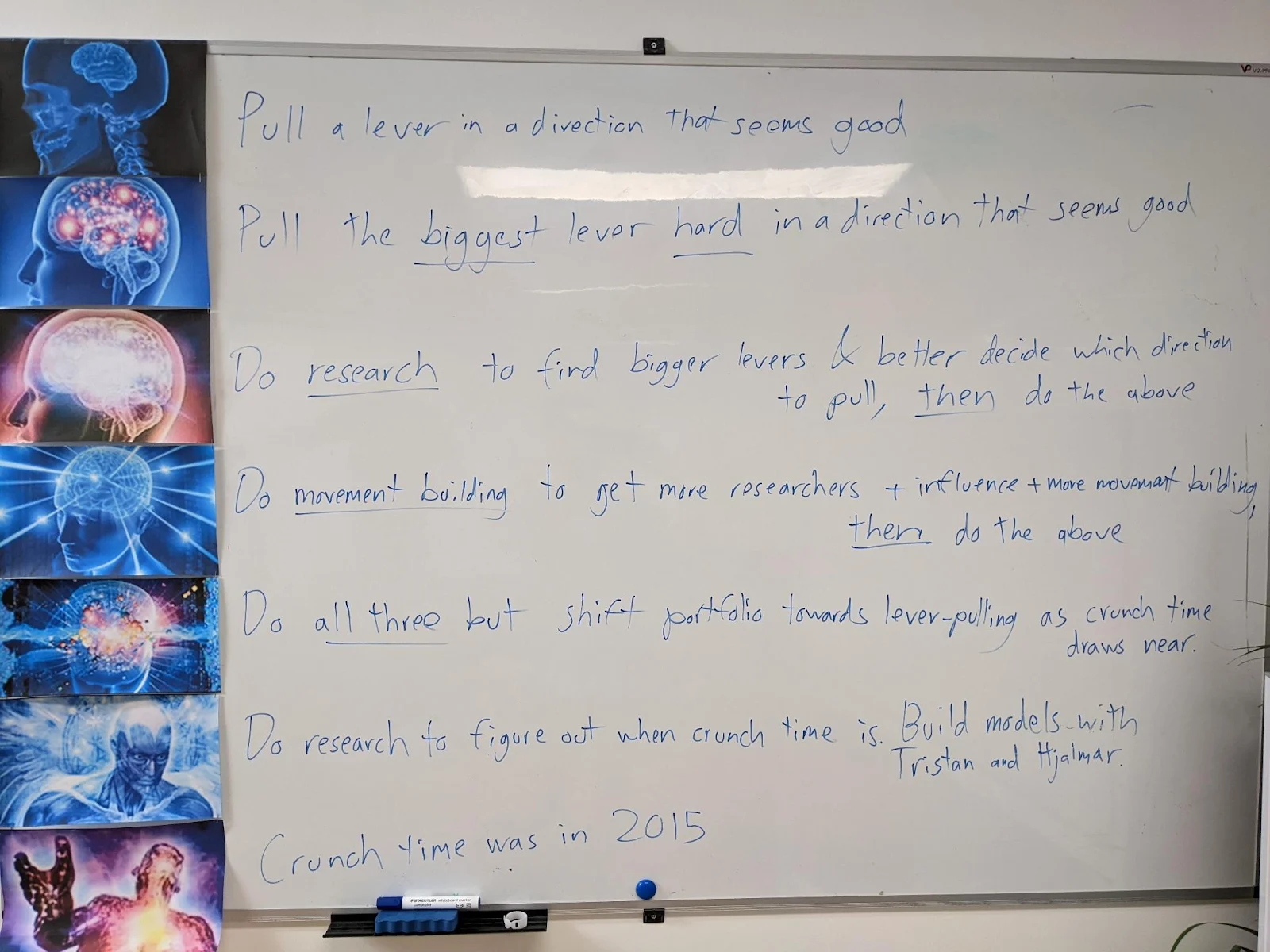
and, yes, this is still true right now. this was always part of the thinking and hope of Surplus, that we could find a bunch of people to start amazing startups, because now is a very leveraged time. (if you don't think your idea is on track to do something massively good for the world -- talk to me! well, talk to me either way)
but also: it will continue to be true, that there's lots of scope to do great things. it will be true next year. it will be true in 2030. and beyond. work hard, build great things, but don't stress too much about crunchtime
Relatedly, AI safety is not the only pressing problem, and it's likely not even the most necessary problem to solve, and the mindset which produces them is a mixture of just overreacting to social cascades combined with bad assumptions around what would happen post-singularity, assuming humans survive AGI and then ASI.
mm i agree with some flavor of this, which is that "not literally everyone, or even all the smart people, should be working on AI safety". with Mox, I'm pretty open/interested to do some good ol-fashioned broad-tent EA fieldbuilding.
but also I think "crunchtime" is overblown? like, actually, things have always been crunch-y, in that at any point in history, someone smart and thoughtful and hardworking could have had a great impact.
It does seem like people could have been more impactful in 2015 than in 2026, but also it was extremely hard to predict what the right thing to do would've been:
In the year 2015 specifically, probably the thing to do would've been to try to stop OpenAI from being founded, although I don't know how to do that. And I do think the founding was knowingly a bad idea at the time, and many people said so.
I view "crunchtime" as a claim about default trajectories/timelines. I view it as people saying "if we do not take decisive action within <the next year> we will see catastrophic outcomes." That was probably not true in 2015 (I say probably because I guess it's possible that we got locked into a bad incentive structure then and are now doomed). I think people claiming it is crunchtime hope that it will still be crunchtime in 2030, but think that we may not make it there still in control of our destiny.
Have you ever thought "Inkhaven seems great but there's no way I could leave my job to write for a month"?
If so, I made https://justwrite.club/ for you:
Fill the form if you feel >10% down, and I'll sort out final commitments by EOD Oct 30!
I've seen proposals for buying coal mines as a way of efficiently reducing emissions, by reducing the supply of coal and thus driving up coal's price on the open market. But how does that balance against the increasing the demand for coal mines, thus encouraging coal prospectors to seek out new coal sources?
Intuitively, this doesn't seem that likely; it feels like new coal sources should be pretty hard to discover? But two worrying examples that come to mind include:
One reason this has been on my mind: I wonder whether paying AI researchers lots of money to not do AI research would slow AI timelines, or would drive more people into research...
My sense is that coal mines 1) take a lot of money to make in the first place and 2) have poor future prospects. So the thing that happens if you buy a 40-year old coal mine with 10 years of coal left, and shut it down instead of operate it, is not that someone else just opens up a new coal mine with 50 years of life on it. [But this is probably more of a local effect than a global one--people are actually opening new coal mines somewhere.]
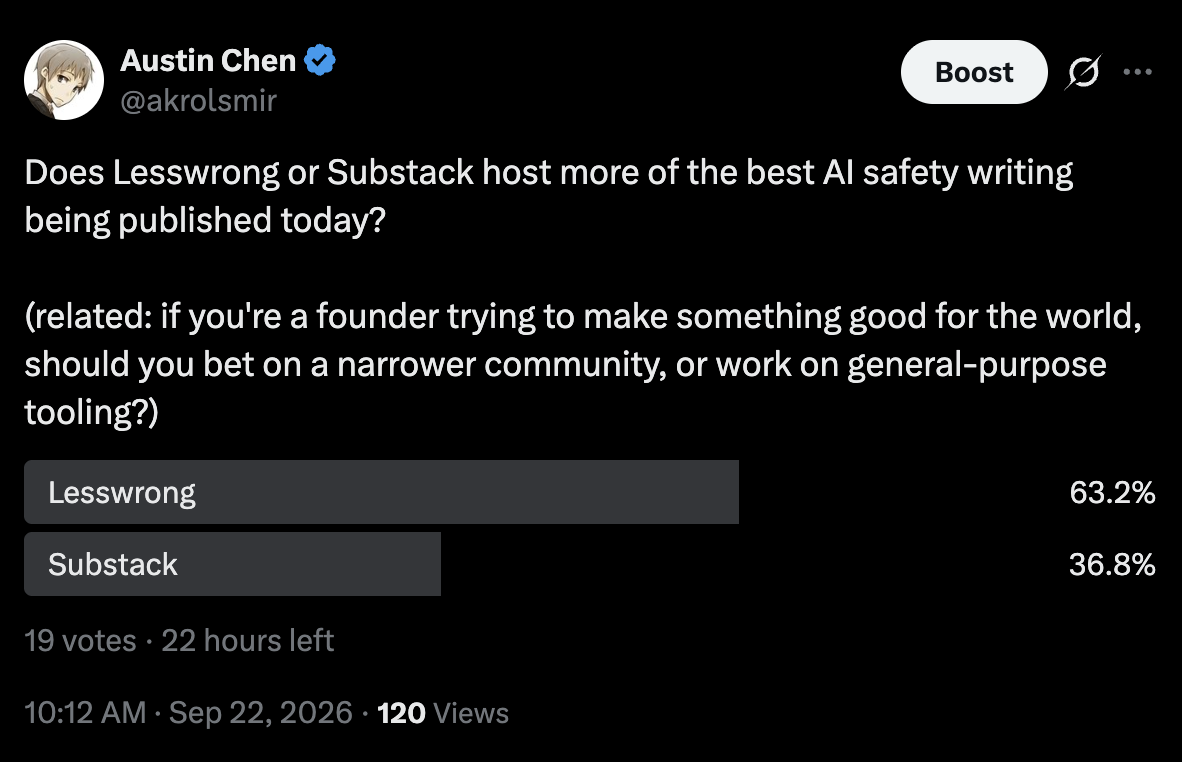
Does Lesswrong or Substack host more of the best AI safety writing being published today?
I find this an interesting question because it's not obvious to me. On one hand, Lesswrong has a historical claim to greatness, incubating the community that does some of the most important work on earth, and is still the first place I check habitually. On the other, I suspect AI safety on Substack today gets more total reach, maybe even quality adjusted reach. Certainly I feel like the comments on Manifund's Substack have been much better than the comments on the LW crosspost over the last year (excepting that one time I interviewed Oli).
My sense is that the LW team hasn't been investing nearly as much in LW, compared to new bets like Lighthaven and Lightcone Commons. (I wrote a bit about this 2 years ago while donating to Lightcone). While LH and LC are great and possibly the right call for Lightcone and the world, I'm a bit sad that the writing and discourse experience hasn't improved much, especially given the recent drastic improvements in AI for coding + thinking. (If Manifund goes belly-up, I might take a stab at this myself.)
I think this is also an interesting question for impact-oriented software founders, too, eg in Surplus -- which kind of startup would you start? A narrow, community-based bet, or a broader general purpose tool?

What are examples of good Substack AI safety writing?
Just dropping some Substacks that don't get mirrored to LW enough. Some are safety or AI-focused, others more EA or safety-adjacent:
And, I guess kind of obvious but ACX and Zvi are primarily hosted on Substack and not LW.
I think one obvious low hanging fruit for LW is to invest in a good Substack mirror/integration to pull the writing here, so they could be discussed using the (imo vastly better) LW commenting system.
From what Habryka has said, it sounds like LessWrong is actually the expensive part and Lighthaven is (was?) a minor expense which they hope to make profitable. A lot of Lighthaven programs are LessWrong support too, like Inkhaven and LessOnline.
I suspect LessWrong is also "getting worse" in part because rapidly improving AI make it much harder to run a high SEO value public website.
My guess is these aren't that true anymore, depending on how you account -- I think Lightcone has recently received major donations in support of their mission, more due to Lesswrong than Lighthaven (though I don't know the precise allocation for a fact).
And I don't imagine that AI traffic has made it much harder to run Lesswrong, vs more of a lack of current interest from the team to expand Lesswrong functionality.
Low sample size, but my Twitter poll currently indicates 60/40, which I think justifies "it's not obvious".

A narrow, community-based bet, or a broader general purpose tool?
I suspect high-impact software projects would involve a bit of both; implementing improvements within a narrow community as proof-of-concept, and hopefully facilitating clearer thinking/discourse in a way that is demonstrable enough to incentivize adoption elsewhere eventually.[1]
As an aside, I am incredibly interested in this direction (and have been in contact with others I think could contribute meaningfully), and would make it my primary focus for relatively modest funding. Would love to connect with anyone who's also interested, as well as any potential funders I could make my ideas more legible to (will reach out!).
I think this ACX post does a good job of critiquing ambitious top-down "discourse improvement" shaped proposals that often fail to generalize to the broader public, but misses the potential for incremental improvements and modular approaches that I think could be seriously high-impact (some of which are discussed in the comments).
Some people seem mad that Anthropic shredded a bunch of books (eg this comic, this writeup). I wonder if Anthropic could solve this by making those books available, Google Books style?
Idk what the legal complexities around copyright would imply but Google Books has solved some of those by previewing a few pages at a time. Anthropic could maybe go further and see if any of the book authors/publishers want to make their work available, offer the $3k or wtv from the other settlements, etc.
Probably Penny Arcade's reactions aren't actually driven by book shredding per se and more of a general unhappiness about AI. But it'd still be a nice gesture, I think.
Yeah, I'm not sure exactly how much negotiation would be involved, but given again that Google Books has paved the way for this (and also, they hired one of the Google Books people to run the project?) it might be easier the second time around, maybe relatively cheap way to buy goodwill?
(Other ways of buying goodwill on this particular topic might be to publish the full list of scanned book titles, link to whatever versions are still available for sale, make a statement that they're supportive of books and authors etc)
I remember the book shreddings getting horrified reactions in my social circle when the story first popped up ~2 years ago, when reactions to LLMs were generally less intense. I think the general consensus was people really wished they had donated the rarer books to a library.
Thinking on this more, I'm curious how/whether copyright is considered in Plan A's Total Research Transparency (a proposal I broadly like.) Rereading the default proposal for TRT, it calls to restrict most training data:
AI model weights, significant fractions of the training data, and a small amount of other sensitive information is prevented from leaving the datacenters.
I'm a bit surprised because I assumed "data" was part of "research"; most calls for "open science" include calls to publish the underlying data. And I assumed that if the goal of Plan A is to make it so that model progress is strictly gatekept on compute, in which case making training data also transparent/public would aid that goal.
And now I'm also curious what kind of training data would be published as part of TRT.
Tagging @Thomas Larsen?
Rob Wiblin from 80k asks:
Suggestion: Inline comments for LessWrong posts, ala Google Docs
It's been commented on before that much intellectual work in the EA/Rat community languishes behind private Google Docs. I think one reason is just that the inline-commenting mechanism on a GDoc is so much better than excerpting the comment below. Has the Lightcone team considered this/what is the status?
(I vaguely recall them working on a live-collab feature, not sure if commenting would have been part of this)
If you go into a draft of a post and highlite text you can see a comment button. When I just tested it, clicking the button did nothing but at least the button to create comments is there.
Okay, now I've used the live-collab/commenting feature on a LessWrong draft. It's pretty good! If you haven't seen it yet, I'd recommend writing a new LW post and requesting feedback; Justis Millis's feedback was super fast, highly detailed, and all-around incredibly valuable!
Can I turn on inline comments for a published LessWrong post too? Even after "publishing" it'd super useful to get the comments inline. In my view, a great post should be a timeless, living, breathing, collaborative document, rather than a bunch of words dumped out once and never revisited.
(There's value in the latter in terms for eg news posts; but LW's focus is less on that.)
Thank you!