There do in fact exist $100k iPhones marketed for the ultra-wealthy, see Vertu's lineup. Their most expensive phone is $504k, and seems expensive mainly because they bejewel it with rubies, emeralds, and diamonds.

The stats for the phone are not mentioned, however they have GIA documents certifying their use of real diamonds.
Next is basically the same deal but with alligator skin.
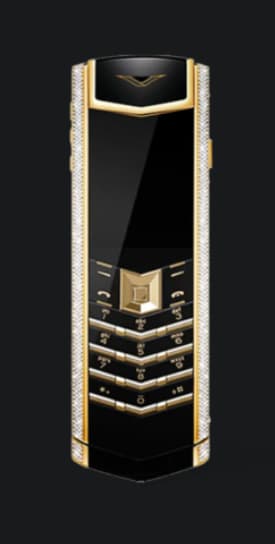
Then we get more interesting. Their third most expensive phone is $110k which markets itself as the "World’s first AI agent phone for entrepreneurs". Here are the specs

 1
1The third most expensive phone, the $110k one, is not bejeweled and in fact seems like it is mostly so expensive because of its specs?
Edit: Oh actually looking up what the specs mean, maybe it's so expensive just because of marketing.
 3
3Here is a >$100k iphone I found by Caviar, it is $196k, and its primary value proposition seems to be the fact it has a Rolex glued to its back

Caviar is a company whose business model seems to be to bejewel iPhones and sell them to Russian oligarchs.
 1
1alcohol is possibly cheating, because it's not really food and an expensive luxury category of its own? (but even there, really, most of the wine all the way at the highest end is like $1000 for bottles you'd consume semi-regularly, and about $10 at the cheap end).
naively, fast food is about $30 a day (fast food is actually kinda expensive, i guess the cheapest things you can do, bulk beans and rice sorts of things, are about one OOM cheaper). i think $1000 a day is actually more than enough to afford an entire person to do skilled work all of the time, although you could push it upwards a bit more if they were truly elite at the thing that they do, but probably not one OOM more.
(accounting tends to get tricky up there because I imagine a big part of the value proposition for your worker past a certain point is a sort of security, access to other commodities/conveniences, connections, etc.)
but to the original point, i do really struggle to imagine how an iphone is meant to provide you more value. i think a lot of what an iphone is supposed to do for you in terms of productivity is better achieved by other means, and it's hard to improve for entertainment at its form factor. as for signaling value, here are two websites that sell phone cases in the $10k range, as a sort of jewelry.
https://caviar.global/ https://leronza.com/24k-gold-luxury-samsung-galaxy-z-fold7/
i guess you could switch between these regularly, as with jewelry, to effectively recover another OOM.
 1
1
I’m not quite sure how unequal the world used to be, but I’m fairly certain the world is more equal (in terms of financial means) than the world was, say, in the 1600s.
There are many things that enormous wealth allows you to buy that’s out of reach for middle-class American consumers, like yachts, personal assistants, private jets, multiple homes, etc. You can frame these things in terms of the problems they solve e.g. private jets solve the problem of travelling long distances, multiple homes solves the “problem” of wanting to go on vacation more often. Note that the problems persist across wealth brackets, it’s just that the ultra-wealthy have different methods of solving those problems. While the ultra-wealthy might solve the problem of “vacation travel” using a private jet, those without extreme wealth might travel using commercial airlines. The ultra wealthy introduce novelty into their lives by purchasing multiple homes, while everyone else goes on vacation and stay in a hotel or similar.
If you cluster goods and services based on the problem they solve, most seem to be available at wide range of prices, with the higher end being around 2 or maybe 3 orders-of-magnitude greater than the lower end. For example:
I have low confidence that the difference between the lower- and the higher-end of goods/services to solve a problem is precisely 100x to 1000x, but I’m very certain that it’s orders of magnitude greater and not 1.01x to 2x greater.
However, you do get some products/services which do not exhibit this behaviour: Even the wealthiest man in the world will use the same iPhone, play the same video games, read the same books[1], and watch the same movies[1] as a middle-class American. What gives? What is the underlying factor that means some goods and services have 1000x range in value, and others have basically no difference? Put plainly: Why are there no incentives to build a $100k iPhone[2]? I have some hypotheses about the constraints:
Option 1 seems a little fishy to me. I’m not sure, but I doubt there’s nothing Apple could do to put more high-end features in a $5k iPhone. $100k does start to push the limits, but $1k seems low considering the frequent critique of iPhones. And there’s a very wide range of non-technical features (different colours, different sizes, various customisations) that are present in other high-end luxury goods (cars, watches, jewellery, etc) but aren’t present in iPhones.
Option 2 also doesn’t quite sit right with me. It seems okay on its own, but I don’t see why iPhones would have this dynamic but not watches, furniture, cars, etc.
One third option that I think is closer to the truth:
Consumer technology regularly experiences game-changing innovations, much more so than cars/furniture/housing/etc. So under option 3 we’d expect to see that goods or services with a very small financial range (like iPhones) to be things that are undergoing rapid innovation and change (including but not limited to tech products).
This hypothesis seems to hold up: laptops, smartphones, internet services (like YouTube, Netflix, Gmail, etc), Starlink, all have a very small financial range, some of them you can’t buy a more expensive variant even if you wanted to.
Our hypothesis also predicts that goods/services which experience little innovation should have a wider range of prices. One example of this would be gas-powered cars, which have been stagnant for several decades[3]. There have been improvements in comfort, efficiency, and safety, but I’d argue that these improvements stem more from increased demand for these features rather than previous inability to innovate in these features. Most recent innovation in cars have come from changing preferences, rather than static preferences which undergo more thorough innovation.
I suspect there’s something deeper here which might be empirically useful. If hypothesis 3 is true, then we could use the range of prices for a given product/service as a measure of the innovation in that field: A narrower range of prices means that there’s much more innovation. And this could be impactful, as it gives a way to measure how much the economic market expects a field to be innovating. It would be foolhardy to try sell a $100k iPhone if you suspect a competing product might be released that has significantly better features but with a lower price tag.
The large price associated with luxury goods effectively serves as a bounty for someone to come along and innovate.
We can also make some empirical predictions from this. Smartphones during the 2000s and 2010s underwent a lot of innovation, but they have become stale in recent years: every black slab of glass is nearly identical. I suspect the luxury smartphone businesses take a while to boot up, and it’s possible that new battery technology could cause a resurgence in smartphone innovation. So I’d predict, in the next ~10 years or so, we’ll either see a luxury smartphone business start up[4] and stays in business, or we’ll see significant innovation in smartphones (something like 10x better batteries or other components).
Thanks to Jasmine Li, Jo Jiao, Desiree J, Jay Chooi, and the MATS 9 blogging and writing channel for reviewing drafts of this essay.
I'll note that books and movies might be a slight outlier here: centi-millionaires absolutely can pay or sponsor creative professionals to produce work that they specifically wish to exist. This might be explicit (contracting a director to make a specific film), but more likely this is implicit (funding a film studio, sponsoring an artwork, organising meet-and-greets with powerful donors).
If you google, you can find example 100k iPhones [1, 2] but I've never seen anyone who could afford a 100k iPhone actually using one.
You might debate the precise duration of the stagnation, but the past 20 years of gas-powered car innovation is certainly less impressive than the last 20 years of mobile phone innovation.
one that produces a smartphone ~10x more expensive than the most popular iPhone