8 Answers sorted by
1510
I think the answer pretty much has to be "yes", for the following reasons.
- As noted in the above post, weather is chaotic.
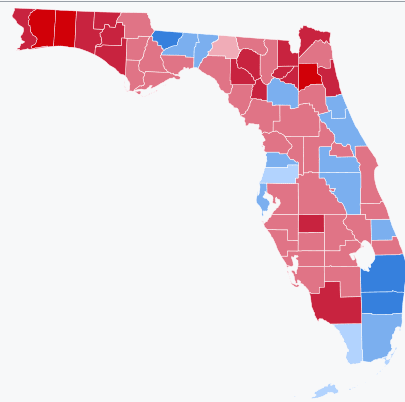
- Elections are sometimes close. For example, the winner of the 2000 presidential election came down to a margin of 537 votes in Florida.
- Geographic location correlates reasonably strongly with party preference.
- Weather affects specific geographic areas.
- Weather influences voter turnout[1] --
During the 2000 election, in Okaloosa County, Florida (at the western tip of the panhandle), 71k of the county's 171k residents voted, with 52186 votes going to Bush and 16989 votes going to Gore, for a 42% turnout rate.
On the day of November 7, 2000, there was no significant rainfall in Pensacola (which is the closest weather station I could find with records going back that far). A storm which dropped 2 inches of rain on the tip of the Florida panhandle that day would have reduced voter turnout by 1.8%,[1] which would have resulted in a margin that leaned 634 votes closer to Gore. Which would have tipped Florida, which would in turn have tipped the election.
Now, November is the "dry" season in Florida, so heavy rains like that are not incredibly common. Still, they can happen. For example, on 2015-11-02, 2.34 inches of rain fell.[2] That was only one day, out of the 140 days I looked at, which would have flipped the 2000 election, and the 2000 election was, to my knowledge, the closest of the 59 US presidential elections so far. Still, there are a number of other tracks that a storm could have taken, which would also have flipped the 2000 election.[3] And in the 1976 election, somewhat worse weather in the great lakes region would likely have flipped Ohio and Wisconsin, where Carter beat Ford by narrow margins.[4]
So I think "weather, on election day specifically, flips the 2028 election in a way that cannot be foreseen now" is already well over 0.1%. And that's not even getting into other weather stuff like "how many hurricanes hit the gulf coast in 2028, and where exactly do they land?".
- ^
"The results indicate that if a county experiences an inch of rain more than what is normal for the county for that election date, the percentage of the voting age population that turns out to vote decreases by approximately .9%.".
- ^
I pulled the weather for the week before and after November 7 for the past 10 years from the weather.gov api and that was the highest rainfall date.
var precipByDate = {} for (var y = 2014; y < 2024; y++) { var res = await fetch('https://api.weather.com/v1/location/KPNS:9:US/observations/historical.json?apiKey=<redacted>&units=e&startDate='+y+'1101&endDate='+y+'1114').then(r => r.json()); res.observations.forEach(obs => { var d = new Date(obs.valid_time_gmt*1000); var ds = d.getFullYear()+'-'+(d.getMonth()+1)+'-'+d.getDate(); if (!(ds in precipByDate)) { precipByDate[ds] = 0; } if (obs.precip_total) { precipByDate[ds] += obs.precip_total } }); } Object.entries(precipByDate).sort((a, b) => b[1] - a[1])[0] - ^
Looking at the 2000 election map in Florida, any good thunderstorm in the panhandle, in the northeast corner of the state, or on the west-middle-south of the peninsula would have done the trick.
- ^
https://en.wikipedia.org/wiki/1976_United_States_presidential_election -- Carter won Ohio and Wisconsin by 11k and 35k votes, respectively.
 2
2*
158I think I’m with Thomas Kwa on this one, mainly because I see 0.1% as a really low bar. E.g.
- let’s say ≥10% chance that the election is close enough to turn on “random-ish things” rather than “structural factors” (random-ish things would include [as discussed in other answers] weather on election day, decisions of particular individuals that “could have gone either way” [to run or not, to endorse or not, to assassinate or not, to release incriminating information on a candidate right before election day or not, whatever Patient Zero of COVID-19 was doing at the time], etc.);
- and out of those ≥10%, it seems reasonable to me to guess ≥1% chance that a re-roll of quantum randomness would flip the result.
So that gets us above 0.1%.
I think my guess would be more like, I dunno, 1%–10%?
111
In this very particular case, since chaotic variation of winds seem likely to be affected by QM, I think we can confidently say yes. From Metaculus
@Jgalt I did some research. The reporting is that the shooter was likely 150 yards away, so 137 meters), and the wind speed in Butler, PA during the rally was ~2-3m/s. Apparently at a range of 400m and 1m/s wind, bullets deflect by ~4 inches. So Trump's survival could have come down to simply the wind being favorable. Very very close call.
 1
1Eh, I don't buy it, or like, I think it's just restating the underlying question. My best guess is wind direction is pretty strongly overdetermined (like, even on just the extremely dumb first order approximation you can often get to 95%+ confidence about wind direction, because places tend to have pretty consistent wind patterns).
But even granting that, it's still not settled because there might be other reasons that would have overdetermined the outcome of the election. For example, it might be overdetermined that Trump dies before the election due to ol...
 1
1*
9-4I think "one of the potential candidates might quantum-randomly die in the timeframe" is a pretty strong argument that there's at least ~0.1% quantum uncertainty.
ETA: For some stats on this, see this table from the government of Canada. Annual death rate ranges from 0.1% for 35-year olds, up to 0.5% for 55-year-olds, and 3% for 75-year-olds. Multiply those by 4 to get the death rate in the relevant window. Obviously only a small fraction of those deaths will be quantum-randomness-influenced. Also note the relatively high rate of presidential assassinations -- 4 of 45(!) presidents were asssassinated in office(although I assume the "true" probability is lower now)
40
Ok, so in the box of gas case, you have individual gas molecules following newtonian physics with no process to give any kind of structure at all. However, a human brain of a voter is more like an optimizing process. Most small perturbances to the "house" example, say you go nudge a 2x4 in the materials pile a tiny amount, which is much larger than quantum randomness, and the workers building the house will still put that piece of wood where it goes in the structure, or select an equivalent piece of wood which ends up forming the structure still.
Inside a human brain of a voter, including the primary voters who will determine the candidates for the 2028 election, there is an overall function the brain circuitry tries to satisfy, and many synaptic weights that encode policies that will attempt to satisfy that function. Small fluctuations from quantum randomness are unlikely to change voter preferences, since these are encoded by many weights that reflect life experiences etc. And you can empirically check this - look at experiments where people are presented with new evidence that challenges their currently held beliefs. Generally this just doesn't work, people interpret the new evidence to support their beliefs, even if a rational agent would not.
What about bigger trends, such as the price of gasoline, or economic activity and employment rates and relative spending power per voter? Same thing here, small quantum randomness is drowned out by larger macroscale trends and inertia, many of the fluctuations cancel out. As in, if you can "reroll" history, and the fluctuations have the same distribution as before, but a different random seed, many of these larger trends would happen identically to the original run.
What about historical events where critical decisions came down to the whim of one man? One of the famous ones being Hitler's choice of when to attack, allegedly years before his advisors recommended. Maybe. One theory is that Hitler personally had a terminal illness, and so this man would always order an early attack. You could not convince him not to attack with rational evidence or arguments on the probability of winning, because he would personally be dead and unable to see the outcome if the war were delayed.
The existence of the terminal illness would be known to an omniscient observer, and so this would be a case where a seeming "black swan" - an irrational early attack - would be predictable.
WW2 is a specific case where we know that the material advantages the winning side had were enormous, we know the ultimate winners, but tiny perturbations could have changed the course of entire campaigns.
I wonder what the margin of infection was for patient 0 in Wuhan...
31
Daniel Kahneman notes that if sperm are randomized, the chance of Hitler, Stalin, and Mao all being born boys is 1/8. Re-run the 20th century with any of them being female and you get vastly different results. That thought experiment makes me suspect our intuitions for the inevitability of history are faulty.
22
I strongly feel Habryka is right here. Things are not that contingent. In particular, the invocation of chaos theory feels misleading here. The weather is chaotic on relevant timescales but most of our world and society is very much not.
Interested to hear different intuitions
The weather significantly impacts society, especially lately. Eg, to pick one kind of event, via wikipedia via IPCC report 2021:
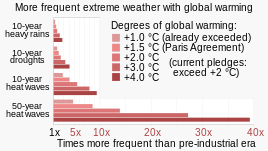
this has practical effects for a variety of parts of the economic network, notably shipping and natural disasters, both of which affect prices in ways that can affect what policies people want, as well as anyone who's directly impacted by a natural disaster.
-80
Perfect predictions of certain physical systems are downright impossible due to tipping points, ie chaos theory.
I do think even if you change the outcome of all people using quantum random number generators, this is quite unlikely to flip the outcome of an election. It's just not that many people, and election margins are quite large. There are butterfly effects here, but I think the prior on the people who use quantum random number generators explaining a lot of the variance of election outcomes seems quite unlikely to me, even if you can correlate their actions somehow.
 2
2Looking just at one particular mechanism: how often will weather counterfactually impact the outcome of an election? Presumably only if the election is very close, but seems very plausible for e.g. the 2000 election, so it's not that rare, though definitely not the norm. Conservatively call it one election in 50 sensitive to the weather? (I expect it should be much higher than that given how recent 2000 was, but I'm trying to get a lower bound here.)
... and I'd be very surprised if weather isn't mostly-quantum-randomized on a four year timescale.
So I'd expect that at least one in fifty elections is counterfactually sensitive to quantum noise.
On the other hand, most elections are not that close, and I'd expect that even a moderately-stronger-than-human AI could usually guess pretty confidently in advance which elections will and won't be that close.
For elections which aren't unusually close, are the tail probabilities sensitive to quantum noise? I'd be surprised if they were; central limit theorem bites hard at the scale of elections. With a hundred million voters we're talking about standard error on the scale of ten thousand, or 0.01% of the electorate... and e.g. the 2020 election had ~4.5% advantage for Biden according to wikipedia... so that's hundreds of standard deviations. (Though admittedly that's ignoring the electoral college, which could definitely have weird effects.) So quantum noise would have to have, not just local effects in a few places, but huge correlated effects over a large chunk of the electorate in order have appreciable effects on the election counts themselves.
Impact on individual candidates is maybe more plausible? Not sure what specific mechanisms would be relevant there. E.g. interstice's suggestion of a candidate randomly dying seems probably less than 0.1% probable in a typical election? Based on a quick google someone 65-75 years old has roughly a 0.8% chance of dying over four years, it will be an OOM lower for younger candidates, and even for old candidates most of that probability will be packed in health problems which can be seen coming well in advance if one is looking for them.
3Let me try to state this problem a little more precisely. (And I'll frame it in terms of this year's election.)
Using Newtonian mechanics, we can calculate where the Earth should be (relative to some galactic coordinate system) on election day 2024. Then consider the past light-cone of that Earth, back to the present day, the end of January. That's covers a region of space about ten light-months around the solar system.
We are asking: Suppose we knew the quantum state of that 20-light-month-diameter region of space, as precisely as possible. What is the uncertainty in the outcome of the 2024 election, 10 months in the future?
I think the uncertainty is pretty large, because quantum uncertainty isn't just in radioactive decays, it's in every emission of a photon from an excited atom or molecule. We are surrounded by an ocean of quantum thermal noise. And so any dynamical system which chaotically amplifies microscopic differences, will be amplifying that ubiquitous quantum thermal uncertainty. This is definitely the case for fluids like the atmosphere, and it must surely be the case for biological decision makers made out of neurons, even if it is filtered by canalization of neural and cognitive dynamics. There would be other macroscopic material processes in which quantum uncertainty gets amplified, e.g. fractures in solids under stress. (It would be interesting to calculate the role of amplified quantum uncertainty in earthquakes!)
My proposition is, that in a quantum world, exact microscopic knowledge of the physical state of the world, may do nothing to reduce the uncertainty of an event like an election. That may be overstating a little, because better knowledge of people and the world and the events that might come to pass in the remaining months, can reduce the uncertainty. But in systems which are authentically chaotic or dynamically unstable, the quantum uncertainty in initial conditions has exactly the same effect as merely epistemic uncertainty - it renders the future unpredictable.
11
This came up as a tangent from @habryka and me discussing whether The Hidden Complexity of Wishes was correct.
Is the result of a US presidential election 4 years from now >0.1% contingent on quantum randomness (i.e. is an otherwise omniscient observer forecasting the 2028 election today capable of >99.9% confidence, or is there >0.1% irreducible uncertainty due to quantum mechanics observer-effects)?
I think the answer is yes, because chaotic systems will quickly amplify this randomness to change many facts about the world on election day.
Oliver thinks the answer is no, because in a system as large and complicated as the world, there should be some macro-scale patterns that survive, and an omniscient observer will pick up on all such patterns. Humans are limited to obvious patterns like economic trends and extrapolating polls, but there are likely way more patterns than this, which a forecaster could use to accurately get over well 99.9% confidence.
Who is right?