I mean, I'm mostly agreeing with you, and also adding that I think you didn't meet the bar in this post for being grounded in this post. The opening 4 paragraphs make a ton of claims about a discourse that I am not following without giving links for me to check the claims, and throughout makes lots of implicit claims about what is relevant.
I like your proposal in the post for how to get more grounded, to build up a historical dataset of unconstitutional or criminal activities by the US executive branch. Your questions seem too narrow to me though. Like, you list questions you'd like to ask about past Presidents, but I think they're (mostly) based on specific accusations of overreach by the current President you've heard, and would miss other relevant corruption / criminality by the executive branch in the past that could be much greater.
It's a bit like asking how many historical presidents lied under oath, and then deciding that Bill Clinton is the most corrupt president in history because he lied about his affair, rather than asking a more broad set of questions that would find other kinds of abuse of power, such as the Teapot Dome scandal where a Cabinet member secretly leased national security assets (oil) at super low prices in exchange for bribes, and the Cabinet member was sent to prison for it.
 1
1 1
1 1
1 1
1This is such a bizarre reply. Part of the time-honored ideal of being widely read (that I didn't think I needed to explicitly spell out) is that you're not supposed to believe everything you read.
Right? I don't think this is special "rationalist" wisdom. I think this is, like, liberal arts. Like, when 11th grade English teachers assign their students to read Huckleberry Finn, the idea is that being able to see the world through the ungrounded lenses of 19th-century racists makes them more sane, because they can contrast the view through those particular ungrounded lenses with everything else they've read.
many sources of news have been adversarially pursued and optimized to make the consumers of it be corrupted and controlled.
I mean, yes, but the way they pull that off is by convincing the consumers that they shouldn't want to read any of those awful corners of the internet where they do truthseeking far worse than here. (Pravda means "truth"; Donald Trump's platform is called Truth Social.)
some environments have valuable info [...] but I would say that most environments talking about "current events" in government/politics are not.
Given finite reading time, you definitely need to prioritize ruthlessly to manage the signal-to-noise ratio. If you don't have time to read anything but Mowshowitz, that's fine; most things aren't worth your time. But if you're skeptical that a human can expose itself to any social environment on the internet and do better, that doesn't sound like a signal-to-noise ratio concern. That sounds like a contamination concern.
 1
1These were in my model, it's plausible I shouldn't have posted this without putting more work into laying out the full model and trying to be fair / clear / ITT passing.
I edited the post to address a bit of this. In particular including:
[ETA] Of course, I know for many Trump supporters, the whole point is that he's destroying a bunch of institutions that need destroying. I am actually pretty sympathetic to the idea that if you want a better government, you need to tear down the old one quickly. There might be enough differences of values here that there's not much common ground to be had, but for me, the crux is that he seems to:
– Not merely be tearing down various bureaucracies, but, eroding norms like "there is supposed to be rule of law, generally."
– It does not look like this is laying the way for anything good to follow, it looks like it's just kinda making a more corrupt world.
...
> That seemed ... like it was approaching a methodology that might actually be cruxy for some Trump supporters or Trump-neutral-
No? The pretense that media coverage is "neutral" rather than being the propaganda arm of the permanent education-media-administrative state is exactly what's at issue.
I agree the examples I listed there weren't currently a methodology Trump supporters would agree with, the point was just that it felt pointed in a direction where I was like "oh, as long as I'm doing something comprehensive in this way, it's probably worth putting in the extra work to find something that be cruxy for others.
I do disagree about "searching for instances of conflict between executive branch and courts" being something that's particularly prone to media bias. I think most sides would agree there was conflict, just disagree on who was right, and media would report on it regardless just with different framing. (But I agree "seems like executive overreach" would definitely have that problem)
 1
1For general American decline there is a recent article by Noah Smith on capital flight away from America. Its quantitative and its a Trump second term phenomenon. There is also the number of meetings between Trump and different traditionally independent agencies like the FBI and the Department of Justice. I believe those numbers have exploded in this term. The number of probes into elected and appointed officials have definitely also exploded this term. There have also been a large number of acquittals at the grand jury level because the charges are so clearly vindictive and false.
I've always thought about using LLMs to analyze and compare speeches. You could for example look at the ratio of the most information dense summary to the length of the speech. Also, in the wake of tragedies Presidents have been historically consistent in calling for unity. Most people left or right would agree that's a good historical precedent that's still common practice. It's a practice that Trump has clearly broken. A LLM could simply count the number of times he calls the other side evil and compare that with past responses to tragedies. In his speeches Trump also makes it very clear that he rewards loyalty to Trump and not to abstract ideals like the rule of law. Those are Trump specific norm-erosions.
1 1
1Capital flight is a great indicator, thank you for the suggestion.
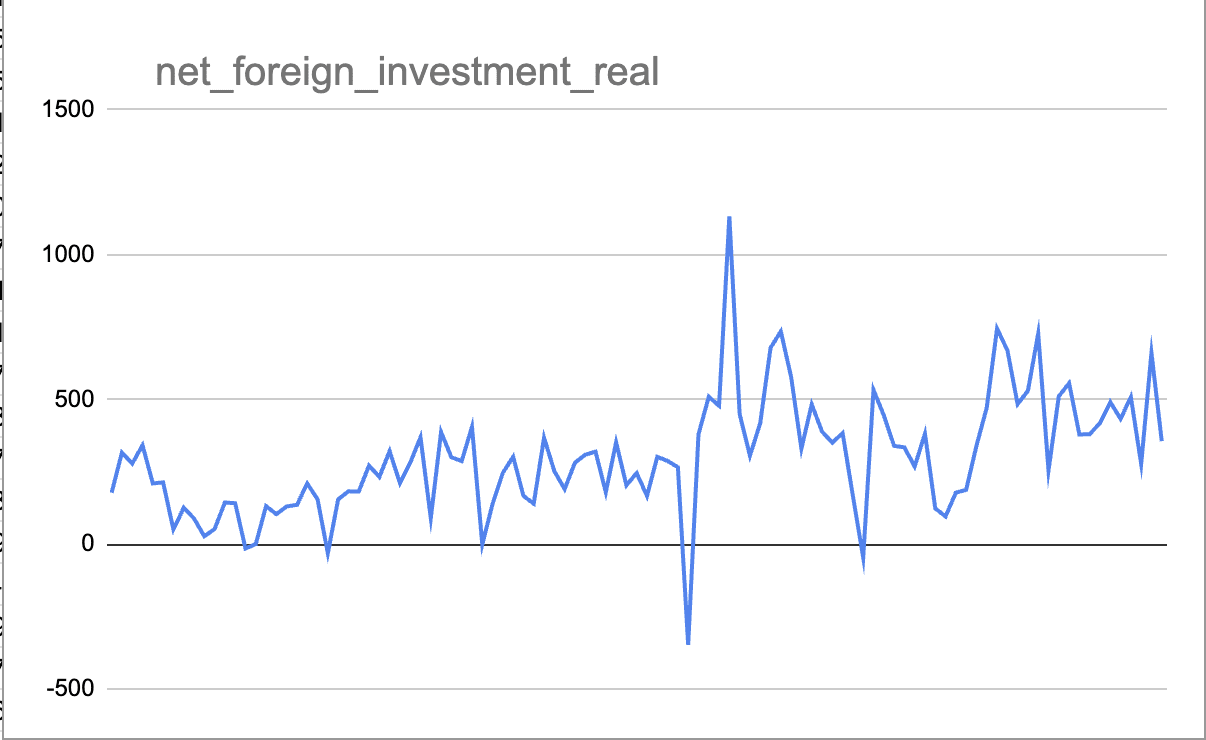
I'm dubious on Smith article though. He claims to be talking about foreign capital investment, then uses a bunch of proxies that aren't net investment. If you graph actual foreign investment, you see a decline, but it looks like a continuation of a trend from the Biden years, or arguably even Obama. The only time investment went net negative was in 2014, which stems from Vodafone selling Verizon back to itself.
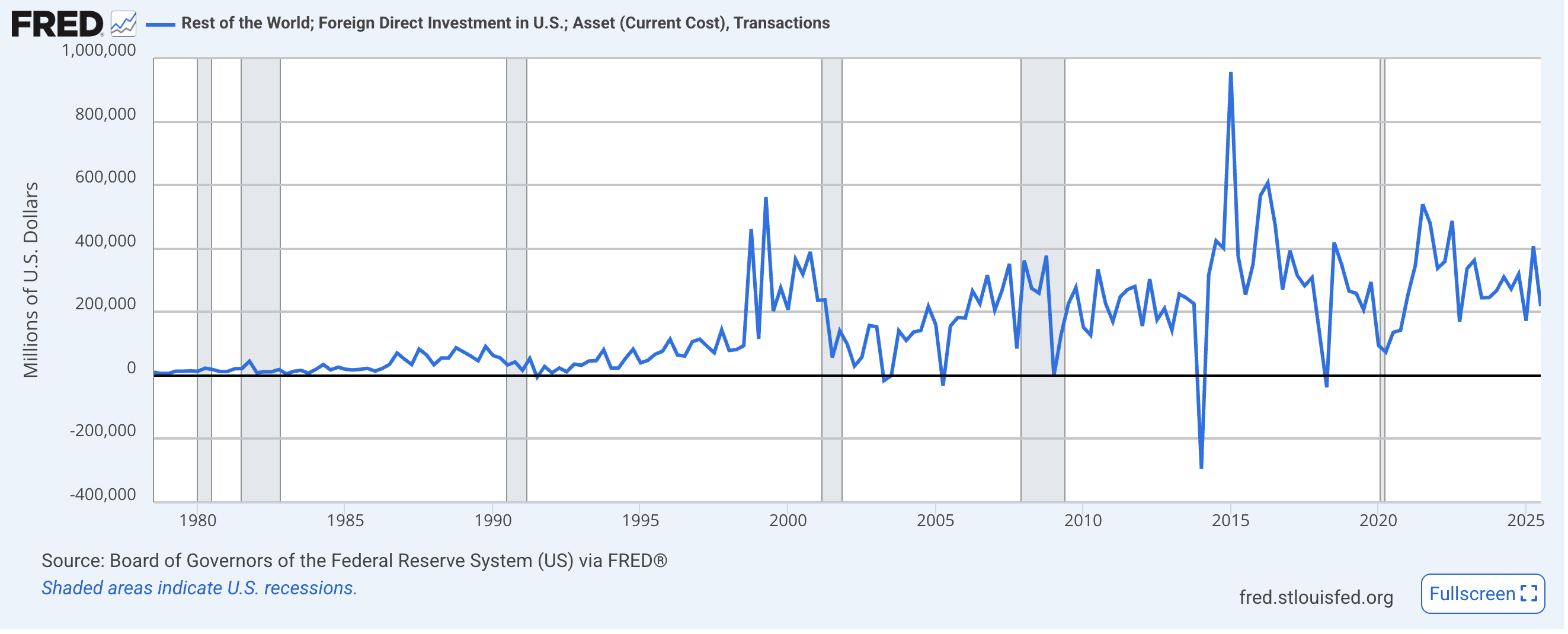
If anyone is feeling ambitious I'd love to see this graph normed for inflation or GDP.
I got a little ambitious and normed the data by value of dollar, relative to 2006Q1. 2025 looks even less exceptional than it did in nominal terms
 11
11Having sat on this for a night, I think basically yeah this posts's framing doesn't make sense as a way to engage with active Trump supporters.
Right now my main question is "should I spend more time thinking about this or go back to ignoring it and hope it isn't too bad?". I think if I decided to do that I'd probably expect "solve political polarization" to be a major piece of it and yeah I'd want to talk to a wider variety of people qualitatively.
I agree that baking in the framing into the initial question is bad, but, like, the framing is the reason why I'm even considering thinking more about this in the first place and I'm not sure how to sidestep that.
The point about "online arguments" vs "chatting with individual people" is well taken though.
1How many incidents will an LLM find of a president ignoring a court order?
To my knowledge at least, there hasn't really been an actual time this has "truly" happened even now. It's often said that Andrew Jackson did but the situation is complex enough that it's arguable it shouldn't count and the famous quote of "John Marshall has made his decision, now let him enforce it!" seems to be apocryphal.
Now there are lots of ways to essentially get around the court order for a long while without actually violating it like a favorite of modern presidents to go "ok X justification doing thing was ruled unconstitutional, but that doesn't mean Y is, and if that gets ruled it doesn't mean Z is" or dragging things out in court exhausting as many appeals and pauses as possible to delay for months/years but I'm not aware of any direct violations at least. Even something like this list I found not only gets the facts wrong about Jackson but openly contradicts itself in the parts about Lincoln and Roosevelt where the executives "victory" is not because they ignored the court, but because Congress acted.
"The Supreme Court ruled the act unconstitutional as the government could not levy a tax on companies merely to have that money paid back to farmers. However, the act was adjusted two years later and continued in its new form."
Like that's literally not defying the courts. That's the previous act being ruled unconstitutional and a new act being made that didn't contain the specific unconstitutional part in it.
Which is to say that you also need to be careful about what is actually happening. Biden's quotes about how the supreme court "didn't stop me" looks like the admin ignored a court order, but they were really just did that workaround in the previous paragraphs of doing Y and Z. The Trump admin right now is talking about their tactics with tariffs if they get ruled against and many make it look like they plan to defy the ruling, but it so far seems to just be the same exact tactic of pivoting to something else and claiming it gives authority.
1The problem with this idea is that the metrics are cherry-picked in order to make Trump look bad. And even then, what they actually measure is how much Trump is in conflict with the rest of the government, not how much we should be scared of him.
1doesn't have direct metrics, so we have to come up with proxies of some kind.
See also: McNamara procedure
the first step is to measure whatever can be easily measured. The second step is to disregard that which can't easily be measured or given a quantitative value. The third step is to presume that what can't be measured easily really isn't important. The fourth step is to say that what can't be easily measured really doesn't exist.
1AIs are known to have political bias in favor of the left. Using AIs to get information about Trump won't produce fair results. Also, AIs are trained on the Internet and the media, which bakes media bias into the AI's results. The AI will inherently trust the media's side of things, and will rarely tell you that the media blew up an unimportant incident or left things out.
In some recent posts, some people have been like “Wait why is there suddenly this abrupt series of partisan LW posts that are taking for granted there is a problem here that is worth violating the LW avoid-most-mainstream-politics norm?”.
Like TV shows that point out their own plot holes, saying "look, my post is violating the rules" doesn't excuse violating the rules.
There's an abrupt series of partisan posts because partisans like to think their enemies are the worst people ever--so bad that they can violate all the norms they want in order to get their enemies, including norms about avoiding politics. And when you stand to gain from thinking your enemies are the worst people ever, there's a lot of motivated reasoning going around.
1Given that, how do you propose to distinguish the worlds where the president is genuinely much worse than average, vs. one where they’re completely precedented or following a trend line?
What you do is you say "given that, we are not doing politics here".
But if you have to violate that rule, at least you could try to avoid biased tools and procedures.
 1
1Votes also come in integers, but are not so small, so I don't think you're really providing any support for your hypothesis here. We've seen broadly anti-Trump and anti-Republican posts, they've usually been met with pretty strong disagreement (even just as a matter of form, often from people who agree with the overall sentiment) and a desire to avoid drawing too many conclusions, but this has changed recently. We can tell that it's changed by noticing patterns in discourse and voting. That five months ago detailed anti-Trump posts were being made, downvoted, and mere expressions of disagreement in the comments were pretty roundly applauded, but now people (basically correctly) take for granted that the median LWer is so strongly anti-Trump that the position doesn't need justification, is exactly what I'm pointing out.
There are multiple possible explanations, sure, but merely that this is a partisan issue isn't one of them. That it's a partisan issue and that partisan hostility is worse and more common now is, but as I mentioned, it requires argument. Have you noticed this pattern on other issues here? Is there a breakthrough effect, such that it happens first on one issue without seeming to change other discussions? If so, why? What other patterns of behavior on LW does this fit, and what does it predict?
The relevant counter-hypothesis is that Trump really is that bad, such that suspending judgment on whether he's bad impedes discussion even if it elides some nuance. Elsewhere you've claimed that this isn't a hypothesis we should allow ourselves to even consider no matter how true it is, here it seems like you're arguing that it's basically wrong in the sense that increased partisanship in general rather than exceptional circumstances are responsible. I think it's pretty likely that lots of people are overestimating how bad Trump is somewhat, but not to an extent that is easy or productive to correct - I think I'd basically have to lie to someone to convince them that Trump is actually completely fine and totally in line with what they should expect, to the extent that breaking communication norms to mention his mistakes is escalatory. Do you think I'm wrong, or just that I shouldn't talk about it on LW? It's really unclear to me what you're trying to argue for, and hence, what (if anything) I can expect to get from discussing this with you. (I notice this sounds snarky, what I mean to say is that since disagreements can get pretty wide hear and require a ton of tension to sort out, I can imagine either talking further or agreeing to disagree being reasonable actions for both of us, depending on what your answer here is.)
1Anti-Obama sentiment was not partisan?
It is literally partisan, but it was nowhere near the same degree of being partisan that's involved here.
I wonder if you’ve thought about the bad incentives this behavior produces?
The incentives that being able to respond to political rants create are that such rants become less useful (since they don't go unopposed) and people would be less likely to make them. I find these incentives acceptable.
Like, if Satan himself were president of the United States and was killing a million people per day, eliciting celebration from his supporters, would you still think discussion was not justified on the grounds that it’s political?
Thousands of people are being killed in Sudan--certainly more than Trump has killed--and we've managed to go without LW being full of discussion about it. So yes.
1 1
1
Updated title to include "corruption", and changed some framing in the post.
Critics of Trump often describe him as making absolutely unprecedented moves to expand executive power, extract personal wealth, and impinge on citizens’ rights. Supporters counter that Trump’s actions are either completely precedented, or are the natural extension of existing trends that the media wouldn’t make a big deal over if they didn’t hate Trump so much.[1] Other supporters say "yes, his actions are unprecedented and this is good, they're tearing down corrupt things that need tearing down."
In some recent posts, some people have been like "Wait why is there suddenly this abrupt series of partisan LW posts that are taking for granted there is a problem here that is worth violating the LW avoid-most-mainstream-politics norm?".
My subjective experience has been "well, me and most of my rationalist colleagues have spent the past 15 years mostly being pretty a-political, were somewhat wary but uncertain about Trump during his first term, and the new set of incidents just seems... pretty unprecedently and scarily bad?"
But, I do definitely live in a bubble that serves me tons of news about bad-seeming things that Trump is doing. It's possible to serve up dozens or hundreds of examples of a scary thing per day, without that thing actually being objectively scary or abnormal. (See: Cardiologists and Chinese Robbers)
Elizabeth and I wanted to get some sense of how unusual and how bad Trump’s actions are. “How bad” feels like a very complex question with lots of room for judgment. “How unusual” seemed a bit more likely to have an ~objective answer.
I asked LLMs some basic questions about it, but wanted a more thorough answer. I was about to spin up ~250 subagents to go run searches on each individual year of American history, querying for things like “[year] [president name] ‘executive overreach’” or “[year] [president name] ‘disobeying court order’”, and fill up a CSV with incidents.
That seemed… like it was approaching a methodology that might (with addititional workshopping) be cruxy for some Trump supporters or Trump-neutral-ers. It seemed like maybe good practice to ask if there were any ways to operationalize this question that’d be cruxy for anyone else. And, generally pre-register it before running the query, making some advance predictions.
[ETA] Of course, I know for many Trump supporters, the whole point is that he's destroying a bunch of institutions that need destroying. I am actually pretty sympathetic to the idea that if you want a better government, you need to tear down the old one quickly. There might be enough differences of values here that there's not much common ground to be had, but for me, the crux is that he seems to:
But, I'm aware the world is already pretty corrupt, and there's generally been a trend of executive overreach for awhile. It wouldn't be too surprising if my intuitions here are just way off.
Each operationalization I’ve thought of so far seems a bit confused/wrong/incomplete. I feel okay with settling for “the least confused/wrong options I can come up with after a day of thinking about it," but, I'm interested in suggestions for better ones.
Some examples so far that feel like they're at least relevant:
These questions all have the form "checking if allegations by detractors about Trump are true", which isn't necessarily the frame by which someone would defend Trump, or the set of questions that'd be most salient to them. If you're trying to build a complete picture of what's going on, you probably also want to ask questions like:
I also don't know that any of this is really the right frame for actually answering my own question of "is the US in a period of rapid decline in a way that's a plausible top priority for me or others to focus on?"
None of them really get at things like "tweeting a picture of yourself wearing a crown", which feels intuitively fairly bad to me but I'm not really sure how to think about that.
I'm interested in whether people have more suggestions for questions that seem relevant and easy to check. Or, suggestions on how to operationalize fuzzier things that might not fit into the "measure it per year" ontology.
Appendix: Subagents Ahoy
A lot of these are recorded in places that are pretty straightforward to look up. i.e. there's already lists of Pardons per President, and Executive Orders per president.
But, I have an AI-subagent process I'm experimenting with that I expect to use for at least some of these, which currently goes something like:
I do basically think it's true that
I have a pet theory about leaning on exact quotes rather than summaries to avoid having to trust their summarization