This is a special post for quick takes by GradientDissenter. Only they can create top-level comments. Comments here also appear on the Quick Takes page and All Posts page.
Particularly creepy that they didn't change this when they saw the controversy and pushback against OAIs similar terms. I'm surprised and disappointed. And embarrassed to be surprised.
Does this apply to US employees as well? Does this apply to everyone at Google? At most big companies? What counts as disparaging? Would saying anything negative about their products (AI) or practices count? Are the terms clear?
 2
2Note that unlike OpenAI, we're free to talk about them
This does seem like it should make the situation a lot better, though I would have expected it to make it better via the channel of people learning about the non-disparagement agreements, and so it's concerning that I haven't heard about them before. I'm surprised that no one mentioned them during the discourse about openai's or anthropic's or goodfire's non-disparagement clauses.
 2
2[I would say: no, probably no, because your did not disparage your employer in this comment, but this heavily depends on the exact language of the clause].
My understanding is that these clauses are hard to enforce through the courts, and are drafted broadly because their real function is ex ante deterrence, backed by conditional payments rather than by injunctions. But I would be a bit skeptical to say that the corporation adopted the practice because "some risk averse lawyer inserted it once in our template", and I'd think that Executive buy-in would be a requirement- this deviates from standard UK practice, it is not the usual to have lifetime non-disparagement clauses in UK employment contracts.
I agree with you instincts otherwise.
2 1
17
For what it's worth Neel, I bet you have unusually high tolerance for taking actions that a lawyer would advise you might get you sued. I'm often shocked by how scared people are of doing things that a lawyer would caution could give someone grounds to sue them, even in cases where that party would clearly never actually sue (because it would be terrible from an optics perspective or because they lose the suit). Many people will clam up, especially when doing more stakesy things like speaking publicly about something that actually matters/hits a sore spot.
Do you think most folks at Google DeepMind who had signed something like this would have felt little impediment from it if they wanted to boldly tweet something very critical of GDM?
7
* It is true that there are lifetime non-disparagement clause
* it's now standard language in our employment contracts
* we're free to talk about them
Thank you for these facts. Could you help me understand the reason for inclusion of the remainder of your comment? On the face of it, it reads as contentless/speculative apologism (varying by clause) on my read, complete with burying the lede wrt chilling effect from such clauses ("presumably net bad for overall transparency").
3
Heh, good point, what does it even mean to criticize someone? If two people state the same facts, but one says it approvingly and the other disapprovingly, does the former comply with the clause and the latter violates it?
"My company is doing things that will either result in human extinction or some kind of fascism forever... which is totally cool, because I am a misanhtopic anti-natalist and an edgy neoreactionary!" -- technically okay?
0
[Image: image.png]
4
The mechanism for this can be debated, but I think OpenAI has been uniquely susceptible to public backlash, in ways that other companies haven't been. Google has faced a ton of backlash for policies including censorship, privacy invasion, and, more humorously, removal of their "don't be evil" motto, and has generally remained unmoved. After the 4o debacle in which OpenAI burned a lot of its (at the time) lead by shutting down its flagship model and deprioritizing the full multimodality that they had had a monopoly on, most of the users with unhealthy relationships with AI moved to Anthropic, which was much more accommodating to their behavior without much pushback. Likewise, OpenAI has routinely tried to be sensitive to accusations of political bias from either side of any issue, whereas Anthropic definitely hasn't.
I'm no Altman fanboy, but I think public opinion moving his actions is an exception rather than a rule.
4
It’s not clear to me what this actually means in terms of real world actions (as opposed to documents in vaults).
It doesn’t seem to me that this is actually enforceable in any meaningful sense, e.g. if I quit A and then five years later I say “A smell like poo and did these bad things (using public information)” - what happens? What are the damages? If it’s just that another employer sees me as being a contract breaking heathen - well that’s no different really from generally just burning bridges - it is optics wise bad to criticise a former employer unless you have very good reason.
Basically - what does it actually mean? What am I missing? The article reads like corporate gobbledegook. You can write ”esotericn may never write the word chocolate again” in a contract, you can’t actually stop me or punish me if I do indeed then use the word chocolate in the future.
2
1. What the hell?
2. How is it even legal?
3. Can they leave comments "I'm under non-disparagement clause" under descriptions of specific things they don't like that they couldn't write themselves?
4. Can they sign the petitions they couldn't write themselves?
5. Can they like things they couldn't write themselves in social media?
Is it even legal to ask in California?
Per CA Labor Code section 980:
...(a) "social media" means an electronic service or account, or electronic content, including... instant and text messages, email, online services or accounts...
(b) An employer shall not require or request an employee... to (1) Disclose a username or password for the purpose of accessing personal social media. (2) Access personal social media in the presence of the employer. (3) Divulge any personal social media, except as provided in subdivision (c).
(c) Nothing in this section shall affect an employer's existing rights and obligations to request an employee to divulge personal social media reasonably believed to be relevant to an investigation of allegations of employee misconduct or employee violation of applicable laws and regulations, provided that the social media is used solely for purposes of that investigation or a related proceeding.
(d) [This doesn't stop] an employer from requiring... a username, password, or other method for the purpose of accessing an employer-issued electronic device.
(e) An employer shall not discharge, discipline... or otherwise retaliate against an employee... for not complying with a
 1
14
I am curious why the OAI researchers didn't use Signal on their work phones for communicating with METR though, insofar as Signal was required? It does seem very strange to use Signal for communicating with contractors at work, and even more so via your personal phone.
To be clear I don't think they leaked, and think OAI is in the wrong here, but I am still confused.
My vague understanding of journalism: a lot of people in AI safety are starting to talk to media more, both as the public becomes more interested in the issues and as it becomes apparent that even when the scientists have figured out how to make systems safer, the companies do not always implement these solutions, and therefore public pressure becomes the bottleneck rather than innovation.
However, a lot of researchers don't know and don't have a very good model of how the media works. Here are some basic points I wish I'd known sooner:
- News is best when it's fresh, so talk to reporters ASAP after a story breaks. People don't want to write about things that are stale. You cannot just put off talking to the media this week and talk to them next week instead because you don't feel like doing it this week. By next week, the news cycle will probably have moved on. It is often best to talk to outlets immediately after something has happened, or, if possible, before something has happened.
- Outlets do not want to publish things that another outlet has already published. They want to be contributing something new. This is why journalists love exclusives. They get a lot of clout if they are th
52 2
2On the other hand, another norm I'd heard of was "no quote approval": you can't have a conversation and then approve which quotes get used after the fact. But apparently you can have an off-the-record conversation where they might come back and ask for permission to use quotes from it. Sometimes, journalists will also just ask you for a written quote (of you can offer one up).
I have requested quote approval twice, and gotten it twice. Both times I promised I would be timely in getting back to them and honestly said I was expecting I'd be fine with it. Both times they allowed me to make minor edits to the quotes (for clarity) before they published.
2 1
1I have never worked in journalism but I have talked to the press. And I have seen other people talk to the press. And I have learned one extra rule of thumb:
Journalists want to tell an interesting story. Interesting stories sell papers.
If you give them a 45 minute interview which is 98% relevant expertise and one very slightly spicy quote, then they will run the slightly spicy quote, because it's a better story.
Be especially careful with "contrast" stories comparing two different groups:
- If you are a slightly terrible person, but the story would be more entertaining if you were comically terrible, then you'll be written up as comically terrible.
- If you are a bit weird and odd, but the story would be more entertaining if you were a highly admirable goody-two-shoes, guess what: The press will puff you up. I've seen the NYT blow very basic fact checking in order to make a contrast more entertaining.
Please don't try to use this information to spin the press; they're better at seeing through spin than most people here are at spinning. But do use this information to know when to shut up and stop talking to a reporter. If a reporter seems to have a preconceived narrative in which you'r...
 1
12
As someone who is now working in journalism for about a year (albeit at a Substack newsletter; I previously did MATS), this seems like a pretty good rundown to me.
Three notes:
* On embargoes/exclusives: I want to +1 this. One underrated thing here is that for e.g. a paper, an embargo gives the journalist more time to breath and get all of the details right. (Also, feel free to pitch me; my signal is kai_williams.48)
* Deep background: I get the sense that this is used less than on the record/off the record/on background. But it's where the reporter can use the information you say but can't attribute it to anyone. But there might be situations where this is helpful.
Full text of Anthropic's draft proposal for a federal AI bill.
Admittedly it is a draft. Perhaps things will change in the future. But it does not strike me as the kind of document that comes from a culture that puts safety above winning the race.
Commentary on the bill from Nathan Calvin on Twitter:
...I found myself viscerally angry at multiple points reading this bill. There are some good and sensible parts, but overall this legislation is not remotely close to meeting the moment and I overall think passing it would make us less protected against catastrophic risks than we are under existing law.
Two parts that stand out as particularly infuriating when taken together:
1. Some of the preemption provisions are remarkably far reaching and consequential, and in addition to preempting legislation like SB 53 would also remove general powers that state courts have to enjoin defendants and protect the public. Most outrageously, it has a provision that looks like its intended to stops states from enforcing laws or judicial decrees that "suspend the development, deployment, or internal use of an AI model" to protect their citizens from imminent catastrophic harms. Such powers to block and sus
2Humanity has only ever eradicated two diseases (and one of those, rinderpest, is only in cattle not humans). The next disease on the list is probably Guinea worm (though polio is also tantalizingly close).
At its peak Guinea worm infected ~900k people a year. In 2024 we so far only know of 7 cases. The disease isn't deadly, but it causes significant pain for 1-3 weeks (as a worm burrows out of your skin!) and in ~30% of cases that pain persists afterwards for about a year. In .5% of cases the worm burrows through important ligaments and leaves you permanently disabled. Eradication efforts have already saved about 2 million DALYs.[1]
I don't think this outcome was overdetermined; there's no recent medical breakthrough behind this progress. It just took a herculean act of international coordination and logistics. It took distributing millions of water filters, establishing village-based surveillance systems in thousands of villages across multiple countries, and meticulously tracking every single case of Guinea worm in humans or livestock around the world. It took brokering a six-month ceasefire in Sudan (the longest humanitarian ceasefire in history!) to allow healthcare workers to ac...
 10
10 2
2Notes on living semi-frugally in the Bay Area.
I live in the Bay Area, but my cost of living is pretty low: roughly $30k/year. I think I live an extremely comfortable life. I try to be fairly frugal, both so I don't end up dependent on jobs with high salaries and so that I can donate a lot of my income, but it doesn't feel like much of a sacrifice. Often when I tell people how little I spend, they're shocked. I think people conceive of the Bay as exorbitantly expensive, and it can be, but it doesn't have to be.
Rent: I pay ~$850 a month for my room. It's a small room in a fairly large group house I live in with nine friends. It's a nice space with plenty of common areas and a big backyard. I know of a few other places like this (including in even pricier areas like Palo Alto). You just need to know where to look and to be willing to live with friends. On top of rent I pay ~$200/month (edit: I was missing one expense, it's more like $300) for things like utilities, repairs on the house, and keeping the house tidy.
I pool the grocery bill with my housemates so we can optimize where we shop a little. We also often cook for each other (notably most of us, including myself, also get free m...
3 2
2 1
12
As the father of 2 kids (a 5 y/o and 2 y/o) in Palo Alto, I can confirm that childcare is a lot. $2k per kid per month at our subsidized academic-affiliation rate. At $48k, it's almost the entirety of my wife's PhD salary. Fortunately, I have a well-paying job and we are not strapped for money.
We also got along with just an e-bike for 6 years, saving something like $15k per year in car insurance and gas (save for 9 months when we had the luxury of borrowing a car from family) [Incorrect, see below]. We got a car recently due to a longer commute, but even then, I still use the e-bike almost everyday because the car is not much faster and overlapping with exercise time is valuable (plus the 5 y/o told me he likes fresh air),
For clothes/toys/etc., we've used Facebook market place, "Buy Nothing" groups, and our neighbors to source pretty much everything. The best toys have just been cardboard, masking tape, and scissors, which are very cheap.
[Edit: As comments below point out, the figure for no-car savings was incorrect. It's closer to $8k, taking into account gas, insurance, maintenance, and repairs. Apologies for the embellishment—I think it was from a combination of factors including (i) being proud of previously not owning a car, (ii) making enough not to track it closely, and (iii) deferring to my spouse for most of our household payments/financial management (which is not great on my part—she is busy and household management is a real burden).
To shore up my credibility on child care, I pulled our receipts, and we're currently at $2,478 per month for the toddler, and $1,400 per month for the kindergartener's after-school program (though cheaper options were available for the after-school program).]

I also live in the Bay area, and live similarly.
- Pay 800-ish a month in rent for one room in a shared house.
- Pay a few hundred a month for a PA to help me with tasks like laundry and packaging supplements.
- Walk to and from work, am happy to use ubers when I travel farther afield.
- Eat almost exclusively at the office, and generally buy simple groceries that require minimal prep rather than eating out.
- If I think something might make me more effective, and it costs less than ~150, I buy it and try it out, and give it away if it doesn't work out. (Things like "kneeling chair", "lifting shoes", "heart rate monitor", "backpack that's better for running in", "shirt that might fit me", "heavy duty mask and filters", "textbooks", "bluetooth headphones", "extra chargers".)
I currently save (and invest) something like 90% of my income. Though my my income has changed a lot in different years. When I'm working a lot less on paid projects, and don't have a salary, I make less money, and only save like 20% to 40%.
However, I'm semi-infamously indifferent to fun (and to most forms of physical pleasure), and I spend almost all my time working or studying. So my situation probably doesn't generalize to most people.
 1
18
My rent, also in a small room in a Bay Area group house, is around $1050. This is an interesting group house phenomenon where if rent is $1800 on average, the good rooms go for $2600 and the bad ones have to be $1000 to balance out total rent. The best rooms in a group house are a limited supply good and bc people (or even couples) often are indifferent between group house with good social scene and a $4000 luxury 1bed, prices are roughly similar. There is lots of road noise, but I realized I could pay $1000 for extra-thick blackout curtains, smart lightbulbs, etc. to mitigate this, which has saved me thousands over the past couple of years.
As for everything else, my sense is it's not for most people. To have expenses as low as OP's you basically need to have only zero-cost or cost-saving hobbies like cooking and thrifting, and enjoy all aspects of them. I got into cooking at one point but didn't like shopping and wanted to use moderately nice ingredients, so when cooking for my housemates the ingredients (from an expensive grocery store through Instacart) came out to $18/serving. A basic car is also super useful, bay area or not.
I am probably one of the people OP mentions, with a bunch of financial anxiety despite being able to save close to $100k/year, but this is largely due to a psychological block keeping me from investing most of my money.
7
This resonates with me. I've always been a fan of Mr. Money Mustache's perspective that it doesn't take much money at all to live a really awesome life, which I think is similar to the perspective you're sharing.
Some thoughts:
* Housing is huge. And living with friends is a huge help. But I think for a lot of people that isn't a pragmatic option (tied to an area; friends unwilling or incompatible; need privacy), and then they get stuck paying a lot for housing.
* Going car free helps a lot. Unfortunately, I think most places in North America make this somewhat difficult, and the places that don't tend to have high housing costs.
* Traveling is expensive. Flights, hotels, Ubers, food. I find myself in lots of situations where I feel socially obligated to travel, like for weddings and stuff, and so end up traveling maybe 4-6x/year, but this isn't the hardest thing in the world to avoid. You could explain to people that you have a hard budget for two trips a year.
* Spending $200/month or whatever on food means being strategic about ingredients. Which I very much think is doable, but yeah, it requires a fair amount of agency.
3
So... the biggest savings here, by far, is the rent. At a guess it's bigger than everything else combined. If you don't have enough friends, or your friends all live in full houses, guess you're screwed here. Hope we're OK with the tyranny of structurelessness?
For context, how would you rank the AI safety community w.r.t. integrity and honor, compared to the following groups:
1. AGI companies
2. Mainstream political parties (the organizations, not the voters, so e.g. the politicians and their staff)
3. Mainstream political movements e.g. neoliberalism, wokism, china hawks, BLM,
4. A typical university department
5. Elite opinion formers (e.g. the kind of people whose Substacks and op-eds are widely read and highly influential in DC, silicon valley, etc.)
6. A typical startup
7. A typical large bloated bureaucracy or corporation
8. A typical religion e.g. christianity, islam, etc.
9. The US military
 5
58
For those that rely on intelligence enhancement as a component of their AI safety strategy, it would be a good time to get your press lines straight. The association of AI safety with eugenics (whether you personally agree with that label or not) strikes me as a soft target and a simple way to keep AI safety as a marginal movement.
6
I think a good counter to this from the activism perspective is avoiding labels and producing objective, thoughtful, and well-reasoned content arguing your point. Anti-AI-safety content often focuses on attacking the people or the specific beliefs of the people in the AI safety/rationalist community. The epistemic effects of these attacks can be circumvented by avoiding association with that community as much as is reasonable, without being deceptive. A good example would be the YouTube channel AI in Context run by 80,000 Hours. They made an excellent AI 2027 video, coming at it from an objective perspective and effectively connecting the dots from the seemingly fantastical scenario to reality. That video is now approaching 10 million views on a completely fresh channel! See also SciShows recent episode on AI, which also garnered extremely positive reception.
The strong viewership on this type of content demonstrates that people are clearly receptive to the AI safety narrative if it's done tastefully and logically. Most of the negative comments on these videos (anecdotally) come from people who believe that superintelligent AI is either impossible or extremely distant, not that reject the premise altogether. In my view, content like this would be affected very weakly by the type of attacks you are talking about in this post. To be blunt, to oversimplify, and to take the risk of being overconfident, I believe safety and caution narratives have the advantage over acceleration narratives by merit of being based in reality and logic! Imagine attempting to make a "counter" to the above videos trying to make the case that safety is no big deal. How would you even go about that? Would people believe you? Arguments are not won by truth alone, but it certainly helps.
The potential political impact seems more salient, but in my (extremely inexpert) opinion getting the public on your side will cause political figures to follow. The measures required to meaningfully i
4
One such article came out yesterday; I think it's a fairly representative example of the genre.
The advice and techniques from the rationality community seem to work well at avoiding a specific type of high-level mistake: they help you notice weird ideas that might otherwise get dismissed and take them seriously. Things like AI being on a trajectory to automate all intellectual labor and perhaps take over the world, animal suffering, longevity, cryonics. The list goes on.
This is a very valuable skill and causes people to do things like pivot their careers to areas that are ten times better. But once you’ve had your ~3-5 revelations, I think the value of these techniques can diminish a lot.[1]
Yet a lot of the rationality community’s techniques and culture seem oriented around this one idea, even on small scales: people pride themselves on being relentlessly truth-seeking and willing to consider possibilities they flinch away from.
On the margin, I think the rationality community should put more empasis on skills like:
Performing simple cost-effectiveness estimates accurately
I think very few people in the community could put together an analysis like this one from Eric Neyman on the value of a particular donation opportunity (see the section “Comparison to non-AI safety opportuni...
111I think very few people in the community could put together an analysis like this one from Eric Neyman on the value of a particular donation opportunity (see the section “Comparison to non-AI safety opportunities”).
Huh, FWIW, I thought this analysis was a quite classical example of streetlighting. It succeeded at quantifying some things related to the donation opportunity at hand, but it failed to cover the ones I considered most important. This seems like the standard error mode of this kind of estimate, and I was quite sad to see it here.
Like, the most important thing to estimate when evaluating a political candidate is their trustworthiness and integrity! It's the thing that would flip the sign on whether supporting someone is good or bad for the world. The model is silent on this point, and weirdly, it indeed, when I talked to many others about it, seemed to serve as a semantic stopsign for asking the much more important questions about the candidate.
Like, I am strongly in favor of making quick quantitative model, but I felt like this one missed the target. I mean, like, it's fine, I don't think it was a bad thing, but at least various aspects about how it was prese...
 421
4213
For "Performing simple cost-effectiveness estimates accurately", I would like to be better at this but I feel like I'm weak on some intermediate skills. I'd appreciate a post laying out more of the pieces.
(A thing I find hard is somewhat related to the thing habryka is saying, where the real crux is often a murky thing that's particularly hard to operationalize. Although in the case of the Eric Neyman thing, I think I separately asked those questions, and found Eric's BOTEC useful for the thing it was trying to do)
1
(1) Thanks for writing this!
(2)
[...]
Mind spelling out a few more items?
(3) Consider posting this as a top-level post.
When I was first trying to learn ML for AI safety research, people told me to learn linear algebra. And today lots of people I talk to who are trying to learn ML[1] seem under the impression they need to master linear algebra before they start fiddling with transformers. I find in practice I almost never use 90% of the linear algebra I've learned. I use other kinds of math much more, and overall being good at empiricism and implementation seems more valuable than knowing most math beyond the level of AP calculus.
The one part of linear algebra you do absolutely need is a really, really good intuition for what a dot product is, the fact that you can do them in batches, and the fact that matrix multiplication is associative. Someone smart who can't so much as multiply matrices can learn the basics in an hour or two with a good tutor (I've taken people through it in that amount of time). The introductory linear algebra courses I've seen[2] wouldn't drill this intuition nearly as well as the tutor even if you took them.
In my experience it's not that useful to have good intuitions for things like eigenvectors/eigenvalues or determinants (unless you're doing something like SLT)....
 72
72 21
21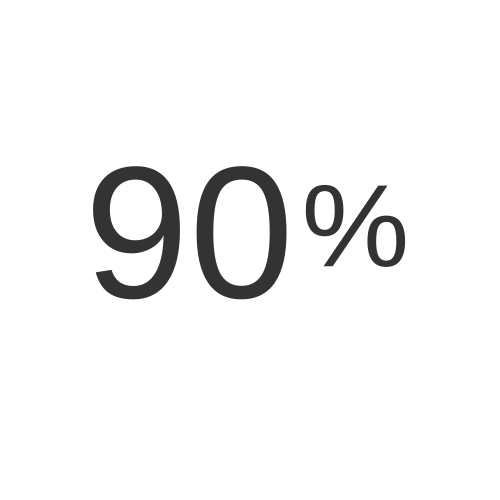 1
1This is a great list!
Here's some stuff that isn't in your list that I think comes up often enough that aspiring ML researchers should eventually know it (and most of this is indeed universally known). Everything in this comment is something that I've used multiple times in the last month.
- Linear algebra tidbits
- Vector-matrix-vector products
- Probably einsums more generally
- And the derivative of an einsum wrt any input
- Probably einsums more generally
- Matrix multiplication of matrices of shape [A,B] and [B,C] takes 2ABC flops.
- This stuff comes up when doing basic math about the FLOPs of a neural net architecture.
- Vector-matrix-vector products
- Stuff that I use as concrete simple examples when thinking about ML
- A deep understanding of linear regression, covariance, correlation. (This is useful because it is a simple analogy for fitting a probabilistic model, and it lets you remember a bunch of important facts.)
- Basic facts about (multivariate) Gaussians; Bayesian updates on Gaussians
- Variance reduction, importance sampling. Lots of ML algorithms, e.g. value baselining, are basically just variance reduction tricks. Maybe consider the difference between paired and unpaired t-tests as a simple example.
- This is relevant for understanding ML algorithms, for doing
29
I think I somewhat disagree here, I think that often even good empirics-focused researchers have background informal and not-so-respectable models informed by mathematical intuition. Source is probably some Dwarkesh Patel interview, but I’m not sure which.
4
I think this is largely right point by point, except that I’d flag that if you are rarely using eigendecomposition (mostly at the whiteboard, less so in code), you are possibly bottlenecked by a poor grasp of eigenvectors and eigenvalues.
Also, a fancy linear algebra education will tell you exactly how matrix log and matrix exponent work, but all you need is that 99% of the time any number manipulation you can do with regular logs and exponents will work completely unmodified with square matrices and matrix logs and exponents, but if you don’t know about matrix logs at all this will be a glaring hole: I use these constantly in actual code. ( Actually 99% is definitely sampling bias- for example, given matrices A and B, log(AB) only equals log(A) + log(B) if A and B share eigenvalues, and them being numerically equal may require being tricky about which branch of the log to pick, and my pleading may fall on deaf ears that well of course, but you’d only think to try it if they share eigenvalues and you’re doing an operation later that kills branch differences so in practice when you try it it works)
4
this feels intuitively true to me, but I'm also very biased - I've basically shovelled all of my skill points into engineering and research intuition, and have only a passable understanding of math, and this generally has not been a huge bottleneck for me. but maybe if I knew more math i'd know what I'm missing out on
TurboTax and H&R Block famously lobby the US government to make taxes more annoying to file to drum up demand for their products.[1] But as far as I can tell, they each only spend ~$3-4 million a year on lobbying. That's... not very much money (contrast it with the $60 billion the government gave the IRS to modernize its systems or the $4.9 billion in revenue Intuit made last fiscal year from TurboTax or the hundreds of millions of hours[2] spent that a return-free tax filing system could save).
Perhaps it would "just" take a multimillionaire and a few savvy policy folks to make the US tax system wildly better? Maybe TurboTax and H&R Block would simply up their lobbying budget if they stopped getting their way, but maybe they wouldn't. Even if they do, I think it's not crazy to imagine a fairly modest lobbying effort could beat them, since simpler tax filing seems popular across party lines/is rather obviously a good idea, and therefore may have an easier time making its case. Plus I wonder if pouring more money into lobbying hits diminishing returns at some point such that even a small amount of funding against TurboTax could go a long way.
Nobody seems to be tryin...
1The world seems bottlenecked on people knowing and trusting each other. If you're a trustworthy person who wants good things for the world, one of the best ways to demonstrate your trustworthiness is by interacting with people a lot, so that they can see how you behave in a variety of situations and they can establish how reasonable, smart, and capable you are. You can produce a lot of value for everyone involved by just interacting with people more.
I’m an introvert. My social skills aren't amazing, and my social stamina is even less so. Yet I drag myself to parties and happy hours and one-on-one chats because they pay off.
It's fairly common for me to go to a party and get someone to put hundreds of thousands of dollars towards causes I think are impactful, or to pivot their career, or to tell me a very useful, relevant piece of information I can act on. I think each of those things individually happens more than 15% of the time that I go to a party.
(Though this is only because I know of unusually good cause areas and career opportunities. I don't think I could get people to put money or time towards random opportunities. This is a positive-sum interaction where I'm ...
 1
1