There's this bit from Chandler's "The Long Goodbye", one of my favorite books:
"Maybe I can quit drinking one of these days. They all say that, don't they?"
"It takes about three years."
"Three years?" He looked shocked.
"Usually it does. It's a different world. You have to get used to a paler set of colors, a quieter lot of sounds. You have to allow for relapses. All the people you used to know well will get to be just a little strange. You won't even like most of them, and they won't like you too well."
With losing faith I imagine it's like that too. There's no longer a voice booming at you that you must avoid death, or behave morally or whatnot. From now on, the motivation has to come from you and from the world around you, and it'll be quieter at first. You won't find it in one philosophical swoop (and I'd be wary of anyone offering you such a swoop: you're vulnerable right now). It'll have to come gradually, in time. Just give it time.
I’m sorry to hear that. What helped me was finding (after many years) a non-denominational church where I could get a community and weekly lectures on morality but without the supernatural baggage.
Good luck!
When I deconverted, I found the following readings helpful in orienting to a new worldview:
- Eliezer's Sequences. Many of these are explicitly about the problem of finding meaning in a godless world. But even the articles that are not about that demonstrate a hard-to-summarize way of orienting to the world that can be healthy and joyful. Particularly relevant sequences:
- Luke's old Common Sense Atheism blog. I liked following his journey from Christianity to atheism and beyond.
But most importantly, I benefited from talking with friends about the big questions ("How do we feel about death?"), the small questions ("Which religiously proscribed activities are fun, and how do I do them?"), and nonreligious questions that I needed to reexamine (history, politics, race, gender). I hung out with my college's Atheism/Humanism/Agnosticism student group and the local Less Wrong meetup, where I met some newly-deconverted people.
I was just reminded of this post of yours in the suggested posts section at the bottom of this page. Based on that, I especially recommend:
- Reading Existential Angst Factory;
- Focusing on solving the biggest practical problems in your everyday life;
- Talking to your psychiatrist about experimenting with different medications, if appropriate;
- Finding a good talk therapist, if you're able.
"I'd rather be sad than wrong."
What's helped me is to realize that "sad" and "wrong" are different dimensions, and don't need to be correlated at all.
I grew up in a less-community-intensive church than LDS, and my intellectual beliefs have been purely atheist since my mid-teens. My professed beliefs among some groups of family and community is more agnostic, and I'm very comfortable with others believing things that seem unlikely to me, as long as we can still cooperate in having fun and improving the world (which means I'm not part of groups that demand explicit declarations I don't believe).
Happiness for most humans does require community and love from other humans. It may or may not require (it doesn't for me, nor for a lot of people I know, but it could for some) having a strong belief in supernatural meaning. Helping to improve the lived experience of existing and near-future-probable-humans is meaningful and wonderful. Reality is enough.
But don't sleep on community and personal relationships. These often require compromise and even some unresolved disagreement on things that seem important. From what I can tell, LDS is among the more effective community-building religions, and does seem somewhat accepting of socially-compatible unbelievers.
This is very good. I'd argue that "sadness" and "wrongness" are irreversibly correlated in this context - it'll always be easier to create joyful illusions like eternal families than it is to face hard truths like inevitable death - but it's worthwhile to explore options that would decouple them.
I'm a bit nervous about making my beliefs (and lack thereof) public knowledge for now. The Church wouldn't necessarily ostracize me, but I could be labeled "inactive" (even if I still participate in events like Sunday services) and my family could be the target of unwanted attention as (well-meaning) people try to "fix" me.
I will definitely explore options for social support, though. Thank you for your suggestions.
I became an atheist in September of 2025. I really sympathise with you here.
I like being alive, it's fun! Things have meaning because we assign them meaning, in my opinion. Fight for good things, and help others be happy. Sorry for the short and simple reply (I'm tired) but I hope it's better than nothing, and if you want to talk deconversion feel free to message me!
You may find my blog post on my deconversion interesting: https://blueprintingheaven.substack.com/p/deconversion-has-been-a-real-productivity
For me, becoming an atheist translated into a burning fire to live and help humanity live, for us to progress and be happy. I hope reading my post can help you feel this way!
Try Kevin Simler's A Nihilist's Guide to Meaning and David Chapman's Schematic overview of stances towards purpose: mission, materialism, and enjoyable usefulness?
Why should anything matter if we're just arbitrary self-reinforcing arrangements of chemicals?
Why should anything matter if we were something else?
(This is probably not helping, but... the thing you imagine that you have lost, perhaps you have never had it.)
Suppose that you learn that instead of being chemicals, we are actually particles of a fart of a great god Gugulag. Why specifically should learning this information make you feel happier, and your life more meaningful?
Is it because you think that Gugulag is cool (after all, your entire village worships him), so being connected to him in any way makes you cool? So, basically, is this about your perception of your own social status?
Or is it because you expect Gugulag to have a plan for you? So, basically, you need someone to tell you what to do, and perhaps also take responsibility for the outcome?
Or does Gugulag provide a convenient Schelling point for coordination? Like, it would be really sad if there were many good people who end up fighting each other because they disagree on what is good? Luckily, we all know that worshiping Gugulag is the greatest good, so now all the good people can easily agree on the same answer and they don't have to fight anymore. (And those who disagree, obviously aren't as good as they think they are.)
Something else...?
Maybe some of these points can be addressed separately. Maybe not. Perhaps you could try to make plans yourself? Or even respect yourself? (After all, you are currently one of the smartest beings in existence.) Love yourself unconditionally? Try to figure out for yourself what is good?
The advantage of Gugulag was that he was supposed to be infinite, omniscient, omnipotent, omni-whatever. Yeah, those things do not exist, it was a lie.
That doesn't mean that your desires that you connected with him were invalid. You just have to accept that the solutions to them won't be perfect and infinite. But there still could be some pretty okay solutions.
One of the nice things about realizing that you're Douglas Adams' puddle is that the nature of cosmic reality doesn't have much to do with what you have for lunch. I think if you frame things more concretely, your questions will be more answerable.
Don't you want things? What do you want?
Why you want those things has to do with your particular circumstance, but this is probably what you believed before. And if you start thinking about what you want, as opposed to what you should want, you may find that it's not a simple and unsatisfying thing, but that there's a lot of depth there. And I suspect you'll find also that what you want is sort of warm and fuzzy and prosocial. These things seem to be in most of our firmware. Tautologically, I like that.
If self-reference isn't satisfying, and you want grand cosmic majesty, I think that if you look up at the sky and keep asking why, you will find plenty of wonder. Tegmark thinks that all things which can be, are. Can we ask for more?
Also, I'm happy to chat anytime if you ever need someone to talk to.
Thank you for your comment and your offer for conversation; I'll definitely keep that in mind. I also really appreciate the wondrous tone of your comment.
Your point about connecting with my desires is good, but at the moment it's struggling to hit home. I would've previously given a sort of "religious utilitarian" answer, something like "I want to ensure that as many souls find eternal happiness as possible." Reframing that as a more general sense of maximizing human joy is functional, but it feels like it lacks a solid foundation when joy is reducible to an arbitrary arrangement of atoms. My "wants" themselves are just the system trying to self-propagate.
I'll still think on your points, though. Very helpful.
Noticing that a description of a system from the intentional stance is isomorphic to a description from the physical stance when you have perfect information can help with this feeling. Otherwise in one frame you feel like you have something magical (in a good way), and in the other stance you have "just" what's actually there. It's both. It's one thing (you), described in 2 ways. It's not that one is right and one is wrong - think of it as a unification of 2 frameworks, or a mapping between the 2 sides of the dualism you were used to previously. You're still a cool guy who likes jazz or whatever in addition to being a transient pattern of excitation in some fields.
And yeah, if you thought that God said "do X" then maybe you might want to see if there's any other reason to do X. But don't take that as a license to be a sociopath, or selfish, or whatever. Number 1, that isn't what most of us want when we notice that we like other people and account for secondary and tertiary effects of our actions. And number 2, the rest of us will be angry at you and try to stop you, because we explicitly don't want that.
I think you're mixing your metaphors when you say this:
"the system trying to self-propagate."
You have an intentional / teleological word, "trying", mixed in with your physicalism. That's going to get confusing. In the physical stance, systems don't try. You're a pattern which has propagated so far. From the intentional stance, is self-propagation actually what you're trying to do? I suspect not. I suspect you're trying to do other stuff, like read this message, and figure out what's for lunch. You're the captain of the ship - why describe yourself in physical terms then try to guess at what you want, when you can just check directly?
 1
1First, I sympathise! And I don't think your sadness is a mistake; I grew up with quite fuzzy religious beliefs and moved away from them gradually, but if I had been a true believer I think I would have felt a great sense of loss. And I've certainly felt (and sometimes continue to feel) a range of negative existential emotions that could have been comforted or completely obviated by religious belief. But I don't think your new worldview has the ramifications you're implying it does.
Why should anything matter if we're just arbitrary self-reinforcing arrangements of chemicals?
We're not "just" that, unless you're taking for granted that "arbitrary self-reinforcing arrangements of chemicals" have the capacity for joy, suffering, love, creativity, kindness, and so on and so on. And if you are taking that for granted, well, the question almost answers itself! If someone's suffering and you comfort them, or if you have a family and you love them, why on earth shouldn't that matter?
It matters to those other people, and I'm guessing that, at least at some level, it also still matters to you. I think you can choose to embrace that, rather than talking yourself out of it just because there's probably no divine third party who also cares.
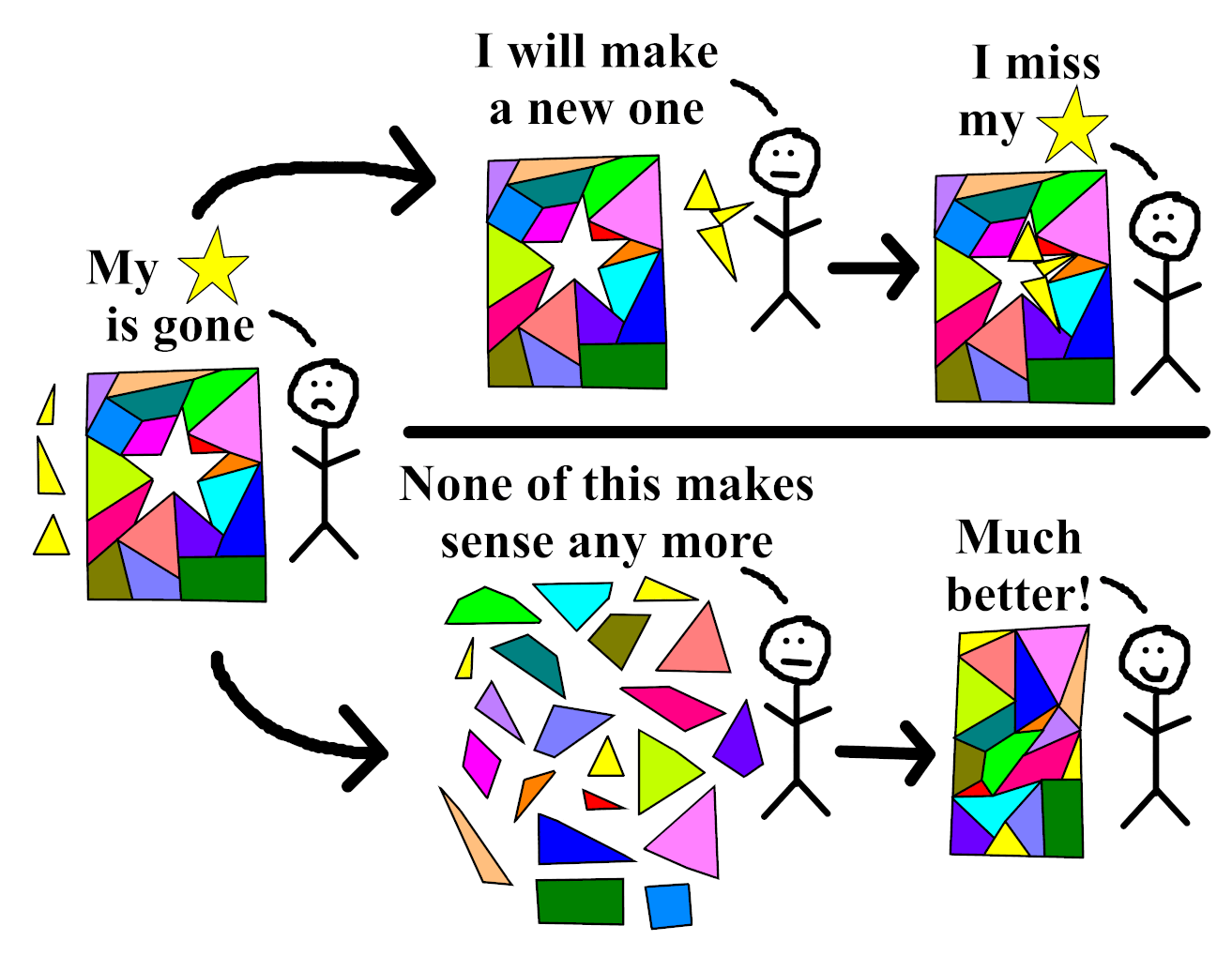
I think some of the comments suggesting you cobble together an "ersatz religion" [1] are misguided - it will always feel like a fake, inferior substitute for the real thing, because that's what it is. Instead I suggest: read up on a wide variety of perspectives from different cultures and historical periods, and try to imagine how they feel from the inside. Then you might see that the very concept of "religion" is rather more fuzzy and contingent than you may have thought, and you'll feel less of a sense that you're missing something important.
This motivated me to start writing an explainer about "ersatzness" which I think is a useful concept in general. It's not ready yet, but the above crudely-drawn visual aid conveys the essence of it. ↩︎
"I'd rather be sad than wrong."
Your prior expectation was that deconversion would bring you sadness, and now you are sad. Perhaps there's something at play like a performative effect or a self-fulfilling prophecy. At least that could be part of it.
I grew up in an environment where religion and especially faith was a very individual and private matter, with nobody talking about it publicly. Most of my parents and friends were neither true agnostics nor true atheists, but rather not interested in the subject. I was among this category. Churches and Christian artifacts were simply art, history and culture, like Greek, Roman or Egyptian traditions and remnants. We had great interest in this cultural aspect. I became a true atheist after reading Dawkins and various philosophers.
I've never seen the atheist condition as something sad. You are a free and genuine moral agent, you don't do good out of fear of being thrown into hell. You're not subject to a mysterious supernatural will that could ask you to sacrifice your son or cast a meteor shower on your town because your friend is gay, nor to miracles violating causality. Nature shows terrible things but also beauty and happiness, which you can seek, cherish and cultivate. It's up to us humans to make the world a hell like Mordor or a paradise like the Shire or Lothlórien. Nothing is written, you're not a character in God's novel. You are the author, you write the story. Life is yours.
However, I didn't go through deconversion myself, and I can understand that you might endure a feeling of loss, the loss of a promised paradise, of an enchanted world. Religion was part of your life, of your childhood; this was a very courageous move and not an easy one. You must be facing something like mourning.
However, maybe Gendlin's litany can help ? The world was already as it is when you were a child, it has not changed, nothing is truly lost, happiness is still there, just where it was. Maybe you can go back to the places you cherished in your childhood, even the church - it's still there, you can still enjoy the place. And look at the children playing. The enchantment was always in their eyes, not in the world.
Maybe part of what you feel is mourning for childhood itself. I also feel that, but atheism is not guilty.
An excellent response. Thank you for describing your experience - I kind of wish I'd grown up in a similar environment.
I'm familiar with Gendlin's litany, but I've often found it slightly lacking. Humans are imaginative creatures, and our beliefs about a subject hold genuine psychological power. If we imagine that a placebo is beneficial, it becomes so. If I believe that death is impermanent, it loses much of its sting. To invert Gendlin, I'm uncertain if I can stand what is true, for I never really had to endure it.
I'll still keep your points in mind - they're valuable. Thank you for sharing them.
Knowing truth doesn't provide, by itself, human connection. In the Mormon church you had a community, people with whom you interacted and had a common ground, shared interests, and collective goals. When one breaks with such a community, without having first established a new one, the result may be extreme loneliness.
The way to fix that is to find a new community. Many atheists and rationalists schedule periodic meetings to interact with each other and talk in person, so depending on your need of connection that might suffice. If not, there are church-like organizations that require no profession of faith and welcome atheists, which is particularly effective if one's been raised with church attendance and miss that. In the US Unitarian Universalism is one of the oldest movements along those lines, with the form of Protestant Christianity minus the belief system, but there are others. This CBS article lists several: Inside the "secular churches" that fill a need for some nonreligious Americans.
If you're not particularly attached with atheism itself, you also have the option of exploring personal religiosity and communities that go along with those, which basically means constructing your own religion from your own experiences, which can be induced through mean ranging from meditation and self-suggestion all the way to psychedelic trips. Doing that while remaining 99% a rationalist isn't particularly difficult, the cost being embracing compartmentalization. But then, if that's what it takes for one to find enough meaning in the world that they want to continue on it, I'd say it's a price well worth paying. It's what I myself do, and it hasn't caused me any major problem, my take simply being that, if what I perceive is true, science will eventually catch-up, and if it isn't, as long as I'm not trying to assert it above the perfectly legitimate skepticism of others, then shrugs.
So, my suggestion, in order, would be: meet other atheists and rationalists in real life with some regularity; if that isn't enough, try a church-like atheist/agnostic/agnostic-friendly community; and if that still isn't enough, do your own thing with others doing similarly.
An excellent series of suggestions. At the moment, I haven't left the Church's community, so I don't feel that loss just yet. I'll still keep that in mind.
As for coming up with a "personal religion", I'll have to give that some thought. Arguably the one real-world religion that comes closest to my personal understanding of objective reality is Secular Buddhism. Perhaps embracing that more fully could give me some peace.
At the moment, I haven't left the Church's community, so I don't feel that loss just yet.
There's a potential middle-way there.
I don't know much about Mormonism, mind, but I watch and read a Biblical scholar, Dan McClellan, who's skeptical of everything and then some. His YouTube channel, and other videos in which he appears, as well as his papers and books, are all in line with the academic consensus in Biblical scholarship, meaning he deconstructs every single Christian belief (and most Jewish ones too) to the point it's easy to assume he's a militant Atheist. But he's actually a practicing Mormon, and his intense criticism extends to the books of the Mormon canon.
Contacting him might thus help. if someone like him can be an active member of the LDS church, even if it's in some kind of minority movement, you might find a way to similarly keep both things going.
Arguably the one real-world religion that comes closest to my personal understanding of objective reality is Secular Buddhism.
That's what I myself follow, mixed with some Taoism and Shinto. It's a combination that works well for me.
If you go with Buddhism, it'll help to familiarize yourself with the concept of Apatheism, which is distinct from Theism, Atheism and Agnosticism, and see if you'd be comfortable adopting it, since that's the Buddhist take on things.
To summarize: Theisms care about deities and affirm their existence. Atheism cares about deities and affirms they don't exist. Agnosticism cares about deities and wishes it knew if one or the other take. As such, all three fall under the umbrella term Patheism: caring about the existence or inexistence of deities.
Apatheism is strict indifference towards deities. There are Apatheists who think deities exist, but if they don't, nothing of import was lost. There are those who think they don't exist, but if perchance they do, they still don't matter much, or at all (though in that case it's advisable to try and teach them Buddhism too, so they become better deities). And there are those who don't know, and really don't care. So Apatheism has equivalents to Theism, Atheism and Agnosticism, but their Apatheistic counterparts are so weakly distinct it barely registers.
Buddhism is the Apatheistic religion par excellence, so adopting that rather than Atheism or Agnosticism makes it much easier to understand its philosophy and to put it into practice.
Why should anything matter if we're just arbitrary self-reinforcing arrangements of chemicals? Why should I avoid death if it's just the chemicals finding a new arrangement?
Let me propose a new theology. God and souls are real, but God only cares about order, not good; and souls die with the body. Nonetheless, souls are the only thing in the world that can understand good, and is capable of acting in favor of good (or evil). I think that would be truer to the nature of reality than the depressed materialism that you have landed in for now. The fact is, reality is not just atoms, it's also mysteriously persistent order; consciousness exists, and it is still unknown how it relates to the world of atoms; and, we do have something like a moral sense, even in the absence of a benevolent deity. Philosophy can replace religion, and then all you need is the vital energy to act in the world again.
I grew up a Mormon, but recently decided that the evidence strongly supports atheism instead of any religious worldview. My motto has become "I'd rather be sad than wrong."
Unfortunately, I have indeed become very sad as I think about the ramifications of my new worldview. Why should anything matter if we're just arbitrary self-reinforcing arrangements of chemicals? Why should I avoid death if it's just the chemicals finding a new arrangement?
I've explored several philosophical schools to try and cope (constructivism, nihilism, existentialism, etc.), but very little is actually making a difference.
What helped people in this community with similar experiences?