In an update, the cruxes of disagreement with your past selves (facts or framings, where legible) would be directly more interesting than changes in downstream predictions.
For me over 2025, updates on RLVR mostly rearranged what is likely to happen soon (some forms of 2026-2027 AGI got more likely because IMO, but other forms of 2026-2030 AGI got less likely because jaggedness of RLVR), rumors of continual learning (in conjunction with IMO results) increased chances of higher pre-AGI TAM for an AI company within 3-10 years (something around 1 trillion dollars per year), making pre-AGI 20-50 GW training systems more likely in 2030-2035 (for the supply chains to make it possible, more money needs to systematically go into datacenters before that first, it's not enough for money to be suddenly there in 2033). So the median for AGI remains around 2032-2033, maybe it got 1 year shorter from expecting more compute by 2035 and from cheapness/ease of reaching IMO-level capabilities, even if they remain jagged and not obviously directly usable on their own in building AGI.
Fair enough. There is some reasoning on my end at the bottom of the post:
Dec 2024: 2032. Updated on early versions of the timelines model predicting shorter timelines than I expected. Also, RE-Bench scores were higher than I would have guessed.
Apr 2025: 2031. Updated based on the two variants of the AI 2027 timelines model giving 2027 and 2028 superhuman coder (SC) medians. My SC median was 2030, higher than the within-model median because I placed some weight on the model being confused, a poor framework, missing factors, etc. I also gave some weight to other heuristics and alternative models, which seemed overall point in the direction of longer timelines. I shifted my median back by a year from SC to get one for TED-AI/AGI.
Jul 2025: 2033. Updated based on corrections to our timelines model and downlift.
Nov 2025: 2035. Updated based on the AI Futures Model’s intermediate results. (source)
Jan 2026: Jan 2035 (~2035.0). For Automated Coder (AC), my all-things-considered median is about 1.5 years later than the model’s output. For TED-AI, my all-things-considered median is instead 1.5 earlier than the model’s output, because I believe the model’s takeoff is too slow, due to modeling neither hardware R&D automation nor broad economic automation. See my forecast here. My justification for pushing back the AC date is in the first “Eli’s notes on their all-things-considered forecast” expandable, and the justification for adjusting takeoff to be faster is in the second.
And Daniel and I both wrote up relevant reasoning in our model announcement post. (edit: and Daniel also wrote some at the bottom of this blog post).
How far is it from Claude Code to superhuman coder?
I wish I had a more confident answer to give you! But my answer is:
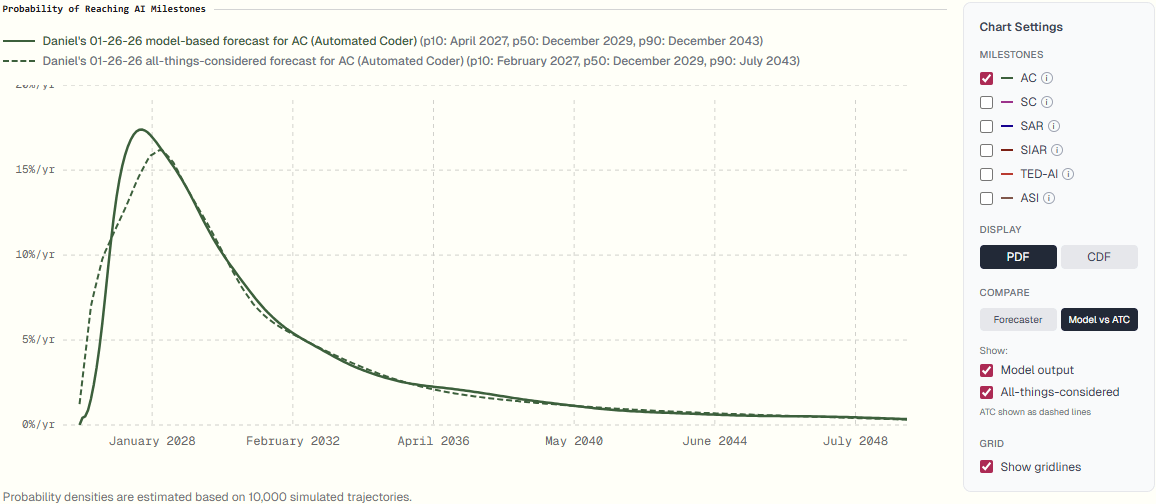
You can read more about it here: https://www.aifuturesmodel.com/forecast/daniel-01-26-26
(OK this is for Automated Coder which is a somewhat weaker milestone than Superhuman Coder, we are switching to it because it seems a more appropriate milestone)
At least to me Claude 4.5 definitely reminds me of the description of Agent-1 in ai-2027 for Early 2026: "On the other hand, Agent-1 is bad at even simple long-horizon tasks, like beating video games it hasn’t played before. Still, the common workday is eight hours, and a day’s work can usually be separated into smaller chunks; you could think of Agent-1 as a scatterbrained employee who thrives under careful management. Savvy people find ways to automate routine parts of their jobs."
Have you reached out to your press contacts about this? If not, why not? (feel free to DM if sensitive)
I helped with a previous situation similar to this and ‘contact the journalists’ was a definite step in our process.
If useful, I may be able to get you in touch with people who have experience on the researcher side here, or ask advice from some senior journalists.
I don't really track p(doom) that closely (or think that much about it) compared to timelines and takeoff speeds. Overall over the past few years it's been one piece of bad news after another on the governance side, mostly, but on average good news on the technical side. At least that's my opinion. I usually say it roughly cancels out in my mind. Basically, AGI is going to be built in more haste, by less competent people, with less wiggle room to make it safe, than I expected in 2022, but on the bright side, we've made steady progress in various forms of interpretability and it seems like we have a decent shot at getting a roughly human-level automated alignment researcher that's nonscheming / honest / etc. and hopefully they'll be able to solve the rest of the problem for us fast enough.
Do you think it would be useful to contrast your views with those of Yudkowksy/Soares/MIRI? Both parties seem largely aligned on the direction of the efforts that need to be made, with the MIRI folks making a more fundamental conditional statement about alignment, and yours seeming less pessimistic about its tractability given the potential for bootstrapping alignment via automated researchers, which is the crux of MIRI's catch-22 view on the matter
That seems like a reasonable summary to me of the contrast.
Some recent news articles discuss updates to our AI timelines since AI 2027, most notably our new timelines and takeoff model, the AI Futures Model (see blog post announcement).[1] While we’re glad to see broader discussion of AI timelines, these articles make substantial errors in their reporting. Please don’t assume that their contents accurately represent things we’ve written or believe! This post aims to clarify our past and current views.[2]
The articles in question include:
Our views at a high level
Important things that we believed in Apr 2025 when we published AI 2027, and still believe now:
How exactly have we changed our minds over the past 9 months? Here are the highlights. See https://www.datawrapper.de/_/vAWlE/ for the same table but with links to sources for most of the predictions.
Here is Daniel’s current all-things-considered distribution for TED-AI:
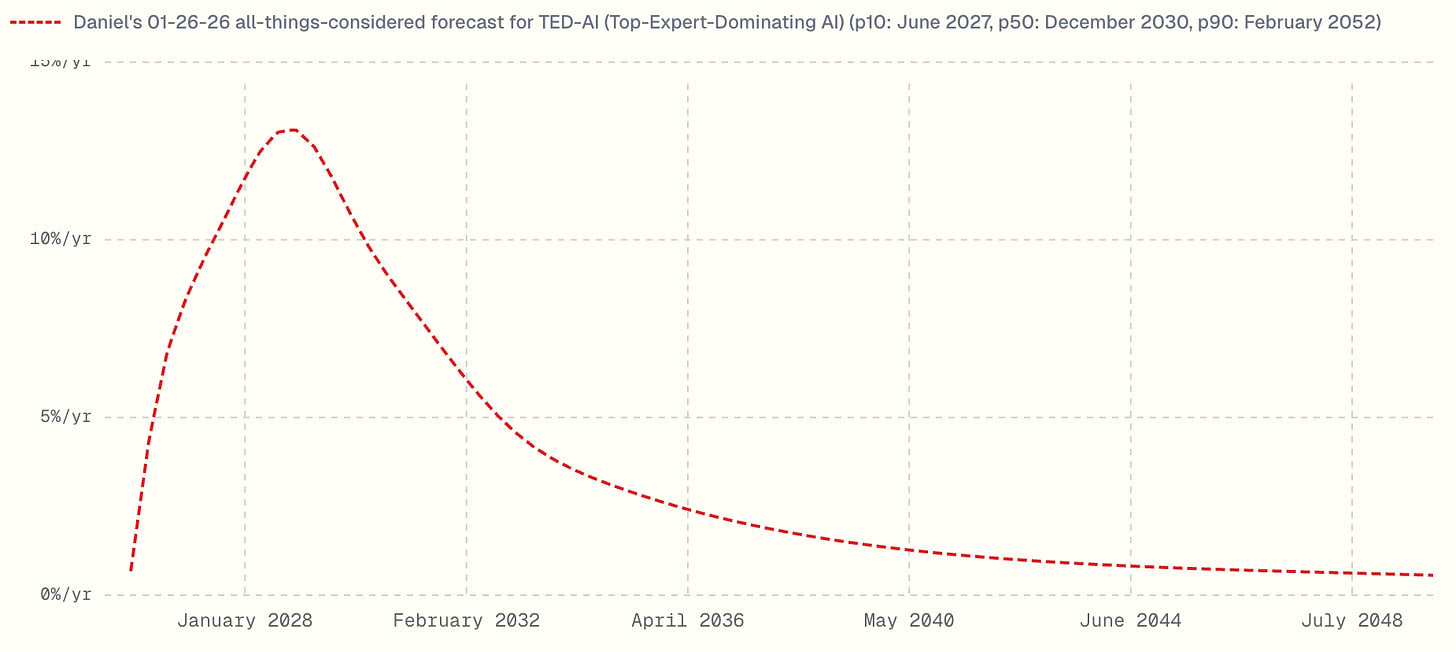
If you’d like to see a more complete table including more metrics as well as our model’s raw outputs, we’ve made a bigger table below.
We’ve also made this graph of Daniel and Eli’s AGI medians over time, which goes further into the past:
See below for the data behind this graph.
Correcting common misunderstandings
Categorizing the misunderstandings/misrepresentations in articles covering our work:
Implying that we were confident an AI milestone (e.g. SC, AGI, or ASI) would happen in 2027 (Guardian, Inc, Daily Mirror). We’ve done our best to make it clear that it has never been the case that we were confident AGI would arrive in 2027. For example, we emphasized our uncertainty several times in AI 2027 and, to make it even more clear, we’ve recently added a paragraph explaining this to the AI 2027 foreword.
Comparing our old modal prediction to our new model’s prediction with median parameters (Guardian, Independent, WaPo, Daily Mirror), and comparing our old modal prediction to Daniel’s new median SC/AGI predictions as stated in his tweet (WaPo). This is wrong, but tricky since we didn’t report our new mode or old medians very prominently. With this blog post, we’re hoping to make this more clear.
Implying that the default displayed prediction on aifuturesmodel.com, which used Eli’s median parameters until after the articles were published, represents Daniel’s view. (Guardian, Independent, WaPo, Daily Mirror). On our original website, it said clearly in the top-left explanation that the default displayed milestones were with Eli’s parameters. Still, we’ve changed the default to use Daniel’s parameters to reduce confusion.
Detailed overview of past timelines forecasts
Forecasts since Apr 2025
Below we present a comprehensive overview of our Apr 2025 and recent timelines forecasts. We explain the columns and rows below the table. See https://www.datawrapper.de/_/m4PVM/ for the same table but with links to sources for most of the predictions, and larger text.
The milestones in the first row are defined in the footnotes.
Explaining the summary statistics in the second row:
Explaining the prediction sources in the remaining rows:
2018-2026 AGI median forecasts
Below we outline the history of Daniel and my (Eli’s) forecasts for the median arrival date of AGI, starting as early as 2018. This is the summary statistic for which we have the most past data on our views, including many public statements.
Daniel
Unless otherwise specified, I assumed for the graph above that a prediction for a specific year is a median of halfway through that year (e.g. if Daniel said 2030, I assume 2030.5), given that we don’t have a record of when within that year the prediction was for.
2013-2017: Unknown. Daniel started thinking about AGI and following the field of AI around 2013. He thought AGI arriving within his lifetime was a plausible possibility, but we can’t find any records of quantitative predictions he made.
2018: 2070. On Metaculus Daniel put 30% for human-machine intelligence parity by 2040, which maybe means something like 2070 median? (note that this question may resolve before our operationalization of AGI as TED-AI, but at the time Daniel was interpreting it as something like TED-AI)
Early 2020: 2050. Daniel updated to 40% for HLMI by 2040, meaning maybe something like 2050 median.
Nov 2020: 2030. "I currently have something like 50% chance that the point of no return will happen by 2030." (source)
Aug 2021: 2029. “When I wrote this story, my AI timelines median was something like 2029.” (source)
Early 2022: 2029. "My timelines were already fairly short (2029 median) when I joined OpenAI in early 2022, and things have gone mostly as I expected." (source)
Dec 2022: 2027. Daniel joined OpenAI in late 2022 and his median dropped to 2027. “My overall timelines have shortened somewhat since I wrote this story… When I wrote this story, my AI timelines median was something like 2029.” (source)
Nov 2023: 2027. 2027 as “Median Estimate for when 99% of currently fully remote jobs will be automatable” (source)
Jan 2024: 2027. This is when we started the first draft of what became AI 2027.
Feb 2024: 2027. “I expect to need the money sometime in the next 3 years, because that's about when we get to 50% chance of AGI.” (source, probability distribution)
Jan 2025: 2027. “I still have 2027 as my median year for AGI.” (source)
Feb 2025: 2028. “My AGI timelines median is now in 2028 btw, up from the 2027 it's been at since 2022. Lots of reasons for this but the main one is that I'm convinced by the benchmarks+gaps argument Eli Lifland and Nikola Jurkovic have been developing. (But the reason I'm convinced is probably that my intuitions have been shaped by events like the pretraining slowdown)” (source)
Apr 2025: 2028. “between the beginning of the project last summer and the present, Daniel's median for the intelligence explosion shifted from 2027 to 2028” (source)
Aug 2025: EOY 2029 (2030.0). “Had a good conversation with @RyanPGreenblatt yesterday about AGI timelines. I recommend and directionally agree with his take here; my bottom-line numbers are somewhat different (median ~EOY 2029) as he describes in a footnote.” (source)
Nov 2025: 2030. "Yep! Things seem to be going somewhat slower than the AI 2027 scenario. Our timelines were longer than 2027 when we published and now they are a bit longer still; 'around 2030, lots of uncertainty though' is what I say these days." (source)
Jan 2026: Dec 2030 (2030.95). (source)
Eli
Unless otherwise specified, I assumed for the graph above that a prediction for a specific year is a median of halfway through that year (e.g. if I said 2035, I assume 2035.5), given that we don’t have a record of when within that year the prediction was for.
2018-2020: Unknown. I began thinking about AGI in 2018, but I didn’t spend large amounts of time on it. I predicted median 2041 for weakly general AI on Metaculus in 2020, not sure what I thought for AGI but probably later.
2021: 2060. 'Before my TAI timelines were roughly similar to Holden’s here: “more than a 10% chance we'll see transformative AI within 15 years (by 2036); a ~50% chance we'll see it within 40 years (by 2060); and a ~2/3 chance we'll see it this century (by 2100)”.’ (source). I was generally applying a heuristic that people into AI and AI safety are biased toward / selected for short timelines.
Jul 2022: 2050. “I (and the crowd) badly underestimated progress on MATH and MMLU… I’m now at ~20% by 2036; my median is now ~2050 though still with a fat right tail.” (source)
Jan 2024: 2038. I reported a median of 2038 in our scenario workshop survey. I forget exactly why I updated toward shorter timelines, probably faster progress than expected e.g. GPT-4 and perhaps further digesting Ajeya's update.
Mid-2024: 2035. I forget why I updated, I think it was at least in part due to spending a bunch of time around people with shorter timelines.
Dec 2024: 2032. Updated on early versions of the timelines model predicting shorter timelines than I expected. Also, RE-Bench scores were higher than I would have guessed.
Apr 2025: 2031. Updated based on the two variants of the AI 2027 timelines model giving 2027 and 2028 superhuman coder (SC) medians. My SC median was 2030, higher than the within-model median because I placed some weight on the model being confused, a poor framework, missing factors, etc. I also gave some weight to other heuristics and alternative models, which seemed overall point in the direction of longer timelines. I shifted my median back by a year from SC to get one for TED-AI/AGI.
Jul 2025: 2033. Updated based on corrections to our timelines model and downlift.
Nov 2025: 2035. Updated based on the AI Futures Model’s intermediate results. (source)
Jan 2026: Jan 2035 (~2035.0). For Automated Coder (AC), my all-things-considered median is about 1.5 years later than the model’s output. For TED-AI, my all-things-considered median is instead 1.5 earlier than the model’s output, because I believe the model’s takeoff is too slow, due to modeling neither hardware R&D automation nor broad economic automation. See my forecast here. My justification for pushing back the AC date is in the first “Eli’s notes on their all-things-considered forecast” expandable, and the justification for adjusting takeoff to be faster is in the second.
In this post we’re mostly discussing timelines to AI milestones, but we also think “takeoff” from something like AGI or full coding automation to vastly superhuman AIs (e.g. ASI) is at least as important to forecast, despite getting far less attention. We focus on timelines because that’s what the articles have focused on. ↩︎
From feedback, we also think that others besides the authors of these articles have had trouble understanding how our views and our model’s outputs have changed since AI 2027, giving us further motivation to make this post. ↩︎