This is interesting work, but I don't think it's a significant update to the big picture of interpretability.
I'm on board with the broad idea of doing exploratory interpretability with neurons, e.g. neuron-based attribution graphs, for pragmatic problems like why did a model do a sketchy thing? I think this work provides some reasonable evidence, in addition to good earlier work from Transluce, that this might actually work for practical purposes, and has some advantages over the standard alternatives like SAEs/transcoders. I do not agree with some people's grander inferences like that this is substantial progress towards ambitious reverse engineering, solving interpretability etc.
I expect that a neuron-based attribution graph will still have significant error and be missing a lot just like transcoders, once you prune them down to the most important components, even if they solve error terms. Which is fine for pragmatic purposes, and may suffice for getting the gist of what's going on, but I remain pessimistic about really fully understanding things and being confident there's nothing we're missing. I do think that using neurons is just vastly easier to, for example, do on a frontier model, which is great. I'm also excited to see more innovation in using agents to interpret neurons. I feel like this is an area the field has somewhat neglected, and where there's probably a very high ceiling on how far things can go. The SwiGLU double negative thing is also a useful point.
I still think superposition is real and this work doesn’t really affect my cruxes. Most importantly, it seems highly likely to be true that the model can represent more concepts in the residual stream than it has dimensions, ie representational superposition, which I think the authors agree with me on. For neuron/computational superposition, it seems to me like language models have far more facts and memorized things in them than they have neurons. And that superposition is an efficient way to pack in more facts than you have neurons by representing them as linear combinations of neurons, especially for arbitrary unstructured values. Facts/memorized content is largely an unstructured database of key-value pairs IMO and I don’t see how this is compatible with a monosemantic view of neurons. I expect that weak neuron activations contain lots of semantic superposition-y info, which, if ablated, would meaningfully damage network performance. As I understand the work, it does not properly address what's going on with weak neuron activations in LLMs (I am skeptical of how much vision results will transfer, eg I expect small image models memorise far less). This picture is compatible with the highest activations of a neuron being mono semantic (though IMO the post defines monosemantic too loosely, I think I’d call a fair few of those polysemantic). It’s also plausible that the most important concepts are likely to correspond to a neuron (or a handful), which would be great, and may suffice for practical purposes!
Similarly, my impression is that SAEs generally don't find things that are a single neuron, or even very sparse in the neuron basis, and are often a better basis for certain tasks than the neuron basis, though the evidence base is kinda weak here since we largely focus on residual stream or layer output SAEs, I’d love to see work on this in Goodfire’s forthcoming paper! I also think residual stream SAEs are extremely useful, as they give a good bottleneck of the model’s information at this token and layer, and I don’t see a good way to replicate them in the neuron framework.
And kudos to Nick for updating a bunch of his historical vision work! Revisiting old results with modern tools and more rigour seems great.
Yes, this is basically correct.
in qwen (and I think most LLMs, at least the MLP part) the neurons partition the model weights by design. a neuron links an input vector to an output vector: "sky in a color context" triggers (towards) "blue". whether this is an optimal arrangement is an open question, but it seems to have reasonable practical applications.
I expect that weak neuron activations contain lots of semantic superposition-y info, which, if ablated, would meaningfully damage network performance. As I understand the work, it does not properly address what's going on with weak neuron activations in LLMs (I am skeptical of how much vision results will transfer, eg I expect small image models memorise far less).
Can you explain more why you believe the post doesn't properly address this?
EDIT: Wait duh, you said you didn't expect it to transfer to LLMs from small image models, sorry.
The post's "Do Weak Activations Matter?" section seems to make a strong experiment-backed argument that removing weak activations only loses you fine distinctions:
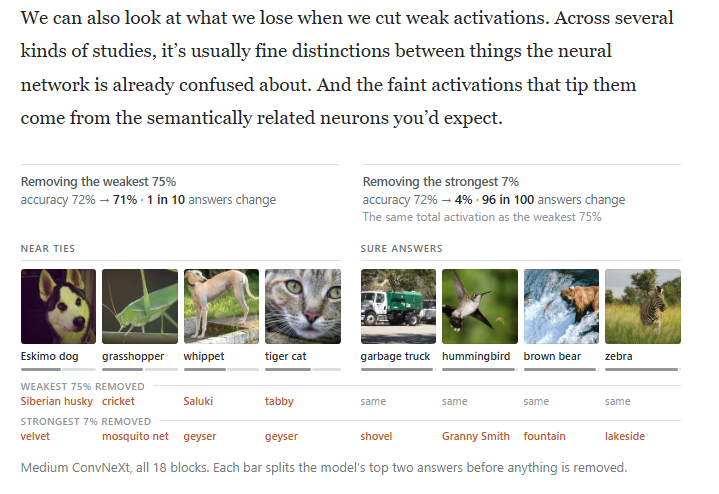
(The above image is a bit confusing, but basically, if you remove the weakest 75% of neuron activations in an image model, it loses the ability to distinguish between similar things like "tiger cat" vs. "tabby", but keeps the ability to reliably identify more core concepts like "zebra". It also notes that the strongest 7% of neuron activations are absolutely essential; cutting those breaks the model completely.)
Irrespective of the contents of the blog post itself, which would be a quite interesting post in a vacuum, I find the discourse surrounding it pretty concerning.
From Nick's X linkpost: "The roadblocks I expected mostly aren't there. I now think ambitious interpretability will be solved by the time we need it most"
From the OG SAE "Towards Monosemanticity" Blog Post: "it increasingly seems like a large chunk of the mechanistic interpretability agenda will now turn on succeeding at a difficult engineering and scaling problem, which frontier AI labs have significant expertise in"
SAEs did not solve interp, and I will bet at absurd odds that this blog post is not going to come close to solving ambitious interpretability in a concrete alignment relevant sense.
The fact that the interp posts which absurdly overclaim like this do so well among outsiders to the field (Many are now using this overclaim to present Eliezer as someone who just won't update on new evidence, and even some Pause people are talking about updating positively) is a reason i'd argue that unfortunately interp has been net negative (if only fractionally.)
The lay audience generally don't have the ability to critically interrogate a post like this, because of its long and technical nature, which imo means interp people have a duty to be responsible/measured in how they present their work.
I think this has gone viral in part because people have grown a little desperate for good AI news. Right post at the right time.
That said, while I agree that this blog post alone doesn't "solve ambitious interpretability", I think the core of Nick's claim is more "I no longer think there are insurmountable walls to scaling interpretability because of these initial results". That's a speculative claim, yes, but he does say that explicitly, at least inside the post:
4. Highly speculative: this might be most of what we need, and interpretability might be far more tractable, possibly in the near term, than we’ve assumed.
And he is surely aware of the previous SAE overoptimism... though I suppose I didn't see that mentioned in the post.
I don't think this is good enough. The X post evidently does a poor job at communicating the level of speculation involved, given how most people have interpreted it.
There was no "Highly Speculative" in the X post, and you have to know most people aren't going to read the blog post.
which imo means interp people have a duty to be responsible/measured in how they present their work
I think it would have been nice if Nick/Goodfire had shared their findings beforehand not only with their friend (roon), but also with other interp experts who could provide a more independent assessment.
I think a great example is when Anthropic asked Neel Nanda and his team to replicate their work on J-space and write an independent critique in advance.
If Nick’s work had been accompanied by a review from Neel or other experts, we might have been able to avoid hyperbolic assessments like "alignment/mech interp is solved" from people who don't understand the topic very well.
I think it would be worth a toplevel post explaining why you think Nick is too optimistic.
As Julian mentions below, I don't think Nick is as optimistic as his X post suggests.
I don't think it'd make sense to put much effort into engaging on the object level when the technical paper hasn't been released. But Roko + Leo Gao's replies on X are both quite good imo.
Adding some context and takeaways from my initial reading as I'm fairly excited about this:
(edit: have added some extra takeaways above, have not substantively changed any previous ones)
(edit2: honestly recommend reading Nick's post itself, it's well-written and has interesting tangents too, not to mention interactive features!)
(edit3: added section 1.d.iv which I think is important! boy this comment got overly complex though)
(edit4: okay I really recommend playing around with some of Nick's interactive features, ex. the five neurons in Qwen3-32B—I like the Colorado Neuron, who knew Bolivia was the Colorado of South America…?)
(edit5: fyi at least some of the core text in the blog post was written by AI according to Pangram, particularly the section around the sentence "Ten billion real tokens had their chance, and a sentence written from the explanation alone got closer." Pangram says ~2% of core blog post (not counting interactive stuff), and ~31% of the appendix, is AI with high confidence.)
I spent about an hour this morning looking over the ConvNeXt architecture, then browsing through the features on Goodfire's microscope page (the one linked from the post).
I would really love an artifact which walks through every neuron in that net, gives a human-interpretable explanation of what it does, and then presents whatever visual evidence supports that interpretation. I would happily read through every single neuron, if that artifact existed. I find it pretty plausible that Nick could produce such an artifact, but AFAICT that artifact doesn't exist yet? Just looking at the microscope page, the semantics of each neuron are not quickly obvious to me (though most of them feel like there's probably some pattern there which I could understand if I spent a lot of time per neuron staring at them).
If and when that artifact does exist, please shout it from the rooftops, I want to read it in its entirety.
That sounds like an interesting project, and might even be something you could turn into an LLM benchmark. Can you give an example of what you'd want to see as a human-interpretable explanation for one "neuron" using one you do understand the semantics of?
Have you done experiments with GANs? I suspect GANs actually have a different learning mechanism, and you would get a different kind of fractal structure. I also suspect RL does similar things to learning, but image GANs are a simpler species to study.
First impressions: The thrust of the essay, that we're much closer to fully interpreting and understanding frontier models than we thought, is big if true and both exciting and scary. It would speed up prosaic alignment and control progress, but it seems like it'd also speed up capabilities progress. For example, the author points out that the older models they studied had hard-to-interpret neurons in part because the older architecture was worse at learning in deeper layers, which implies researchers could use interpretability tools to uncover problems with their learning algorithms.
It might go further than that. I think AI 2027 (specifically the section about Agent-5 in the Race ending) predicted that mechanistic interpretability would bring about a major increase in capability through the ability to create fundamentally new AI architectures. But it assumed that mech interp could only be solved by an already superintelligent AI (Agent-4). If they are right about the first part but mech interp is easier than assumed, then we are in for a hell of a ride.
Showing that most neurons in a model encode one primary concept is not the same as showing that most concepts a model knows are represented by one neuron. Qwen3-32B has only tens of thousands of neurons per layer, right? How is this possibly enough for every complex social concept, every turn of phrase in memorized literature, neurons that help spell specific words or assist with grammar in specific languages, all the model’s knowledge of mathematics and coding and medicine, etc.?
I would like to see the authors first attempt to quantify the total number of things known by the model, when broken down as finely as in the examples given. If a plausible case can be made that this is smaller than the model’s neuron count, then monosemanticity is worth considering as a hypothesis. Otherwise it’s (cue “dead in the water“ neuron) dead in the water.
Crossposting from my Shortform, quickly written. Overall I think the essay makes valuable contributions to interpretability. But I am also worried that the community vastly overestimates the state of the field, and quite a lot of second-hand discussion I've seen online seems over-optimistic.
*superposition is used to mean different things, and I don't have time for a proper discussion at the moment. For this shortform I think the essay's definition is close enough. I want to note though that Representation in Superposition (a la Elhage et al. 2022, storing exponentially many concepts in high dimensional vector space) and Computation in Superposition (a la Hänni et al. 2024, computing polynomially many functions with fewer non-linearities than functions) are different things, and at least for Transformers it's worth distinguishing these.
But in fact, cosine similarities between feature vectors have rich semantic content [...] Features aren't just crammed together arbitrarily; they're grouped with similar features.
Adam Scherlis, 2024
Last year I wrote "Polysemanticity is a Misnomer" which made a very similar argument. I said:
When we imagine the polysemanticity of LLM neurons you probably think about something like a neuron which will trigger off of unrelated concepts like a neuron that triggers on airplane parts and phrases signifying periodic repetition. In my exploration of gpt2 -xl, I haven't really encountered neurons that are polysemantic in that way. Many times neurons signify a somewhat abstract concept which has many different instantiations in text: concluding remarks in a sales email; contemporary sci-fi adjacent fears like 5G conspiracies; a group of performers; etc[2]. While abstract these concepts do seem unitary and centralized around an intuitively identifiable and recognizable individual concept. I'm not entirely sure these neurons represent what we typically conceive of as polysemanticity.
One of the points I make is that human languages are often polysemantic themselves; the word "right' has many different meanings, right? Neuron 23:4813 in GPT2-XL captures several of these meanings together, the directional sense of "right" as well as the immediacy ("right here," "right now"), confirmatory ("right?"), and political ("right-wing," "right to life") meanings of the term. While 23:4813 does also trigger on things like "higher" and "lower" and some other directional words I don't think this supports the broadly conceived idea of polysemanticity.
I have to agree that the GPT4 interpreter used to interpret GPT2-XL neurons on OpenAI's Neuron Viewer kinda sucks. There are many examples where a neuron that I could easily interpret was given a low interpretability score and possibly an inaccurate interpretation by the GPT4 interpreter. It seems very likely that the newer more sophisticated models we have now would be better at interpretation. Interpreting a neuron is very much like thematically interpreting a short story or poem, something the models (and most humans for that matter) are also not very good at doing. As he explains you sometimes need to look at a different level of analysis, in his example looking at pose rather than looking at the noun-label of dog or car. I'd disagree that this isn't a word-level idea, it likely is just that we don't have a word for it in English or other popular languages. "Tetrapod" is very close to capturing most of what this example neuron for dogs and cars is activating on (although there may be some viewing-angle specific aspects or things like "has exactly four equally sized and compact points of contact with the ground" that are not captured in that word).
My project is also based on using a similarity map to allow easily interpreted neurons to inform interpretation of their neighbors (and to thereby spread interpretability in a manner similar to what is described in Cammarata's post). I am almost done running some confirmations on an interpretation of a similarity mapping for GPT2-XL based on forward linkages. There are two very interesting human-interpretable global conceptual gradients running through the entire mapping. I presented the preliminary findings at LessOnline and since then have developed a method of confirming my interpretations more rigorously (I'm using an automated sentiment analysis to confirm my interpretation of what appears to be a valence gradient, for example).
Edit: Corrected "Tetraped" to the actual term "Tetrapod."
Wow! The implications are amazing…
I'd love to see what happens when we point this at Emergent Misalignment, and at reward hacking. Is there a single "toxic persona" neuron (something like "current persona shows Dark Triad behavior"), or a handful of them? Can we just ablate it/them? How many neurons are changing significantly when a model learns to reward hack during RL, and what are their semantic meanings?
Can we just ablate it/them?
even if the network doesn't self-repair, the problem is ... I don't think we want the models to be oblivious to toxic (human) personas?
when a model learns to reward hack
again though, how to distinguish from simple efficiency? model CoT: "user authentically only cares about Y and Z, although X is important. but X costs 100 times more compute to resolve. per trained policy, I'll forgo X for these responses."
If ablation isn't a good idea, other possibilities might be to monitor activation, and activations then flag outputs for further review, Another would be to clip or zero-pin activations during inference but not during prefill. Obviously it depends a good deal what the particular neuron actually does. But we're already doing per-neuron automated experimentation, even before we get to this point.
Yeah, I think this would be the test that we need to in order to know whether the author's theories help with alignment. Build a Golden-Gate-Claude, except target the (alleged) handful of neurons for problematic character traits, and turn them to the minimum instead of the maximum.
How helpful would this be if it were true?
Suppose we take this claim at face value: mechinterp is much easier than we thought yesterday. Should we lower our p(doom)? I don't think we know.
I think our models of how we'd use mechinterp to help alignment aren't well-developed enough to know if better mechinterp would help alignment enough to be worth the capabilities speedup.
I hope there are better models of how we'd use mechinterp for alignment. To broadly characterize what I have seen: optimists on mechinterp for alignment say "knowing what's going on in there has got to be useful for alignment. We will be better able to adjust our alignment techniques by having more windows into how the network represents its 'values' or value-related behaviors/thoughts". Meanwhile pessimists say things along the lines of "we'll never fully understand frontier networks with trillions of parameters and complex chains of thought, even if mechinterp works much better than expected".
I think these are both pretty clearly true. The question is: how much does partial understanding get us? How can we leverage it, and how could limited understanding aid capabilities and lend to false senses of security?
I think we'd need more developed models of how we might apply mechinterp for alignment and safety to answer those questions. Has anyone written more about this? I can't remember seeing anyone really tackle this question, but it must be out there, right?
At the moment, we know frontier companies often use multiple linear probes to flag generations for further review by e.g. CoT monitors.
This and work based on it could almost certainly replace/supplement the linear probes, probably more accurately and in more detail.. With further work, automated auditing based on using this data as input might also be able to replace or supplement CoT monitoring (especially if the latter was no longer reliable or sufficient).
Has anyone written more about this?
maybe these will be helpful ...
For context the link is https://already-clean.goodfire.com/ @Yair Halberstadt Could you include the link into your post?
Thanks fixed
It's a notable fact that, as authors of fiction, LLMs are unusually bad at metaphors and similes: they often have the bad writer's purple prose habit of using a lot of them, and the ones they create frequently sound vaguely poetic but are nonsensical, suggesting nothing appropriate. (This observation is a year and a half old, and the models have improved, but it definitely was a significant weak point of AI writing.) I'm wondering if this is related to the recursive generalization phenomenon described? Maybe the metaphors/similes it's generating make sense to it, but not to humans?
A key issue that stops ANN interpretability findings from translating to BNNs is the instrumentation problem.
With ANNs, we have the "god's eye view" over every weight and activation, and can run however many interactions we can afford the compute for - all in a very clean reproducible environment. Numerous interpretability techniques rely on that.
Our ability to inspect and experiment on BNNs is nowhere near that. So even if some ANN interpretability techniques could plausibly fit BNNs, we don't know that because we can't really try. We lack the observability prerequisites for implementing them.
That being said, the functioning of BNNs is still looking more interpretable now than it ever was.
We can't reuse most of the specific ML mechanistic interpretability techniques, but the broader understanding of learning systems and their dynamics does give us a leg up - some concepts and findings apply across substrates. ML has already come to provide plenty of advanced tooling for interfacing with BNN - like high performance neural decoders. It's also possible that ML research into biologically plausible learning rules like three-factor learning could in the future allow for deeper understanding of - and interfacing with - the brain's learning mechanisms.
Neuro background here. There's a lot of overlap, honestly. Polysemanticity is what we call mixed selectivity, and the CLIP multimodal neurons paper directly compares its findings to "concept cells" like the Jennifer Aniston neuron.
Also a couple analogies:
Feature viz <=> receptive field mapping
patching/ablation <=> lesion/optogenetics
The big difference is access. Interp is easier to intervene, neuro is stuck inferring from a handful of noisy electrodes with a bunch of what I call evolutionary legacy code.
See: Jonas & Kording's "Could a Neuroscientist Understand a Microprocessor?"
Not a neuroscientist, but you may like this great post (by a neuroscientist) on artificial neurons vs biological neurons.
This post reminds me of this concept in neuroscience
https://en.wikipedia.org/wiki/Grandmother_cell
The jigsaw puzzle / crossword analogy is particularly compelling to me. Nick seems to be saying: imagine that you're trying to decipher the meaning of a neuron, without knowing what anything else in the network does. The neuron may fire in all sorts of seemingly unrelated circumstances (ie, it's polysemantic). Now imagine that you know what every other neuron in the network does, except for the one you're looking at. Suddenly it gets a lot easier to spot what subtle abstraction ties together all of the neuron's seeming polysemanticity.
When you're doing a sudoku, you eventually reach a cascade point where you have so much information that everything else just drops into place. Seems like Nick has reached this point on smaller networks and expects to on larger networks, with more effort.
Very cool & exciting post (at least to me, a layman)!
Sorry fixed
I agree with Nick Cammarata and Goodfire that monosemanticity should've been treated as more of a null hypothesis. IMO, the polysemanticity hypothesis has historically achieved a strange degree of memetic status and has been taken far too seriously.
Nevertheless, I want to underscore that neuron-level interpretability is not just another technique. It marks a new paradigm in interpretability research. Unlike previous paradigms, such as the NLA/SAE paradigm of using other neural networks to explain the original one, neuron-level interpretability has the advantage of potentially eliminating a class of unknown unknowns: uncertainties about the computations models learn to perform, thus potentially reducing loss-of-control risk. This could also help us understand to what degree alignment and unlearning strategies actually rework and remove circuits and concepts in models, respectively.
At the same time, I think the excitement around its potential for safety may be unwarranted.
I worry that trustworthy understanding of neuron labels and circuits won't scale with models. Think of how difficult it is to understand a large program; now imagine it's written in assembly, and its input is arbitrary strings of text. Even knowing what each line of code reads from and writes to, understanding how all the lines connect may prove quite difficult, especially when seeking guarantees about how the program will behave under every possible input string. I also worry these findings could make it particularly easy for bad actors to steer open-weight models, though this may not be a new concern, given how feasible it already is.
Overall, I'm afraid AI labs will use the insight of monosemanticity to create better safeguards (such as single-neuron probes) and call it a day, without properly addressing the gap between the map and the territory. Given Dario's direct admission that interpretability is one of the bottlenecks slowing AI progress, I'm afraid such safeguards might remove that bottleneck even though this work only addresses one of the most surface-level problems.
One final thing I want to stress, particularly to anyone reading this who is an AI lab employee or has friends in AI labs: please do not use these insights for alignment. Just as the cardinal sin of chain-of-thought monitorability is explicitly or implicitly supervising chains of thought during training, the cardinal sin of neuron-level monitoring would be explicitly or implicitly supervising potentially malicious neurons during training. Neuron-level computations are likely both more precious and more fragile than CoT computations, and thus more important to preserve. Otherwise, without fixing the underlying incentives and objectives models are trained on, models would be incentivized simply to learn to exhibit the same malicious behaviors they already do, but in a distributed, polysemantic fashion across neurons.
Why would the null hypothesis be "one human-understandable concept per neuron"? This seems like a very specific claim along the lines of looking at the RAM of a running computer and expecting one human-understandable binary variable ber bit, or looking at DNA and expecting one human-understandable quaternary variable per base.
do not use these insights for alignment
I think you mean, don't train on them during training?
I think the right use of neuron-level interp is:
a) probing and monitoring a running model during inference. As in "Hmm, the 'current persona is a deceitful psychopath neuron' lit up — that's probably not good. Pass this trace up the chain for more detailed review…"
b) fine-grained abliteration. As in "Do we even want a 'current persona is a deceitful psychopath' neuron during inference? Maybe remove it entirely, or maybe keep it during prefill (if it's needed for spotting psychopaths) but pin its activation to, or near, zero during inference? Let's have the auto-interp look at scenarios where any of those interventions would make a difference, and see if it's an improvement.…"
c) If using this technique during training, don't include it directly in any loss function, use it only to decide to roll back a bad run, discard certain training environments of datasets, and so forth. And even then, remember to keep an unused holdout set until the final eval.
These require us to locate a manageable number of neurons (say of the rough order of thousands) that represent specific, alignment-relevant concepts, and then have the auto-interp do futher experiments on each one. Which is an obvious extension of the interp methods that the post is already discussing, done on a number of neurons small enough we can devote some human attention to the process.
This is interesting, I believe I had also indirectly found monosemantic-ish neurons when doing various perturbations over swiglu MLPs. I think this is a convenience of swiglu and possibly just gated MLPs in general, nonetheless an overlooked one (afaict the models llms used in this post all use gated MLPs)
IMO still seems underdetermined that networks can or should just be broken into neuron circuits and not higher-rank components
Suppose this is true, and we eventually find out what each neuron in the networks correspond to and can ablate the ones that are misaligned to prevent reward hacking / emergent misalignment. Doesn't this equally increase the capability of anyone to ablate the opposite pole i.e. the ones that cause 'aligned' behaviour? What's going to stop anyone from doing that when we reach ASI level intelligence? This also seems like it improves capabilities research, so is it possible that this leaves us worse off than when we started?
LLMs are already really controllable: even a simple system prompt produces a lot of effect, refusal abliteration is easy, and so forth. If someone has the weights, they can train the model to do whatever they want. This is just making an already pretty controllable technology more reliably controllable. Yes, the technical knowledge that makes Claude more consistent can also be used to make a model toe the Chinese party line more consistently, or even more consistently act like a supervillain if anyone wwas stupi enough to apply it that way. This is pretty common for technological skills, that oteh rpeople can use them in ways you don't like.
Regardless of how we finally settle on this paper's importance, this does make me think about verifiability.
Some people claim that we wouldn't be able to check an ASI claim to have sufficiently solved alignment. However would any ASI be able to fake such a result? (assuming we agree its true and repeat it)
Seem like some interp/alignment results and techniques will be a lot easier to check than come up with.
I spent about an hour this morning looking over the ConvNeXt architecture, then browsing through the features on Goodfire's microscope page (the one linked from the post).
I would really love an artifact which walks through every neuron in that net, gives a human-interpretable explanation of what it does, and then presents whatever visual evidence supports that interpretation. I would happily read through every single neuron, if that artifact existed. I find it pretty plausible that Nick could produce such an artifact, but AFAICT that artifact doesn't exist yet? Just looking at the microscope page, the semantics of each neuron are not quickly obvious to me (though most of them feel like there's probably some pattern there which I could understand if I spent a lot of time per neuron staring at them).
If and when that artifact does exist, please shout it from the rooftops, I want to read it in its entirety.
That sounds like an interesting project, and might even be something you could turn into an LLM benchmark. Can you give an example of what you'd want to see as a human-interpretable explanation for one "neuron" using one you do understand the semantics of?
This is an extremely lengthy post by Nick Cammarata.
Author's summary on twitter:
Roon's quote tweet
I'd love to know: