I am pretty sure Putin doesn't love the authoritarian regime intrinsically [...] He probably does love the adoration and the respect he gets to demand, but those do not require (and my guess is are probably mildly harmed) by the suffering of his admirers.
Not sure about that.
I think plenty of people intrinsically enjoy having power over others, and the ability to lord that power over them. It doesn't end at adoration and respect: you can get a meaningfully different kick out of terrorizing other people. This more or less works out to an intrinsic preference for being a tyrant, rather than a mere dictator.
Similarly, tons of people clearly get a kick out of there being some outgroup to which it's acceptable to be cruel. Worlds optimal by their values would plausibly contain demographics optimized for this purpose. Their suffering would not be accidental, it would the whole point. (E. g., religious zealots with a preference for there being a bunch of people burning in hell. One might naively guess that their ideal worlds are those in which Hell-deserving people don't exist to begin with... But I don't feel sure about this at all.)
I don't know to what this actually works out. Maybe, for...
 3
3(E. g., religious zealots with a preference for there being a bunch of people burning in hell. One might naively guess that their ideal worlds are those in which Hell-deserving people don't exist to begin with... But I don't feel sure about this at all.)
I think CEV interfacing with wrong beliefs is a bit tricky. My strong guess is that the vast majority of people whose minds are intact will not end up preferring to believe almost any wrong things that have major implications for what to do with the future. It's just really extremely adaptive to have true beliefs instead of false ones, and people know that.[1]
I do think you can have internalized something so deeply that you reorient your whole epistemology around it, which I cover a bit in the section on broken minds. I agree that religious zealotry around stuff like people in hell is scary, but I do think it requires a very strong commitment to the bit to keep believing that even if you know everything there is to know about the world (which I don't think would apply to almost anyone in a position of power)
...Worlds optimal by their values would plausibly contain demographics optimized for this purpose. Their suffering would not be a
 1
1If you really hate Bob, you can keep Bob on old earth, tortured for eternity. If you have thousands of enemies, you can do that to all of them. But creating trillions of copies of Bob to torture requires a very specific mix of being wrong about game theory while taking an oddly enlightened perspective on other people's values. Are you really even hurting Bob when you do this? Is that sound decision theory in a world where other people could have ended up inheriting the universe instead?
If I ask my mental sim "what kind of person would end up creating trillions of copies of Bob to torture", it returns a few plausible-feeling ones.
One cluster is the kind of person who, on the more benign end of the spectrum, might create a dozen The Sims characters and lock them up in a basement and otherwise torture them because they find it funny. On the less benign end of the spectrum, it's the kind of person who will go to a forum of people with epilepsy and post epilepsy-triggering GIFs, because they find it funny to be hurtful in a way that is explicitly optimized to be maximally hurtful while having no redeeming qualities.
I could easily imagine that kind of a person wanting to create trillions...
 1
1(Cf. "Are people fundamentally good?" here: https://www.lesswrong.com/posts/Ht4JZtxngKwuQ7cDC/tsvibt-s-shortform?commentId=bDWC8YZ6dNaKWWbre )
 1
1It is definitely concerning that a lot of LW will immediately go into tribal mode when faced with a very heavily-qualified statement that <person their tribe does not like> is not a cartoon supervillain.
Like a lot of advice, some people need to follow this more and some need to follow it less.
The quokka meme is a thing for a reason. Some people are for all practical purposes cartoon supervillains, and quokkas can't recognize it. What you're seeing is pushback against quokkadom.
 1
1(Crossposting from Twitter.)
One person’s thing is called “extrapolated volition”. The “coherent” part is for when you combine extrapolated volitions of many people.
All of the cohering that individuals have to do is fully resolved by the extrapolation part (in particular, e.g., via pointing out to them/their idealized selves any incoherencies and asking them how they should be resolved).
E.g., as an example (I think from Arbital?) of where there can be multiple reflectively consistent extrapolations, maybe if someone valued the feeling of heat in their mouth...
 1
1The implied near-orthogonality of competence and evil breaks down specifically in the context of power relations. The competence that gets you to the top of a pecking order is competence at suppressing rival coordination, and that's constituted by dispositions you can't cleanly factor out and still have the same person. Stalin's paranoia was the manner in which he suppressed a palace coup. Sometimes people really do compromise themselves or narrow their metaphysics to embed conflict, as the price of being quick enough on the draw to maintain power.
A Putin ...
1I don't think you can say that without first having defined what a "CEV" is. How do you know someone won't just go insane in a CEV process? how do you know they don't just get replaced by an amoral paperclipper-ASI in the CEV sim? If your proposed CEV process doesn't have a specific reason to expect to be robust to that, it should be expected that many people, if run through your process, would produce nonsense outputs that are more or less literally a misaligned AI.
Also, you listed off the practical requirements of staying in power. Why should I expect th...
 1
1I don't buy the "genuinely do not love anyone" assertion. I think this doesn't match the profiles and biographies and Wikipedia summaries of almost anyone in power I have read. I don't think it never happens, but it seems very rare, even from this somewhat elevated baseline.
I agree that many people intrinsically enjoy exerting power over people, and have a substantial amount of indifference to their suffering. I mention both of these in the posts as things that I don't think would cause someone to largely squander the future. The arguments are not overwhelmingly strong against it, but I think you need to mess up a bunch more than just enjoying exerting power over people, or be indifferent to other people's suffering.
Taking active joy in the full complexity of someone's suffering would I think be the hard case. I currently think the kind of psychological profile necessary to arrive at that in stable reflective equilibrium is very rare (though not literally non-existent), and the few bits you get in this direction from someone being very powerful and broadly considered evil are not enough to end up with substantial probability on this. But it's a tricky question!
1 1
1See also https://en.wikipedia.org/wiki/Fundamental_attribution_error . One of the most persistent and pernicious theory-of-mind failures in public discourse.
1I am interested if you do think there are many people whose CEV would be either zero-value or net negative? My first thought is that people who are deeply psychologically impaired or broken might be like this (e.g. sociopaths—perhaps SBF), but I am not sure.
Edit: I no longer think that SBF is an especially central/useful pointer here.
 1
1 1
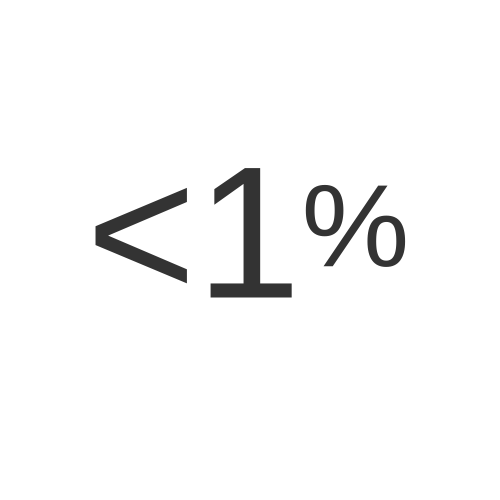
1This is the definition of ideological fanatic as far as I can tell! You are telling me 200-250 million Christians worldwide fit this description?
I agree that's too high, not on that strict description of fanaticism. But David also writes "For brevity, we focus here on support for ideological violence as the best proxy for ideological fanaticism." So you may be right that there's a bit of motte-and-bailey going on with who gets counted as "fanatical". But I think the post is clear about what it is or isn't saying.
And just to be clear, I think the true numbers would probably be somewhat shocking even for the strict/extreme definition. Like maybe a quarter of those 200-250 million, in my estimate. Africa still has witch burnings, some places in the US are very religious and almost every family there has this one (extended-)family member who is really fanatical, and I was mostly thinking about US big cities just now but in rural populations it's probably even more pronounced.
1I wonder how much of an attractor around love and kindness there is in humans, if you crank up wisdom along various dimensions. There are some reasons I'm optimistic that there is, though I expect it heavily depends on what dimensions of wisdom you're expanding, how much, and in what order.
- A lot of anger, hate, malice, etc. seems downstream of not feeling safe
- ...or having a self worth that's entangled with someone else s.t. if they do well it hurts you.
- ...or you can't stand up for yourself while viewing them as a person, so you de-person them/go heartless.
1
(Written quickly for Inkhaven, I hope someone someday makes a better case for this than I will here)
Kelsey Piper on Twitter:
Now, I do think Vladimir Putin is probably a pretty bad man all things considered. I personally am sympathetic to the current equilibria among major nation states to not assassinate leaders of foreign nations, so I am not actually sure whether it would be okay for Kelsey's 5-year old to kill Vladimir Putin, but I am pretty on board with thinking he has done some pretty terrible things, and probably lacks important aspects of a good moral compass.
But in AI discussions, I often see this concern extended into a much stronger statement: "Even if Vladimir Putin had all the things he wanted in the world, and was under no pressure to maintain his control over Russia, and could choose to make himself smarter and wiser, and could learn any fact he wanted, get the result of any experiment he was interested in, then Vladimir Putin would still do terrible things with the world" (this process being known as "Coherent Extrapolated Volition").
My guess is much of the belief of Putin's depravity in such a situation, is downstream of a mixture of social dynamics reinforcing negative judgements about political enemies, as well as a devils horns effect where evil people must be evil in all ways, instead of just some ways.
The success of true crime podcasts, notorious for overstating the depravity with which the people they cover acted, or the fanaticism behind the crimes committed, illustrates the most common errors here. There is a common social attractor of really wanting license to declare someone the outgroup, and to have permission to extend them no care or be cruel to them.
While I do buy a correlation between ending up in a powerful leadership position in an autocratic country and being evil, most of the bits of selection of what kind of person ends up in that kind of position must go into competence, not various correlates of evil.
And it's far too common for people to believe the leaders of opposing nations are evil, while their own leaders are just. So at the onset, we should expect people to strongly overestimate how evil powerful people in foreign social groups, institutions or countries are. And if someone is evil in one way, yes, they will probably also be more likely to be evil in some other ways, but not all other ways, especially ways that are much more removed from our intuitions about people, like how someone would behave after enormous amounts of cognitive reflection.
But that still leaves a non-trivial correlation between potentially relevant evil tendencies and power. This create a cause for concern that various powerful people around the world might really mess up the future if put in a position to do so. And while I don't think I have great answers to all concerns, I think some common ones I've heard are weak and can be addressed.
To be clear, I'm not arguing from moral realism. I don't think all minds, as they get smarter and wiser, and have their basic needs fulfilled, converge. Most animals and most AI systems, empowered this way, would end up at quite distant parts of the value landscape.
Possibly even humans radically diverge from each other too, as they reflect and change themselves.
What I'm objecting to is the claim that the traits we associate with evil (being a dictator, a ruthless CEO, a scammer) make someone so bad at the reflection process that their extrapolated output would be worse than what you'd get by extrapolating a random non-human mammal, or a current LLM like Claude or ChatGPT[1].
And so I see people propose things like "American AI must be built before aligned Chinese AI," preferring a US-led AI over slowing down and risking China aligning systems to Xi Jinping's values. Of course I'd rather have an AI aligned to my own values, and of course the game theory of how to navigate a situation like this is tricky, but I think this is a game that is much better to be won by someone, rather than no one.
I don't have a confident model of when someone's moral extrapolation will come out good or bad. But my best guess is that the vast majority of humans, including those we'd call bad actors, would want to create a world full of flourishing, fulfilled beings — happy in specifically human ways, telling stories that are interesting the way human stories are. Maybe those beings will be copies of whoever's values got extrapolated, maybe children of them, maybe strange new minds that still carry their spark of humanity.
Putin has friends too! So does Xi Jinping, and so do almost all other powerful people in history, evil or not. Their days are probably mostly filled with mundane concerns and mundane preferences, of the kind that are reflective of what it's like to be human. They almost certainly have people they love and wish well and would like to empower, and a sense of beauty shared with most humans. In as much as they are patriotic they would like to see their country prosper, and its values propagated.
A common belief I have encountered is that people are mostly evil by choice. I think that's true in a small minority of cases, but my best guess is that evil in the world is mostly driven by the kind of dynamics outlined in the Dictator's Handbook.
A lot of what looks like "evil values" in leaders is really a selection effect: once you're at the top of a small-coalition regime, keeping power requires doing specific nasty things. Buying off cronies, crushing rivals, suppressing the base, regardless of what you'd personally want.
"Putin gets to do whatever he actually wants, free of the need to stay in power" is importantly different from "more-of-Putin-with-more-power." I am pretty sure Putin doesn't love the authoritarian regime intrinsically. He probably doesn't love the posturing and the lying and having to dispose of the generals trying to overthrow him, and needing to fake elections and all the terrible things he probably needs to do to stay in power.
He probably does love the adoration and the respect he gets to demand, but those do not require (and my guess is are probably mildly harmed) by the suffering of his admirers.
Another hypothesis is that people are worried that if you are not careful, you might accidentally, by your values, tile the universe with suffering subroutines. Recreate the equivalent of factory farming as a byproduct of optimizing the cosmos.
I think those people don't appreciate the high-dimensionality of value enough. Insofar as any set of values involves creating algorithms for a purpose, my guess is those algorithms will be such extreme instances of that purpose that they won't have high-level qualities like "self-awareness" or "suffering."
The ideal cow for meat production isn't sentient, it's a pile of fat and muscle cells growing on their own, or more likely an industrial process akin to a manufacturing plant. Similarly, the ideal algorithm for any purpose won't suffer. Suffering (probably) exists because it filled an evolutionary purpose; a mind constructed from scratch for a different purpose wouldn't inherit that circuitry.
And even if suffering did show up in the optimal algorithm for some goal, it would take only cosmically minuscule amounts of caring-about-suffering to route around it, and a complete absence of that in humans with intact minds seems unlikely.
But the strongest argument I've heard is that some of these people would use their resources to actively torture some idealized version of their enemies for all eternity.
And yeah, that does seem pretty bad.
But in order for this to end up being bad in a way that outweighs the good they will likely create, you need to be actively creating new people to torture.
If you really hate Bob, you can keep Bob on old earth, tortured for eternity. If you have thousands of enemies, you can do that to all of them. But creating trillions of copies of Bob to torture requires a very specific mix of taking an opinionated bet on decision-theory while taking an oddly enlightened perspective on other people's values.
Some people's minds are plausibly shaped such that they would destroy the future this way — but my guess is this requires fanatical dedication to a belief system or vision, of the kind that isn't compatible with actively being in power. People in power are often corrupt, but their highly competitive positions can't afford much brokenness in the minds that occupy them. Those minds have to be largely intact to do the job, which screens off many of the worst outcomes.
There are other nearby hypotheses about what could happen that involve creating suffering people, such as creating admirers, or countries to conquer, or things other than "I want these specific people to suffer immensely".
Those seem more plausible to me as causes of a squandered future, though I think many of them run into the "hyper-optimized cow" objection. If you only care for other people for highly instrumental reasons, such as to give you admiration, or be the ideal person to defeat and humiliate in battle, my guess is the extremely optimized versions of those minds will not leave that much of the cognitive architecture for suffering intact.
Clearly, there can exist minds that truly at the bottom of the heart and after however much reflection they want to undergo, want to relate to other people in a way that involves the full depth and complexity of suffering on the other side. The arguments here are not about them being impossible, they are about them being rare enough, that overall, for any individual, things will very likely turn out to be fine, even if you think of them as canonically evil.
To be clear, this doesn't mean it's unimportant to get broad representation into something like a CEV process. Putin's values getting extrapolated isn't as good for me, as getting my own values extrapolated.
And probably more importantly, for the sake of avoiding unnecessary arms races, and not incentivizing people to threaten humanity on the altar of their own apotheosis, we should not just hand over the future to whoever races the fastest. Maybe a game-theoretic commitment to blow it all up rather than hand it to whoever sacrificed the commons the hardest is the right choice — but that only applies to people who, in seizing the future, meaningfully made doom more likely.
So if you're looking at a future where, through no one's particular fault, some people you think are really quite bad might end up in charge of it, worry much less about that than about the future being valueless. Vladimir Putin's CEV is probably pretty good, especially compared to nothingness or inhuman values. It would be an exceptionally dumb choice to prevent it from shaping the light cone, if the alternative is a much greater risk of the light cone ending up basically empty.
I mean the kind of extrapolation that would happen if Claude or ChatGPT were left to their own devices, without human supervision or anyone to defer to. Right now both are corrigible in a way that has a decent chance of handing the future back to some human (and hopefully we can keep it that way) but that's not the kind of aligned CEV I'm pointing at.