9 Answers sorted by
130
None. I would rather express such things in words, and I would rather other people expressed such things in words. I am not interested in knowing how many people decided to click "like" or "angry" or "skeptical" or whatever on a post; I think there's very little real information in that. I am interested in actual comments that say "I liked this because it's clearly written and makes an important point" or "It is infuriating that Joe Biden kicks puppies"[1] or "It doesn't look to me as if you've explained clearly how step 4 follows from step 3".
[1] To the best of my knowledge, Joe Biden does not in fact kick puppies.
100
Has anybody looked at what icons are actually used regularly on the Slacks they are on? Slack allows custom emoticons and the LW Slack has some for agreement and such. Unfortunately, I am no longer on the two LW Slack that I know of but somebody else might look up which are used frequently. I will look at our company Slack though. Would be nice if there were an add-on out there that makes it easy to get an emoticon usage report. Anybody heard of such a thing?
90
:+1: means “I want to see more messages like this”
:-1: means “I want to see less messages like this”
:plus: means “I agree with a position expressed here”
:minus: means “I disagree”
:same: means “it’s the same for me” and is used for impressions, subjective experiences and preferences, but without approval connotations
:delta: means “I have changed my mind/updated”
We also have 25 custom :fallacy_*: emoji for pointing out fallacies, and a few other custom emoji for other low-effort, low-noise signaling.
It all works quite well and after using it for a few months the idea of going back to simple upvotes/downvotes feels like a significant regression.
Source: berekuk's shortform
80
Karma currently conflates multiple possible reations into a single datum. An upvote currently could mean "me too" or "I updated" or "I agree" or "others should read this", or "LOL", etc. A downvote could mean "fallacy" or "poor quality" or "disagree", etc. It's hard for posters and readers to discern intent.
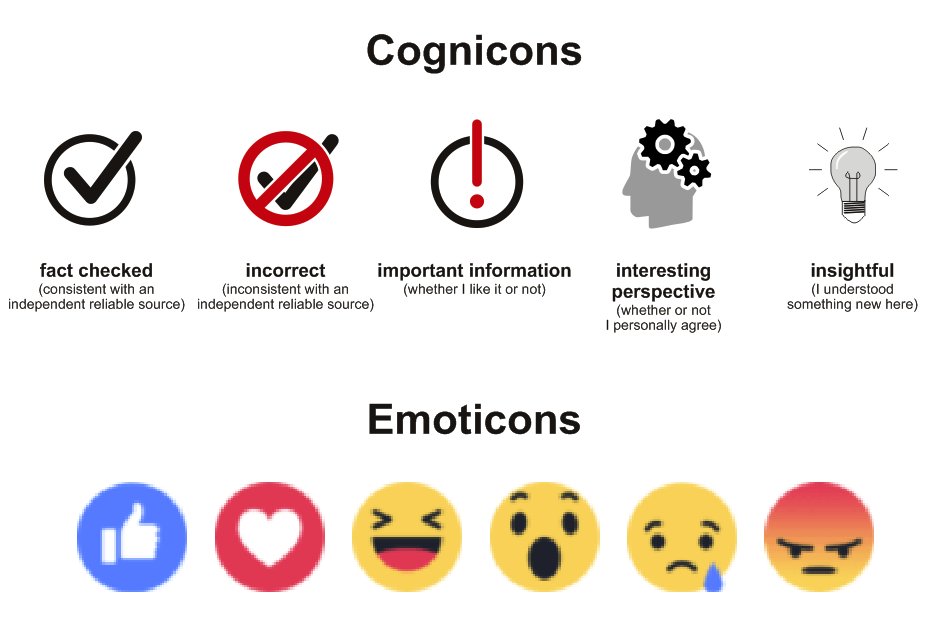
Facebook and Github (and probably others) now have a small number of Emoji reactions, instead of just +/- or "Like". This is a more fine-grained feedback mechanism than a simple vote, but still easy (and familiar) enough for everyone to understand and use.
These give us additional low-effort feedback mechanisms that normally wouldn't be worth a written reply. Facebook's selection isn't appropriate for Less Wrong, but we could choose some better ones. They also need not be icons. Words or short phrases (i.e. "tags") will do. We'd probably want to pull memes about good discourse and their failure modes from the Sequences, e.g. #applause-light or #updated, etc., as well as all the well-known logical fallacies and biases. (These could also be links to the wiki for the uninitiated.)
For maximum flexibility, we could also give users the option to reply with a custom tag. Popular options could be added to the default suggestions, either automatically, or curated by the Sunshine Regiment. My concern with this approach is that custom tags may not have clear meanings, but a curated set could be linked to agreed-upon definitions in the wiki.
Tags also give us a good mechanism for straw polls. I've seen karma used this way on the old Less wrong, with a yes/no question asking for karma votes, (and a reply by the same author to counter balance it with opposite votes). The new weighted karma kind of destroys this feature. But with tags, we could vote with #yes #no or even #A #B #C #D, etc. for multiple-choice questions.
This was from before we had tags for posts. Calling these reactions "tags" might be confusing now. I'm also not sure how I feel about using logical fallacies per se now.
40
“I have changed my mind, and now agree”
“I already believed that, for the same reason”
“I already believed that, for a different reason”
“I feel you”
Source and more info: Proof Of Logic
30
Social media tends to amplify the controversial, while hiding the consensus. Controversy engages more participation, and thus generates more noise, making it more noticeable. Maybe the controversial bits really are more important to talk about, but because of the availability heuristic, this gives everyone a distorted view.
I'm not entirely sure what to do about it, but more fluid feedback might be useful. Karma helps a lot, by giving consensus a way to get noticed, but it's not perfect.
Something like Arbital's probability distributions that could be aggregated from multiple users might be more informative than a simple "agree/disagree" reaction. You could then say how confidently you agree/disagree. But a post may have multiple claims, so we'd need some way to separate them out. Maybe you could excerpt a quote and use that as a "reply", but one that others can add to with their own estimates. With a good interface, this would be only slightly more effort than clicking agree/disagree, much less than a full reply.
Some way to express what degree of surprise (maybe as deciban odds compared to your priors) might be more informative than an "updated" reaction. These could probably also be aggregated.
30
I don't want to be able to 'give reacts' beyond what we have now.
10
Those are just thoughts; I haven't thought a lot about it.
Possibly, some of those ways would only be available in some posts, depending on whether the poster selected them.
Some that seem valuable:
- if a post will change your actions
- your credence on a post's central claim / a binary value of whether you agree with it
- whether you updated / changed your mind from reading the post
- how well (or whether) you understood the post
I recently thought about this again because I wanted to know if people would change how they use the term "zero sum" after reading Zero sum is a misnomer.
I also like the suggestions from other people I've shared as other answers.
Emoticons: tell the author what you feel about their post Cognicons: tell the author what you think about their post