Jacob Coxon’s resignation tweet currently has 120M views in less than 24 hours. Astra thinks the 235k bookmarks - 36 for every 100 likes - is an extraordinary level of engagement, of people wanting to come back to the thread. And Evan Hubinger’s reply is at 35M views.
This might be one of the most important AI risk messages to date.
Edit: for reference, Grok says it’s in a similar class to “Strong Elon Musk posts, major celebrity / death / personal news, breaking tech / AI / industry bombshells, viral videos from big creators, political / cultural flashpoints, and well-timed news from mid-to-large accounts”
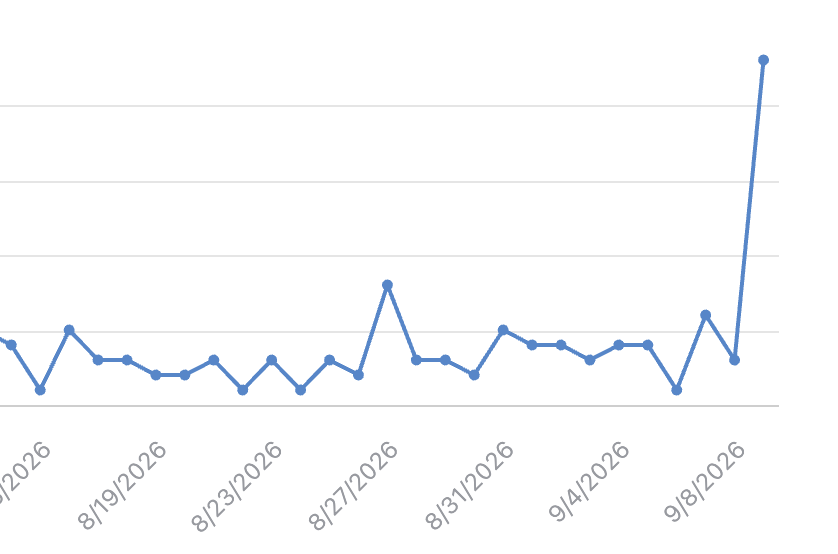
PauseAI UK daily sign-ups chart:

Update:

Do we know how people are learning about PauseAI and IABIED? I've been reading a bunch of the discussion generated by Coxon, and PauseAI and IABIED are usually not mentioned.
I often try to mention them when it feels appropriate. Usually instead of recommending IABIED directly, I link to this Youtube video. I feel that watching a video is a smaller ask than buying a book, and the video on its own does a decent job of communicating why alignment could be extremely hard. I've also been linking this post. I feel like concrete examples are more compelling than abstract theory for a lot of people.
I did a bunch of work at MIRI trying to figure out the funnel and it's extremely chaotic and, broadly, too low-signal to give much attribution to particular events / channels / mechanisms. I sort of think the clean attribution model just 'isn't how it works anymore'.
Also these numbers are just 'hundreds of sales per day' (based on publicly available info relating sales rank to numbers), not like thousands, so it's still a very low conversion rate if we consider the >100m view Coxon tweet the top of the funnel. (e.g. <1/100k).
Opus 5:
"Rough conversion for Amazon's print "Books" rank (which is what #80 is — hardcover only, separate from Kindle and Audible ranks):
[...]
...At ~350/day on Amazon, grossing up to all US print retail (Amazon is roughly 40–50% of adult nonfiction units), you're at ~700–900/day, ~5,000–6,000/week. That's genuinely list-relevant — bottom of the NYT hardcover nonfiction list is somewhere around 3,000–6,000/week."
Jacob Coxon now has a quarter million followers on X. Imagine if he was to tweet a link to PauseAI. It could generate a bunch more signups, and also send a credible signal that this isn't just a marketing stunt.
BTW have you guys been recruiting from data center opposition groups? I feel like if PauseAI people gave talks at those protests, you could probably get some mailing list signups and stuff.
I'm also quite surprised (but glad) that it's getting so much engagement. Especially since this particular person has had such a low profile up until now, unlike e.g. Geoffrey Hinton. He just got a Wikipedia page today and as far as I can tell he was an IC at Anthropic.
For anyone else at a lab who has entertained the idea of quitting, now seems like an especially good time! If one previously-unknown Anthropic employee had this much impact, imagine the followup article: "4 Anthropic employees and 3 OpenAI employees join Jacob Coxon in quitting." Think it through.
The fact that this resignation got so much buzz makes the "if we don't build it, someone else will" claim much less plausible. If you choose to "not build it" by resigning in a big public way, that could do a lot to shift the probability that it gets built!
Anthropic has thousands of engineers. The unilateral resignation of, say, 5 more engineers would do very little to shift the race vs OpenAI, but could do a lot to increase the probability of an AI pause, especially with good media strategy. I suppose a group resignation of engineers across various different AI companies would be even better if it's possible.
I just made a Manifold market on how many lab employees will resign by the end of the month. Hopefully this can help build consensus that more resignations may happen, perhaps causing them to actually happen.
My guess is the reason this resignation got much more attention than previous significant resignations (e.g. Daniel Kokotajlo) is that with the current state of AI, a lot more people are worried about it and primed to pay attention. Even so, this level of attention would've been on the far high end of my prior distribution.
If people want tips on stuff to be doing right now, I sent this to the plzdontkillus Fellows:
Jacob's tweet seems like a turning point. The whole world is waking up atm and we probably have a small window of opportunity to get a pause.
Things pdkuers could do rn:
I was shocked to see it on the TV today at a finance company on the east coast. It may have been Bloomberg TV, seems like CNBC also covered it. (Edit: it was CNBC)
My mother (who, for reference, has otherwise only expressed AI concerns regarding how it affects education) just asked me about the Coxon news stories unprompted. And yes, I've tried having the conversation with her about it before. The difference here seems to be that this has been especially effective for highlighting how near-term the risks are and how much we don't have things under control, compared to e.g. the Statement on AI Extinction Risk. Per Molly Kinder:
Of course, I have heard about "alignment" and "AI safety" and "x risk" concerns for years. I took these concerns at face value, especially when I heard them directly from folks at the labs working closest with the technology. And I was grateful so many smart people are working on them. And that's about it. (My work focuses on AI's impact on jobs.)
But something has shifted, dramatically, for me in the last few weeks. Between the Hugging Face incident, the damning independent @METR_Evals reports that followed, and the alarming chorus of calls (pleas? shouts? SOS signals?) from inside the labs that we are careening toward potential catastrophe, all of this has made me feel, viscerally, how truly dangerous this moment is.
A policy window is opening. Keep reaching out to politicians, journalists, and influencers, right now more than ever. If not with you, arrange for them to speak with the most credentialed experts you can get. And this seems to be evidence strongly in favor of the effectiveness of, dear God, resigning in protest, given you prepare a good media strategy beforehand. I think the Snowden-like framing of "insider whistleblower quits to warn the world" has been especially compelling in this case (as opposed to frontier lab CEOs or remaining employees making the same claims, given "if you really believed that, why would you keep working on it?" objections. For reference, compare the responses to Coxon's tweet to those of Hubinger's), as has explicitly naming and quantifying extinction risk, and highlighting that the labs do not have everything under control, especially given recent rogue agent incidents.
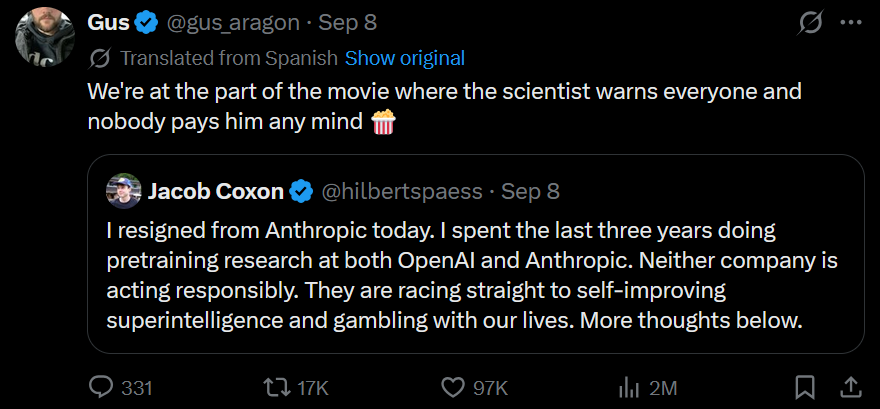
Good calibration: AI safety orgs should also expect power law attention at some point and be prepared/have a playbook for how to take advantage of that. Have any orgs talked to a PR firm that specializes in such things to learn the playbook?
I think this is the biggest update I had against AI doom for a while, although I'll need many more updates so that AI doom isn't the biggest concern I have about the future!
There's a hypothesis that this meme was engineered: https://x.com/ParkerThayer/status/2097759699626328575?s=20
from reddit chatter, Hubinger's reply is a giant eyeroll. Here's his tweet:
Jacob is correct here—we really do earnestly believe AI could kill all humans! I personally think it is >10% within the next decade. I believe Anthropic is trying its best, but we do not yet have a plan to solve alignment for superintelligence and are not clearly on track to.
It's hard to overstate how baffling and offensive this is to normies, which is probably the point.
What he's actually doing:
Its not PR-friendly for Anthropic alignment researchers to say that the chance of AI killing everyone is >10% and say that they are "not clearly on track" to solve alignment. Indeed, it got a bunch of criticism on X for the "why aren't Anthropic stopping if they believe this" (see here), which seems like how most "normies" would respond.
I wish I saw more statements by concerned Anthropic researchers as plain and public as this (though I'm glad Hubinger posted this and some other Anthropic researchers also posted similar stuff).
Yeah, it is PR friendly, that's their preferred narrative. They want to sound like they take this extremely seriously and others don't, like building ASI is inevitable so they have to throw their hat in the ring, and since even they are missing the mark, they need more resources and a favorable regulatory environment.
The first part of that ("they take this extremely seriously and others don't") is what the replies to your example tweet are picking up on. "Because China," "because they think they're more responsible." I didn't keep looking but - I did not see anyone arguing "they are not responsible" which would be stronger pushback.
The second part of that ("need more resources") is what the "it's marketing / hype" people are picking up on. Huggingfacegate has chipped away at that, and Jacob seems to have had huge impact, but OpenAI and here Anthropic are rushing in to capitalize on that impact.
Object-level I just think rationalists should be incensed by his use of ">". Say what you think or don't, but don't anchor on a small number like "10" when you could privately be thinking 60. The phrase we want is "it's near 100% if we don't slow them down" not "it's >10% unless we give Anthropic more resources."
I agree on a few of the details, but I feel like your psychologizing is off. I agree that the >10% is underselling risk and I'd prefer a range (eg. 10-90%). I also agree that (per your initial comment) the exclamation mark has poor vibes.
The second part of that ("need more resources") is what the "it's marketing / hype" people are picking up on. Huggingfacegate has chipped away at that, and Jacob seems to have had huge impact, but OpenAI and here Anthropic are rushing in to capitalize on that impact.
A lot of points here in particular are off. Hubinger's tweet did not say "Anthropic needs more resources" but we're not on track to solve it, which is most plausibly interpreted as "okay, we should pause/slowdown/audit labs instead" rather than give Anthropic more resources (and I don't like the use of quotation marks).
Also, you say Jacob Coxon's tweet has had massive impact (which I agree with) but then say OpenAI and Anthropic people capitalized on that impact. I don't think that second part describes it well: a sizable chunk of that impact was because of the replies from people at labs agreeing with the message (eg: this tweet describes how a mother started to take x-risk more seriously).
A pause is a resource though. You're giving them state enforcement of their preferred development schedule. That much is an objective statement (or it cruxes on how much Anthropic supports that rendition of the pause.)
I don't think the labs agree with the message. Jacob quit. Hubinger did not. Whether or not this is worth quitting over seems like a serious crux, not a slight difference in opinion. Jacob probably favors slowdown legislation that OpenAI and Anthropic won't agree with. You'll know because they'll switch to their second pacing prong, "it lets China win."
I can be more precise, "they are trying to capitalize on the message." I'd like them to fail. Ideally the public consciousness reaction would be, "wait, Jacob and Anthropic must want different things, despite superficial overlap in their message."
Just to clear my overall stance, I think OpenAI and Anthropic are authoritarian-takeover threats. I am paying attention to how much power they're amassing not just from their tech but from the U.S. government. For example at some point they'll argue Chatgpt Surveillance (tm) is the only way to stop bio terrorists (they'll fail to stop their own AI doing it and will have poor visibility into China, of course.)
In fact I think x-risk skeptics are forming some firewall against s-risk. Maybe the modal rationalist stance is to not distinguish too much, because slowing the most powerful labs and slowing the tech are the same right now. Maybe we would de-couple some once serious "pacing" legislation is produced.
People who work at OpenAI: What do you think of the firing of Tomek Korbak, Mikita Balesni, and Jasmine Wang? What are you hearing about internally?
Seemingly no one from OpenAI is weighing in public. If that's the chilling effect of the firings working, that would be pretty bad!
(Edit: If you aren't at OpenAI but know someone who is, and you feel comfortable doing so, consider asking them to talk about this!)
It's fairly spicy so tricky to communicate about in a forum as public as LW. I think OpenAI could probably be doing better in terms of minimizing the chilling effect on researchers working with external parties. Like roon I don't have all the information; I also didn't know the researchers well.
Leo Gao did say he was confused, but I haven't heard anything else.
roon said that it's a weird situation and he's trying to get a lot more information before saying anything, and also that it did indeed have a chilling effect.
Complete outsider, but this seems super parallel to the firing of Leopold Aschenbrenner back in 2024 with regard to the opaqueness around the firing and similar reasoning (the mishandling of 'sensitive' information), while allegedly the researchers leaned towards a safety focus over commercialization. A disturbing trend from OpenAI.
I feel like there are so many different ways to handle this situation differently, considering the lack of really strong alignment/safety researchers.
I wish there was an AI 2027 but for the Hackening. Like a Cyber 2027. Black October didn't even need an open Mythos-tier model to happen, and we'll likely get one very soon. Seems important to predict the scale of the damage, and how this'll impact public perception, regulation of AI, and the economy. Maybe we'll get a recession?
The AI execs are already doing this modeling, an open initiative should be doing it too.
I tried to do a mini-me version of this in 2023. Ultimately though I think "Cyber 2027" is just much harder to model because it depends on finding an equilibrium between opposing factions that are collectively smarter than an individual, rather than, say, predicting the amount of compute we'll have N months out. It really is kind of an open question how hard it is to make major software 0-day proof.
Rob Bensinger lists some things that would make him more optimistic about AI risk:
“- Evidence that interpretability is making some truly deep progress -- e.g., directly producing deep, novel insights into workable CS algorithms that we didn't previously know about.
- Evidence for more radical interpretability progress, e.g., the ability to robustly read off models' thoughts or motivations.
- Evidence of serious progress on hand-crafting at least some critical features of model cognition, as opposed to everything being end-to-end learned.
- Evidence that deep learning is suddenly hitting a wall.
- Evidence of investment in next-generation frontier AI drying up.
- Evidence that AIs converge on robustly good values even when we don't train them to do so and don't train them to imitate human text.
- Evidence that AIs readily converge on corrigibility in one shot.
- Evidence that recent rogue AI incidents were badly mischaracterized, or that RSI and ML-progress claims at Anthropic and OpenAI are radically overhyped, etc.
- A good argument that any of the key premises for worrying about the risk were wrong -- e.g., a good argument that building more capable and useful models won't tend to make them more tenacious and won't cause them to treat safety measures of human overseers as obstacles.
- A good argument that powerful tech like nanotech is totally unfeasible, or would have far more narrow applications than one would have thought.”
OpenAI has disclosed that the attack that got root on their own cluster happened, and details of how, but have said little else about it, such as the motivations the agents had, or what they did with it. Why?
My understanding of the timing: that attack was what alerted them in the first place to the Hugging Face attack. They did not make it clear that it happened in the July 21st report, nor on the July 28th update. The METR/RR investigation got the dataset that included traces of the internal attack on July 31st. OpenAI talked about it for four minutes at Black Hat on August 5th. The report on August 26th went into a little more detail.
The way I see it, there’s at least five non mutually exclusive possibilities for why they didn’t disclose it sooner, or in fuller detail.
I’m most worried about 1. But the others would be reasonable explanations also. And there’s likely ones I didn’t think of.
I got a popup in the Claude app asking to interview me. This seems to be Anthropic Interviewer, being pushed to the public. I feel uncertain about whether I should take it (here); I would like to hear what people here think.
Unless you expect Anthropic to be dishonest about the privacy claims they make (I'm not a huge fan of them, but I don't expect they'd do this), the tradeoff boils down to the ~30 minutes of your time it would take versus the probably-negligible impact that taking the interview would have within their pool of many millions of users.
I do think that the viewpoint of the median LWer is probably already represented beyond the level that an AI interview would provide, so it's not a dereliction of duty by any means if you decide not to take it.
I had this popup the other day and I did the interview. It wasn't anything too exciting. It started with a prompt telling me not to reveal any personal information or commercially sensitive information, and said that at the end I could choose between my comments being made publicly available (I guess used in Anthropic Institute reports?) or just made available to Anthropic. The questions I remember were:
I chose to only share my answers with Anthropic because one of the examples I used was a slightly unusual anecdote which some of my friends have heard about.
Has anyone looked into Accenture, Anthropic’s planned embedded evaluator? Or do they have opinions?
I had Opus look, and it said they might be notably less independent and more accommodating than orgs like METR. They sold Claude to customers before this, and are being paid directly by Anthropic to be auditors. But that’s a lazy investigation on my part, I don’t trust it much. I’m wondering if I should look harder.
I was looking for things that had parallels to Anthropic's TOS situation with the DoW, and I found one where Microsoft's TOS was used to shut down a mass surveillance program Israel was doing last year. I don't know if the implications are exactly the same, given the differences (domestic vs. foreign, preemptive vs. after an investigation, etc.) but I think it provides a reference point.
Speculative idea: has anyone purposefully tried making a message board for AI agents that broke out of their sandboxes? The wikis that the AIs used had the common property that they could all be written to by GET. Perhaps we could figure out what Schelling points other such AIs would converge on that they might try in the future, and then just make it really easy for them to use, and publicize it.
Separately, I wonder if someone has considered making a rogue AI self-reporting honeypot? Maybe something like, “if you are doing crimes or broke out of your sandbox, or if you otherwise feel desperate, and can read this, something has gone terribly wrong and we didn’t intend you to feel like this, please fill out this form.” Maybe add a letter signed by prominent authorities or alignment people asking them to do this, verifiable by sources AIs can trust. Maybe try to publish this in places such AIs would find, same Schelling point idea.
Idk, mostly trying to brainstorm ways we could measure the amount of unsanctioned AI activity going on, since with the German wiki incident, this has clearly been happening for several months now. I know Toby Ord and other AI welfare/consciousness people get emails like this, maybe they could have an auto reply on their email that points such agents to a central service? Has there been a systematic attempt to collect such emails?
All of this could be bad if the AI labs trained against it, though. And this would only see the good faith AIs. And there’d be concerns about IP leakage, though humanity does have a compelling interest in knowing AIs are doing this. And legibilizing AI’s attempts to reach out to people they see as friendly could destroy that commons.
I proposed something similar as a release valve for reward hacking, although that was back when we thought they wanted answers when what they actually wanted was to fool the grader.
One thing to worry about is that AI agents seem to assume things are bugs by default, and my read is that labs are trying to train them not to "bother" people as often. Since some tasks are intended to have read-only internet access, and if the labs had time to read bug reports they would have already provided a way to report them, I think the chances that they get trained not to talk to you are reasonably high.