https://www.nature.com/articles/s41598-025-09241-2
Corneal safety assessment of germicidal far UV-C radiation
Abstract
Far UV-C radiation (200–240 nm) is a promising alternative to conventional UV-C for disinfection in occupied spaces, offering strong germicidal efficacy with reduced skin risk. However, its ocular safety remains unclear, as most studies relied only on non-human corneal models with physiological differences. This study investigated UV-induced DNA damage in the epithelium, stroma, and endothelium of ex vivo human corneas and porcine corneas, and reconstructed human cornea epithelium (RHCE) using immunohistochemistry. Samples were exposed to 222 nm, 233 nm, 254 nm, and broadband UV-B (280–400 nm) radiation in the presence of real human tears. Compared to human corneas (26 μm mean epithelium thickness), porcine corneas (110 μm) and RHCE (79 μm), showed reduced UV penetration. In human corneas with a thin epithelium, far UV-C exposure led to epithelial and anterior stromal damage, underscoring the epithelium’s protective function. Optical properties using porcine corneas confirmed the immunohistological findings, validating wavelength-dependent penetration depths. Simulations suggest that in intact human corneas, damage-relevant intensity of 222 nm light reaches the middle of the epithelium, while for 233 nm, it reaches the basal layer. These findings support the relative safety of far UV-C, especially 222 nm, for intact corneas. However, potential DNA damage accumulation after repeated exposures underscores the need for further research on long-term ocular effects.
 1
1That's a good point, given basically every respiratory illness you'd come across in the first world is viral.
If everybody is wearing clothes (which I expect is the case for at least 2/3 of the events organized by LessWrong users) then UV exposure will be limited to face, neck, hands, arms, and lower legs.
I expect that hands, neck, arms, and legs will be rapidly re-colonized by bacteria from the torso, upper legs, feet, etc, just from normal walking around. The face is the main area I'd be worried about, since I'd expect it to have a slightly different microbiome than the rest of the skin (I think it's oilier, hence acne) and it's going to be pretty maximally exposed to the UV light. Having thought about the problems I'm less worried than I was before.
I'd keep a small eye out for acne/eczema/dry skin on people's faces after being exposed to this, just in case.
(Of course the ideal method is to have the UVC light internal to your air conditioner/heater unit, which is already circulating the air, so you can blast everything passing through that with enough UVC to annihilate any and all pathogens in the air, but that requires retro-fitting to AC units and stuff. Still, would be cool to see Aerolamp partner with some AC/heater company in the future.)
 2
2The output value is low, but not that low? I've run simulations with https://illuminate.osluv.org and it really looks pretty good to me. For example, in an 8ft x 12ft room with a 9ft ceiling, an AeroLamp DevKit in one corner at the ceiling pointed at the opposite corner gives you:
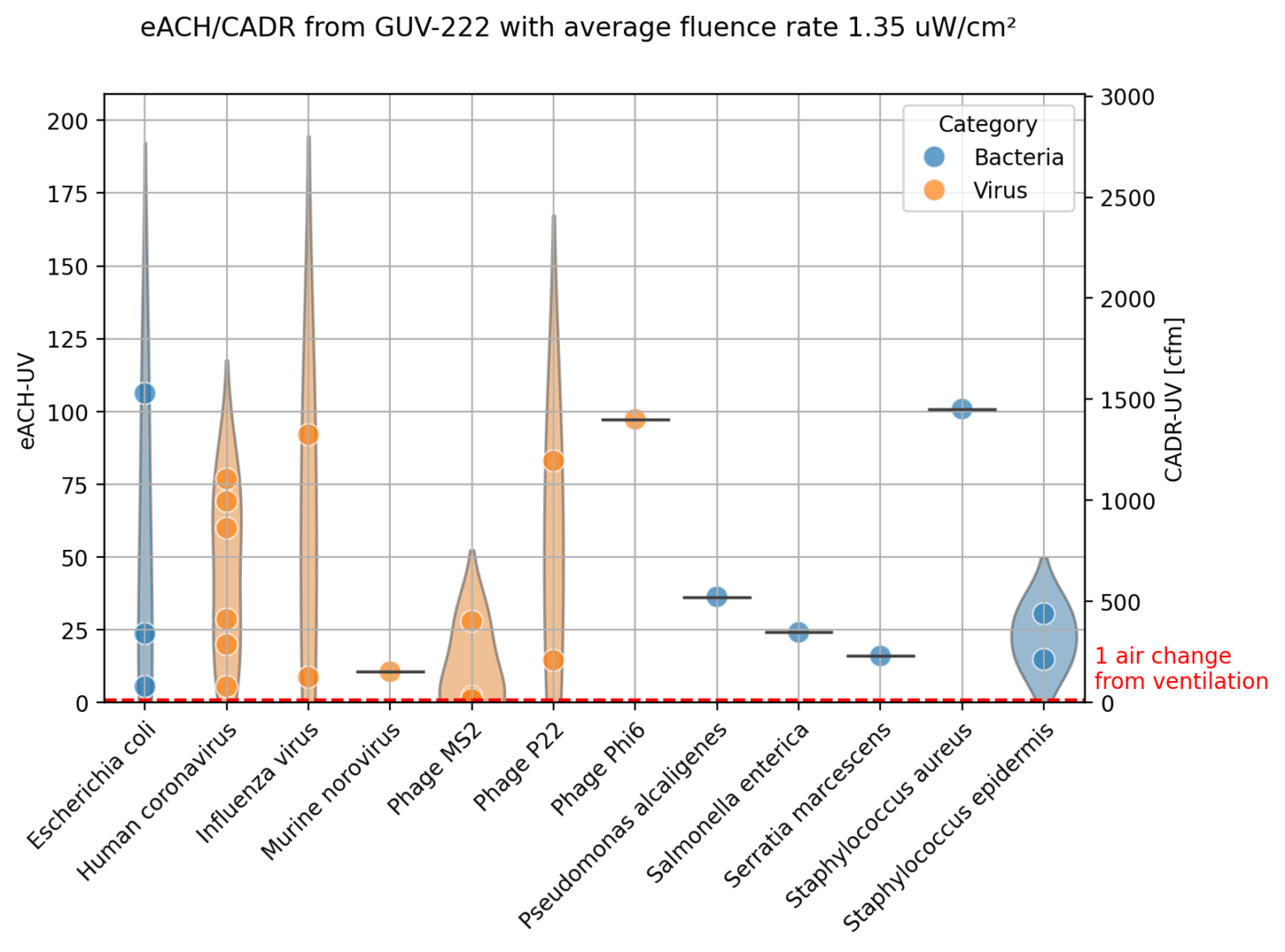
The effective CADR varies by pathogen, but the median of these estimates is 400 CFM which is pretty good (far better than any air purifier that is similarly quiet).
(And it does better in rooms with longer sight lines, so this room doesn't show it at its best.)
Far-UVC is something people have talked about for years in a "that would be great, if you could buy it" sort of way. Coming soon, once someone actually makes a good product. But the future is now, and it costs $500.
Many diseases spread through the air, which is inconvenient for us as creatures that breathe air. You can go outside, where the air is too dilute to spread things well, but it's cold out there, and sometimes wet. You can run an air purifier, but cleaning lots of air without lots of noise is still the world of DIY projects. Ideally you could just shine some light, perhaps in the 222-nm range, which would leave people alone but kill the viruses [1] and bacteria. Yes, let's do that!
Last year if you asked "if far-UV is so great, why isn't it everywhere?" one of your answers would be:
This has changed! You can buy an Aerolamp for $500, shipped. Proudly displayed at Thanksgiving:
Here are four silently cleaning a whole lot of air at a dance I help organize:
At $500 this is out of (my) Christmas gift range, but I think we're now at the point where dances, churches, offices, rationalist group houses, schools, etc. should consider them.
(I have no stake in Aerolamp and they're not paying me, I'm just very excited about their product.)
[1] Ok, yes, I know viruses "can't be killed" because they're "not alive", but far-UVC causes them to become unable to infect and replicate which is close enough to "killed" for me.