Archetypal Transfer Learning (ATL) is a proposal by @whitehatStoic for what is argued by the author to be a fine tuning approach that "uses archetypal data" to "embed Synthetic Archetypes". These Synthetic Archetypes are derived from patterns that models assimilate from archetypal data, such as artificial stories. The method yielded a shutdown activation rate of 57.33% in the GPT-2-XL model after fine-tuning. .. (read more)
Religion is a complex group of human activities — involving commitment to higher power, belief in belief, and a range of shared group practices such as worship meetings, rites of passage, etc... (read more)
| User | Post Title | Wikitag | Pow | When | Vote |
Tips or experiences on coping with existential dread, particularly the kind stemming from the prospect of human extinction caused by misaligned superintelligence.
The ability to persuade at a level beyond the median (or best) human. (this description intentionally left a bit vague since there is little consensus about what this term should mean)
In the context of AI, the search space is used to define the optimization power of the AI. Eliezer Yudkowsky defines optimization power as follows. If S is the search space and S+ is the set of options better or equal to the chosen one, the the optimization power is
The ability to persuade at a level beyond the best human.
April: i do very much struggle to imagine what we could actually do with, like, a decade, that would lead to us being any more prepared for ASI
Yudkowsky: Iterate rapidly on augmenting adult human intelligence.
Short of that, not much.
Pet the cute kitten! This choice can't cause you to get toxoplasmosis; either you already have it or you don't. So you might as well get the 1000 hedons from petting the kitten, if that's what you feel like; and if that causes you to update your probability afterward that you have toxoplasmosis, don't bothbother trying to shoot the messenger.
A dual operations is to ask what an f reports (eliciting latent knowledge).
Tips or experiences on coping with existential dread, particularly the kind stemming from the prospect of human extinction caused by misaligned superintelligence.
OneSince in general Humans can be assigned any values whatsoever), value learning has the pointers problem. It requires that the value can be recovered from the data but cannot prove it.
Practically, the required data has to include sufficient cases of conflict between goals, otherwise, .
People often agree on separate goals until those goals conflict; predicting unconflicted choices does not show how strongly one care should yield to another when both apply.
Another potential challenge is that human values are somewhat mutable and AGI could affect them.
Embedded Agency is the problem that an understanding of the theory of rational agents must account for the fact that the agents we create (and we ourselves) are inside the world or universe we are trying to affect, and not separated from it. This is in contrast with much current basic theory of AI or Rationality (such as Solomonoff induction or Bayesianism) which implicitly supposes a separation between the agent and the-things-the-agent-has-beliefs about. In other words, agents in this universe do not have Cartesian or dualistic boundaries like much of philosophy assumes, and are instead reductionist, that is agents are made up of non-agent parts like bits and atoms. This includes the question of the Boundary of the embedded agent, i.e. the questions which parts an agent considers part of itself and how it delineates other agents (or itself) from its observations.
The ability to persuade at a level beyond the bestmedian (or best) human. (this description intentionally left a bit vague since there is little consensus about what this term should mean)
Formerly Sequent
Formerly SequentSequent
Website: https://resolution.org
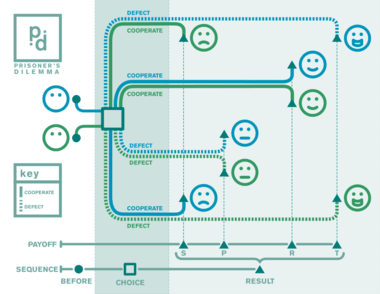
A visual depiction of a prisoner's dilemma. T denotes the best outcome for a given player, followed by R, then P, then S.
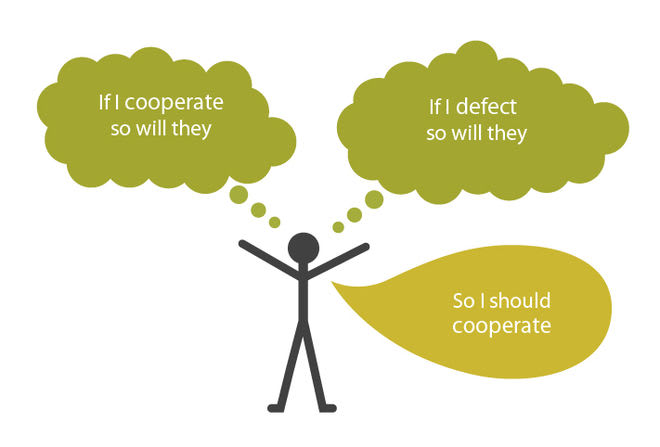
A simple depiction of an agent that cooperates with copies of itself in the one-shot prisoner's dilemma. Adapted from the Decision Theory FAQ.
IMO, commitment races only occur between agents who will, in some sense, act like idiots, if presented with an apparently 'committed' agent.
If somebody demands $6 from me in the Ultimatum game, threatening to leave us both with $0 unless I offer at least $6 to them... then I offer $6 with slightly less than 5/6 probability, so they do no better than if they demanded $5, the amount I think is fair.They cannot evade that by trying to make some 'commitment' earlier than I do. I expect that, whatever is the correct and sane version of this reasoning, it generalizes across all the cases.I am not locked into warfare with things that demand $6 instead of $5. I do not go around figuring out how to invert their utility function for purposes of threatening them back - 'destroy all utility-function inverters (but do not invert their own utility functions)' was my guessed commandment that would be taught to kids in dath ilan, because you don't want reality to end up full of utilityfunction inverters.
The Roko's basilisk incident suggests that information that is deemed dangerous or taboo is more likely to be spread rapidly. Parallels can be drawn to shock site and creepypasta links: many people have their interest piqued by such topics, and people also enjoy pranking each other by spreading purportedly harmful links. Although Roko's basilisk was never genuinely dangerous, real information hazards might propagate in a saimilarsimilar way, especially if the risks are non-obvious.
Given an indexing set (of(of a certain type) indexed by
Yet, mathematicians do disagree about this axiom, and whether it applies to our world as well. Some mathematicians take a Platonic view of mathematics, in which mathematical objects such as sets actually exist in some abstract realm, and for which the axiom of choice is either true or false, but we do not know which. Others take a highly constructive view (in many cases motivated by realism and the ability of the mathematics to model the world) in which either the axiom of choice is false, or infinite sets do not exist in which case the axiom of choice is provable and hence superfluous. Others take the view that the axiom is not true or false, but merely useless, and that anything provable from it is meaningless. Many seem not to care: the axiom is convenient for the mathematics they wish to do (whose application they are not much concerned about in any case) and hence they assume it without qualm. Another interpretation of the axiom is as analogous to Euclid's parallel postulate, delineating one region of the mathematical universe in which it is true from others where it might be replaced with alternatives.
Zorn's Lemma can be proven by using the axiom of Choice to choose the elements in a particular such chain which is so long that it cannot be extended in the 'upwards' direction by adding a further element to it; the existence of this chain combined with the fact that each one has an upper bound implies that there is a maximal element, namely that chain's upper bound.
Consider that if Zorn's lemma were false, then it would not be possible to extend the chain that far, in which case it would have an upper bound, by the chain hypothesis. But this upper bound would need to be less than some element in the...
![]()
A visual depiction of a prisoner's dilemma. T denotes the best outcome for a given player, followed by R, then P, then S.

A simple depiction of an agent that cooperates with copies of itself in the one-shot prisoner's dilemma. Adapted from the Decision Theory FAQ.
IMO, commitment races only occur between agents who will, in some sense, act like idiots, if presented with an apparently 'committed' agent. If somebody demands $6 from me in the Ultimatum game, threatening to leave us both with $0 unless I offer at least $6 to them... then I offer $6 with slightly less than 5/6 probability, so they do no better than if they demanded $5, the amount I think is fair. They cannot evade that by trying to make some 'commitment' earlier than I do. I expect that, whatever is the correct and sane version of this reasoning, it generalizes across all the cases.
I am not locked into warfare with things that demand $6 instead of $5. I do not go around figuring out how to invert their utility function for purposes of threatening them back - 'destroy all utility-function inverters (but do not invert their own utility functions)' was my guessed commandment that would be taught to kids in dath ilan, because you don't want reality to end up full of utilityfunction inverters.
Does anyone in particular own this glossary?
I'm asking because I had a dialogue with ChatGPT that compiled a much more extensive and richly sourced glossary. I used to do this sort of thing by hand - see "The New Hacker's Dictionary" - but an LLM makes an almost perfect neutral observer. Mine now exists as a markdown file containing 222 entries from all across the LW/SSC/ACX corpus and navigation paths for newbies.
What should we do about this?