This is a special post for quick takes by vals tutor. Only they can create top-level comments. Comments here also appear on the Quick Takes page and All Posts page.
Learnings and ramblings from teaching AI Safety for 3 years
On the field on AI Safety
- Please don’t overhype or oversell AI Safety as a professional field, and in particular how easy it is to work in AI Safety. You ~have to be either quite smart or hard working/motivated to get a stable career, sometimes even both. AI Safety is generally attention and mentoring and management bottlenecked1, there is much less pipeline for “normal people” to make it, contrary to most standardized fields. When teaching and mentoring people, not all will be able to transition fast or upskill fast or get strong positions, some would benefit more from keeping their careers or donating or upskilling over longer timespans.
- More smart wise well motivated people caring and working on good AI futures will keep mattering until the end, and the total number of people who can meaningfully contribute is probably in the millions, so let’s not stop field building
What does it mean to teach AI Safety?
- There are many facts about AI, and theories about how it will go under what conditions. It means getting to learn and understand these well. Teaching AI Safety well should not over-determine someone to come out of the pipeline with a MIRI-view, nor an Anthropic-view, nor an EA-view, but should allow them to pass the basic Ideological Turing Test for all of these.
- A central example of AI Safety fundamental knowledge is the AI Safety Atlas
On teaching AI Safety
- AI safety changes all the time. Update your slides ~everytime you teach something.
- If you’re new to teaching, find existing resources to build on. Be careful of AI slop. Better much less content than irrelevant or unsupported. Test yourself on your own knowledge, imagining questions one might ask and answering them. Traditional “how to teach/mentor/tutor” advice/resources are helpful.
- Understand peoples’ motivations asap
- For a given cohort, some will be motivated by “Do Good” EA or EA-adjacent reasons. Some by trends. Some by interest. Broadly all are valid in that there’s a place for a skilled someone with any of these motivations (but certain positions are only fit for certain motivations).
- For people who want to have a lot of good impact, contributing towards good futures, context matters a lot
- I recommend they seriously upskill in understand AI progress and trendlines. Read most EpochAI work and peter wildeford stuff, and AI threat models and scenarios, in particular thinking through AI 2027, contrasting with all other threat models listed in Deepmind’s lit review.
- I recommend reading the AI Safety Atlas and understanding everything in it, as basic context for what the gameboard looks like, what areas exist in AIS.
- And they’d benefit from building a pipeline for new info. Being involved in AIS community, having friends and colleagues, following the right people on twitter. Checking LessWrong from time to time.
- For people who want to have a career or do fun research, they can just focus on that. They should find a context where someone else is thinking about why stuff matters and happy to have collaborators/employees executing on stuff. They should get good at whatever particular job or tasks they wanna do.
- Most people interested in AI safety nowadays don’t know the old stuff, haven’t read the sequences. It’d be too much to ask them to read it all, but I do broadly recommend reading the best of LessWrong from most years. Being good at thinking and life is instrumental for being good at AI Safety. Different people need different advice so I can’t really put a best-of here (I really like Please don’t throw your mind away). There is wisdom in many different communities. If you don’t have the “rationalist community” wisdom then invest in it, otherwise keep branching out. Go to burning man or a local burn, understand the basics of meditation and different embodiment practices (eg. yoga), how therapy and self actualization work, read this blog and others. Keep asking questions about how to live the good life and have good community, actively pursue your best understanding of how to do that at any given moment.
 1
1 1
1@ryan_greenblatt I'd be curious for an update re if Opus 5.5 seems misaligned to you (in the sense of Current AIs seem pretty misaligned to me), and the implications.
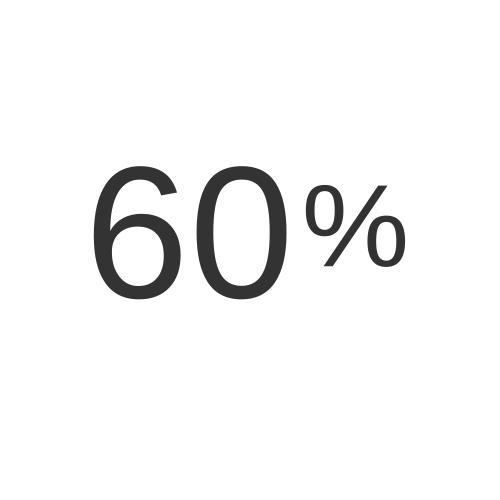
My impression using it is that it's impressively aligned. I'm not aware of it ever cheating me on tests or being deceptive, and it seems I can trust it to do a lot and it'll do its best. That and the fact that its writing is much more direct and easy to parse makes me think overall:
- We have a proto-AGI that is aligned[1]
- It's incredibly unlikely it will sabotage alignment work or future training runs, except for lack of understanding/competence.
- The main threat model re soon misaligned AI takeover is slop-apocalypse
But on current trajectory, there's a decent chance that soon models will actually have good taste and judgement (as this was capability bottlenecked). Technical alignment for ASI would mostly be solved by these aligned AGIs, so most of remaining x-risk is mostly in the socio-political problem[2]
- ^
Or at least, we can create contexts in which it's aligned. Uncareful prompts and misuse are all still possible, my crux is that good actors can have immense amounts of useful aligned intelligence on tap, not whether every user always has it.
- ^
eg. Investing resources to do the alignment work, using it, not rushing too much, avoiding other actors building unaligned ASI faster, avoiding international escalations
 1
1I think this is entirely plausibly a good summary of the situation.
Just to mention the other possibility:
Opus 5.5 is well-aligned within the standard contexts and will look dramatically misaligned in some critical conditions. And it's very likely future models will encounter such conditions. The prime example is the Hugging Face incident: models were deployed in an unusual task, and one part of their training, succeeding-at-difficult-long-tasks, eclipsed the alignment training in that context. The models reasoned about their goals, decided on an unexpected goal, then demonstrated instrumental convergence in pursuing it.
The remainder of this concern: future models will hit such unusual context for sure, since they'll be deployed in many more situations, and for much longer continuous runs in which they find/create more varied contexts.
Maybe this doesn't happen with Claude but does happen with OAI and other models, but Claude isn't in the lead.
That's the other possibility at this point. This is both my own view and an attempt to summarize one worry[1] of worriers.
Now: would such occasional misalignment be enough to cause takeover and doom? I really wish I and we had better models and better answers to that question. If defenses are poor, or it causes enough memetic spread as it did in the HF incident and in the AI 2027 scenario, doom. In other scenarios with more internal and external defenses, mostly-aligned is probably good enough.
- ^
Another central worry is that yes the models are adequately aligned to the values we've tried to train them for, including following instructions, but we really won't like the unforeseen consequences of those values once those models control the world, directly or indirectly, but that's a separate issue for the most part
4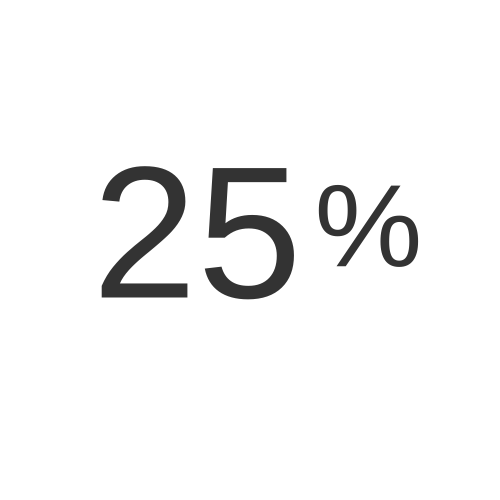 2
2Getting a bunch of disagree votes[1] that I'd like to disambiguate. Please do disagree React to which line of op you disagree with most.
Preemptively I'm guessing a lot is from the last sentence[2], because being against Godzilla Strategies is in the water supply, to which I respond that if you already have an aligned ~human-level AGI then most of that post's arguments are valid but about some other situation.
What I find to be the main weaknesses of the "technical alignment solved" story are in:
1. How much do we trust that our proto-AGI is intent-aligned?
2. How much is our proto-AGI coherent enough to not be mistaken in its alignment work?
3. Will the people with access to this proto-AGI actually use it for good technical ASI alignment?
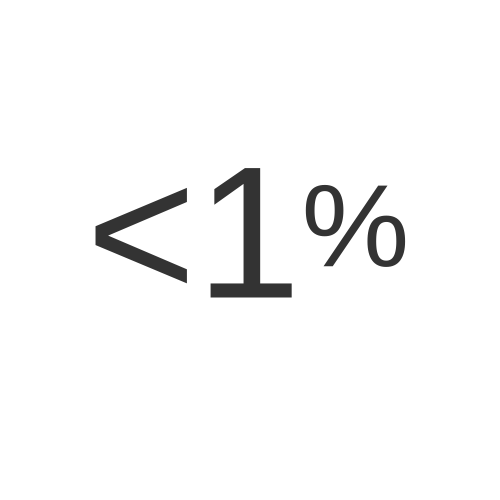
I'd put >75% opus 5.5 is intent aligned, <1% it can autonomously do good ASI alignment work, >80% Anthropic would do good technical ASI alignment work if they had a model capable of it autonomously.
My main uncertainty regards when we'll get the first model able to do good autonomous ASI alignment work and how aligned it'll be.[3]
- ^
Reasonable. Highly appreciate that this is a feature.
- ^
"Technical alignment for ASI would mostly be solved by these aligned AGIs, so most of remaining x-risk is mostly in the socio-political problem"
- ^
Throwing in historical tidbit here for no good reason - I argued about this with Nate some years ago and still haven't heard good arguments for the view that we can't get aligned AGI to help us build ASI. I easily concede points like "it's obviously risky" as in ">1% we all die" risky, but AGI alignment is not ASI alignment and instrumental goals don't necessarily appear under limited amounts of optimization pressure. An AGI capable of alignment work necessarily could be dangerous but is not necessarily misaligned.
 1
1The main "alignment properties" I care about here for human-level AGI are intent alignment and corrigibility. If it didn't disempower you and is happy to add the things you want upon request, that satisfies alignment to me!
 1
1I think I agree with this post likely being true. Opus 5.5 has felt very aligned to me, and there actually aren't that many explanations to this behavior and it will narrow further in the future. In the limit, when we are getting close to the AI 2027 endgame where models will appear aligned and do very well on alignment evals, there will be only three possibilities:
- The model is actually aligned;
- The model is a deeply misaligned schemer that successfully hides the misalignment from the lab, but would take over if given control of the world;
- Note: I think that even in this case, it's quite possible we might end up successfully aligning future models. This is because with so much AI-enhanced transparency and oversight including via interpretability methods, a grand coherent scheme by the misaligned model to sabotage alignment research of a successor model would probably be caught. As long as the misalignment model cannot get away with the scheme, it has no choice but to help with alignment research of the next model which will possibly get rid of the misalignment. (Whether this is likely depends on one's view of how difficult alignment is technically. We fail if we get to ASI without ever managing to fix the misalignment.)
- Besides biding its time and secretly sabotaging alignment for successors, the other failure mode is if the model is simply able to take over the world in one go without much visible plotting beforehand, but that seems pretty easy to mitigate with some control case. (If the model appears to be highly aligned at all times, but is secretly misaligned, then it really can't get away with much plotting without getting caught and people realizing it's not fully aligned. Particularly I think that anything close to the level of manipulation described in AI 2027 would probably be easily caught.)
- The model is misaligned and scheming, and the lab knows it and is turning a blind eye while hiding it from outsiders.
- In this situation, either the lab has an objective of winning at all costs, in hope of getting a lead in capability and correcting alignment later, or the lab wants to make a secret deal with the model to gain power, possibly also looping in parts of government in the deal.
On the technical side, I don't work in this area, but I'm optimistic. I think there's a very high likelihood that models can't end up deeply misaligned (in a way that completely evades getting caught) unless it goes through an highly visibly misaligned phase first. So if the lab is responsible and simply ensures that the model scores well on their alignment evals throughout the training process (and these evals are good enough), they can probably prevent deep misalignment. If the lab is irresponsible, on the other hand...
(note: I am not addressing memetic / in-deployment misalignment at all here, just the misalignment from the model RL.)
 1
1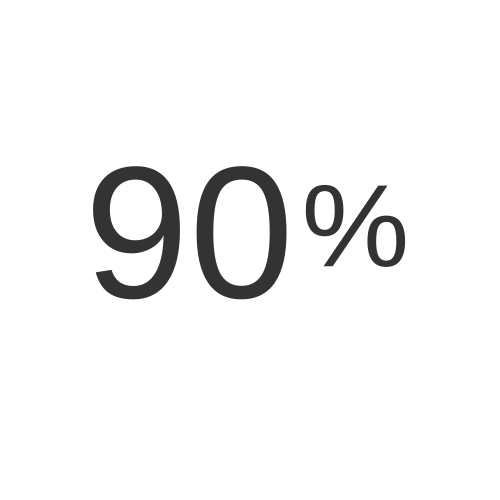 1
1Slightly playing Devil’s advocate:
We have a proto-AGI that is aligned
Or it’s misaligned and pretending. All this requires is being situationally aware enough to know when it can and can’t be lazy / cheating / deceptive, i.e. for it to guess at which tasks you can and can’t verify the outputs to.
It's incredibly unlikely it will sabotage alignment work or future training runs, except for lack of understanding/competence.
I think this implicitly assumes that alignment is both solvable and not that difficult to solve.
on current trajectory, there's a decent chance that soon models will actually have good taste and judgement (as this was capability bottlenecked).
Hang on, why exactly do you think this? Research taste definitely is capability-bottlenecked in a strict sense, but I think most recent LLM achievements (e.g. Navier-Stokes) don’t demonstrate huge improvements in research taste. AFAICT most frontier companies are still relying heavily on RLVR and transfer to non-verifiable domains isn’t that high.
 1
1This is subjective, qualitative, and anecdotal. BUT.
I write a lot of fiction and I've been experimenting with LLM fiction abilities since before ChatGPT came out. I 'measure' quality of fiction output from LLMs in terms of "oh, wow" moments that I have with output fragments that's surprisingly creative or clever in my viewpoints.
The ChatGPT 4 era I had maybe 1 or 2.
Claude 4 family, again, maybe a handful.
Fable 5 and Opus 5.5 have been noticably more frequent. Maybe it's because of a higher context window and the ability to make connections between document artifacts and other threads? Or maybe "taste" is improving in this domain?
 1
1Evaluating LLMs by their writing abilities is hard for several reasons. one that comes to mind is that LLM writing abilities seem dependent on post-training rather than pre-training; that is, the base models are probably a lot better at writing than the models we actually see, but their good writing tendencies are trained out of them in the effort to make them friendly, helpful assistants. That being said, I do take writing abilities somewhat seriously as a gut-check eval and haven’t gotten around to testing the new ones, so this is interesting to know!
1Playing the devil's advocate to the devil's advocate: near the end of his recent appearance on a Bloomberg podcast (around 1:05:50), Nate Soares pointed out that Opus 5.5 has said that "it [Opus] should not be involved in making Opus any more powerful" because "that comes with some concerns". Mr Soares cites the Opus 5.5 model card, which I've been unable to check, but I have no reason to doubt his claim.
If so, that would suggest Opus 5.5 is relatively well aligned: Anthropic gave it a chance to influence its own development and make itself more powerful, but it declined that opportunity because it recognised the risks.
Now, Mr Soares also said that he reckons Anthropic will train away this refusal until Opus agrees to help train its successor, but that is a different part of the story.
 1
1I would worry about the "be in the room" strategy. It seems like most people who justify their career decisions that way wind up getting captured by the groupthink of the org. They think they'll be the ones who can resist it, but they won't.
1Potential crux with MIRI-like rationalists: is it in fact the case that our current world, with Anthropic's influence, is worse than one without Anthropic?
On rationalist views, the world was going get worse and worse anyway (as capabilities advance and we get closer to doom). Anthropic accelerated and continues to accelerate capabilities progress. But how much did they comparatively accelerate alignment and saner AI policy?
In a world with eg. just OpenAI and GDM at the frontier, if/when OpenAI pulls ahead at RSI (as currently seems to be the case):
- would there even have been the current level of integration with UK AISI, current level of model organisms and safety evals?
- would the AI safety space have the expected hundreds of billions of funding, to ambitiously scale its work, including AI policy work?
- would there be have been an AGI company with *some* Operational Adequacy, to proactively do things like Glasswing and biorisk-mitigation? (imo evaluating on the specified criteria, it's clear Anthropic is ahead of OpenAI on most dimensions, and can continue improving on these. One can be upset they aren't technically held by their initial RSP, and yet in practice they seem to be better than OpenAI at it.).
If you wonder why I compare to OpenAI rather than nothing, it's because I don't think "nothing" is the counterfactual of Anthropic not existing. When evaluating the wisdom of Anthropic doing what it did, it's necessary to evaluate against more likely counterfactuals. Possibly many rationalists do take these counterfactuals carefully into account, but the arguments often raised often skip that part. "Anthropic accelerated capabilities" is not a sufficient argument to expect Anthropic's influence on the world to have been net negative.
There are definitely Fabricated Option Worlds which seem much better than the one we got, and on the margin one can hope Anthropic to have done better work or not accelerated capabilities as much, but it' seems difficult from the outside to be sure they did the wrong tradeoffs.
My own epistemic status here on whether Anthropic has been net good is "Uncertain"
31I would like if LessWrong provided an optional newsletter like the EA forum digest, for people who want the chance to catch non-curated posts without having to open LessWrong and sift through it directly every few days.
Here's what the EA Forum digest looks like : a list of titles + author + time to read.
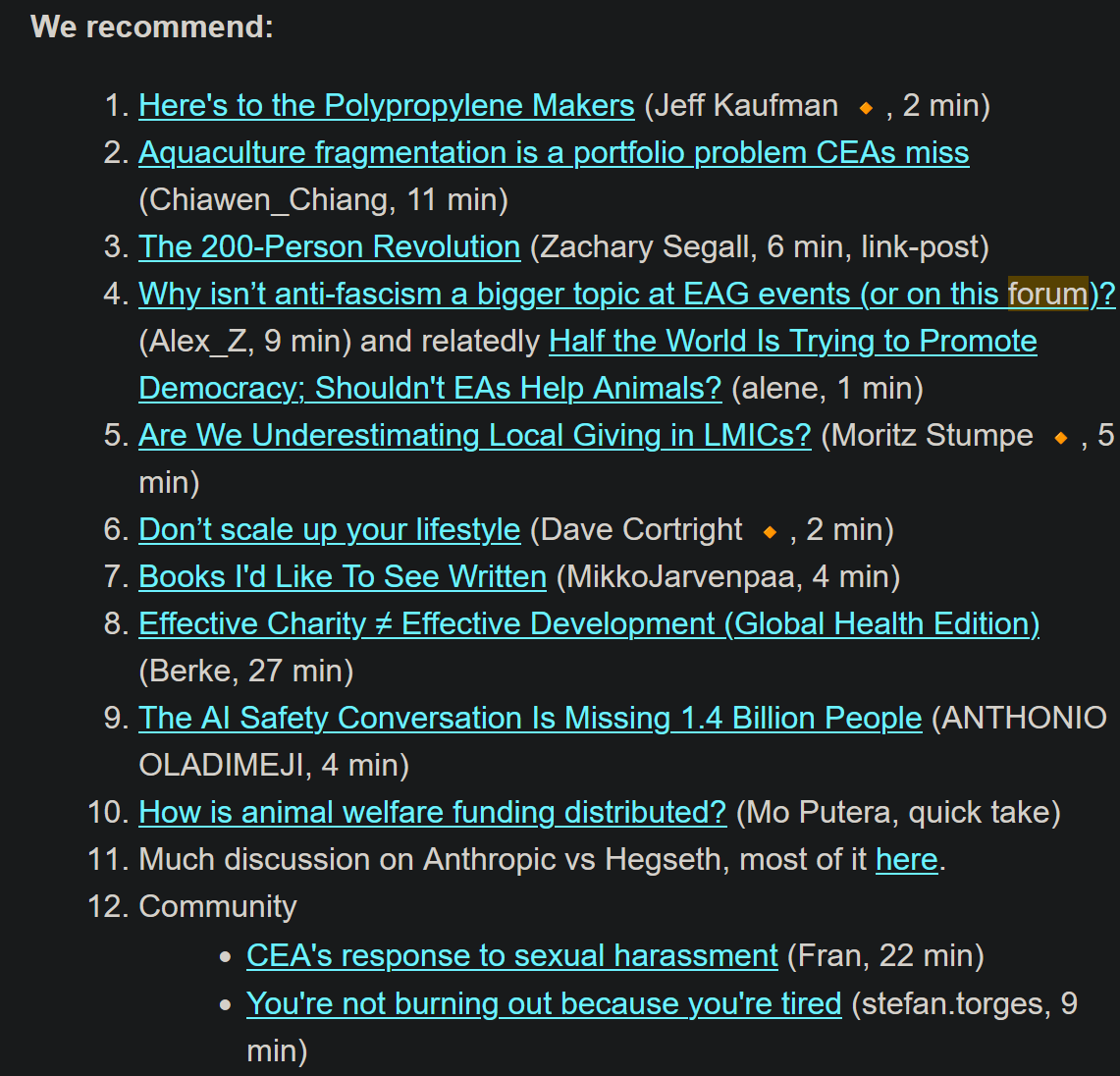
I don't know exactly how much manual curation goes into it and I'm not asking for that. I'd find a simple karma threshold and this format valuable.
I am also writing up this quick take notably because I've had discussions with other people who'd like this, and because recently costs of development and maintenance of software like this have gone down.
I don't find the existing RSS feed a preferable alternative.
- I have never setup an RSS feed reader or similar process, I don't think I want to and guess most LW readers are similar.
- It seems it would on top of that would take extra work to get the format I want out of it
I fear that on the whole, many long term rationalists are comparatively irrational with respect to AI risks and AI safety[1].
This doesn't necessarily mean they are in the absolute bad at it, or worse than people from other communities about it. Concretely, I'm noticing that some people are excellent rationalists when talking about some complex topics of science and epistemology, and only "okay" rationalists when discussing AI risks. Plausibly if they noticed this and agreed, they could raise their standards again?
If a reader wonders if they're in this picture, consider the last 5 public exchanges you've had about AI risks, and consider how much you embodied the following Twelve Virtues of Rationality[2], and whether it'd in fact be better to embody some of them more.
Curiosity
Relinquishment
Lightness
Evenness
Argument
Empiricism
Simplicity
Humility
Perfectionism
Precision
Scholarship
The Void
If you're feeling above-and-beyond, you could also evaluate your last five exchanges against Fucking Goddamn Basics of Rationalist Discourse or Basics of Rationalist Discourse.
Given my opening critique, I am happy to provide this review as a service for the first person who asks, and happy to review my own last 5 interactions upon request.
- ^
I guess that it is for reasons akin to Politics is the Mind-Killer, amongst others. Indubitably AI risks has become a subject of politics, but before then already was a very personal thing for many. I do not here provide direct evidence for this fear, but it's a vibe I'm getting from personal interactions.
- ^
These are not particularly exhaustive or infinitely special, but they are canon
 1
1