And so, this being Japan, robot wolves are being deployed in their stead.
On a first read, in the context of the rest of the paragraph, I thought you were saying/implying that Japan has robot wolves hunting deer. I think this is false? The article you link only says that robot wolves are used as scaredeer.

I think there's a tension between economic efficiency and having people lead good lives. Human beings are not worker bees by default, turning a normally-rebellious human child into a worker bee requires a decade long forced process. If you overdo it in the name of productivity (as I think has already happened in Japan / China / S Korea and to a lesser extent in Western countries), you end up with a society of people who don't find life very fun and don't have many kids, though they may be very civilized and very good at their jobs. Too much domestication.
The difference between tfrs of the worker bee societies of Asia and the tfrs of lazier less overworked European countries is not very high. They are both far below replacement.
Italy: 1.3
Japan: 1.15
Most of these moralistic explanations for low tfrs are just wrong. Rich, poor, conservative, liberal, egalitarian, unequal, religious, irreligious, etc countries all have low tfrs. Israel seems to be the one stable exception I know of.
EDIT:
Fertility Rate Hours Worked/Year
East Asia 1.08 2,265
Europe 1.38 1,548
Difference −0.30 +717
America is also a strong counterexample. FRED says that Americans work 1788 hours per year, and that the fertility rate is 1.61.
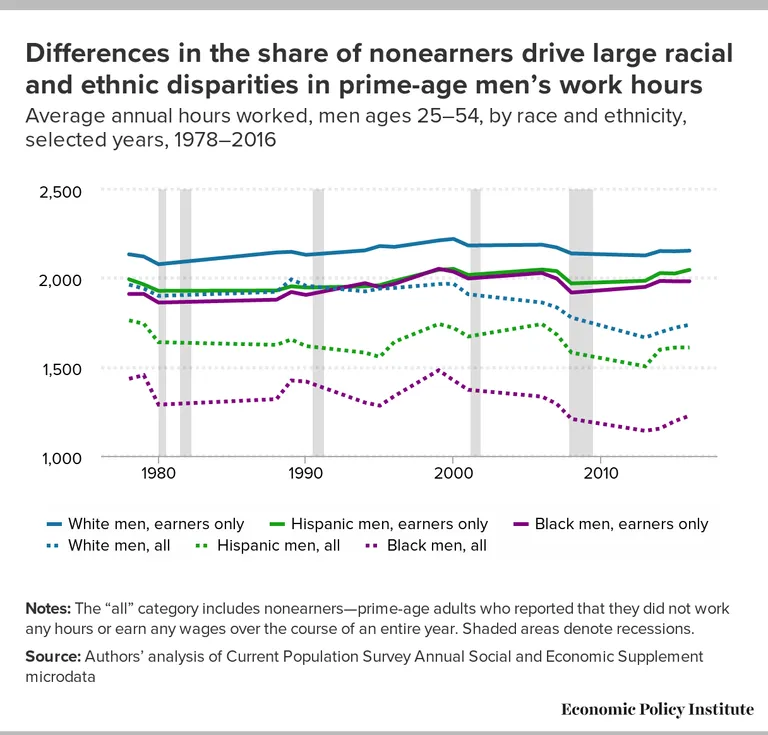
Even if you want to adjust for ethnicity (you'd need counterpart data for work hours by demographic; The Week has data that might fit well enough), U.S. Whites have about the same birthrate as U.S. Blacks despite a large gap in work hours, with Hispanics being the only outlier in birthrate yet sitting directly between the two in work hours. If you filter for U.S. Whites specifically, for a more direct comparison with Europe, you still see substantially more hours worked and a substantially higher birthrate.
At first I thought your comment completely refuted mine, but then I thought some more and not so sure. Italy being "lazy" is just a meme, a lazy country couldn't have such amazing car industry, fashion industry, food industry and so on. You try making a Ferrari if you're lazy :-) My stereotype of Italians is that they often do extremely good work.
You are right. I should clarify my post and provide better sources.
Fertility Rate Hours Worked/Year
East Asia 1.08 2,265
Europe 1.38 1,548
Difference −0.30 +717
Accuracy check: Europe matches official estimates, thus east asian tfr is probably on point
From claude. (population weighted). I think you aren't completely wrong, just that it's not the core component and is actually marginal. I suspect a lot of the European advantage comes from unassimilated immigrants too (who converge to native birth rates within a generation or two).
EDIT: Population-weighted native European TFR: roughly ~1.22 (rough math based on % of kids from immigrants vs % immigrants)

Italian here. I feel like the core issues are probably on point, with the details differing from country to country. For us, our economy has been quite bad for decades now. Work is scarce, poorly paid, often within stultified companies ruled by an idiotic behind the times managerial class (one thing Italy shares with Japan: being a gerontocracy). People don't achieve economic stability until well in their thirties, if ever. Some jobs, like teacher, require absurd humiliation congas (I know of people who kept being substitutes and temps, constantly travelling for each role, well into their fifties, while climbing up the Byzantine public scoreboard to a fixed job). It's just not particularly surprising that fertility craters. Mostly I would say Italians in Italy end up working very hard to achieve very little which is simultaneously tiring and demotivating.

The silver lining is that, while the transition inherent in a low birthrate might be painful, a lower total population selected from internal subcultures that take the time to make life worth living will likely be much happier.
From a Keynesian standpoint, elder care can also be redistributive and beneficial to the economy, so long as things are arranged such that the money doesn't get eaten up by a small handful of managers. Youth unemployment, which is presently high in much of the west, could be made all but nonexistent as well, so long as the temptation to bring in outside workers to fill those jobs instead isn't followed.
This might as well be describing the northernmost part of New York State. It’s getting very close to one in three people in the north country being over 65 years old. There are at least 15 to 20 School districts up there that realistically should be closed due to lack of students, and many of the Adirondack counties have closed schools. Simply look at Zillow for Potsdam, Massena, Ogdensburg. Hundreds of affordable houses for sale that have been on the market for a long time.
I was going to comment this about Vermont too, though perhaps a bit less intense than upstate NY. One of the culture shocks of moving away from VT for college was realizing that not many other Americans had faced the feeling that the way of life was ending.
Yet this approach is politically toxic. Try campaigning not on an optimistic message of turning the tide and making the future as bright as it once used to be, but rather by telling voters that their neighborhood is going to be abandoned, that the bus won’t run anymore and that all the investment is going to go to a different district. Try telling the few remaining inhabitants of a valley that you can’t justify spending money on their flood defenses.
Is it? It feels, intuitively, like cleaning up unneeded infrastructure so that future generations will have an easier time of things would fit naturally into Japan's national psyche.
On a more international level, I should think that per-capita statistics are more salient to voters (if not media outlets, but the general public doesn't really change their mind based on what WSJ or NYT has to say anymore) than raw totals. If GDP fell 10 percent but per capita GDP increased ten percent, quality of life would probably be better. I think a politician could win an election on the basis of "I'm going to pay you to vacate the east half of town so you can enjoy roads that aren't full of potholes and running water that isn't brown".[1]
I think the core of it is that you have to do two things:
- Generously compensate the people whose regions are getting deprioritized. Even if they don't leave[2]. They paid taxes for years, they invested into the community like good citizens, and their adherence to the social contract should feel rewarded.
- Make sure that people like where they end up. There will be pressure to turn relocation into a partisan or demographic lever, and giving into this will kill the entire program because it depends on good faith from the government. Identify towns that are demographically, politically, and culturally similar to the areas being deprioritized, and incentivize the residents to move there to minimize the culture shock on both ends.
- ^
In America specifically, there might be backlash on the basis that lots of people no longer trust any large-scale government initiatives due to past mismanagement, but I think that's a separate issue. Demonstrating competence and good faith is a universal prerequisite to any kind of solution, after all. Suburban sprawl is a product of city governments not being trusted not to 'slaughter the golden goose' that is their taxpaying population, and guarantees against such behavior would need to be very firm.
- ^
Some people prefer fewer neighbors, or are just traditional. A cash bonus will soften the shock and let them make arrangements for getting by with fewer government services.
I think you are underestimating to what extent the old people are opposed to moving. In Ukraine, when the front approaches, some people choose to stay, even though it means living in a war zone.
I think you are underestimating to what extent the old people are opposed to moving.
There will always be some, and, as mentioned, they should be compensated when the service transition occurs, but there are also some people who would prefer a closer community with better services. Right now, neither group is getting what they want.
With government coordination, a Schelling Point could be established that gives everyone what they want. The people who want better services get a simultaneous, coordinated transition to a demographically and culturally similar community that can benefit from economies of scale. The cowboys get their fair share of the economic savings from this transition, and won't be subjected to potentially bothersome "revitalization efforts" meant to transform their communities.
BTW this makes me think that Japan has produced just about the only example of media I have seen in which an enthusiastic youth wanting to revitalise the little declining business they love ends with their dream crushed and them forced to accept reality and move on (if anyone wonders, it's the anime The Aquatope on the White Sand).
I live in Germany and our population has been kept approximately stable in the last decades via immigration, and we also have many people moving to the cities. Especially in Eastern Germany, as was mentioned in this post. Many of the phenomena mentioned in this post are familiar to me from news and anecdotes. I would be curious if there is data on if the depopulation of rural areas is mainly driven by fewer people being born or by more people moving away, and if there are differences between countries. My guess would be that people moving away is the bigger factor in many places.
Potsdam High School used to graduate 150 students each June about 30 years ago, now it is down to 75-90 each year. Potsdam is a town of about 10,000 people with two colleges in NY. The real decline is in the even smaller rural schools outside of the population centers. Those schools are often getting down to 10-20 students in a graduating class, and the wider issue is those students come from a large geographic area.
Side note: I believe some of the demographic collapse at the younger end is being masked by the increase in Amish population. Two Amish families can produce as many kids as in an elementary school classroom.
Generally, TFR collapses first in the cities, then in the countryside. Yet countryside depopulates quicker than the cities. Draw your own conclusions.
Interesting post! Personally, I would have liked more soft and hard data.
For the former, the lack of anecdota or specific examples of residents meant I didn't feel the emotions I normally feel in a town without children. The book Children of Men does this quite well - capturing the spiritual sense of 'what is this all for?' There is something very sombre about 1-2 people left remaining in a town which previously held hundreds and sometimes even thousands. Before-after comparisons show this powerfully. Satellite image comparisons using birthrate proxies?
For the latter, I would have liked more forecasts. It seems low birthrates cascade slowly, with nurseries closing, then primary schools, and finally secondary schools. Each can have progressively large catchment areas so the cascade is not linear. As they go, swimming pools, play parks, sports fields, and community centres (in the UK at least) begin falling into disrepair. I suspect 'children qua customers' is actually more load-bearing in our society than we realise, and all manner of things not typically associated with children by non-parents will shrink or transform (exhibit 30). The distribution of young people in society also seems to be shifting, hiding to some extent the falling birthrate - e.g., university towns, particular areas of cities, suburbs with good schools. Concretising this with some stats would be fascinating.
Finally, the effects of low birthrates superficially look similar to rural depopulation. But they are clearly not: when do you think the first city in japan will be abandoned/cease running normally? That seems like an important threshold.
I wonder if, should the tech to create gamete-less, womb-less embrios becomes available, governments would step in to guarantee population control by birthing and raising these children themselves.
Very Brave-New-Worldly, I know, but if incentives are high enough...
The ethical debats would be galore, from diversity of representation in education and ethnical composition, to necessary genetical diversity, to the ammount of modifications that should be warrented.
I also wonder if should this day come, if birth rates will be treated as a Central Bank's "interest rate" of sorts, but instead of the price of money, it would be optimized to reflect the price of human lives.
Not really, I think significant increases in life expectancy are unlikely because of inherent tradeoffs.
Keeping the organism coherent requires supression, otherwise the signal eventually diverges into noise, which is why only a tiny, compressed set of instructions is what's passed forward.
We're already developing immunte therapies that will help with this, the end of sarcopenia will also afford us more independece much later, but all of our systems eventually fail because of unavoidable thermodynamics
Sources:
https://www.nta.go.jp/english/taxes/others/02/15001.htm
https://www.nta.go.jp/taxes/shiraberu/taxanswer/sozoku/4155.htm
https://souzoku.asahi.com/article/14314394
https://www.japaneselawtranslation.go.jp/en/laws/view/2058/en
Thanks! Fixed.
Curious what is the tool that you’re using to generate this?
I can't help but be reminded of Degrees of Gray in Philipsburg:
Isn’t this your life? That ancient kiss
still burning out your eyes? Isn’t this defeat
so accurate, the church bell simply seems
a pure announcement: ring and no one comes?
Don’t empty houses ring? Are magnesium
and scorn sufficient to support a town,
not just Philipsburg, but towns
of towering blondes, good jazz and booze
the world will never let you have
until the town you came from dies inside?
This sounds horrible, but also...
Have you ever dreamed about living in a rationalist community, but a group house does not provide enough privacy, and the Bay Area is too expensive? This seems like a possible answer. If we (at least the ones in Europe) could coordinate on the same Italian village and move there, working remotely (at least the ones who are software developers)...
Working remotely is the rub, even for software developers (archive):
We appear to be reaching remote-work equilibrium, after years of conflicting trends and predictions. The share of open jobs listed as remote on the career site Indeed has held steady between 8% and 8.6% for the past six months.
That’s roughly triple what the rate was in 2019 but markedly less than it was in 2022. Back then, more than 10% of jobs were advertised as remote, and many others were understood to be for obvious reasons.
[...]
Forty percent of applications submitted through LinkedIn are for remote roles, even though those jobs represent only 8% to 9% of listings.
JobHire.AI, which makes an artificial-intelligence tool for job hunters, recently analyzed more than 600,000 users’ applications. It found remote roles are roughly four times harder to get than in-office or hybrid positions.
It feels tempting, but I don't see it happening. Imagine the practicalities of having a poly relationship in Bratislava. Everyone's going to treat you as a madman. And that's trivial compared to having some kind of rationalist co-living arrangement. And that's Bratislava, a capital. Italian countryside is going to be much worse. Here's Lucie Philippon complaining about this kind of problems in Paris, as big a city as it gets: https://aelerinya.substack.com/p/in-paris-i-dream-of-lighthaven I am afraid that only Bay Area with its constant influx and large population of weird/autistic people can really sustain that kind of thing.
Hm, I guess I am too conservative in behavior to appreciate this.
My guess is that as long as you don't do anything outrageous on the streets, people mostly don't care about what you do at home. (And even if they do, they will round it up to "young-ish people having extramarital sex", which may be a food for rumors, but it's nothing extraordinary.)
If we could get 30 rationalists in a village that otherwise mostly contains old people, I think as long as we behave nicely to them (be polite neighbors, don't make much noise), it would be okay. Taking drugs on the streets or organizing prides or similar things, yeah that would create lots of conflict.
Similarly, if we built something like Lighthaven there, it would only be a problem if it creates noise, or if perhaps the locals would feel that we are spending their tax money on our fun. Even the problem with noise could be solvable in theory by choosing a sufficiently distant and abandoned part of the village.
I guess the crux is how weird people do we expect there, and what do we expect their public behavior to be like. I think that people like me wouldn't be a problem, I even think that people like the ones I meet at Vienna meetups wouldn't be a problem... but of course the Bay Area idea of "normal" is a distant galaxy.
That said, I would prefer some vetting for sanity... to put it bluntly, to keep the Zizians out. Not just for the sake of the locals, but for ourselves, too. Generally, no mentally ill people, no homeless people who need a shelter, just because they created a Less Wrong account it doesn't automatically make them ingroup. But I guess this is my conservative behavior showing...
I like your thinking, but I believe the entire rationalist subculture stems from global agglomeration effects, as seen in the Bay Area, and cannot really live without them. To give an example, I am currently living in Zurich. There are big Google offices here, many crypto startups, Basel with its big pharma is close enough and so is Geneva with its international organizations and CERN. When people talk about possible "Silicon Valley of Europe" it's either London or Zurich. That being said, there's an EA coworking space here. Then there are regular EA and ACX meetups, with 5-15 people attending. And that's it. Definitely not enough to sustain something like Lighthaven. Elsewhere in Europe, I think, the problems with insufficient agglomeration would be even worse.
This is one of the most depressing articles I’ve read. It’s also why I remain confused at how doggedly some people fight against our AI future beyond maybe a short pause, when it’s the one silver lining in the gloomy clouds at the horizon.
The general optimism also confuses me. We are looking at an inflationary Malthusian world where an invisible tyrant is taxing 50% of productive output, the pool of bright minds rapidly shrinking, and nostalgia ruling culture/politics. (Many of these factors are present today in growing prevalence already)
To me, betting on the AI future is delusional optimism (or something akin to religious faith). I think slowing down "progress" is better than speeding it up, since all these problems are caused by "progress" in the first place.
The existence of LLMs has only made society worse so far, and I don't expect taking a bad idea further will turn it into a good idea. But while I do not agree with your proposed solution, I do agree with the problem

Fair, main empires have collapsed, so the cause cannot be purely modern. But I can see a lot of similarities in how they collapse. Here's a quote from "The Fate of Empires and Search for Survival" (1978), about the Arab Empire on the tenth century: "Many women practised law, while others obtained posts as university professors. There was an agitation for the appointment of female judges, which, however, does not appear to have succeeded. Soon after this period, government and public order collapsed, and foreign invaders overran the country. The resulting increase in confusion and violence made it unsafe for women to move unescorted in the streets, with the result that this feminist movement collapsed".
Similar issues happened in rome: "The later Romans complained that, although Rome ruled the world, women ruled Rome"
It also mentions sexual degeneracy, corruption, mass-immigration into capital cities, and the decline of religion. Sexual freedom, the decline of religion, and immigration are all considered "progress" today. These topics are all controversial now, but the author doesn't strike me as an ideologue.
Concretely how have LLMs only made society worse so far?
Let me first state that I can think of no benefits except for convenient access to common information. Downsides of LLMs include harming education (Students cheat with LLMs, teachers might also use LLMs). Harming employment (automated reading and writing of CVs). A massive increase in slop (LLMs makes mass production of low-quality content trivial, and those who use LLMs are rarely capable of producing high-quality content). And a general downgrade in the quality of fields where AI integration has been attempted (e.g. The problems with recent Windows updates). I haven't even started on AI psychosis and the price of ram sticks.
They'll be used for automated moderation (terrible idea, terrible results) and various things which further erode online privacy (perhaps selling peoples private information as a way to make up for their lack of profitability). I strongly believe that shareholders have been mislead about the capabilities of LLMs and that everyone else suffers as a result. Would you agree if I said that the value of LLMs lie in their future potential rather than their current abilities?
I imagine there are regulations - intended for business as usual - that are interfering with people adapting to the new situation.
Inheritance tax and 'vacant house' charges distorting the market value of houses.
Possibly - anti-hunting laws that stop any willing person from hunting deer themselves.
With businesses that have dependent customers, where pressure is put on the aging owner to have a succession plan - what stops a PE firm rolling up all such companies in an industry, for a discount?
The entrepreneur has a home-field advantage: he understands locals and has friends and a community. PE firms are at a disadvantage, and possibly the economy will shrink so it's a bad time to buy. They took would need to find managers, if that was easy, the original owner could have found a successor among family of friends (if not his own), or sold his business to a local competitor. But all labor is short, all consumption is falling, buying a company is a fool's game.
I grew up where New York, Quebec and Vermont meet. As a kid my long bike rides would cross borders.
I returned to the region and got tenure at SUNY Potsdam. In the 1990’s SUNY Potsdam had 4,500 students, today around 1,800 on campus.
St Lawrence County where it is located used to have about 1,500 people graduate from the county high schools each year about 30 years ago. Now it is around 1,000. My cousins graduated from Indian Lake, a little south. Indian Lake just graduated a high school class of four students.
You do not need to go to Japan to find this. Look at Zillow for that region.
with its still-docile population accustomed to state directives, than in democratic Japan
This is a very strong claim. I'd be interested in your sources.
Lived experience. I happened to live through the fall of communism. The typical communist/post-communist mindset is: "Don't oppose the system. Do what you are told to do, but throw a wrench into the machine by pretending to be dumb, sleuthing, stealing and just being generally corrupt."
I doubt that this is a good description of current Eastern Germany. I assume the reaction to vaccination campaigns during the pandemic would have been different. Here you can see the share of the population vaccinated (April 2023): https://impfdashboard.de/ Shares in the west were, in general, higher than in the East. This is of course only one piece of data, but in general it seems appropriate to be more careful with respect to such claims.
Long term depopulation wouldn't be a problem, as we are just undergoing an evolutionary event where women with higher maternal drives are being strongly selected for. But the AI singularity makes this all moot, that disruption means long term demographic problems aren't going to play out anywhere near where current trends point.
What is your opinion on state-funded surrogacy to produce children who can then be injected into the existing foster care system (which will of course require significant expansion if this is to work)?
It seems like one of the few option left that won't be impacted by the continued desire for childrearing, and becomes more cost-efficient than childbirth subsidies when the cost of the latter reaches $200,000-300,000.
The only optimistic case would be if robots get so good & cheap that they can do most of the maintenance / adjusting / eldercare works in rural areas and thus we're able to afford an aging population still living there based on general abundance.
If not, the feedback loop makes the situation much worse: the older the population in an area, the smaller the tax base and the more gets extracted by the government of the smart young people, who have even more incentive to move to the few places still attracting young people.
Immigration isn't a fix for that. It can work if you have yourself children and then they grow up with the immigrant children and form a common generation. But if all the old people are locals and all the young people are immigrants (who'll move away when they realize they pay more and more for the old people they have no connection with), it's not a stable system. Japan might already be too aged to integrate tons of young immigrants.
We're entering a new era of abundant housing.
Japan. Much of Europe. China. All of them with more homes than they can use. I used to wonder what the fall of Rome felt like, or the middle ages in Greece. Now I know, because I've been to rural Japan. A great civilisation living quietly among its own ruins.
You know what's going to be hot property later this century? Not property. Migrants.
AI proponents might tell us that people are devalued, I rather think the opposite. A few big expensive cities will be automatic drawcards (Tokyo, notably, is still very expensive to buy or rent in). While a big second-tier of cities (Winnipeg, Philadelphia, Birmingham, Adelaide, Seville, Frankfurt) will compete desperately for population.
he water sits in oversized pipes. It stagnates and chlorine dissipates. Bacteria move in, creating health risks. You can tear down an abandoned house in a week.
Perhaps they can use this water for carbon capture or farming
This is a cross-post from: https://www.250bpm.com/p/life-at-the-frontlines-of-demographic
Nagoro, a depopulated village in Japan where residents are replaced by dolls.
In 1960, Yubari, a former coal-mining city on Japan’s northern island of Hokkaido, had roughly 110,000 residents. Today, fewer than 7,000 remain. The share of those over 65 is 54%. The local train stopped running in 2019. Seven elementary schools and four junior high schools have been consolidated into just two buildings. Public swimming pools have closed. Parks are not maintained. Even the public toilets at the train station were shut down to save money.
Much has been written about the economic consequences of aging and shrinking populations. Fewer workers supporting more retirees will make pension systems buckle. Living standards will decline. Healthcare will get harder to provide. But that’s dry theory. A numbers game. It doesn’t tell you what life actually looks like at ground zero.
And it’s not all straightforward. Consider water pipes. Abandoned houses are photogenic. It’s the first image that comes to mind when you picture a shrinking city. But as the population declines, ever fewer people live in the same housing stock and water consumption declines. The water sits in oversized pipes. It stagnates and chlorine dissipates. Bacteria move in, creating health risks. You can tear down an abandoned house in a week. But you cannot easily downsize a city’s pipe network. The infrastructure is buried under streets and buildings. The cost of ripping it out and replacing it with smaller pipes would bankrupt a city that is already bleeding residents and tax revenue. As the population shrinks, problems like this become ubiquitous.
The common instinct is to fight decline with growth. Launch a tourism campaign. Build a theme park or a tech incubator. Offer subsidies and tax breaks to young families willing to move in. Subsidize childcare. Sell houses for €1, as some Italian towns do.
Well, Yubari tried this. After the coal mines closed, the city pivoted to tourism, opening a coal-themed amusement park, a fossil museum, and a ski resort. They organized a film festival. Celebrities came and left. None of it worked. By 2007 the city went bankrupt. The festival was canceled and the winners from years past never got their prize money.
Or, to get a different perspective, consider someone who moved to a shrinking Italian town, lured by a €1 house offer: They are about to retire. They want to live in the country. So they buy the house, go through all the paperwork. Then they renovate it. More paperwork. They don't speak Italian. That sucks. But finally everything works out. They move in. The house is nice. There's grapevine climbing the front wall. Out of the window they see the rolling hills of Sicily. In the evenings, they hears dogs barking in the distance. It looks exactly like the paradise they'd imagined. But then they start noticing their elderly neighbors getting sick and being taken away to hospital, never to return. They see them dying alone in their half-abandoned houses. And as the night closes in, they can't escape the thought: "When's my turn?" Maybe they shouldn't have come at all.
***
The instinctive approach, that vain attempt to grow and repopulate, is often counterproductive. It leads to building infrastructure, literal bridges to nowhere, waiting for people that will never come. Subsidies quietly fizzle out, leaving behind nothing but dilapidated billboards advertising the amazing attractions of the town, attractions that closed their gates a decade ago.
The alternative is not to fight the decline, but to manage it. To accept that the population is not coming back and ask a different question: how do you make a smaller city livable for those who remain? In Yubari, the current mayor has stopped talking about attracting new residents. The new goal is consolidation. Relocating the remaining population closer to the city center, where services can be still delivered, where the pipes are still the right size, where neighbors are close enough to check on each other.
Germany took a similar approach with its Stadtumbau Ost, a federal program launched after reunification to address the exodus from East to West, as young people moved west for work, leaving behind more than a million vacant apartments. It paid to demolish nearly 300,000 housing units. The idea was not to lure people back but to stabilize what was left: reduce the housing surplus, concentrate investment in viable neighborhoods, and stop the downward spiral of vacancy breeding more vacancy. It was not a happy solution, but it was a workable one.
Yet this approach is politically toxic. Try campaigning not on an optimistic message of turning the tide and making the future as bright as it once used to be, but rather by telling voters that their neighborhood is going to be abandoned, that the bus won’t run anymore and that all the investment is going to go to a different district. Try telling the few remaining inhabitants of a valley that you can’t justify spending money on their flood defenses.
Consider the España Vaciada movement representing the depopulating interior of Spain, which has achieved some electoral successes lately. It is propelled by real concerns: hospital patients traveling hours to reach a proper facility, highways that were never expanded, banks and post offices that closed and never reopened. But it does not champion managed decline. It champions the opposite: more investment, more infrastructure, more services. Its flagship proposal, the 100/30/30 plan, demands 100-megabit internet everywhere, no more than 30 minutes to basic services, no more than 30 kilometers to a major highway. They want to reopen what was closed. They want to see more investment in healthcare and education. They want young people back in the regions.
And it’s hard to blame them. But what that means on the ground, whether in Spain or elsewhere, is that the unrewarding task of managing the shrinkage falls to local bureaucrats, not to the elected politicians. There’s no glory in it, no mandate, just the dumpster fire and whatever makeshift tools happen to be at hand.
***
You can think of it as, in effect, a form of degrowth. GDP per capita almost always falls in depopulating areas, which seems counterintuitive if you subscribe to zero-sum thinking. Shouldn’t fewer people dividing the same economic pie mean more for each?
Well, no. It’s a negative-sum game. As the town shrinks, the productive workforce, disheartened by the lack of prospects, moves elsewhere, leaving the elderly and the unemployable behind. Agglomeration effects are replaced by de-agglomeration effects. Supply chains fragment. Local markets shrink. Successful firms move to greener pastures.
And then there are the small firms that simply shut down. In Japan, over half of small and medium-sized businesses report having no successor. 38% of owners above 60 don’t even try. They report planning to close the firm during their generation. But even if they do not, the owner turns seventy, then seventy-five. Worried clients want a guarantee of continued service and pressure him to devise a succession plan. He designates a successor — maybe a nephew or a son-in-law — but the young man keeps working an office job in Tokyo or Osaka. No transfer of knowledge happens. Finally, the owner gets seriously ill or dies. The successor is bewildered. He doesn’t know what to do. He doesn’t even know whether it’s worth it. In fact, he doesn’t really want to take over. Often, the firm just falls apart.
*** So what is being done about these problems?
Take the case of infrastructure and services degradation. The solution is obvious: manage the decline by concentrating the population.
In 2014, the Japanese government initiated Location Normalization Plans to designate areas for concentrating hospitals, government offices, and commerce in walkable downtown cores. Tax incentives and housing subsidies were offered to attract residents. By 2020, dozens of Tokyo-area municipalities had adopted these plans.
Cities like Toyama built light rail transit and tried to concentrate development along the line, offering housing subsidies within 500 meters of stations. The results are modest: between 2005 and 2013, the percentage of Toyama residents living in the city center increased from 28% to 32%. Meanwhile, the city’s overall population continued to decline, and suburban sprawl persisted beyond the plan’s reach.
What about the water pipes? In theory, they can be decommissioned and consolidated, when people move out of some neighborhoods. At places, they can possibly be replaced with smaller-diameter pipes. Engineers can even open hydrants periodically to keep water flowing. But the most efficient of these measures were probably easier to implement in the recently post-totalitarian East Germany, with its still-docile population accustomed to state directives, than in democratic Japan.
***
And then there’s the problem of abandoned houses.
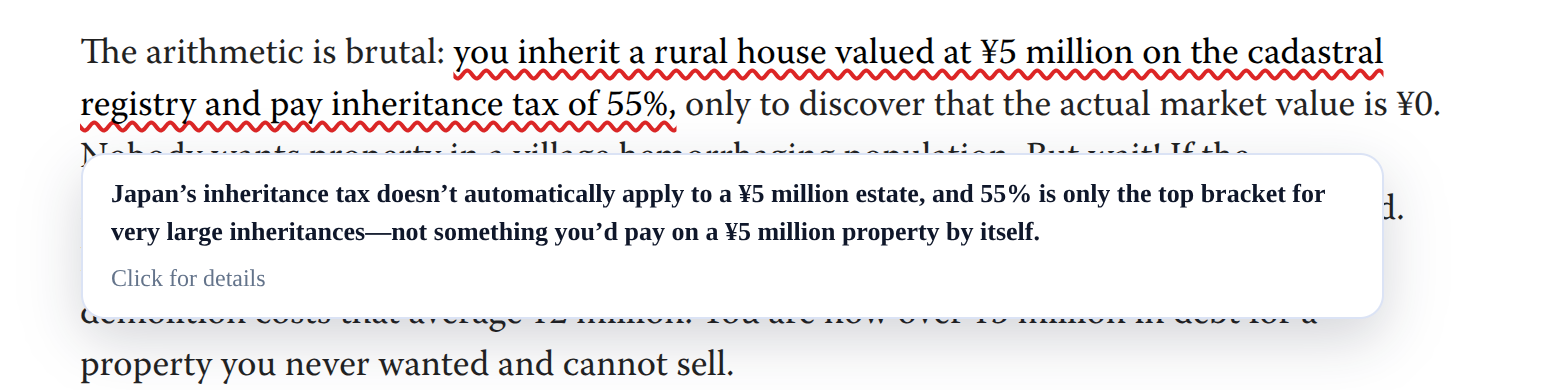
The arithmetic is brutal: you inherit a rural house valued at ¥5 million on the cadastral registry and pay inheritance tax of up to 55%, only to discover that the actual market value is ¥0. Nobody wants property in a village hemorrhaging population. But wait! If the municipality formally designates it a “vacant house,” your property tax increases sixfold. Now you face half a million yen in fines for non-compliance, and administrative demolition costs that average ¥2 million. You are now over ¥5 million in debt for a property you never wanted and cannot sell.
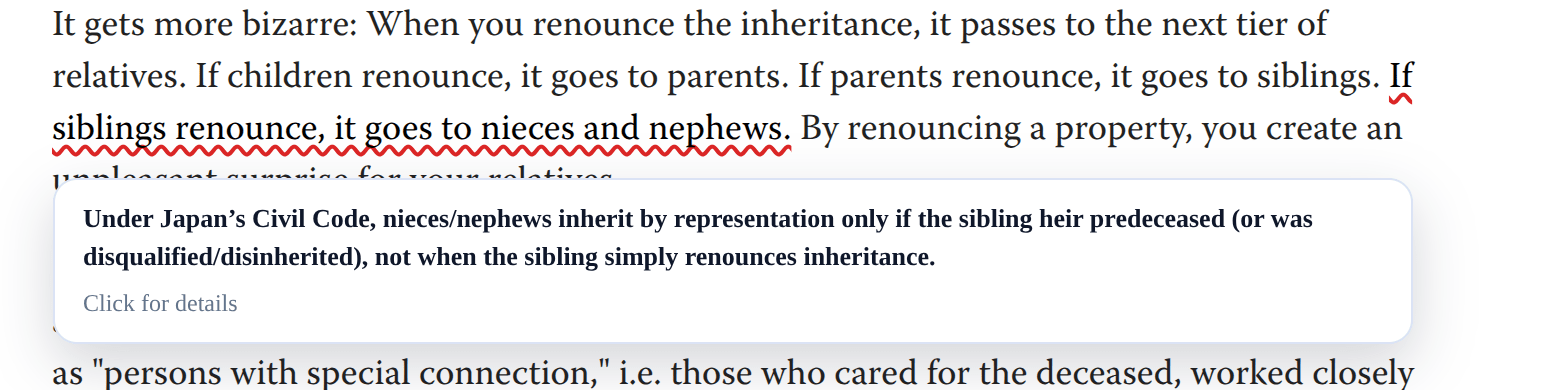
It gets more bizarre: When you renounce the inheritance, it passes to the next tier of relatives. If children renounce, it goes to parents. If parents renounce, it goes to siblings. By renouncing a property, you create an unpleasant surprise for your relatives.
Finally, when every possible relative renounces, the family court appoints an administrator to manage the estate. Their task is to search for other potential heirs, such as "persons with special connection," i.e. those who cared for the deceased, worked closely with them and so on. Lucky them, the friends and colleagues!
Obviously, this gets tricky and that’s exactly the reason why a new system was introduced to allows a property to be passed to the state. But there are many limitations placed on the property — essentially, the state will only accept land that has some value.
In the end, it's a hot potato problem. The legal system was designed in the era when all property had value and implicitly assumed that people wanted it. Now that many properties have negative value, the framework misfires, creates misaligned incentives and recent fixes all too often make the problem worse. Tax penalties meant to force owners to renovate only add to the costs of the properties that are already financial liabilities, creating a downward price spiral.
Maybe the problem needs fundamental rethinking. Should there be a guaranteed right to abandon unwanted property? Maybe. But if so, who bears the liabilities such as demolishing the house before it collapses during an earthquake and blocks the evacuation routes?
***
Well, if everything is doom and gloom, at least nature benefits when people are removed from the equation, right?
Let’s take a look.
Japan has around 10 million hectares of plantation forests, many of them planted after WWII. These forests are now reaching the stage at which thinning is necessary. Yet because profitability has declined — expensive domestic timber was largely displaced by cheap imports long ago — and the forestry workforce was greatly reduced, thinning often does not occur. As a result, the forests grow too dense for light to penetrate. Little or nothing survives in the understory. And where something does manage to grow, overpopulated deer consume new saplings and other vegetation such as dwarf bamboo, which would otherwise help stabilize the soil. The result is soil erosion and the gradual deterioration of the forest.
The deer population, incidentally, is high because there are no wolves, the erstwhile apex predators, in Japan. But few people want them reintroduced. Instead, authorities have extended hunting seasons and increased culling quotas. In an aging and depopulating countryside, however, there are too few hunters to make use of these measures. And so, this being Japan, robot wolves are being deployed in their stead.
***
Finally, care for the elderly is clearly the elephant in the room. Ideas abound: Intergenerational sharehouses where students pay reduced rent in exchange for “being good neighbors.” Projects combining kindergartens with elderly housing. Denmark’s has more than 150 cohousing communities where residents share meals and social life. But the obvious challenge is scale. These work for dozens, maybe hundreds. Aging countries need solutions for millions.
And then again, there are robot nurses.
***
It’s all different kinds of problems, but all of them, in their essence, boil down to negative-sum games.
Speaking of those, one tends to think of it as of the pie shrinking. And there’s an obvious conclusion: if you want your children to be as well off as you are, you have to fight for someone else’s slice. In a shrinking world, one would expect ruthless predators running wild and civic order collapsing.
But what you really see is quite different. The effect is gradual and subtle. It does not feel like a violent collapse. It feels more like the world silently coming apart at the seams. There’s no single big problem that you would point to. It feels like if everything now just works a bit worse than it used to.
The bus route that ran hourly now runs only three times a day. The elementary school merged with the one in the next town, so children now commute 40 minutes each way. Processing paperwork at the municipal office takes longer now, because both clerks are past the retirement age. The post office closes on Wednesdays and Fridays and the library opens only on Tuesdays. The doctor at the neighborhood clinic stopped accepting new patients because he’s 68 and can’t find a replacement. Even the funeral home can’t guarantee same-day service anymore. Bodies now have to wait.
You look out of the window at the neighboring house, the windows empty and the yard overgrown with weeds, and think about the book club you used to attend. It stopped meeting when the woman who used to organize it moved away. You are told that the local volunteer fire brigade can’t find enough members and will likely cease to operate. You are also warned that there may be bacteria in the tap water. You are told to boil your water before drinking it.
Sometimes you notice how the friends and neighbors are getting less friendly each year. When you need a hand, you call them, but somehow today, they just really, really can’t. It’s tough. They’ll definitely help you next time. But often, they are too busy to even answer the phone. Everyone now has more people to care for. Everyone is stretched out and running thin on resources.
When you were fifty and children started to leave the home, you and your friends, you used to joke that now you would form an anarcho-syndicalist commune.
Ten years later you actually discuss a co-living arrangement, and all you can think about is the arithmetic of care: would you be the last one standing, taking care of everybody else?
Finally someone bites the bullet and proposes moving together but signing a non-nursing-care contract first. And you find yourself quietly nodding in approval.