New Comment
More context: an internal survey (n=16) from the Opus 4.6 system card they said they got a 2.52x average speedup[1], so Mythos is apparently 59% better than Opus 4.6 for productivity uplift.
Productivity uplift estimates from the use of Claude Opus 4.6 ranged from 30% to 700% with a mean of 152% and median of 100%
- ^
152%/100% = 1.52, plus 1 because a 0% uplift would be a 1x speedup
 2
2The Opus 4.7 system card includes more details about this uplift survey (done for Mythos):
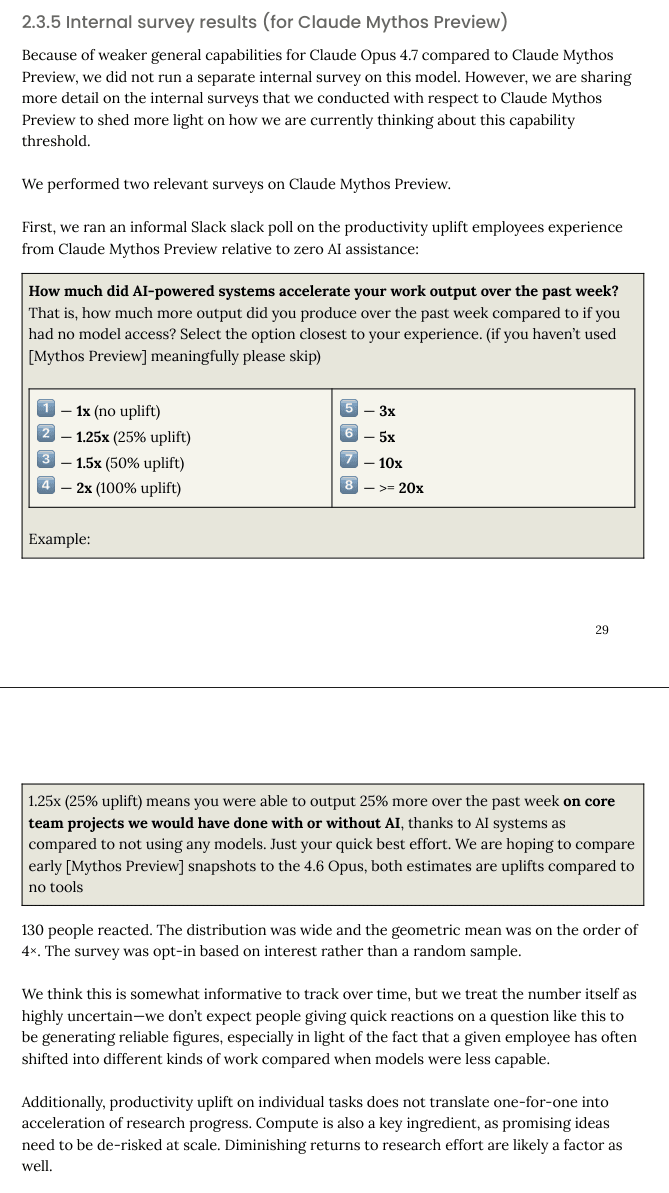
My takeaways:
- I agree with "We think this is somewhat informative to track over time, but we treat the number itself as highly uncertain—we don’t expect people giving quick reactions on a question like this to be generating reliable figures, especially in light of the fact that a given employee has often shifted into different kinds of work compared when models were less capable." I think this might give some sense for the relative vibe between models, but it's unclear how to convert the resulting number into a reasonable uplift estimate.
- I don't think the survey question clearly corresponds to a particular notion of uplift and I don't think this question with this methodology would result in survey takers understanding the difference and thinking carefully about what notion is in use. (I don't think a slack emoji poll could really do this, this is just capturing something else.)
- It looks like Anthropic isn't really taking an official stance on the level of uplift (seems reasonable).
I appreciate this additional information from Anthropic. Thanks to whoever put this in!
Anthropic's system card for Mythos Preview says:
It's unclear how we should interpret this. What do they mean by productivity uplift? To what extent is Anthropic's institutional view that the uplift is 4x? (Like, what do they mean by "We take this seriously and it is consistent with our own internal experience of the model.")
Edit: Anthropic has released more information about this survey and their interpretation in the Opus 4.7 system card. I appreciate that they did this! I discuss this new information here.
One straightforward interpretation is: AI systems improve the productivity of Anthropic so much that Anthropic would be indifferent between the current situation and a situation where all of their technical employees magically work 4 hours for every 1 hour (at equal productivity without burnout) but they get zero AI assistance. In other words, AI assistance is as useful as having their employees operate at 4x faster speeds for all activities (meetings, coding, thinking, writing, etc.) I'll call this "4x serial labor acceleration" [1] (see here for more discussion of this idea [2] ).
I currently think it's very unlikely that Anthropic's AIs are yielding 4x serial labor acceleration, but if I did come to believe it was true, I would update towards radically shorter timelines. (I tentatively think my median to Automated Coder would go from 4 years from now to maybe 1.3 years from now; my median to AI R&D parity would go from 5 years from now to maybe 2.5 years from now.) My best guess is that 4x serial labor acceleration would cause AI progress to go 1.75x faster (see "Appendix: Estimating AI progress speed up from serial labor acceleration") which is very large and close to the 2x "dramatic acceleration" threshold Anthropic is using for "Autonomy threat model 2: risks from automated R&D". [3]
My current best (low confidence, low precision) guess for the serial labor acceleration is ~1.55x (with a higher serial labor acceleration of ~1.75x for just research engineering activities). I currently think that reasonably informed Anthropic employees that have thought about this topic in a decent amount of detail think the serial labor acceleration is closer to 1.5x than 4x.
I think uplift metrics like "serial labor acceleration" at AI companies are some of the most relevant metrics to track when trying to figure out how close we are to key risk-relevant milestones in AI development like full automation of AI R&D. I also think uplift metrics are among the most relevant metrics for Anthropic's "Autonomy threat model 2: risks from automated R&D". I also think accurately capturing the views of employees, managers, and leadership at AI companies (probably with something like a survey) is currently one of our best ways of assessing serial labor acceleration (or other uplift metrics), especially for AI systems that aren't publicly deployed.
Thus, I'm pretty unhappy about a situation in which:
Some things that would improve the situation in future system cards / risk reports:
If there is a large disagreement about the current level of uplift, this seems like a particularly tractable empirical crux: I would substantially shorten my timelines if I learned the uplift was much higher than I expect, and I'd guess some people at Anthropic would lengthen theirs if they learned it was significantly lower than they expect. I also expect that various people who are much more skeptical than me of reaching very high levels of AI capability within the next 10 years would update some on credible internal uplift measurements. Getting better empirical information about the level of uplift seems hard but doable.
Additionally, Anthropic claims "We estimate that reaching 2× on overall progress via this channel would require uplift roughly an order of magnitude larger than what we observe." Insofar as "productivity uplift" is supposed to correspond to something like serial labor acceleration, I'm very skeptical. I think ~40x serial labor acceleration would yield much more than 2x faster progress. My guess (see "Appendix: Estimating AI progress speed up from serial labor acceleration") is that you'd get 2x overall AI progress at around 5x serial labor acceleration. My understanding is that the AI Futures Project timelines model would indicate that around 8x serial labor acceleration is required. It seems that Anthropic might have their own takeoff speeds / timelines model that differs substantially from current public modeling, produces much less conservative conclusions about the level of concern, and that they are using for decision making. If so, I think they should either publicly write up their modeling (informally would be fine) or get third parties to review it privately. Insofar as they mean "we think we'll maybe reach 2x overall progress when our survey—that's mostly capturing vibes and doesn't have a clear correspondence to any particular notion of uplift—reaches 40x", fair enough, but it seems good to clarify this.
The current state of our evidence about AI R&D acceleration from Mythos seems extremely limited and AI companies should (and can) do much better going forward. [4]
Appendix: Estimating AI progress speed up from serial labor acceleration
This model is basically a simplified version of the AI Futures Project model with somewhat different constants.
Appendix: Different notions of uplift
There are several different concepts that could be meant by "productivity uplift", and which one we're talking about makes a huge difference:
A parallel labor acceleration of X is much less useful than a serial labor acceleration of X. And depending on the operationalization, the AIs doing 90% of the work is way less useful than a 10x serial labor acceleration. So the choice of concept matters a lot for interpreting any claimed level of uplift.
I'm using a specific name to distinguish from other things we might call "4x productivity uplift" like "if the median employee had to do the tasks they are currently doing without the use of AI, they would be 4x slower". These notions have strongly different implications as I discuss here and in Appendix: Different notions of uplift. ↩︎
For reference, the speed up modeling I do in that post is out of date with my latest thinking. ↩︎
The update toward shorter timelines is almost entirely from thinking we're further along in the capability progress than I previously realized, rather than from thinking progress will be faster but we're starting from a similar point. As in, I both update towards getting more acceleration at a lower level of capability and towards models being closer in capability space towards various high milestones, and I'm mostly updating timelines based on the second of these. ↩︎
I think there are also some other issues in the system card's assessment of AI R&D acceleration. They seemingly argue that even if Mythos was substantially above trend due to AI acceleration, because this acceleration was done by earlier (less capable!) AIs, this would imply this Mythos-caused acceleration wouldn't be that high: "This means that even if the slope change were AI-attributable, the model it would implicate is not the one we are assessing." This seems backward: if less capable AIs yield a large acceleration, then we should expect the effect from more capable AIs to be even larger. To be clear, this seems like a minor/moderate issue, I just thought it was worth mentioning. ↩︎