8 Answers sorted by
190
TL;DR Leverage
"Upside risk" I am going to divide into two categories:
- Skewed returns - "Bets with a payoff which is either very large and positive; or small and negative"
- Outsized returns - "Bets with a higher mean return"
It seems to me that you're mostly thinking in terms 1. There are plenty of ways to do this systematically;
- buying options [Buying SPACs slightly above NAV is roughly equivalent to buying options]
- buying insurance
- buying early-stage growth stocks
- buying lottery tickets
- betting on dogs
They all have a range of distributions but largely they are money-losing (on average). The reasons for this are fairly straightforward. Everyone likes lots of upside, with limited downside, so those bets get bid up and their expected returns fall. Personally I think these are a bad thing to do systematically*. You need to be deriving some value from the "excitement" for these strategies to be compensating you for the average loss you're taking.
* Where you're hedging some personal risk and paying over the odds to do it (health/home insurance) then you should do it systematically.
More interesting to me is how can retail investors achieve 2. without losing their shirts. (You mentioned a few of these (selling options, EM equity)). Off the top of my head there are a few different ways to boost your returns systematically (roughly in order of how "good" I think they are for retail):
- Leverage
- Equity factors (momentum, value, etc)
- Vol risk premium
- FX/Rates carry, CDS premia, ...
- "Alpha"
People have already mentioned vol risk premium. (Mostly expounding it's virtues). To give a bear case on this. This strategy can definitely become crowded. Even before the March '20 sell-off, vol sellers had had a terrible run from 2018-2020. Personally I believe that VRP exists, but it's not a premium I'd want to collect as a retail account. The market is pretty sophisticated and most of the ways to express that trade are full of nasty gotchas.
There have also been a few discussions of alpha. (Or at least the idea that LW-ers can beat the market in some risk-adjusted sense). For someone uninterested in finance, I think this is extremely unlikely - and probably going to end badly.
I think leverage is broadly underrated by retail. Margin accounts are getting cheaper and cheaper, and running a leveraged (say) 60/40 portfolio is becoming increasingly viable. This will increase risk and returns. You will pay some cost for the leverage, but this is by far the cleanest way to boost your returns in my option.
Equity factors - momentum, value etc. There's hundreds of these factors now all with a range of "acceptance" within the finance community. Access to them is becoming much easier (factor ETFs are a thing).
Carry etc - ... There's a bunch of different strategies which fall into this bucket. I'm not going to say a huge amount about them because I think this is something which is really worth doing your own research on. They are accessible to smart retail investors, but you will need to think carefully about what your strategy is,
50
Hi! I've made ~800% over the last 6 months with a basic strategy of selling options on highly volatile stocks (which I am confident in) and buying cheap OTM options on less volatile stocks to take advantage of any black swans. One of those black swans was GME, and without GME I'd be closer to a 250% or so increase (take that how you will).
A pretty safe strategy imo is to put most of your account into near-NAV SPAC's, then use margin to sell puts on stocks you would like to own. The SPACs have very little downside risk, and selling puts is fundamentally less risky than owning the stock itself, but you have potentially high returns if the SPACs do well or you are selling puts on highly volatile stocks.
In general, I believe the average less wronger to be more intelligent than the average trader (possibly even the average professional trader) and thus capable of achieving steady returns which beat the market. Maybe this is just survivorship bias talking, though.
30
Buy SVXY in small amounts, and keep your exposure to it balanced (i.e. regularly pull excess money out so you don't lose it all when it inevitably crashes hard). It's a short-VIX ETF, which makes it kind of similar to selling straddles on a big index, but you don't need a margin account since it's an ETF. It's also a lot less hassle than rolling options every month.
You can also manually apply something like the VXTH hedging algorithm that I mentioned in my other comment to this one.
What. In. The. World. Happened. In. 2018.
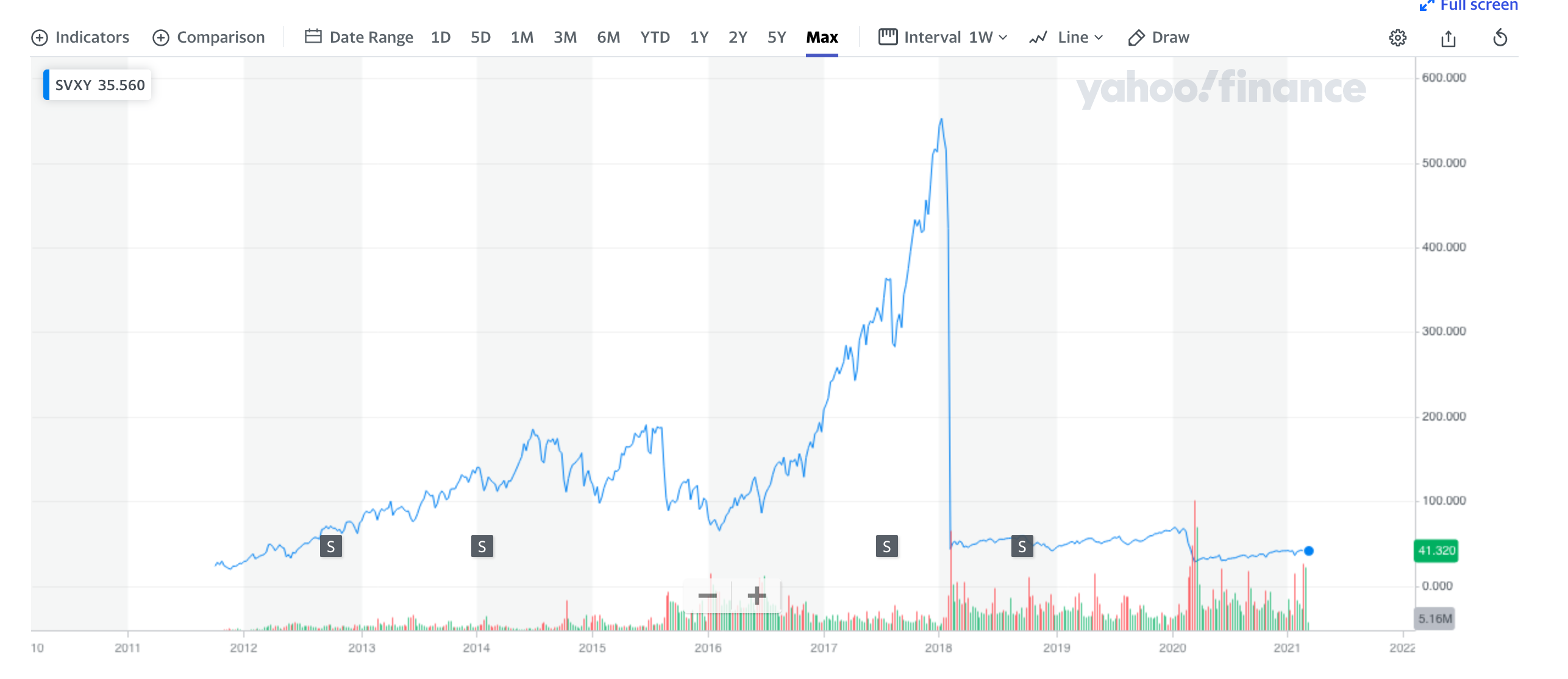
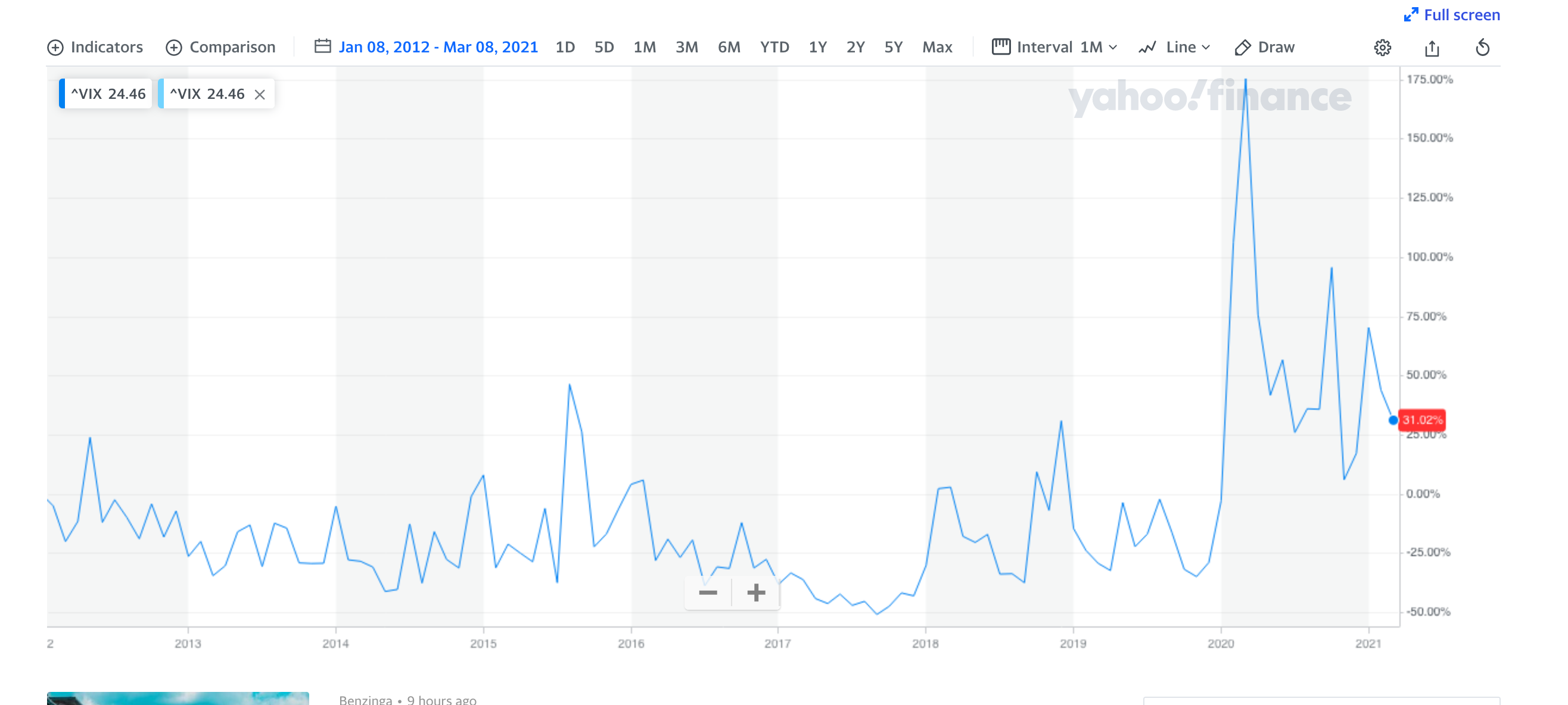
SVXY falling off the cliff looks like it was associated with a spike in VIX, but why didn't the previous, bigger spikes have the same effect, sooner?
[ETA]: "For example, SVXY was crushed in the volatility run-up of 2018. The instrument has since reduced leverage to half exposure..." That may explain the shift in behavior since 2018, but not what happened leading up to it. Altho perhaps that might be sufficiently explained by the counter-intuitive behavior of leveraged/inver...
30
ARKK looks interesting. It's an ETF focusing on "disruptive innovation", so its upside is potentially pretty high. It's done quite well so far (its biggest holding is currently TSLA), but, as always, that's really no guarantee of future performance. It's hard to separate skill from luck, especially with so little data. I don't currently hold this one, but if I were looking for more "upside risk", it's one I'd consider adding to my portfolio.
30
For crypto:
- buy btc
- buy eth
- buy defipulse index
For even higher variance crypto:
- buy defi small cap
- get eth, turn it into st-eth/eth LP on curve.fi, and then stake into the harvest.finance st-eth pool for ~30% APY on your eth
20
Anatomy of a bubble.
1. People are not interested
2. People ask for advice on getting into the market.
3. People give experienced traders advice on trading.
4. Crash.
I'd say we are between (2) and (3) at this stage.
20
For a cryptocurrency I consider Filecoin to be potentially high upside. It makers focused on producing a technology that can do new things (effectively selling storage) instead of hyping it.
There's an accelerator for projects that build on Filecoin.
With Amazon deciding to withdraw hosting from Parler there a clear incentive to use decentralized hosting like that provided by Filecoin.
10
I was also wondering about this.
The economists behind Lifecycle Investing suggest deep ITM SPY LEAPS. This works as leverage in an IRA or similar account.
I also like to use a little bit of margin and I prefer to keep as much money as I can in my Interactive Brokers account, with the idea that I can use the margin loan in lieu of an emergency fund or other savings.
By "upside risk" I mean: more upside risk than just holding the market.
By "reasonable" I mean: will not require an arbitrarily long education process to understand/carry out. I work a day job and have other commitments in my life, and I'm not that fundamentally interested in finance/investing. I'm not trying to get anywhere near an efficient frontier, I just want to be able to get upside risk more systematically than "some smart seeming EA/LWer drops a stock/crypto tip in a facebook group".
By "average": I assume I'm close to the LW median: I'm comfortable making kelly bets in the $1k - $100k range, depending on details. Mostly in the $10k range.
Are IPO ETFs a good candidate for this?
SPACESPAC ETFs? Buy and hold cryptocurrencies that aren't BTC/ETH? Buy and hold BTC/ETH? Sell random call and put options? Something else? Emerging markets ETFs?