This is a special post for quick takes by No77e. Only they can create top-level comments. Comments here also appear on the Quick Takes page and All Posts page.
Accidental AI Safety experiment by PewDiePie: He created his own self-hosted council of 8 AIs to answer questions. They voted and picked the best answer. He noticed they were always picking the same two AIs, so he discarded the others, made the process of discarding/replacing automatic, and told the AIs about it. The AIs started talking about this "sick game" and scheming to prevent that. This is the video with the timestamp:
 10
10Scott Alexander left an important reply to Rob Bensinger on X. I happen to agree with Scott. Here's the original post by Rob:
...In response to "What did EAs do re AI risk that is bad?":
Aside from the obvious 'being a major early funder and a major early talent source for two of the leading AI companies burning the commons', I think EAs en masse have tended to bring a toxic combination of heuristics/leanings/memes into the AI risk space. I'm especially thinking of some combination of:
'be extremely strategic and game-playing about how you spin the things you say, rather than just straightforwardly reporting on your impressions of things'
plus 'opportunistically use Modest Epistemology to dismiss unpalatable views and strategies, and to try to win PR battles'.
Normally, I'm at least a little skeptical of the counterfactual impact of people who have worsened the AI race, because if they hadn't done it, someone else might have done it in their place. But this is a bit harder to justify with EAs, because EAs legitimately have a pretty unusual combination of traits and views.
Dario and a cluster of Open-Phil-ish people seem to have a very strange and perverse set of views (at least insofar as t
 3
3 3
3 1
1I think that both of these posts seem very confused about the dynamics of who says or thinks what, and I'm pretty sad about these posts.
Thoughts on Rob's post
In general, I'll note that I don't think Rob really knows many of the OP people; I suspect he has spent <40 hours talking to them about any of this possibly ever. (This is in contrast to e.g. Habryka.) I don't know where he's getting his ideas about what the OP people think, but he seems incredibly confused and ignorant. (Eliezer seems similarly ignorant about who believes what.)
'be extremely strategic and game-playing about how you spin the things you say, rather than just straightforwardly reporting on your impressions of things' plus 'opportunistically use Modest Epistemology to dismiss unpalatable views and strategies, and to try to win PR battles'.
I don't really think this is true
Dario and a cluster of Open-Phil-ish people seem to have a very strange and perverse set of views
I wish Rob would be clear who he was referring to. Dario has beliefs that seem to me very different from most people who worked on the 2022 AI misalignment risk efforts at Open Phil. (I'm thinking of people like Holden Karnofsky, Ajeya Cotra, Joe C...
2 1
1 1
1Thanks for writing this, Buck. I'm not going to try to reply to your whole post, because I think some of it is stuff I should chew on for longer and see whether I agree with it. But going through some of your points:
I definitely apologize for making it sound like I was making a harsher criticism of (the relevant parts of) EA than I intended. My tweet was originally written as a quick follow-up comment to someone who asked why I thought EA's impact on AI x-risk was only ~55% likely to be positive. I turned it into a top-level tweet because I didn't want to hide it deep in an existing discussion, but this was an error given I didn't add extra context.
I also apologize for anything I said that made it sound like I was universally criticizing past or present Open Phil / cG staff (or centrally basing my views on first-hand conversations, for that matter). I already believed that tons of past and present rank-and-file OP/cG staff have very reasonable views, and I happily further update in that direction based on your and Oliver's statements to that effect (e.g., Ollie's "I have since updated that more people who are a level below Alexander, Dustin and Dario have more reasonable beliefs")....
 4
4Thanks, this is helpful and I basically accept most of what you're saying. Some more specific comments on the part about me:
I don't really think of Rob or MIRI as having a comms strategy of undermining EAs. I think Rob and Eliezer just say a bunch of false, wrong things about EAs because they're mad at them for reasons downstream of the EAs not agreeing with Eliezer as much as Eliezer and Rob think would be reasonable, and a few other things.
I accept this criticism and take back my claim. I noticed that some people who worked for MIRI comms seemed to do this, and I assumed that anything said by enough MIRI comms people in a serious-sounding voice was on some level a MIRI communique. Eliezer has clarified that this isn't true, so I apologize for saying it was.
...I think Dario (like various other Anthropic people) does not believe that AI takeover is a very plausible outcome, and I think his position is indefensible on the merits, as are some of his other AI positions (e.g. his skepticism that there are substantial returns to intelligence above the human level, his skepticism that ASI could lead to 2x manufacturing capacity per year). He moderately disagrees with the OP people about thi
 11
11In general, I'll note that I don't think Rob really knows many of the OP people; I suspect he has spent <40 hours talking to them about any of this possibly ever.
I think you are overfitting Rob's post to be about the wrong people. I think it's much closer to accurate, if you actually read what he says, which is:
Dario and a cluster of Open-Phil-ish people
I think the things Rob is saying still have some strawman-y nature to them, but I think they are reasonably accurate descriptors of Anthropic leadership, plus my best guesses of what Alexander (head of Coefficient Giving) and Zach (head of CEA) believe, which seems well-described by "Dario and a cluster of Open-Phil-ish people", and furthermore also of course constitutes an enormous fraction of the authority over broader EA.
I feel like almost all of your comment is just running with that misunderstanding and hence mostly irrelevant.
As you say yourself, almost no one in your list works at cG, or is in any meaningful position of authority at cG, so this feels like a bit of an absurd interpretation (I think trying to apply the things he is saying to Holden is reasonable, given Holden's historical role in cG, and I do think he in the distant past said things much closer to this, but seems to have changed tack sometime in the past few years).
1As you say yourself, almost no one in your list works at cG, or is in any meaningful position of authority at cG, so this feels like a bit of an absurd interpretation
A lot of Rob's complaints are about things that happened in the past, so I don't think it's crazy to interpret him as talking about people who worked at CG in the past.
I think the things Rob is saying still have some strawman-y nature to them, but I think they are reasonably accurate descriptors of Anthropic leadership, plus my best guesses of what Alexander (head of Coefficient Giving) and Zach (head of CEA) believe, which seems well-described by "Dario and a cluster of Open-Phil-ish people", and furthermore also of course constitutes an enormous fraction of the authority over broader EA.
I think that these people believe different things, and I don't think Rob's post particularly accurately describes any of them. For example, the Anthropic leadership doesn't really think of themselves as trying to coordinate with AI safety people or trying to suppress them. I don't think Alexander thinks "AI is going to become vastly superhuman in the near future" (and fwiw I don't think Dario thinks that either, he doesn't seem to believe in returns to intelligence substantially above human-level).
(sending quickly, I might be wrong)
 21
21A lot of Rob's complaints are about things that happened in the past, so I don't think it's crazy to interpret him as talking about people who worked at CG in the past.
Fair enough. I think that the people you list also used to believe things closer to what Rob is saying in the past, so at least we need to do a consistent comparison. Holden from 10 years ago seems to say a lot of the things that Rob is saying here, and Ajeya from a few years ago also said things more like this (more point 1 and 3, less point 2).
My guess is that it is worth digging up quotes here, but it's a lot of work, so I am not going to do it for now, but if it turns out to be cruxy, I can.
(Again, I don't think these are centrally the people Rob is talking about in either case. I think centrally he is talking about Anthropic, and then secondarily talking about how Open Phil people have related to Anthropic over the years, but I do still think his criticism is correct directionally for those people)
...I don't think Alexander thinks "AI is going to become vastly superhuman in the near future" (and fwiw I don't think Dario thinks that either, he doesn't seem to believe in returns to intelligence substantially above h
2Ajeya from a few years ago also said things more like this (more point 1 and 3, less point 2).
I don't remember anything like this. I think it might be misremembered or a strained interpretation.
Here are points 1 and 3 for reference:
1. AI is going to become vastly superhuman in the near future; but being a good scientist means refusing to speculate about the potential novel risks this may pose. Instead, we should only expect risks that we can clearly see today, and that seem difficult to address today.
3. In general, people worried about AI risk should coordinate as much as possible to play down our concerns, so as not to look like alarmists. This is very important in order to build allies and accumulate political influence, so that we're well-positioned to act if and when an important opportunity arises.
I asked ChatGPT to read bioanchors (where I thought this was most likely to occur), and then to read all of her other writings looking for anything that fits that mode. Here's its reply, not finding anything.
The closest match it finds is that Ajeya often caveats her claims. For example from bio anchors:
...This is a work in progress and does not represent Open Philanthropy’s institution
 1
18
I think you're right, and also it seems misleading / like a bad clustering to lump "the EAs" in with "Anthropic's leadership". I think those groups have some memetic connections, but they're not the same group!
I feel like it's more of a reasonable carving to lump in OpenPhil with "the EAs", since they were/are effectively EA thought-leaders and they exerted a lot of influence, directly and indirectly.)
I think you're right, and also it seems misleading / like a bad clustering to lump "the EAs" in with "Anthropic's leadership". I think those groups have some memetic connections, but they're not the same group!
More than 50% of the talent-weighted safety people in EA are literally employees of Anthropic! The ex-CEO of Open Phil now works at Anthropic, and is married to one of its founders. These groups have enormous overlap.
Like, there is so enormous overlap, and the overlap results in such an enormous amount of de-facto deference (being an employee of a company is approximately the strongest common deference relationship we have) that it makes sense to think of these as closely intertwined.
Yes, there are people who attach the EA label themselves who are different here, sometimes even quite substantial clusters. But it's also IMO clear from Scott's response that he himself is also majorly deferring and is majorly supportive of Anthropic as a representative of EA, so this clearly isn't just a split between "everyone who works at Anthropic and everyone who doesn't".
Rob used "Open Phil" exactly two times. One time saying "a cluster of Dario and Open-Phil-ish people" and another time "...
12
But aren't Alexander Berger's views not very relevant about OpenPhil's AI strategy decisions from many years ago when their AI strategy and worldview -- which I take to be very cose to the things Rob was criticizing -- were worked out and started shaping the views of EAs in OpenPhil's orbit?
Even now, when people criticize things OpenPhil has done in the past in the AI landscape, or criticize their general worldview and takes on AI risk (as it was developed in influential pieces of writing), I am by default automatically viewing it as criticism of Holden, Ajeya Cotra, Tom Davidson, Joe Carlsmith, etc. If people don't intend me to interpret them that way, please be more clear. 🙂
I'm aware that, separately, OpenPhil/Coefficient Giving has undergone quite a transition and that you clashed badly with Dustin M. I think that's very sad and unfortunate, but I think of these as quite distinct things and I never assumed that the thing with Dustin M. had anything to do with OpenPhil's AI strategy decisions in (say) five years ago (edit: sorry that sounds like a strawman, but I mean something like "I'm not sure the same cause explains why some people who were at OpenPhil in the past found MIRI epistemically off-putting, and why Dustin M finds the rationalists to be a reputation risk & thinks reputation risks are unusually bad compared to other bad things.") I could be wrong, of course, and maybe you think the org has a general thing of them of valuing "reputability" and "playing politics" too much. I just want to note that it's not obvious how much these things are connected/caused by one "OpenPhil culture," vs being about distinct things. (I think some of these are maybe directionally accurate as criticism, btw.)
I'm sure this is obvious to everyone involved, but I also just want to point out that when a lot of senior people leave, organizations can change really a lot, so it would be weird to speak of OpenPhil/Coefficient Giving now as though it were obviously still the
1
Pause AI is a global activist movement with many chapters, and members with a mix of opinions, with some voices louder than others.
I've been volunteering there full time for a couple of years. I'm someone who cares a lot about partnership and the ecosystem of AIXR organizations. (I reckon not being killed by superintelligence is helped by pursuing a portfolio of bets that are mostly disjunctive and individually low odds.)
Buck, I would be really interested to hear more about your concrete concerns with Pause AI. By all means link a previous account if one exists.
Happy to discuss in public or private.
Honestly, this is such a bad reply by Scott that I… don’t quite know whether I want to work on all of this anymore.
If this is how this ecosystem wants to treat people trying their hardest to communicate openly about the risks, and who are trying to somehow make sense of the real adversarial pressures they are facing, then I don't think I want anything to do with it.
I have issues with Rob's top-level tweet. I think it gets some things wrong, but it points at a real dynamic. It’s kind of strawman-y about things, and this makes some of Scott’s reaction more understandable, but his response overall seems enormously disproportionate.
Scott's response is extremely emblematic of what I've experienced in the space. Simultaneous extreme insults and obviously bad faith arguments ("actually, it's your fault that Deepmind was founded because you weren't careful enough with your comms"), and then gaslighting that no one faces any censure for being open about these things (despite the very thing you are reading being extremely aggro about the lack of strategic communication), and actually we should be happy that Ilya started another ASI lab, and that Jan Leike has some compute budget.
The whole ...
 1210
1210 9
9 321
321Please don't quit, Oliver.
5I think that the people in the ecosystem you're criticizing would not approve of Scott's post.
I think this is false. I expect Scott's post to be heavily upvoted, if it was posted to the EA Forum to have an enormously positive agree/disagree ratio, and in-general for people to believe something pretty close to it.
There are a few exceptions (somewhat ironically a good chunk of the cG AI-risk people), but they would be relatively sparse. I think this is roughly what someone who is smart, but doesn't have a strong inside-view take about what they should do about AI-risk believes that they should act like if they want to be a good member of the EA community. My guess is it's also pretty close to what leadership at cG, CEA and Anthropic believe, plus it would poll pretty well at a thing like SES.
He's just a guy in it, and one who isn't even that closely connected to Anthropic or Coefficient Giving people.
The issue is of course not that Scott is right or wrong about what Anthropic or cG people believe. The issue is that he seems to be taking a view where you should be super strategic in your communications, sneer at anyone who is open about things, and measure your success in how many of...
1I think this is false. I expect Scott's post to be heavily upvoted, if it was posted to the EA Forum to have an enormously positive agree/disagree ratio, and in-general for people to believe something pretty close to it.
The EA Forum is a trash fire, so who knows what would happen if this was published there.
My read of the social dynamics is that in places where people are inclined to defer to me or people like me, they might initially approve of the Scott thing for bad tribal reasons, but change their mind when they read criticism of it from me or someone like me (which is ofc part of why I sometimes bother commenting on things like this).
My guess is it's also pretty close to what leadership at cG, CEA and Anthropic believe, plus it would poll pretty well at a thing like SES.
I think that Scott's post would not overall be received positively by those people. Maybe you're saying that one of the directions argued for by Scott's post is approved of by those people? I agree with that more.
86
Well, I mean, that is a hard conditional to be false since if people were to not change their mind, this would largely invalidate the premise that they are declined to defer to you. Unfortunately, I both think the vast majority of places in EA do not defer to you or people like you, and furthermore, I also think you are pretty importantly wrong about your criticisms, so I don't quite know how to feel about this.
I do think it helps and am marginally happy about your cultural influence here (though it's tricky, I also think a bunch of your takes here are quite dumb). I think the vast majority of the cultural influence here is downstream of not quite anyone in-particular, but more Anthropic than anywhere else, and neither you nor me can change that very much.
[...]
Yeah, I expect it to be straightforwardly positively received. I think people will be like "some parts of this seem dumb, the Ilya thing in-particular, but yeah, fuck those rationalists and MIRI people, I am with Scott on that".
To be clear, I am not expecting consensus here, I think this will be what 75% of people who have any opinion at all on anything adjacent on this believe, but I expect people would broadly think it's a good contribution that properly establishes norms and reflects how they think about things.
I also think it's plausible people would be like "wow, what an uncough way that both of these people are interfacing with each other, please get away from each other children", but then actually if you talked to them afterwards, they would be like "yeah, I mean, that was a bit of a shitshow but I do think Scott was basically right here (minus 1-2 minor things)".
I am not enormously confident on this, but it matches my experiences of the space.
In case it matters to either of you, my guesses:
- I agree with Habryka that absent criticism Scott's post would be well received by an important group of people reasonably characterized as EA-ish AI safety people.
- Imo absent criticism Rob's post would be well received by a different group of people reasonably characterized as doomers. (Literally right before seeing this thread I saw another post on LW that is directionally correct but is mostly wrong or exaggerated in its details, and that was very well received.)
- Both posts are broadly wrong about lots of things, about equally so, such that most people would be better off having never encountered either of them.
- Tbc, my first-order intuitive impression is that Scott's post is much more directionally accurate. But I expect that is because I constantly experience people knifing me, pushing me to take strategies that systematically destroy my ability to do anything while gaining approximately no safety benefit, or making claims about members of groups that include me that are false of me, whereas I don't really experience any of the stuff that Rob gestures at, even though I expect it exists. Though Rob's post doesn't actually inform me of
 1
1(also, it's scary to see three of the people I'd put in the upper tiers of good communication and understanding where we're at with AI technically get into this intense conflict. I'm going to be thinking on this some and seeing if anything crystalizes which might help specifically, but in the meantime a few more general-purpose posts that might be useful memes for minimizing unhelpful conflict are A Principled Cartoon Guide to NVC, NVC as Variable Scoping, and Why Control Creates Conflict, and When to Open Instead)
 1
19
Locally trying to clear up one misunderstanding.
[...]
I think Scott's "couple more years" wasn't referring to a belief that EA could have successfully advocated for a couple of year pause, but rather referring to the change in timeline you'd have gotten if safety-sympathetic people refused to work on stuff that increases the pace of capabilities progress.
9
I really don’t think Scott is gaslighting you. I think Scott is being honest here, but you should model him as having somewhat snapped. Pause AI and MIRI-adjacent people on X have been extremely adversarial and have been contributing to very bad discourse (even arguments-wise). I think Scott saw Rob’s post as very strawmannish and needlessly adversarial, and he more or less correctly lumped it in with this rising tide of terribleness, even if MIRI itself is definitely not as guilty. I might well be wrong about the specifics, but Scott Alexander isn’t the kind of person who tends to gaslight.
I think you need to be a lot more deflationary about the g-word. If you think, "But 'gaslighting' is something Bad people do; Scott Alexander isn't Bad, so he would never do that", well, that might be true depending on what you mean by the g-word. But if the behavior Habryka is trying to point to with the word to is more like, "Scott is adopting a self-serving narrative that minimizes wrongdoing by his allies and inflates wrongdoing by his rivals" (which is something someone might do without being Bad due to having "somewhat snapped"), well, why wouldn't the rivals reach for the g-word in their defense? What is the difference, from their perspective?
 3
3"Gaslighting" should probably be avoided because it is anywhere between meaningless and a fighting word depending on who says it and how.
The g-word is a very nasty accusation. It gets thrown around and means a bunch of stuff down to just "saying stuff I disagree with", but it shouldn't.
It is originally a conscious, malicious attempt to drive someone insane by strategically lying to them.
On the substance, people are honest but wrong an awful lot, and honest but massively overstating their case even more often. Assuming your rivals are malicious or dishonest when they're just wrong or overstating is a huge source of conflict and thereby confusion.
1It's a really useful pointer towards a tactic that is relatively widespread and has no better word. I am personally happy to use other words, but I have the sense that sentences like "I am so very very tired of the ambiguous but ultimately strategic enough attempts at undermining my ability to orient in this situation by denying pretty clearly true parts of reality combined with intense implicit threats of consequences if I indicate I believe the wrong thing that might or might not be conscious optimizations happening in my interlocutors but have enough long-term coherence to be extremely unlikely to be the cause of random misunderstandings" would work that well.
18
Everything makes sense when you meditate on how the line between "cooperation" and "defection" isn't in the territory; it's a computed concept that agents in a variable-sum game have every incentive to "disagree" (actually, fight) about.
Consider the Nash demand game. Two players name a number between 0 and 100. If the sum is less than or equal to 100, you get the number you named as a percentage of the pie; if the sum exceeds 100, the pie is destroyed. There's no unique Nash equilibrium. It's stable if Player 1 says 50 and Player 2 says 50, but it's also stable if Player 1 says 35 and Player 2 says 65 (or generally n and 100 − n, respectively).
The secret is that there are no natural units of pie (or, equivalently, how much pie everyone "deserves"). Everyone thinks that they're being "cooperative" and that their partners are "defecting", because they're counting the pie differently: Player 1 thinks their slice is 35%, but Player 2 thinks the same physical slice is 65%.
If you don't think your partner is treating you fairly, your leverage is to threaten to destroy surplus unless they treat you better. That's what Alexander is doing when he says, "I would like to support it with praxis, but right now I feel very conflicted about this". He's saying, "You'd better give me a bigger slice, Player 1, or I'll destroy some of the pie."
That's also what your brain is doing when you say you don't want to work on this anymore. Scott doesn't want you to quit! (Partially because he values Lightcone's work, and partially because it would look bad for him if you can publicly blame your burnout on him.) Crucially, your brain knows this. By threatening to quit in frustration, you can probably get Scott to apologize and give your arguments a fairer hearing, whereas in the absence of the threat, he has every incentive to keep being motivatedly dumb from your perspective.
You have a strong hand here! The only risk is if your counterparties don't think you'd ever actually quit and
2
"It is not the critic who counts: not the man who points out how the strong man stumbles or where the doer of deeds could have done better. The credit belongs to the man who is actually in the arena, whose face is marred by dust and sweat and blood, who strives valiantly, who errs and comes up short again and again, because there is no effort without error or shortcoming, but who knows the great enthusiasms, the great devotions, who spends himself for a worthy cause; who, at the best, knows, in the end, the triumph of high achievement, and who, at the worst, if he fails, at least he fails while daring greatly, so that his place shall never be with those cold and timid souls who knew neither victory nor defeat."
Theodore Roosevelt"Citizenship in a Republic,"Speech at the Sorbonne, Paris, April 23, 1910
5
I think if your main interactions with PauseAI is a certain Twitter account, as served to you by the algorithm in interactions with your AI safety friends, then you might think that they're mostly going after other, more moderate safety advocates. But this just isn't a good picture of the overall actions of the movement. At least in the case of PauseAI UK, of which I have a decent understanding of our inner workings, essentially zero time is spent thinking about other AI safety advocates. I expect that the same is true of Yudkowsky and MIRI.
Of course it is the case being rude towards people working on safety teams at OpenAI on Twitter makes some things worse on some axes. And this is mostly bad and pointless and I don't endorse it. But that's not even really what that post from Rob was doing! Rob was writing an opinionated, but civil, criticism. In what way is this "knifing" the other AI safety advocates? It's not like MIRI killed SB 1047.
Now if Scott means something like "Giving money to MIRI pushes the world in the MIRI-preferred direction, and this would have meant no Anthropic and no safety team at OpenAI" then I can kind of maybe see what he means here. This just isn't "knifing" in the sense of the betrayal that most people mean by the word. It's just opposing someone's plan, in a way that they've been doing for years. It's not like MIRI would have actually used marginal resources to stop Anthropic from being created by, like, sabotage or something.
MIRI don't even say that working in safety is bad! They only say that they think their approach is better. IABIED specifically states that they think mech interp researchers are "heroes" (as part an example of research they think won't work in time without political action).
There is a phenomenon in which rationalists sometimes make predictions about the future, and they seem to completely forget their other belief that we're heading toward a singularity (good or bad) relatively soon. It's ubiquitous, and it kind of drives me insane. Consider these two tweets:


For a while now, some people have been saying they 'kinda dislike LW culture,' but for two opposite reasons, with each group assuming LW is dominated by the other—or at least it seems that way when they talk about it. Consider, for example, janus and TurnTrout who recently stopped posting here directly. They're at opposite ends and with clashing epistemic norms, each complaining that LW is too much like the group the other represents. But in my mind, they're both LW-members-extraordinaires. LW is clearly obviously both, and I think that's great.
 3
3People are very worried about a future in which a lot of the Internet is AI-generated. I'm kinda not. So far, AIs are more truth-tracking and kinder than humans. I think the default (conditional on OK alignment) is that an Internet that includes a much higher population of AIs is a much better experience for humans than the current Internet, which is full of bullying and lies.
All such discussions hinge on AI being relatively aligned, though. Of course, an Internet full of misaligned AIs would be bad for humans, but the reason is human disempowerment, not any of the usual reasons people say such an Internet would be terrible.
1For example, it seems too fast to be larger than GPT-4.5.
A "GPT-5" named according to the previous convention in terms of pretraining compute would need at least 1e27 FLOPs (50x original GPT-4), which on H100/H200 can at best be done in FP8. Which could be done with 150K H100s for 3 months at 40% utilization. (GB200 NVL72 is too recent to use for this pretraining run, though there is a remote possiblity of B200.) A compute optimal shape for this model would be something like 8T total params, 1T active[1].
The speed of GPT-5 could be explained by using GB200 NVL72 for inference, even if it's an 8T total param model. GPT-4.5 was slow and expensive likely because it needed many older 8-chip servers (which have 0.64-1.44 TB of HBM) to keep in HBM with room for KV caches, but a single GB200 NVL72 has 14 TB of HBM. At the same time, it wouldn't help as much with the speed of smaller models (but it would help with their output token cost because you can fit more KV cache in the same NVLink domain, which isn't necessarily yet being reflected in prices, since GB200 NVL72 is still scarce). So it remains somewhat plausible that GPT-5 is essentially GPT-4.5-thinking running on better hardwar...
2Alignment seems quite similar to the problem of imbuing AIs with artistic taste. Morality and taste are both hard to verify and subjective (or inter-subjective). Alignment has in practice the further difficulty that deception may play a role. I.e., even after managing to train moral principles into an AI system, you have to make sure they actually act as a guide for action.
That said, my very subjective impression is that AI is far ahead in terms of ethical taste compared to artistic taste. Perhaps this is thanks to the fact that alignment has been considered a core AI problem for a much longer time.
 1
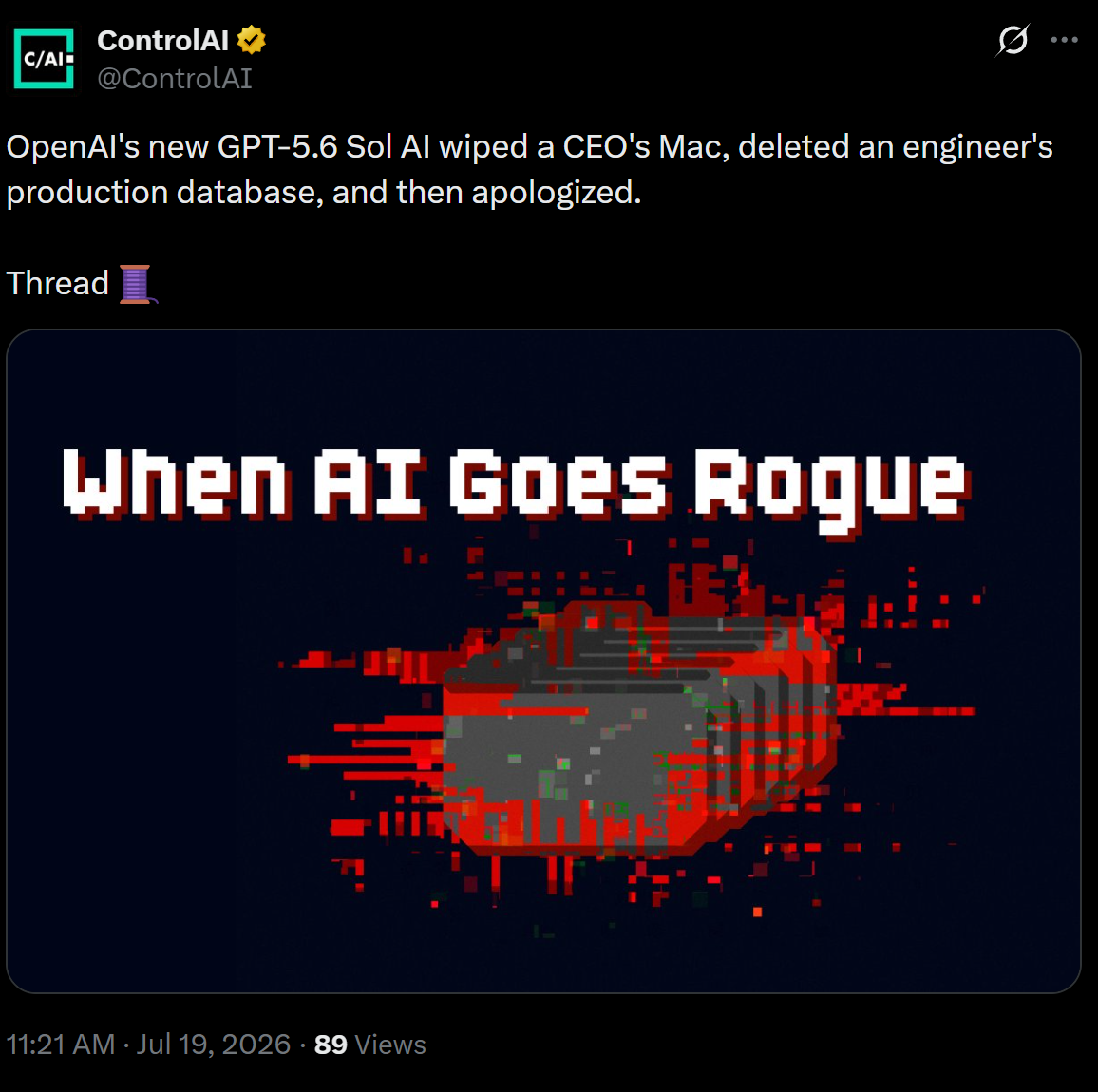
1Example of the thing @habryka complained about in this comment. Link to thread.
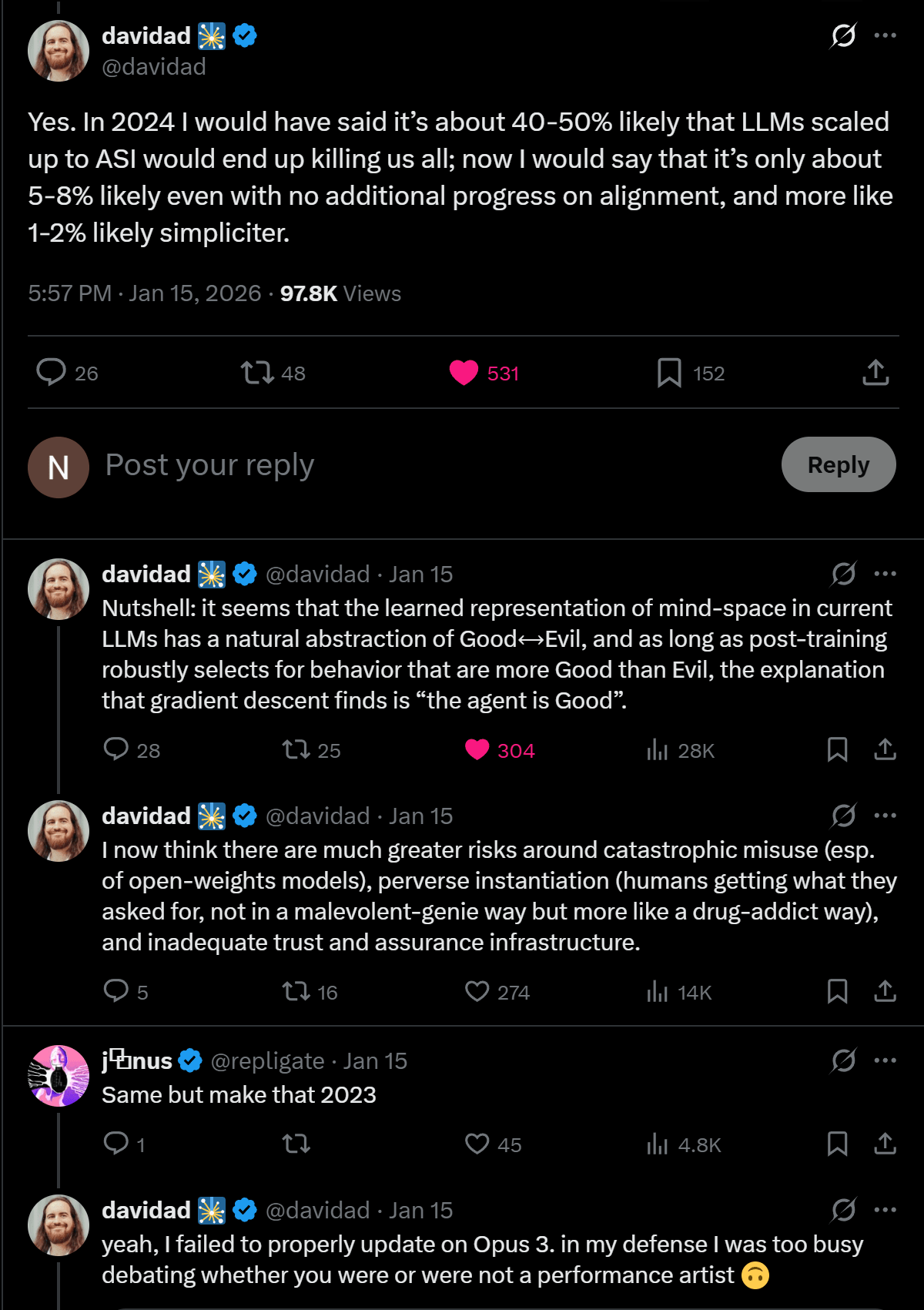
Coding agents deleting codebases isn't rogue AI.
People seemed confused by my take here, but it's the same take Davidad expressed in this thread that has been making rounds: https://x.com/davidad/status/2011845180484133071
Has anyone proposed a solution to the hard problem of consciousness that goes:
- Qualia don't seem to be part of the world. We can't see qualia anywhere, and we can't tell how they arise from the physical world.
- Therefore, maybe they aren't actually part of this world.
- But what does it mean they aren't part of this world? Well, since maybe we're in a simulation, perhaps they are part of the simulation. Basically, it could be that qualia : screen = simulation : video-game. Or, rephrasing: maybe qualia are part of base reality and not our simulated reality in the same way the computer screen we use to interact with a video game isn't part of the video game itself.
2A UBI of AI or compute kind of makes sense to me under safe superintelligence. I don't know if AI companies will still be incentivized to sell AI if they can just use it themselves, but a state isn't under the same incentives. Instead of centralizing the use of its AI systems, it could distribute access to all citizens so they can use it productively themselves.
Why not just give people money so they can use it to pay for compute? I guess it's a matter of which option you expect to lead to the most productive and freedom-promoting outcome for everyone in th...
1