At the time we did most of the writing for AI 2027, 2027 was my median. It really was a very representative scenario for me, and the whole thing was my project, my baby, so we went with what I thought instead of what some of the other authors thought.
So when people publish extremely short timeline estimates, especially when those estimates are unendorsed "modal" years, it feels like we are playing the "guess the number out of ten" game, our opponents picked "17", and we countered with "1".
I am aware of this dynamic. If I was playing political games optimally, I would have picked a year for the scenario that is short enough to be shorter than what most people expect, but otherwise as long as possible -- maybe 2033? and wrote the scenario to have AGI and takeoff happen in that year. Then, when things predictably went faster than my scenario, I could keep milking that saying "I was already concerned, but now unfortunately things are going even faster than I, the concerned expert, expected." This does seem like a politically better strategy to take, and it's one that I did briefly consider at the time.
But the scenario I wrote would have been trash; it wouldn't have represented what I actually expected and it wouldn't have been as close to what actually happened as AI 2027 in fact was.
I also could have, like, tried to conceal the fact that AI 2027 was actually what I expected. I could have said for example "This is just a scenario, it's not what I actually expect, don't worry I'm not crazy." That way if 2028 comes and AI still seems normal and not recursively self-improving, I can shield myself better from criticism of the form "you cried wolf."
I considered that strategy too and rejected it. I thought it would be better to just say what I actually thought.
I think I made the right choices. I think too many people too often try to play political games, and instead should just make quantitative, falsifiable forecasts. Yes, this makes it easier for people to criticize them if and when the forecasts fail to occur. That's (part of) the point. Society would be better off if this was standard practice, if this was the norm, if this was encouraged.
 9
 1
 1
Thanks. Yeah I had the idea to write it while still at OpenAI, and gathered a team to help me do it (Eli & Thomas were the first). They had somewhat longer timelines but I was the boss and insisted on telling the story I thought was most plausible; I told them we would do other scenarios that represented their views later -- and indeed, AI 2040 has a somewhat slower timeline in which the Plan D race trajectory takes off in 2030, and that's because it was Thomas's baby not mine. We also had plans to do an AI 2035 story representing Eli's timelines, but then Eli's timelines got shorter and now they are shorter still...
Here's a graph of our timelines-over-time:
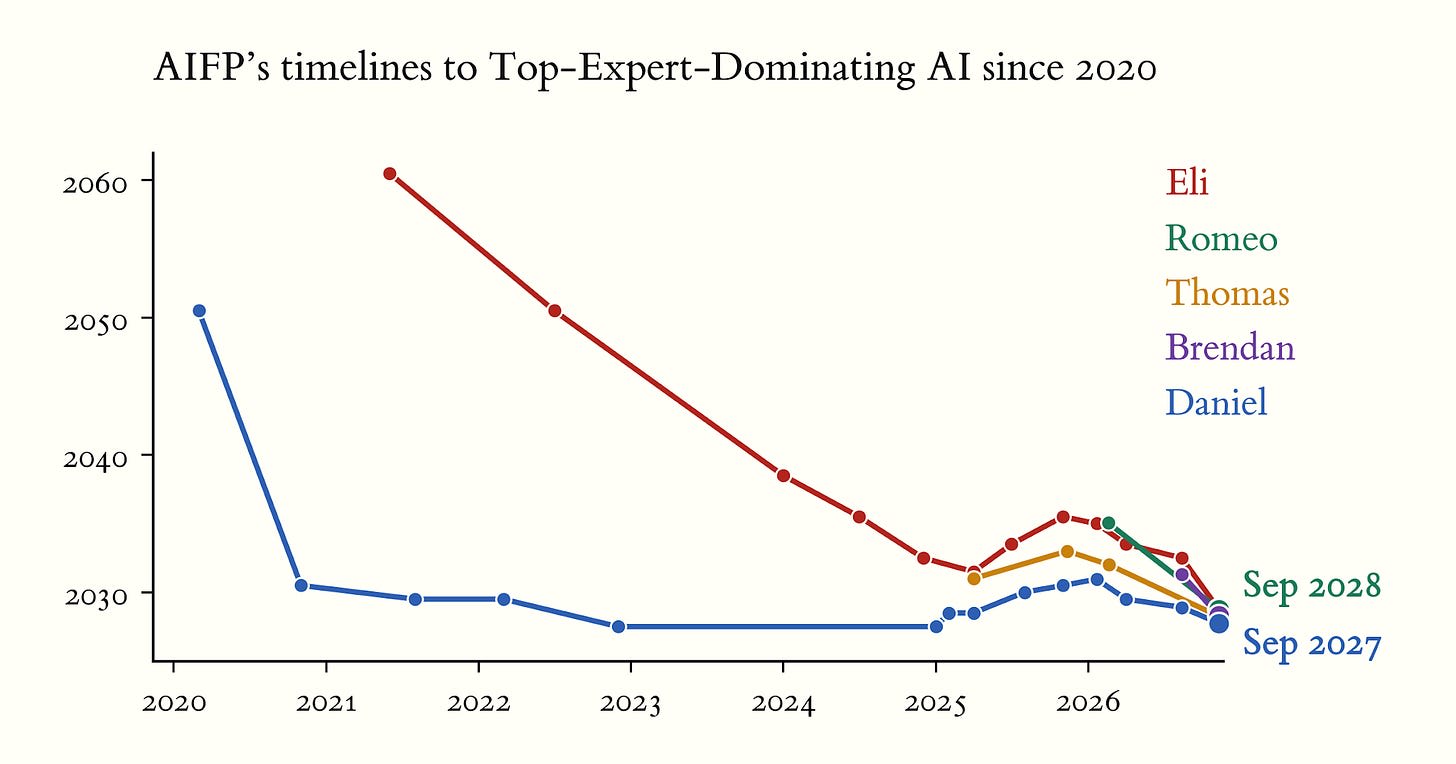
Median AGI (TED-AI) forecasts by AI 2027 authors over time, updated from the August 2026 version in our blog post. The Nov 2026 points are the TED-AI medians from "Overall forecasts" above, after METR's estimate of ~1.7x AI-attributable acceleration: Daniel Sep 2027 (from late 2028), Eli Sep 2028 (from mid-2032), Brendan Apr 2028 (from early 2031), Thomas Apr 2028 (from early 2032), Romeo Sep 2028 (from early 2035).
Yeah. It seems like a mistake strategically, and from the public-communications perspective, I'd say it's downright deontologically irresponsible. If you're taking on the mantle of keeping the public informed, if you want to earn their trust and deserve that trust, you have a duty to represent the danger accurately, instead of taking any opportunity to elevate it in their mind. Yet, I think people are being really epistemically sloppy on the topic, in a way that biases towards the latter. They can and should do better.
Edit: Also, is it just me, or cute dark gallows humor like this thread no longer feels appropriate? Like, those jokes were fine before the perceived situation got this stark, ha ha we may not see the next Christmas, "'how much do I have to live?' / 'five' / 'five years?' / 'four...'". Hilarious, I did laugh. But now that this is an actual position some serious people espouse, I don't find these funny at all, they're just contributing to a sense of panic in an unhelpful manner.
(Not to police how people in general are coping with the situation, but from high-profile public AI-risk speakers specifically this seems inappropriate.)
 3
 2
I don't get what you think is up with the tweet. Seems like he is communicating his genuine position, while throwing shade at people who are vaguely saying "long timelines".
1It is, at the very least, tonally off. To use one of our stock metaphors, imagine the pilot of a falling plane making similar rhetorically cute setup-into-payoff jokes to passengers over the speakers, with the setup creating a momentary sense of hope that the payoff then dashes. "Good news: there's a good chance that we survive... the next ten minutes!"
while throwing shade at people who are vaguely saying "long timelines"
I don't think that's it at all? I think it's just "haha the really short timelines to humanity dying are late-2027 now".
 11
I feel like you just disagree with them? Seems extreme to say they're deontologically irresponsible for stating what they believe is accurate (aside from the post's point about AI 2027 being misleading wrt their timelines, but afaik they've learned from that mistake)
I think everyone's better off just stating (or linking to) actual criticisms and their own differences of opinion. Nate seems like a pretty good example here fwiw
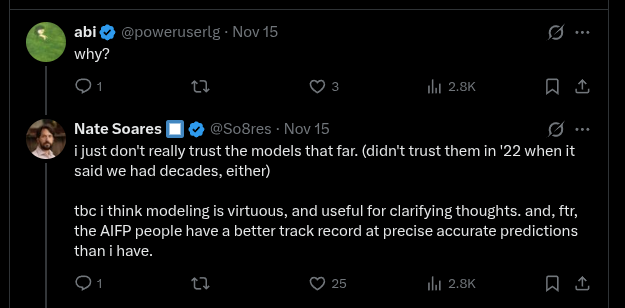
What I'm getting at is it can be unhealthy to view people as part of your "faction" since it leads to a desire to control what they say. Maybe I'm naive but my vision is closer to a flourishing market of ideas.
Like, those jokes were fine before the perceived situation got this stark
It was fine to joke about it when it was likely that ASI would kill everyone within our lifetimes, just not in the next couple years? I'm being purposely obtuse but to an to outsider that probably looks like a odd delineation.
I feel like you just disagree with them?
Yes, and I'm irritated precisely because I don't think it's a factional values conflict at play here. I think they're making an epistemic-rationality mistake by not having sufficient over-model uncertainty, in a way they're more than smart enough not to do. Then, downstream of that mistake, they're disastrously over-committing to short-timeline worlds, in a way that'd likely compromise our chances in other worlds (per the original post here).
What I'm getting at is it can be unhealthy to view people as part of your "faction" since it leads to a desire to control what they say.
Mm, you might be somewhat right here, I may be making a this-shaped mistake too somewhat.
It was fine to joke about it when it was likely that ASI would kill everyone within our lifetimes, just not in the next couple years?
Yes. There's such a thing as a joke about a painful matter being "too soon", because the emotional pain is still too raw. Same logic here: it's too late for those now, the matter is too near-term and too emotionally (instead of only intellectually) real.
 1
 1
For the middle one, I feel a lot of hope for just showing up and arguing with people and being like "Here are concrete accurate predictions from AI 2027. Please give me some concrete inaccurate predictions."
I have extremely little hope that this would work.
Well I think you should be more hopeful! The world has swung massively in the direction of respecting the kinds of conversations we have been having on LessWrong. Obama talking about the dangers of RSI, Nate Soares winning debates watched by millions of people, the New York Times editorial board advocating for an agreement with China for a slowdown, to list just three. LessWrong-style arguments are often winning the day!
 2
group of people and I are working on a piece to address exactly this with hopefully some useful actionable insights, totally agree with you here
 1
By any reasonable definition I am an AI doomer. It has nevertheless been historically very strange for me to see how closely associated "AI doomers" and short timelines have been in the popular imagination. As anybody who's interacted with the AI risk case will realize, timelines are (at least in theory) mostly orthogonal with your beliefs on AI safety. Yes, timelines have some impact on what kinds of interventions are going to be viable, but among people who "believe in AGI" the variance in their optimism about the problem is more immediately dependent on underlying technical questions than anything else. Before GPT-2 or AlphaGo, there was still a much smaller, nascent "AI safety community", and these people were certainly not basing their worries on some data about AI uplift that we only got in 2026.
However, for years people on general social media have taken it on faith that the "AI safety position" and "short timelines position" were the same, and even argued against short timelines as if in doing so they were arguing against "doomers." I actually don't think the AI safety people did much to promote this association in the beginning. Instead people would just assume that, if you were worried about AI, you must be worried about it happening in the next ten years, and therefore you must think LLMs scale to superintelligence all that there.
Personally, I don't have any inside view on how long it will take to get to superintelligence. I see remarkable progress, but I don't have a model for how optimizing verifiable metrics like pretraining loss perplexity or whatever will actually cash out into getting AIs to generalize much further, so I can't say whether current systems are going to get us to superintelligence, even if they can solve hard math problems. When I have encountered anti-short-timelines-conflated-with-AI-safety-people, I have historically responded[1] to them by explaining that we will eventually develop superintelligence, even if it takes twenty years, and that most of the theoretical reasons you should be worried about AI alignment will probably still apply. I then make the separate and distinct observation that skeptics of all stripes have essentially gotten the pace of AI progress wildly wrong, and so if your skepticism of AI risk is just that powerful AI will not happen soon, that seems really tenuous.
In the last few years, though, it sure has gotten a lot harder to make that argument, because a group of people who represent the AI safety community:
It was quite annoying to have to explain this last bullet to upwards of a dozen friends and relatives throughout the last two years, whom I do not think did anything wrong in getting a different impression. It was even more annoying to see the METR report come out, and almost everybody start to move toward ludicrously fast 6-12 month timelines based off of evidence that they're not even able to read.
I suppose it's possible that these people are right, and if they're right then I salute them for their bravery and intelligence. But I can't help but feel personally annoyed that the attention economy is structured such that all of the people that state aggressive timelines end up representing the clique. The only AI predictions people remember, on both sides, are the extreme Ege Erdil/Daniel Kokotajlo-type predictions that are surprising and/or turn out extremely wrong. Mostly people just remember the year that was quoted and not the probability you attached to it. And the people we most disagree with, in general, tend to have ludicrously long timelines, extending out decades. So when people publish extremely short timeline estimates, especially when those estimates are unendorsed "modal" years, it feels like we are playing the "guess the number out of ten" game, our opponents picked "17", and we countered with "1".
In real life, not on Twitter.