Do you have evidence for this? I thought it was fairly well-established that slavery had higher agricultural production than the systems that followed it. Production is the last thing I'd expect to increase with abolition because sharecroppers and other free people want to grow food, have free time, etc rather than spending 90 hours a week picking cotton in a gang labor system. ChatGPT agrees that slave plantations had higher productivity.
 3
3The clearest example is prewar Virginia where there was direction competition between free and slave labor. The free labor outcompeted slave labor at growing tobacco,
Source? No source I can find supports this.
Then the cotton boom caused Virginia plantations to switch to growing slaves.
Virginia plantations specialized in breeding slaves because the price of enslaved people was extremely high, because slavery had high agricultural production.
You also make a theoretical argument. At most that suggests that the landowners should earn more. That is not the same as production.
My claim was directly about production: the number of bushels of cotton, tons of sugar, etc produced per unit of land, or per laborer. Of course the free farmer or sharecropper can have higher welfare than the slave, because they can invest in their own welfare at the expense of production.
Moreover, free people put most of their surplus into growing the next generation of free people. Empirically, free populations expand much faster than slave populations.
This doesn't seem true for the US historically. The growth rate of the US Black population seems basically constant in 1840-1880. If emancipation increased the growth rate we would see it in the trends. The reason is that when the slaveholding class steals the surplus of the slave class, they also have an incentive to increase the slave population, as in Virginia.
See this chart ChatGPT made:
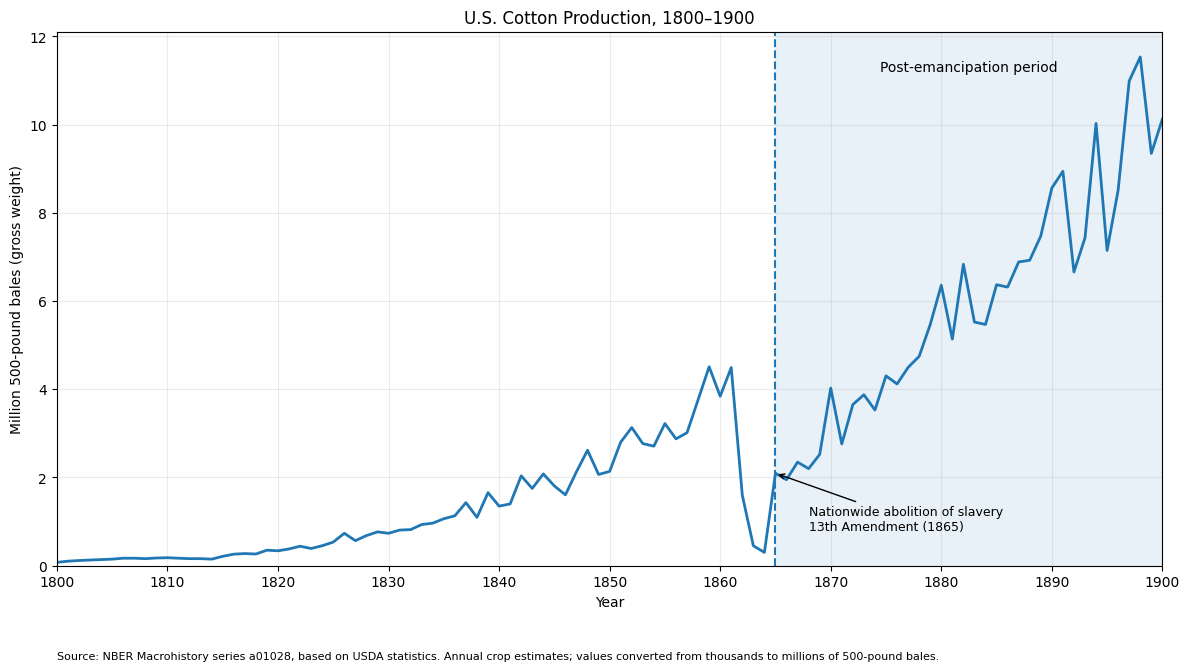
If free labor actually increased cotton production, we would see production after 1865 quickly surpass the 1860 trendline, not just the level. Instead, just surpassing the level took until late 1870s and needed greatly increased land area and better technology, while the trendline remained permanently below the pre-1860 trend. The economics literature suggests that the end of slavery meant a huge downwards shock in agricultural productivity in the American South, and the disadvantages, like reduced human capital investment, mostly affected skilled labor sectors rather than agriculture.
I'm not sure "efficiency" is the right way to think about it. The realistic counterfactual was probably not the people who were slaves instead being immigrants with rights to their own person, but rather staying in Africa. And while it seems possible that slavery as it was practiced was economically harmful relative to that, I would be surprised if the analysis came out that way (unless you made your case by assigning economic value/disvalue to things that usually aren't measured in those terms, when people are analyzing economic impacts of things).
ETA: maybe not that surprised, on second thought. The slave trade was, as described in the post, pretty disruptive to the social fabric of the continent that bore the brunt of it; the effects there might have been quite large.
 1
1Ok yeah my bad, economic good is a term that already has a specific meaning and I meant it more as that C is a good thing for the overall economy lol. I mean it more like this:
A: Has a Pikachu card but wants a Charizard card.
B: Has a Charizard card but wants a Pikachu card.
Normally A and B would just trade each other, but what if they don't know the other exists or can't find each other? In comes our "matcher" C. Maybe A values the Charizard card as (Pikachu + $2) so he pays C a dollar to find a person willing to trade, they find B, a trade occurs and everyone's life is better for it. It is a good thing that C did the job of matching A and B together.
Matchmakers, brokers, marketplaces, etc are examples of matchers. A grocery store has an actual economic purpose that creates value instead of extraction.
 1
1Hochschild and historians generally treat his book as a reliable source for the factual details.
Clarkson's book and the historiographical tradition it spawned are highly controversial among historians.
Anita Rupprecht puts it like this: "Clarkson's History established a heroic British narrative of humanitarian action that remained largely intact until the period of decolonisation in the middle of the last century. As is well known, Eric Williams's dismissal of that version of events set terms for a vigorous historiographical debate that still rages today."[1]
The story about the Zong Rupprecht analyzed in her article is particularly interesting, because Clarkson himself claims it was pivotal for mobilizing. She traces how this story is used for dramatic effect by later authors, among them your second source for this post, Hochschild ("David Hochschild’s recent populist abolition history, Bury the Chains, also refers to the event to help set a dramatic scene.") and also how Clarkson himself changed the story later on in other publications, where "he rewrites it to fit his purpose and the moment."
She analyzes him as a propagandist: "Given the moral, political and aesthetic issues at stake, one of the significant rhetorical strategies deployed by propagandists, as many critics have noted, was to write endlessly about how it was, in fact, impossible to represent the Middle Passage at all. [...] Perhaps the most famous illustration of the replacement of description by ‘unspeakability’ occurs in the introduction to Thomas Clarkson’s History. Clarkson had no personal experience of slavery but excelled in imaginatively evoking its barbarity in print. After celebrating the moral benefits that the abolition of the slave trade has delivered to the nation (rather than to the Africans) he takes his readers on a fictionalised ‘ethnographic tour’ to the coast of Africa."
Her verdict is quite strong: "Clarkson's sentimental appropriation of the Zong as both a true instance and an exemplary moment of generalised horror illustrates, of course, the power of propaganda as a form of mythologisation."
Christopher Leslie Brown has similar things to say in Moral Capital: Foundations of British Abolitionism (which can be considered a modern definitive work): "Clarkson’s History would provide the framework in which, for more than a century, the origins of the British antislavery movement would be understood. [...] This interpretive framework, what might be thought of as the Clarkson thesis, with its reliance on narration rather than explanation, with its emphasis on providential mission rather than human calculation, comported nicely with how most in Britain, deep into the twentieth century, preferred to reflect on the nation’s slave trading and slaveholding past."[2]
Others, like Michael E. Jirik are merely unhappy about the central role in the story that historiographic tradition gave Clarkson: "The foundational role of Peckard and black abolitionism in Cambridge antislavery reveals how the university played a pivotal role in the fight against the slave trade and shifts focus from the singular figure of Clarkson to the evolution of antislavery at Cambridge. A sole focus on Clarkson overshadows the radicalism of black abolitionism and Peckard at the university. The story of antislavery at Cambridge begins not with Clarkson but instead with Peckard and the writings of Wheatley and Afro-British abolitionists such as Sancho and later Equiano."[3]
J. R. Oldfield has corrected a bunch of Clarkson's exaggerations and self-serving misrepresentations, namely his claim the Wedgwood cameos made cameos a general fashion in Britain or his claim to have organized a committe in Exeter, when actually someone else did that.[4]
Historians generally treat his book as a source and a source and its author need to be contextualized and corroborated. This is source criticism.
>>> Of all the examples you could pick, this is one area where I feel very confident in the reliability of Clarkson's account. <<<
What is the reason for this confidence? The more heroic side-tales are not part of the parliament records afaik, Clarkson himself has written his account twenty years after the events, he is in most cases the only known source for them happening and he burned almost all of his personal documents.
>>> Just as The Media Very Rarely Lies, a respectable and highly scrutinized figure like Clarkson is rarely going to just fabricate specific factual details <<<
That's not my experience. Like all others, the early modern period is chock full of people (even respectable and highly scrutinized figures) making all sorts of false and sometimes outrageous claims. A certain tendency to exaggeration and embellishment was not unusual in earlier times and not all of that even has to be intentional. Some tales grow over decades of retelling and false memories exist.
One example I like to give to students when familiarizing them with source criticism and how to evaluate witnesses is Ronald Reagan. On numerous occasions he talked about a specific incident that happened during World War II, even claimed he rewarded a Medal of Honor to someone for this, but it never actually happened.[5][6][7] It was a scene from the 1944 war movie Wing and a Prayer.
During my time at university senior citizens were allowed to fill up free spots in history lectures. When we talked about the bombings of Dresden, we also talked about how Nazi propaganda invented low-level strafing runs aimed at civilians by Allied airplanes. One of the senior citizens spoke up. He survived those very bombings as a child and he told us through tears that those strafing runs really happened and that we weren't even there, but he was; it was heartbreaking to listen to. But we know for a fact that those strafing runs did not happen and that furthermore they would have been impossible.[8]
Do I believe that Clarkson is a notorious liar and invented his account out of whole cloth? No, I don't think that. But I think it is possible, even likely, that some of it is embellished. Some of the historians I cited here have shown examples of him putting the narrative and its effect over the facts.
I think that he should be treated as the propagandist (a well-intentioned propagandist, with whose broader goal I very much sympathize) he was and that we should take his account with a much bigger grain of salt than this post does.
I think this post would have been better if it's framing wouldn't have simply taken his whole heroic narrative at face value and presented pretty much everything as a fact, starting with the title.
A framing more along the lines of "Clarkson was a pretty interesting historical figure who has carried out a successful campaign against one of the greatest evils of his time. Let's take a look at his account of how he did that, what he has to say for himself and what we maybe can learn from that" would have been much better in my opinion.
- ^
Anita Rupprecht (2007) ‘A Very Uncommon Case’: Representations of the Zong and the British Campaign to Abolish the Slave Trade, The Journal of Legal History, 28:3, pp. 329-346.
- ^
Christopher Leslie Brown (2006). Moral Capital: Foundations of British Abolitionism. University of North Carolina Press, pp. 4-5.
- ^
Michael E. Jirik (2020) Beyond Clarkson: Cambridge, Black Abolitionists, and the British anti-slave trade campaign, Slavery & Abolition, 41:4, pp. 748-771.
- ^
J. R. Oldfield (1992) The London Committee and Mobilization of Public Opinion Against the Slave Trade, The Historical Journal, 35, 2, pp. 331 -343.
- ^
- ^
- ^
- ^
 4
4 2
2Thanks. You're clearly much more informed on this topic than I. I agree with you to some extent and our views are converging. I agree that Clarkson was in many ways a propagandist. And I did take a lot of his claims at face value when I should have been more skeptical.
However I think your comment implies that this undermines his specific claims more than it actually does.
The story about the Zong Rupprecht analyzed in her article is particularly interesting, because Clarkson himself claims it was pivotal for mobilizing.
I don't think this is true. At the very least, in the book I read he only makes very modest claims about its impact. The Zong incident is not a substantial part of the book at all. I don't dispute that it was used more by later authors.
Clarkson himself changed the story later on in other publications, where "he rewrites it to fit his purpose and the moment."
This is true, but again somewhat less undermining than you imply. The basic facts about the atrocity itself are never inflated. It's the surrounding context and implications that he adjusts for his purpose. But I do agree this is one of the best example of Clarkson's inaccuracy.
She analyzes him as a propagandist: "Given the moral, political and aesthetic issues at stake, one of the significant rhetorical strategies deployed by propagandists, as many critics have noted, was to write endlessly about how it was, in fact, impossible to represent the Middle Passage at all.
Saying that the middle passage was unspeakably horrific is entirely reasonable. It's not like he never goes into the details; throughout the book, he often documents the particular horrors on the middle passage and the sources of his information.
he takes his readers on a fictionalised ‘ethnographic tour’ to the coast of Africa.
Similarly, this seems entirely fine to me. He's very clear where he is writing from his imagination, and his narrative is grounded in solid evidence.
J. R. Oldfield has corrected a bunch of Clarkson's exaggerations and self-serving misrepresentations, namely his claim the Wedgwood cameos made cameos a general fashion in Britain or his claim to have organized a committe in Exeter, when actually someone else did that.[4]
I can't access the whole of your source but this paragraph itself seems like a substantial exaggeration to me. I don't think Oldfield is offering a whole litany of Clarkson's mistakes and exaggerations, only a very small set of critiques. And Clarkson was involved in the Exeter committee, the question is just about founding of the committee.
Moreover the whole thesis of Oldfield's article is that "the Committee's activities [...] were central to the success of the early abolitionist movement", which tends to supports the heroic-Clarkson narrative.
Your other examples, such as "the role of Peckard and black abolitionism in Cambridge" are much more the type of the historiographical interpretation that I conceded are beyond my own knowledge to definitively prove, although I think the timing suggests that Clarkson caused the biggest upswing of momentum of all of the people who joined the cause and some historians like Oldfield clearly have a similar view.
What is the reason for this confidence? The more heroic side-tales are not part of the parliament records afaik, Clarkson himself has written his account twenty years after the events, he is in most cases the only known source for them happening and he burned almost all of his personal documents.
Like all others, the early modern period is chock full of people (even respectable and highly scrutinized figures) making all sorts of false and sometimes outrageous claims.
What's the source for him burning his papers? I still kinda think that he probably is representing himself fairly accurately. The claims that can be checked usually check out pretty well. Even under great scrutiny there are very few clear, glaring errors to point to.
 1
1 1
1 1
1 1
1>>> However I think your comment implies that this undermines his specific claims more than it actually does. <<<
I assure you this is not the case. I don't intend to convey an amount of underminding. I rather intend to convey the existence of conflicting evidence and scholarly opinions.
>>> I can't access the whole of your source but this paragraph itself seems like a substantial exaggeration to me. I don't think Oldfield is offering a whole litany of Clarkson's mistakes and exaggerations, only a very small set of critiques. [...] Moreover the whole thesis of Oldfield's article is that "the Committee's activities [...] were central to the success of the early abolitionist movement", which tends to supports the heroic-Clarkson narrative. <<<
That's exactly the point I'm trying to make. I haven't only cited historians that are detractors of Clarkson. Oldfield is (as you say) quite sympathetic to Clarkson, but he still does his due diligence.
>>> What's the source for him burning his papers? <<<
He himself. He merrily informs his executor about it in a letter.[1] He did it too save his executor the trouble to read through it all. His biographer Wilson complains about only some letters and religious essays remaining.[2]
>>> I still kinda think that he probably is representing himself fairly accurately. The claims that can be checked usually check out pretty well. Even under great scrutiny there are very few clear, glaring errors to point to. <<<
I think that's a defensible judgment. But we don't know. Some people only lie about stuff that can't be easily checked.
1 1
1 1
1Curated! Thank you for collecting these historical quotes. It is virtuous to make history available, and this helps a lot. I didn't know that the sailors on slave ships died at a far greater frequency, I didn't know about the counterarguments in favor of continuing the slave trade, and some of these quotes are very inspiring ("Never, never, will we desist..."). When compiling quotes, I always have a hard time with the tradeoff between making it short/readable, and giving full context, and I think you did a good job making this quite readable yet letting the primary sources do the talking.
I appreciate Thirdian's pushback in the comments, and encoruage anyone who is planning to reference Thomas Clarkson elsewhere to do more research into him (I found asking an LLM for a lot of primary sources to quickly pull up a lot of helpful information).
 1
1Because modern Westerners vehemently oppose slavery for reasons unrelated to economic efficiency, arguments about how economically inefficient slavery is seem like they would be prone to motivated reasoning. Not a lot of people say "bad thing I hate is economically efficient". In most places, even attempting to argue that slavery is economically efficient would get you in trouble. I certainly don't expect scientific journals to publish papers claiming that slavery is economically efficient, even if it is.
1
I haven't looked into this very deeply, but I suspect that some of this information is historical propaganda. In particular, when I shallowly looked into the famous slave ship diagram some years ago, it didn't really add up, and I came away thinking it was likely propaganda from the abolitionists' side. (... but I investigated only briefly and don't remember the details, so take this with a lot of salt.) Some of the other things also have a propaganda vibe - e.g. the thing about slavery being bad for the economy, or about the sailors, or Clarkson giving an awfully heroic account of himself.
1Interesting, thanks. That seems like compelling evidence that the slave populations declined after abolition of the trade.
Although palm oil exports from Africa increased, their economic value was still far below that of the slave trade
By contrast, the slave-based sugar economy at its peak had generated several multiples of this figure.
I'm not sure Claude is doing the right comparison here. I think the fair comparison with the palm oil exports is the direct value of the slave trade, not the whole slave-based economy. Although, as you point out, the slave-based economy may have suffered somewhat from the abolition, so we might want to add a bit on top of the direct value of the slave trade for a fair counterfactual comparison.
1
1. The obstacle to abolition was not the economic system, but an industry lobby.
I had always imagined the British abolitionist movement to be a broad battle between an unstoppable moral imperative and an immovable economic incentive. But in practice it started as more of a knife fight between a cabal of moral pioneers and a special interest group representing industry merchants.
The government and the political parties did not come in with any great agenda. MPs were mostly prizes in a furious contest between the Committee for the Abolition of the Slave Trade and a coalition of business interests:
"The merchants and planters availed themselves [...] to wait upon members of parliament by deputation, in order to solicit their attendance in their favour, and to renew their injurious paragraphs in the public papers."[1]
"The committee for the abolition, when the work was finished, printed it at their own expense [...] sent it to every individual member of that House."
However, the public was heavily activated in favor of the abolition, which forced the issue to parliamentary attention.
"The committee, also, in this interval, brought out their famous print of the plan and section of a slave-ship [...] As this print seemed to make an instantaneous impression of horror upon all who saw it, and as it was therefore very instrumental, in consequence of the wide circulation given it, in serving the cause of the injured Africans [...]"
But the abolitionist cabal quickly expanded from an esoteric group of Quakers and other oddballs to an elite coalition including many famous figures such as William Pitt the Younger and the Marquis de Lafayette:
"He [Lafayette] hoped the day was near at hand, when two great nations, which had been hitherto distinguished only for their hostility, one toward the other, would unite in so sublime a measure [...]"
"The cause is so lovely that even ambition, abstractedly considered, is too impure to take it under its protection, and not to sully it."
Part of the explanation for the relatively narrow interests involved in the fight might be that the direct benefits of the trade were quite small and accrued mainly to the merchants themselves.
"[...] the Slave Trade composed but a thirtieth part of the export trade of Liverpool, and that of the trade of Bristol it constituted a still less proportion."
However it should be noted that the system of slavery in general was an instrumental part of a much larger slice of British GDP (maybe something like 10%, but historians differ on the question).
2. The slave trade was truly terrible for sailors.
"[...] instead of the Slave Trade being a nursery for British seamen, it was their grave. It appeared that more seamen died in that trade in one year than in the whole remaining trade of the country in two. Out of 910 sailors in it, 216 died in the year [...]"
While a lot of this was from disease, for some reason the captains in slave trade vessels seemed to be unusually and exceptionally cruel and brutal.
"The captain, without any inquiry, beat him severely, and ordered his hands to be made fast to some bolts on the starboard side of the ship and under the half deck, and then flogged him himself [...]
The pain had now become so very severe, that Green cried out, and entreated the captain of the Alfred, who was standing by, to pity his hard case, and to intercede for him. But the latter replied, that he would have served me in the same manner. Unable to find a friend here, he called upon the chief mate; but this only made matters worse, for the captain then ordered the latter to flog him also; which he did for some time, using however only the lashes of the instrument. Green then called in his distress upon the second mate to speak for him; but the second mate was immediately ordered to perform the same cruel office, and was made to persevere in it till the lashes were all worn into threads. But the barbarity did not close here [...]"
This horrible passage goes on for a while and Green ends up dying. Clarkson puts this unusual behavior towards their own race down to the evil nature of the trade degrading men's characters.
"Men in their first voyages usually disliked the traffic; and if they were happy enough then to abandon it, they usually escaped the disease of a hardened heart. But if they went a second and a third time, their disposition became gradually changed. It was impossible for them to be accustomed to carry away men and women by force, to keep them in chains, to see their tears, to hear their mournful lamentations, to behold the dead and the dying, to be obliged to keep up a system of severity amidst all this affliction [...] without losing their finer feelings, [...] Now, if we consider that persons could not easily become captains [...] till they had been two or three voyages in this employ, we shall see the reason why it would be almost a miracle, if they, who were thus employed in it, were not rather to become monsters, than to continue to be men."
3. The slave trade made Africa scary and violent.
"[...] they came within a certain distance of a village. They then concealed themselves under the bushes [...] during day-light; but at night they went up to it armed; and seized all the inhabitants, who had not time to make their escape. They obtained forty-five persons in this manner. In the second they were out eight or nine days [...] They seized men, women, and children, as they could find them in the huts. They then bound their arms, and drove them before them to the canoes."
This is very un-surprising in retrospect, but I hadn't previously thought much about the invidious effects of slavery on the lands where those slaves came from. African powers would fight wars against each other in order to obtain slaves to sell to the European captains.
"The natives never went any distance from home without arms; and when Captain Wilson asked them the reason of it, they pointed to a slave-ship then lying within sight."
4. The main argument against abolition was that even if the British abolished the slave trade, other countries would continue.
"The next objection to the abolition was, that if we were to relinquish the Slave Trade, our rivals, the French, would take it up; so that, while we should suffer by the measure, the evil would still go on."
"[...] as England had done nothing, after having had it so long under consideration, it was fair to presume that she judged it impolitic to abandon the Slave Trade; but if France were to give it up, and England to continue it, how would humanity be the gainer?"
Interestingly, in the early debates, no one ever suggests the idea of imposing the abolition upon other European powers. Instead, advocates for abolition appealed to the overwhelming ethical principle.
"This was, indeed, a very weak argument; and, if it would defend the continuance of the Slave Trade, might equally be urged in favour of robbery, murder, and every species of wickedness."
5. The early abolitionists explicitly distanced themselves from emancipation.
While in many ways the abolitionists stuck to their principles and refused to stoop to the level of the slave traders, they made a decisive call very early on to utter no mention of the abolition of slavery itself until after the trade had been abolished, even though they surely had this in mind from the very beginning.
"It was again insisted upon that emancipation was the real object of the former; so that thousands of slaves would be let loose in the islands [...]"
"[...] emancipation was now stated to be the object of the friends of the negroes. This charge I repelled, by addressing myself to Monsieur Beauvet. I explained to him the views of the different societies, which had taken up the cause of the Africans [...]"
6. The slave trade may actually have been bad for the economy (at least after some date).
Much of the early debates focused on the extent to which the slave trade was needed to maintain the slave populations of the British colonies. The abolitionists insisted that better treatment of slaves would allow their populations to increase naturally and make the slaves more productive.
"[Richard Phillips] put into my hands several documents concerning estates in the West Indies, which he had mostly from the proprietors themselves, where the slaves by mild and prudent usage had so increased in population, as to supersede the necessity of the Slave Trade."
"He believed [...] that the planters would be great gainers by those wholesome regulations, which they would be obliged to make, if the Slave Trade were abolished."
Moreover, the abolitionists insisted that more could be gained from regular trade with African merchants than by the slave trade.
"They were perhaps not aware that a fair and honourable trade might be substituted in the natural productions of Africa, so that our connexion with that continent in the way of commercial advantage need not be lost."
"I wished the council to see more of my African productions and manufactures, that they might really know what Africa was capable of affording, instead of the Slave Trade; and that they might make a proper estimate of the genius and talents of the natives."
7. The 1780s were not so different from today
I find myself shockingly compelled by some arguments on the opposing side. In particular, the point that the trade would continue unaffected through the merchants of other countries is hard to definitively refute. It's amazing how effectively motivated arguments can throw doubt and uncertainty on a question that from another vantage point feels so over-determined. It's easy to imagine how people like myself, in those circumstances could end up on the wrong side of history, even in such a monstrous case.
On the other hand, those who favor abolition do so in terms that feel just as vigorous and vehement as any advocate for justice today. The main change might be the superior eloquence of politicians at that time:
"Never, never, will we desist till we have wiped away this scandal from the Christian name; till we have released ourselves from the load of guilt under which we at present labour; and till we have extinguished every trace of this bloody traffic, which our posterity, looking back to the history of these enlightened times, will scarcely believe had been suffered to exist so long, a disgrace and a dishonour to our country."
8. Thomas Clarkson is a hero for the ages
Clarkson is the key figure in the abolitionist movement. His autobiographical accounts could be cut straight from the script of a fantasy role-playing video game. He travelled around Britain on his horse to collect evidence and witnesses in favor of the abolition in a perfect adventure story.
Many times, he enters an unfamiliar city armed only with a couple of letters of introduction to sympathetic supporters of the cause. He then has to befriend local people and persuade them to tell him about the horrors of the slave trade. In most places, he quickly becomes notorious among slave merchants, who obstruct and intimidate his investigations. More than once, he is almost murdered by thugs or an evil ship captain for his interference and has to make a daring escape.
He occasionally detours on side quests to assist a poor, helpless sailor who has been abused by his captain and has no other recourse. He travels at breakneck speed through the nights, often braving severe weather or a perilous river-crossing.
"I was absent only three weeks. I had travelled a thousand miles in this time, had conversed with seventeen persons, and had prevailed upon three to be examined."
He is a super-smart scholar, winning the prestigious Latin essay competition at Cambridge University two years in a row. He befriends many famous figures of the age and rubs shoulders with the leaders of the French Revolution in Paris during 1789.
And he takes ideas seriously. No one told him he should take up the cause of abolition. He derived it from the empty string.
"On returning however to London, the subject of it almost wholly engrossed my thoughts. I became at times very seriously affected while upon the road. I stopped my horse occasionally, and dismounted and walked. I frequently tried to persuade myself in these intervals that the contents of my Essay could not be true. The more, however, I reflected upon them, or rather upon the authorities on which they were founded, the more I gave them credit. Coming in sight of Wades Mill, in Hertfordshire, I sat down disconsolate on the turf by the roadside and held my horse. Here a thought came into my mind, that if the contents of the Essay were true, it was time some person should see these calamities to their end. Agitated in this manner, I reached home. This was in the summer of 1785.
In the course of the autumn of the same year I experienced similar impressions. I walked frequently into the woods, that I might think on the subject in solitude, and find relief to my mind there. But there the question still recurred, 'Are these things true?' Still the answer followed as instantaneously 'They are.' Still the result accompanied it, 'Then surely some person should interfere.'"
Sources:
All quotations are taken from Clarkson (1808).