Thank you for writing this up! I remember when I first did research into egg freezing in my mid 20s, something I couldn't quite get to the bottom of is whether or not frozen eggs deteriorate over time. For example, the webpage "freezing embryos" (embryos being even more robust than eggs) on the Johns Hopkins website says:
Frozen embryos are stored and monitored at hospital facilities, usually a lab, or commercial reproductive medicine centers. They can be safely preserved for 10 years and even longer.
This made me nervous about freezing my eggs too early, and I thought that it might be best to maximize optionality by freezing my eggs at thirty. But I've talked to some fertility doctors since then and they seem to think that this isn't an issue and eggs are good indefinitely. Can I ask what your take on this is?
 1
1The language on Joh Hopkins website is being deliberately conservative. The reality is we have almost no data on eggs that have been frozen longer than 10 years, so they say 10 years becuase we don't have direct evidence for them being viable longer. What data we do have on eggs that have been frozen and then used after 4-8 years indicates time frozen has no effect on survival rates or fertilization rates. It would be very surprising to me if there's no impact on survival after 8 years, but at 10 years they suddenly start to degrade.
You can look a little further afield for more direct evidence of the long-term efficacy of freezing for fertility preservation. There are some neat animal studies in which sperm frozen for 50 years was used to create sheep, with the authors noting that the pregnancy rate of the frozen semen was identical to the pregnancy rate for the fresh semen.
My best guess is you'd see essentially zero degradation from longer freezing periods.
1Good article, but I'll come in in defense of the doctors. Note that I'm far more familiar with the way things work in India (a family full of gynos) but I do have a reasonable degree of familiarity with the UK and US.
The thing is, the overwhelming majority of women who evince interest in IVF are in their middle to late 30s! The average woman, at 19, is very unlikely to even consider it.
If some unusually forward-thinking gynecologist suggested egg freezing to her, the modal response would be "wait, why are you telling me this?" The same goes for women in their 20s, it's only in the late 20s and early 30s that egg freezing is taken seriously as a possibility. Before that, the women who are strongly pro-natal are confident that they can get kids the old fashioned way (and usually succeed) while those more lukewarm think that they still have some time and it's not a major priority. This doesn't strike me as necessarily irrational. That means that the woman you implicitly target, in their late teens or 20s, but is confident they need egg freezing, is a rare breed. But of course, if you do want to find them, LessWrong is far from the worst bet.
 1
1Yeah, this is fair. My personal take is that polygenic embryo selection changes the calculus a fair bit. A good third of my friends are now having children via IVF just to get access to embryo selection. If you're going to do that anyways, then freezing eggs at a younger age starts to become a bit of a no-brainer.
 1
1Given my financial situation and that of the rest of my family, I'd benefit a lot less from a paycheck than most people - in my case, I'd be getting a job almost exclusively for the social rewards rather than the monetary ones, and a lot of jobs are pretty bad for that.
Also, my currently unpartnered status is because my wife died in March 2024; she always wanted to be a mother someday but (in addition to other obstacles) she was never healthy enough to handle a pregnancy.
 12
12I worry about this too. One of my biggest concerns with embryo selection is that people in certain social circles will come to believe that you're only a responsible parent if you have children via embryo selection, and that if they can't they just won't have them.
I think the best solution to this long term is to just make the tech really cheap and broadly available. But I also think we should try to encourage people to have more kids. Babies are great!
 1
1GPT-5.2 is saying this:
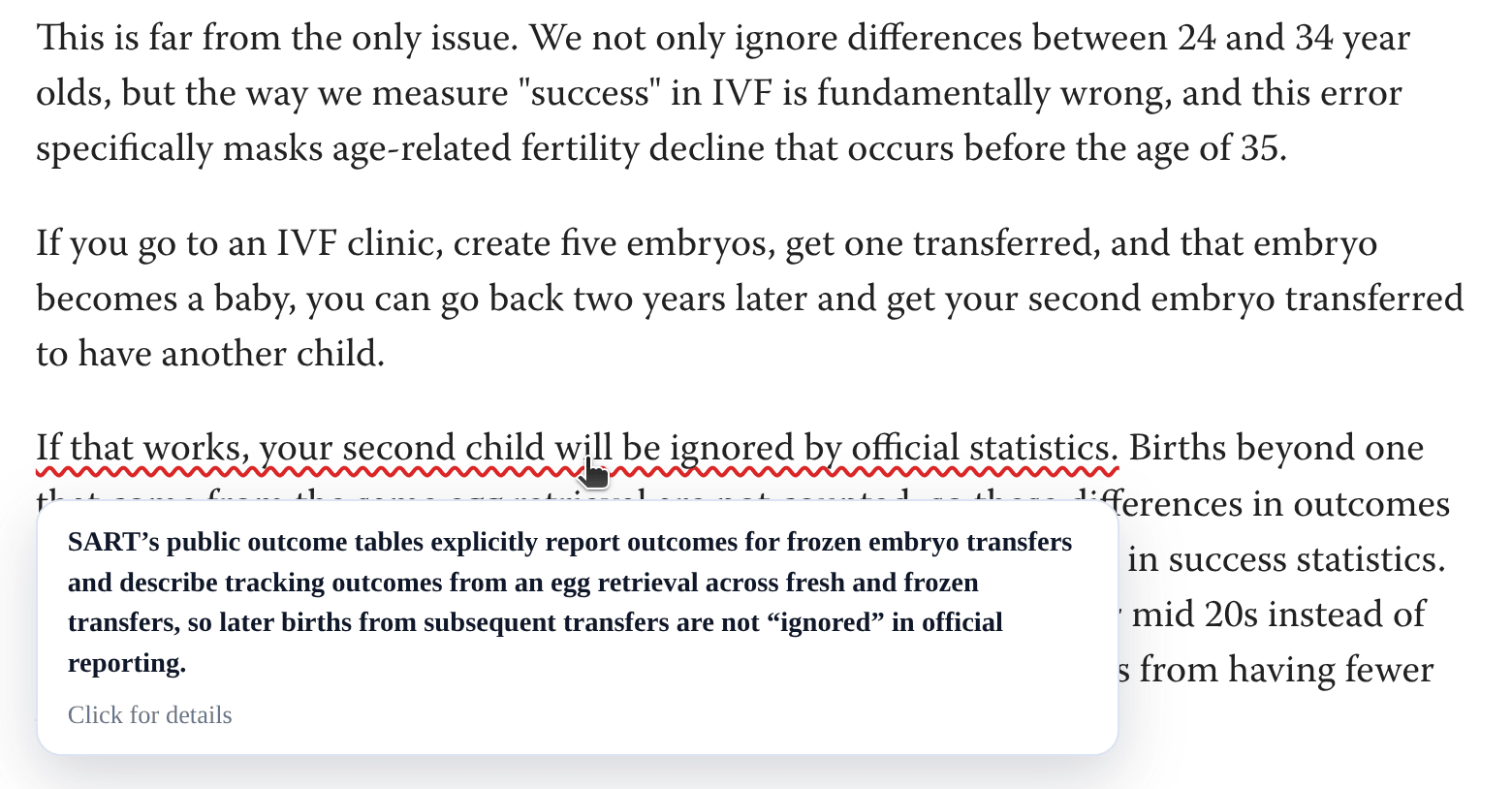
Is that accurate? The clickthrough says:
The post claims that if a later embryo transfer from the same retrieval results in another baby, that second child is “ignored by official statistics.”
But SART’s published outcome tables and methodology describe reporting that includes frozen embryo transfers (FETs) and their live-birth outcomes:
- The SART Outcome Tables page contains dedicated sections for frozen embryo transfer outcomes (with counts of transfers and live birth rates).
- In the “Understand This Report” explanation, SART states that by tracking outcomes from egg-retrieval–initiated cycles, the report “accounts for both fresh and frozen embryo transfers resulting from the egg retrieval cycle.”
- SART also defines that each ART cycle is counted (including separate cycles performed for banking/transfer), which means live births from later FET cycles are part of the official statistics (even if they are not always presented as “children per single retrieval” in one headline number).
So while some summary metrics may focus on the first transfer outcome for a retrieval within a given reporting structure, it is not accurate to say a second child from a subsequent transfer is simply “ignored by official statistics.”
Sources
SART Outcome Tables (Public SART Clinic Summary/Outcome Tables)
GPT 5.2 is misunderstanding the claim. If the first embryo results in a failed transfer, then yes, subsequent transfers from the same cycle can "count" in the sense that live births from second or later transfers can change the outcome for the cycle from "no birth" to "birth".
What they DON'T change is the outcome when the patient has already had a child from an earlier embryo. In that case, subsequent births really are ignored.
1Are there any risks associated with the eggs being frozen for longer?
So far as we know, there are no additional risks. The main risk is you spend a lot of money on keeping them frozen for longer.
Can you freeze an egg for 20 years?
Almost certainly yes
Or even if there are some risks, is it the case that over any timespan you'd rather have an egg in the freezer than in the woman?
If you're planning to have your final kid within a year, freezing eggs doesn't really make sense unless you're older and you need to bank a lot of eggs to have a good shot at having that kid.
For anything over a year, freezing eggs makes sense for fertility preservation.
1
If you're a woman interested in preserving your fertility window beyond its natural close in your early 40s, egg freezing is one of your best options. But if you rely on your doctor to tell you when to freeze them, you will likely be doing yourself and your future prospects for a family a disservice.
The female reproductive system is one of the fastest aging parts of human biology. But it turns out, not all parts of it age at the same rate.
The eggs, not the uterus, are what age at an accelerated rate. Freezing eggs can extend a woman's fertility window by well over a decade, allowing a woman to give birth into her 50s.
In a world where more and more women are choosing to delay childbirth to pursue careers or to wait for the right partner, egg freezing is really the only tool we have to enable these women to have the career and the family they want.
Given that this intervention can nearly double the fertility window of most women, it's rather surprising just how little fanfare there is about it and how narrow the set of circumstances are under which it is recommended.
Standard practice in the fertility industry is to wait until a woman reaches her mid to late 30s, at which point if she isn't on track to have all the children she wants, it's advised she freeze her eggs.
This is not good practice. The outcomes from egg freezing decline in a nearly linear fashion with age, and conventional advice does a great misservice to women by not encouraging them to freeze eggs until it's almost too late.
The optimal age to freeze eggs varies depending on the source and metric, but almost all sources agree it's sometime between 19 and 26.
So why has the fertility industry decided to make "freeze your eggs in your mid-30s" the standard advice as opposed to "freeze your eggs in your sophomore year of college"?
Part of the reason is fairly obvious: egg freezing is expensive and college sophomores are not known for being especially wealthy. Nor is the process especially fun, so given a choice between IVF and sex with a romantic partner, most women would opt for the latter.
But another reason is that the entire fertility industry is built around infertile women in their mid to late 30s and most doctors just don't have a clear mental model for how to deal with women in their mid-20s thinking about egg freezing.
There are countless examples of this blind spot, but one of the most poignant is the fertility industry almost completely ignores all age-related fertility decline that occurs before the age of 35, to the point where they literally group every woman under 35 into the same bucket when reporting success metrics for IVF.
This is far from the only issue. We not only ignore differences between 24 and 34 year olds, but the way we measure "success" in IVF is fundamentally wrong, and this error specifically masks age-related fertility decline that occurs before the age of 35.
If you go to an IVF clinic, create five embryos, get one transferred, and that embryo becomes a baby, you can go back two years later and get your second embryo transferred to have another child.
If that works, your second child will be ignored by official statistics. Births beyond one that come from the same egg retrieval are not counted, so these differences in outcomes that come from having many viable embryos literally don't show up in success statistics. This practice specifically masks the benefits of freezing eggs in your mid 20s instead of mid 30s, because most of the decline between those two ages comes from having fewer viable embryos.
What happens if we measure success differently? What if we instead measure the expected number of children you can have from a single egg retrieval, and show how that changes as a function of age?
The answer is the difference between freezing eggs at 25 and freezing them at 37 becomes much more stark: there's a 60% decline in expected births per egg retrieval between those two ages, and no one in the IVF industry will tell you this.
Worse still, by age 35, over 10% of women won't be able to have ANY children from an egg freezing cycle due to various infertility issues which increase exponentially with age. So for a decent portion of egg freezing customers, they will get no benefit from freezing their eggs and they often won't find this out until 5-10 years later when they go back to the clinic and find that none of the eggs are turning into embryos.
Polygenic Embryo Screening
Freezing eggs at a younger age becomes even more important with polygenic embryo screening. We've had genetic screening for conditions like Down Syndrome and sickle cell anemia for decades, but starting in 2019, it became possible to screen your child for risks of all kinds of things. Parents who go through IVF can now boost their children's IQ, decrease their risk of diseases like Alzheimer's, depression and diabetes, and even make their children less likely to drop out of high school by picking an embryo with a genetic predisposition towards any of these outcomes.
But the size of the benefit of this screening depends significantly on the number of embryos available to choose from, which declines almost linearly with age. The expected benefit of embryo screening declines as a result.
The father's age actually affects the expected benefit as well! But the decline is slower and most of the biological downsides of an older father show up as increased risk of developmental disorders like serious autism.
It is possible to compensate for this to some degree by doing more IVF cycles, but by the late 30s when the modal woman is freezing eggs, even this strategy starts to lose efficacy.
This is just one more reason why the standard advice to wait until your mid-30s to freeze eggs is wrong.
What about technology to make eggs from stem cells? Won't that make egg freezing obsolete?
More clued in people might point out that there are several companies working on making eggs from stem cells, and that perhaps by the time women who are 20 today reach the age at which they're ready to begin having kids, those eggs will be useless because it will be easy to mass manufacture eggs by that time.
Barring the AI-enabled automation of everything, I don't think stem cell derived eggs are going to be commercially practical for another decade or more.
Companies currently working on this whom I've talked to think we're 6-8 years from human trials. Even after trials conclude there will still be a period where stem cell derived eggs are incredibly expensive as every wealthy woman past her reproductive years rushes to get in line.
Lastly, the stem cells we're planning to use to make these eggs accrue mutations with age, and we don't currently have a good method to fix these before making them into eggs. These mutations will bring additional risk of various serious diseases, only some of which we currently have the genetic screening to detect.
How do I actually freeze my eggs?
Cheapest Option
You can actually freeze your eggs for relatively little money if you know where to go. Clinics like CNY Fertility are about a third the price of a regular IVF clinic and have reasonably similar outcomes for procedures like egg freezing. Including the cost of the retrieval, monitoring, medications, flights, and hotels this will usually come out to about $6000-7000 per retrieval. Storage fees generally run around $500/year.
The downside of CNY is the customer experience is worse than average, and there's much less hand holding than you'll get at a higher end clinic.
The luxury option
If you're rich and money is no object, the best IVF doctor I know is probably Dr. Aimee. She's quite expensive compared to the average IVF doctor (somewhere between $25k and $40k per round with all expenses included), but she has produced some pretty outlierish results for a number of my friends and acquaintances.
For everyone else
If CNY doesn't work for you and Dr. Aimee is too expensive, I'd recommend using Baby Steps IVF to find a clinic. It provides ranked lists of the best clinics all over the United States, and it's completely free. Two friends of mine, Sam Celarek and Roman Hauksson spent the last year and a half building this site. It's probably the best resource on the internet for comparing clinics. Most of the clinics you'll find through this website (and indeed most of the clinics in the country) will cost between $12,000 and $22,000 per round of egg freezing, with annual storage fees usually coming in between $800 and $1200.
Lastly, if you're a California resident, check whether your insurance plan offers coverage for IVF. You may be able to get them to pay for egg freezing, especially if you are already married.
Most women will need 1-3 rounds of egg retrieval to have a high chance of having all the children they want. If you plan to do polygenic embryo selection, 2-5 is a better estimate. If you want more precise numbers, use Herasight's calculator to estimate how many kids you could get from a given number of egg freezing cycles. If you want to do polygenic embryo selection, aim to have enough eggs for >2x the number of children you actually want.
If you're interested in freezing your eggs or you're interested in polygenic embryo selection, send me an email. I'm happy to chat with anyone interested in this process and may be able to add you to some group chats with other women going through the process.
Bottom Line: unless you're literally underage, sooner is almost always better when it comes to egg freezing. If you're one of the few women who visits this site, consider freezing eggs sooner rather than later!