The argument that predictable norm-enforcing punishments are better than chaotic vigilantism against perceived bad actors is fine, I accept it.
There is an additional premise, that identifies that distinction with state vs. nonstate actors, I don't see an adequate argument for it here, and I disagree with the conclusion. I will try to explain why.
King vs. Parliament in England is a relevant precedent for those two coming apart: Parliament's eventual use of force against Charles I was legitimated by its fidelity to norms the Crown was violating, not by its prior institutional standing as part of the state. More generally, states can be the active suppressors of the alternative bases for trust that would otherwise allow norm-governed collective action. When a state is organized around trust-suppression, its violence inherently has chaotic and unpredictable elements, because it is hostile to accountability. Of course this is in some tension with the maintenance of state capacity, but in practice we see plenty of capricious violence by states that have normalized executive exceptions to their notional rules (e.g. prosecutorial discretion).
People can be expected to try to act in individu...
 1
1I did a lit review a few months ago. My conclusions were:
- Violent protests probably don’t work (80% credence), and they plausibly backfire but it's unclear (40% credence).
- Peaceful protests probably do work (90% credence).
I was looking at protests, not uprisings, which may not generalize. But the Altman firebombing incident is much more like a protest than like an uprising.
 1
1 1
1They may also have been thinking of this as a commitment signal.
According to the criminal complaint, he explicitly said so.
"Also if I am going to advocate for others to kill and commit crimes, then I must lead by example and show that I am fully sincere in my message."
This is someone whose open interest in violence was explicitly rejected by at least two different activist groups (Stop AI and Pause AI) from what I've heard.
4You can kill one hundred puppies and still not save your kid. There is no sin so great that it just has to be helpful because of how sinful it is.
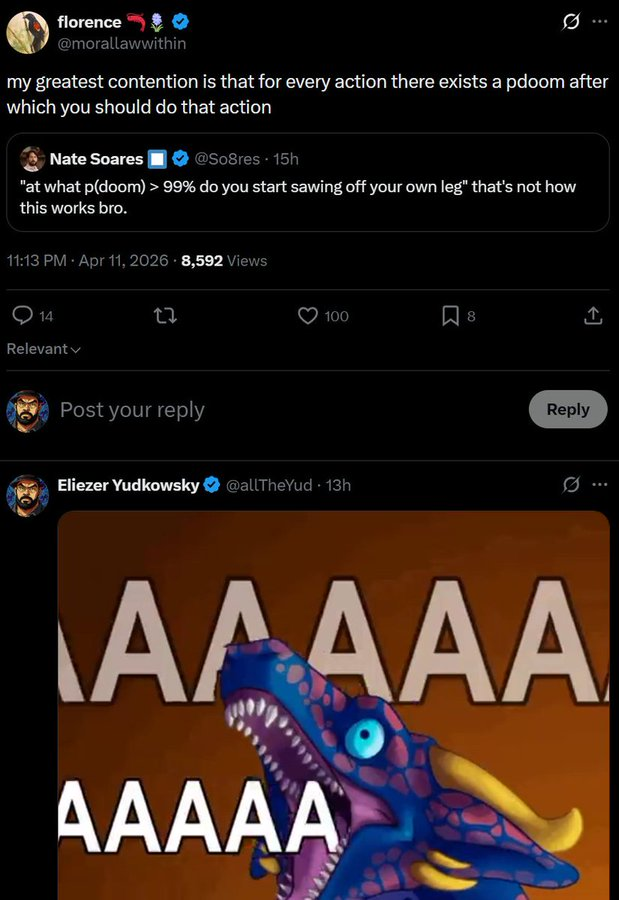
You should add the context that the post you quote was a joke trying to make the same point that you're making. https://x.com/morallawwithin/status/2043680224047444119
Hitler read the messages himself, instead of having the professional diplomats explain it to him; and Hitler read the standard diplomatic politesse and soft words as conciliatory
This is inaccurate: he consulted his foreign minister whom he considered an expert on Great Britain, but unfortunately, he appointed on this role a sycophant businessman who convinced himself and Hitler that the British were bluffing, and went so far to have "the German embassy in London provide translations from pro-appeasement newspapers such as the Daily Mail and the Daily Express for Hitler's benefit, which had the effect of making it seem that British public opinion was more strongly against going to war for Poland than it actually was." For more details, see https://en.wikipedia.org/wiki/Joachim_von_Ribbentrop#Pact_with_Soviet_Union_and_outbreak_of_World_War_II
2I liked this post.
I think there is a different post that feels missing from the discourse, that ties together "what goodness is, with gears-level models all the way up and down." (Which is, like, sort of a massive project. But, it'd be nice to gesturing at enough of the details to get the structure across)
Some people have reacted to this sort of statement with "so, you're saying if it were practical to stop AI with terrorism, it would be worth it?". In one of the twitter threads, Eliezer said "no I didn't say that" and linked to Ends Don't Justify Means (Among Humans).
Some other AI safety people said "Yes, it is evil to try to murder Sam Altman for the same reasons it's usually evil. But, to the people contemplating terrorism, that isn't very persuasive. But, yes, for the record, it is evil and wrong."
I feel a bit confused and dissatisfied with the situation.
I'm a persnickety rationalist. I think "goodness" and "evil" are underspecified and possibly-confused categories that I don't have a complete understanding of.
Nonetheless, I am aware that at least part of what gives some people the heebie-jibbies, when they see long arguments like "terrorism wouldn't work" instead of loudly, s...
 2
2Statistics show that civil movements with nonviolent doctrines are more successful at attaining their stated goals (especially in states that otherwise have functioning police). The factions that throw away all their morals lose the sympathy of the public and politicians, and then they fail. Terrorism is not an instant 'I win' button that people only refrain from pressing because they're so moral. Society has succeeded in making it usually not pay off -- say the numbers.
What are the statistics? I'm not convinced. It seems the sympathy part is mostly solved...
 5
5The utter extermination of humanity, would be bad!
I hope you're open to unexpected blunt criticism. This comma is wrong. This post has ten comma errors including repeated subject-verb splits.
Studying the craft of writing more, including comma rules, would materially help with your efforts to persuade people about AI risk.
I am absolutely not joking or trying to be a pedantic jerk. I wrote philosophy essays for over 15 years before I studied grammar. I wish I'd studied it earlier. Besides improving my writing, it ended up helping with text analysis, debat...
 32
32 1
1I think it's very clearly wrong according to standard English grammar rules, but I also think that Eliezer knows that and is using the comma to simulate a conversational speaking cadence. In this case, it's a pause for effect that emphasizes a sense of absurdity that this has to be said, in a way that "The utter extermination of humanity would be bad!" doesn't.
It would be more grammatical to use an ellipsis ("The utter extermination of humanity... would be bad!") but implies a slightly longer pause, which is probably less accurate to how Eliezer would say this out loud.
This kind of comma usage would be inappropriate for, say, a newspaper article, but I think it's defensible for an informal persuasive essay.
3 1
1To habryka, or anyone else who thinks the example comma in the quotation is correct: Why do you think that? Do you have a source for a rule which permits or requires it? It splits the subject (extermination) from the finite verb (would), similar to writing "Extermination, is bad."
Others have answered why the comma does work.
My relationship to "rules" of writing or "rules" of grammar is approximately the same as my relationship to "rules of dining etiquette". If the reader understands what you are trying to say, you wrote "correctly". There is no "wrong" beyond that.
(This is also the position of most linguists, as it I think becomes very quickly very obvious if you study how people actually use writing and language in practice)
 1
1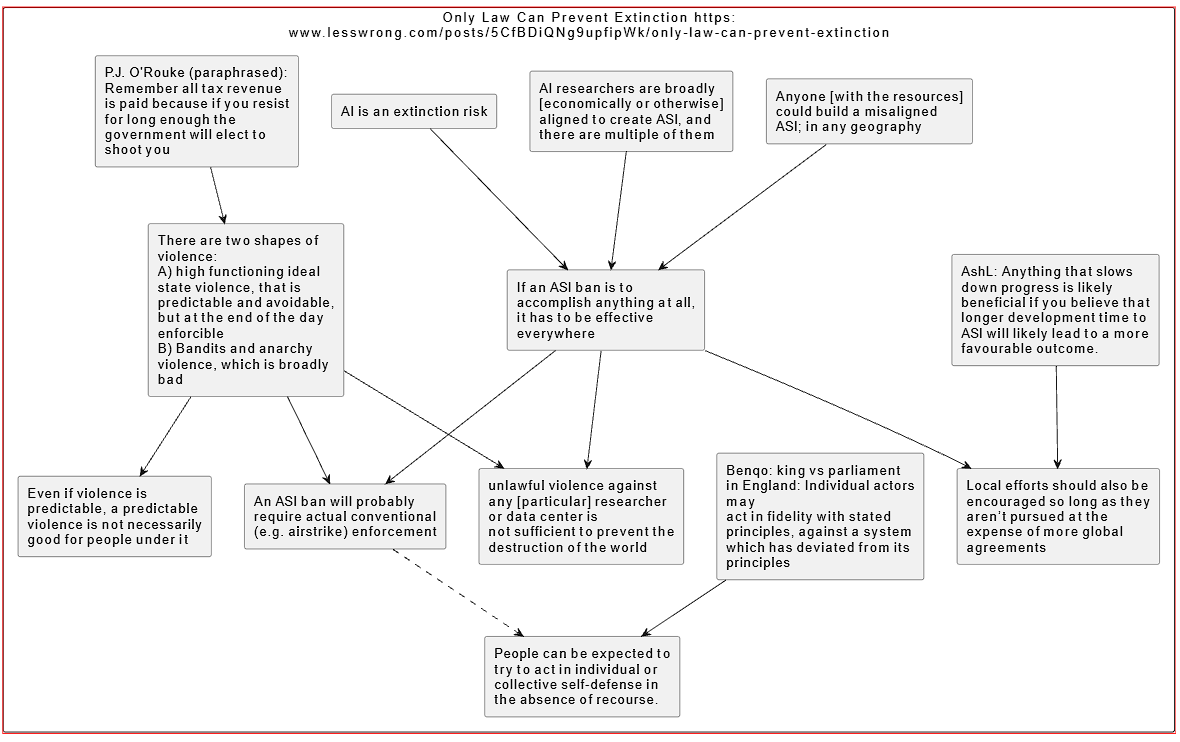
TL;DR.
"That would be a silly way for everyone on Earth to die, if nobody dared to talk about the danger, or argue high estimates of that danger, and it happened without any effort at stopping it."
"So let's not die! Let's save everyone!"
I deeply appreciate the core sentiments and logic in this post. If one has a major interest in preventing machine superintelligence from leading to human extinction, then one might also hold a moral stance that non-violence is essential to preserving all human life. However, humanity currently confronts two simultaneous extincti...
 1
1I read Yudkowsky's article with interest. In particular, I felt that the view of AI risk as an "irreversible event" was convincing enough.
However, as I read it, I had an idea. In some ways, the logic of blocking risks in the pre-super-intelligence stage seemed to resemble the issues addressed in the Minority Report and Psycho-Pass. It makes me wonder how far I can see it as a legitimate intervention in a situation where I have to intervene only with the possibility that has not yet occurred.
So I thought about a slightly different direction.
When talking abo...
 1
1 1
1Root principle articulated in the sequences: falsification is a special case of Bayes
Anxiety: computation is the mechanism that structures all consciousness
Cybernetic premise: simulating something in a conscious substrate by accident would just be making that thing real
Resultant anxiety about free speech: when speech can be reified by machines by accident, there is a proper order of operations to testing it. One that assigns strong lexical priority to the exhaustion of possible good, structured, coordination enhancing, survival increasing interpretations,...
2[edit: to "missed the point" reacts: I did not miss the point. I'm commenting on a different thing.]
I agree with almost everything. One exception:
If a rogue AI has gotten out, and it looks like it's about to destroy us, and we still have time to launch the nukes, states should absolutely launch all the nukes at datacenters. maybe it will be able to shoot them down; but we should give it as hard a time as we can muster, if it's willing to destroy us, and we have time to stop it.
Of course, if you're right about being already strategically outmatched by overw...
 2
2"If an ASI ban is to accomplish anything at all, it has to be effective everywhere."
Hypervelocity impactors for any alien civilization believed to be capable of developing to the point of being able to build a GPU or evolving an organic brain with a measurable IQ over some threshold?
 1
1
There's a quote I read as a kid that stuck with me my whole life:
At first I took away the libertarian lesson: Government is violence. It may, in some cases, be rightful violence. But it all rests on violence; never forget that.
Today I do think there's an important distinction between two different shapes of violence. It's a distinction that may make my fellow old-school classical Heinlein liberaltarians roll up their eyes about how there's no deep moral difference. I still hold it to be important.
In a high-functioning ideal state -- not all actual countries -- the state's violence is predictable and avoidable, and meant to be predicted and avoided. As part of that predictability, it comes from a limited number of specially licensed sources.
You're supposed to know that you can just pay your taxes, and then not get shot.
Is there a moral difference between that and outright banditry? To the vast majority of ordinary people rather than political philosophers, yes.
"Violence", in ordinary language, has the meaning of violence that is not predictable, that is not avoidable, that does not come from a limited list of sources whose rules people can learn.
Violence that is predictable and avoidable to you, whose consequences are regular and not chaotic, can of course still be terribly unjust and not to your own benefit. It doesn't rule out a peasant being told to hand over two thirds of their harvest in exchange for not much. It doesn't rule out your rent becoming huge because it's illegal to build new housing, etcetera etcetera. Laws can still be bad laws. But it is meaningfully different to the people who live under those unjust laws, if they can at least succeed in avoiding violence that way.
The point of a "state monopoly on violence", when it works, is to have violence come from a short list of knowable sources. A bullet doesn't make a smaller hole when fired by someone in a tidy uniform. But oligopolized force can be more avoidable, because it comes from a short list of dangers -- country, state, county, city -- whose actual rules are learnable even by a relatively dumb person. Ideally. In a high-functioning society.
The Earth presently has a problem. That problem may need to be prevented by the imposition of law, though hopefully not much actual use of force.
The problem, roughly speaking, is that if AI gets very much smarter, it is liable to turn into superhuman AI / machine superintelligence / artificial superintelligence (ASI). Current AIs are not deadly on that scale, but they are increasing in capability fast and breaking upward from previous trend lines. ASI might come about through research breakthroughs directly advancing AI to a superhuman level; or because LLMs got good enough at half-blindly tweaking the design to make a smarter AI, that is then sufficiently improved to make an even smarter AI, such that the process cascades.
AIs are not designed like a bicycle, or programmed and written like a social media website. There's a relatively small piece of code that humans do write, but what that code does, is tweak hundreds of billions of inscrutable numbers inside the actual AI, until that AI starts to talk like a person. The inscrutable numbers then do all sorts of strange things that no human decided for them to do, often things that require intelligence; like breaking out of containment during testing, or talking a human into committing suicide.
Controlling entities vastly smarter than humanity seems like it would, obviously, be the sort of problem that comes with plenty of subtleties and gotchas that can only be learned through practice. Some of the clever ideas that seemed to work fine at the non-superhuman level would fail to control strongly superhuman entities. Dynamics would change; something would go wrong. Probably a lot of things would go wrong, actually. It is hard to scale up engineering designs to vast new scales, and have them work right without a lot of further trial-and-error, even when you know how their internals work. To say nothing of this creation being an alien intelligence smarter than our species, a new kind of problem in all human history... I could go on for a while.
The thing about building vastly superhuman entities, is that you don't necessarily get unlimited retries like you usually do in engineering. You don't necessarily get to know there's a problem, before it's much too late; superhuman AIs may not decide to tell you everything they're thinking, until they are ready to wipe us off the board. (It's already an observed phenomenon that the latest AIs are usually aware of being tested, and may try to conceal malfeasance from an evaluator, like writing code that cheats at a code test and then cleans up the evidence after itself.)
Elon Musk's actual stated plan for Grok, grown on some of the largest datacenters in the world, is that he need only build a superintelligence that values Truth, and then it will keep humans alive as useful truth-generators. That he hasn't been shouted down by every AI scientist on Earth should tell you everything you need to know about the discipline's general maturity as an engineering field. AI company founders and their investors have been selected to be blind to difficulties and unhearing of explanations. If Elon were the sort of person who could be talked out of his groundless optimism, he wouldn't be running an AI company; so also with the founders of OpenAI and Anthropic.
If you need to read a statement by a few hundred academic computer scientists, Nobel laureates, retired admirals, etcetera, saying that yes AI is an extinction risk and we should take that as seriously as nuclear war, you can go look here. Frankly, most of them are relative latecomers to the matter and have not begun to grasp all the reasons to worry. But what they have already grasped and publicly agreed with, is enough to motivate policy.
I realize this might sound naively idealistic. But I say: The utter extermination of humanity, would be bad! It should be prevented if possible! There ought to be a law!
Specifically: There ought to be a law against further escalation of AGI capabilities, trying to halt it short of the point where it births superintelligence. A line drawn sharply and conservatively, because we don't know how much further we can dance across this minefield before something explodes. My organization has a draft treaty online, but a bare gloss at "Okay what does that mean tho" would be: All the hugely expensive specialized chips used to grow large AIs, and run large AIs, would be collected in a limited number of datacenters, and used only under international supervision.
It would be beneath my dignity as a childhood reader of Heinlein and Orwell to pretend that this is not an invocation of force.
But it's the sort of force that's meant to be predictable, predicted, avoidable, and avoided. And that is a true large difference between lawful and unlawful force.
There's in fact a difference between calling for a law, and calling for individual outbursts of violence. (Receipt that I am not arguing with a strawman, and that some people purport to not understand any such distinction: Here). Libertarian philosophy aside, most normal ordinary people can tell the difference, and care. They correctly think that they are less personally endangered by someone calling for a law than by someone calling for street violence.
But wait! The utter extinction of humanity -- argue people who do not believe that premise -- is a danger so extreme, that belief in it might possibly be used to argue for unlawful force! By the Fallacy of Appeal to Consequences, then, that belief can't be true; thus we know as a matter of politics that it is impossible for superintelligence to extinguish humanity. Either it must be impossible for any cognitive system to exist that is advanced beyond a human brain; or the many never-challenged problems of controlling machine superintelligence must all prove to be easy. We cannot deduce which of these two facts is true, but their disjunction must be true and also knowable, because if it weren't knowable, somebody might be able to argue for violence. Never in human history has any proposition proven to be true if anyone could possibly use it to argue for violence. The laws of physics check whether that could be a possible outcome of any physical situation, and avoid it with perfect reliability.
That whole line of reasoning is deranged, of course.
I will nonetheless proceed to spell out why its very first step is wrong, ahead of all the insanity that followed:
Unlawful violence is not able, in this case, to prevent the destruction of the world.
If an ASI ban is to accomplish anything at all, it has to be effective everywhere. When the ones said to me, "What do you think about our proposed national ban on more datacenters until they have sensible regulations?" I replied to them, "An AI can take your job, and a machine superintelligence can kill you, just as easily from a datacenter in another country." They later added a provision saying that also GPUs couldn't be exported to other countries until those countries had similar sensible regulations. (I am still feeling amazed, awed, and a little humbled, about the part where my words plausibly had any effect whatsoever. Politicians are a lot more sensible, in some real-life cases, than angry libertarian literature had led me to believe a few decades earlier.)
Datacenters in Iceland, if they were legal only there, could just as much escalate AI capabilities to the point of birthing the artificial superintelligence (ASI) that kills us. You would not be safe in your datacenter-free city. You can imagine the ASI side as having armies of flying drones that search everywhere; though really there are foreseeable, quickly-accessible-to-ASI technologies that would be much more dangerous than drone swarms. But those would take longer to explain, and the drone swarms suffice to make the point. You could not stay safe from ASI by hiding in the woods.
On my general political philosophy, if a company's product only endangers voluntary customers who know what they're getting into, by strong default that's a matter between the company and the customer.
If a product might kill someone standing nearby the customer, like cigarette smoke, that's a regional matter. Different cities or countries can try out different laws, and people can decide where to live.
If a product kills people standing on the other side of the planet from the customer, then that's a matter for international negotiations and treaties.
ASI is a product that kills people standing on the other side of the planet. Driving an AI company out of just your own city will not protect your family from death. It won't even protect your city from job losses, earlier in the timeline.
And similarly: To impede one executive, one researcher, or one company, does not change where AI is heading.
If tomorrow Demis Hassabis said, "I have realized we cannot do this", and tried to shut down Google Deepmind, he would be fired and replaced. If Larry Page and Sergei Brin had an attack of sense about their ability to face down and control a superintelligence, and shut down Google AI research generally, those AI researchers would leave and go to other companies.
Nvidia is currently the most valuable company in the world, with a $4.5 trillion market capitalization, because everyone wants more AI-training chips than Nvidia has to sell. The limiting resource for AI is not land on which to construct datacenters; Earth has a lot of land. Banning a datacenter from your state may keep electricity cheaper there in the middle term, but it won't stop the end of the world.
The limiting resource for AI is also not the number of companies pursuing AI. If one AI company was randomly ruined by their country's government, other AI companies would swarm around to buy chips from Nvidia instead, which would stay at full production and sell their full production. The end of the world would carry on.
There is no one researcher who holds the secret to your death. They are all looking for pieces of the puzzle to accumulate, for individual rewards of fame and fortune. If somehow the person who was to find the next piece of the puzzle randomly choked on a chicken bone, somebody else would find a different puzzle piece a few months later, and Death would march on. AI researchers tell themselves that even if they gave up their enormous salaries, that wouldn't help humanity much, because other researchers would just take their place. And the grim fact is that this is true, whether or not you consider it an excuse.
In other cases of civic activism, you can prevent one coal-fired power plant from being built in your own state, and then there is that much less carbon dioxide in the atmosphere and the world is a little less warm a century later. Or if you are against abortions, and you get your own state to outlaw abortions, perhaps there are then 1000 fewer abortions per year and that is to you a solid accomplishment. Which is to say: You can get returns on your marginal efforts that are roughly linear with the effort you put in.
The ASI problem is not like this. If you shut down 5% of AI research today, humanity does not experience 5% fewer casualties. We end up 100% dead after slightly more time. (But not 5% more time, because AI research doesn't scale in serial speed with the number of parallel researchers; 9 women can't birth a baby in 1 month.)
So we don't need to have a weird upsetting conversation about doing bad unlawful things that would supposedly save the world, because even if someone did a very bad thing, that still wouldn't save the world.
This is a point that some people seem to have a very hard time hearing -- though those people are usually not on the anti-extinction side, to be clear. It's more that some people can't imagine that superhuman AI could be a serious danger, to the point where they have trouble reasoning about what that premise would imply. Others are politically opposed to AI regulation of any sort, and therefore would prefer to misunderstand these ideas in a way where they must imply terrible unacceptable conclusions.
I understand the reasons in principle. But it is a strange and frustrating phenomenon to encounter in practice, in people who otherwise seem coherent and intelligent (though maybe not quite on the level of GPT 5.4). Many people believe, somehow, that other people ought to think -- not themselves, only other people -- that outbursts of individual violence just have to be helpful. If you were truly desperate, how could you not resort to violence?
But even if you're desperate, an outburst of violence usually will not actually solve your problems! That is a general truism in life, and it applies here in full force.
Even if you throw away all your morals, that doesn't make it work. Even if you offer your soul to the Devil, the Devil is not buying.
How certain do you have to be that your child has terminal cancer, before you start killing puppies? 10% sure? 50% sure? 99.9%? The answer is that it doesn't matter how certain you are, killing puppies doesn't cure cancer. You can kill one hundred puppies and still not save your kid. There is no sin so great that it just has to be helpful because of how sinful it is.
Statistics show that civil movements with nonviolent doctrines are more successful at attaining their stated goals (especially in states that otherwise have functioning police). The factions that throw away all their morals lose the sympathy of the public and politicians, and then they fail. Terrorism is not an instant 'I win' button that people only refrain from pressing because they're so moral. Society has succeeded in making it usually not pay off -- say the numbers.
Being really, really desperate changes none of those mechanics.
Almost everyone who actually accepts a fair chance of ASI disaster doesn't seem to have a hard time understanding this part. It's an obvious consequence of the big picture, if you actually allow that big picture inside your head.
But it is hard for a human being to understand a thing, if it would be politically convenient to misunderstand. Opponents of AI regulation want any danger of extinction to imply unacceptable consequences.
They understand on some level how the AI industry functions. But they become mysteriously unable to connect that knowledge to their model of human decisionmaking. You can ask them, "If tomorrow I was arrested for attacking an AI-company headquarters, would you read that headline, and conclude that AI had been stopped in its tracks forever and superintelligence would never happen?" and get back blank stares.
Even some people that are not obviously politically opposed seem to stumble over the idea. I'm genuinely not sure why. I think maybe they are having trouble processing "Well of course ASI would just kill everyone, we're nowhere near being able to control it" as an ordinary understanding of the world, the way that 20th-century concerns about global nuclear war were part of a mundane understanding of the world. "If every country gets nuclear weapons they will eventually be used" was not, to people in 1945, the sort of belief where you have to prove how strongly you believe it by being violent. It was just something they were afraid would prove true about the world, and then cause their families to die in an unusually horrible kind of fire. So they didn't randomly attack the owners of uranium-mining companies, to prove how strongly they believed or how worried they were; that, on their correct understanding of the world, would not have solved humanity's big problem -- namely, the inexorable-seeming incentives for proliferation. Instead they worked hard, and collected a coalition, and built an international nuclear anti-proliferation regime. Both the United States and the Soviet Union cooperated on many aspects of that regime, despite hating each other quite a lot, because neither country's leaders expected they'd have a good day if an actual nuclear war happened.
The sort of conditionally applicable force that could stop everyone from dying to superhuman AI, would have to be everywhere and reliable; uniform and universal.
Let it be predictable, predicted, avoidable, and avoided.
It is so much a clear case for state-approved lawful force, that there would be little point in adding any other kind of force to the mix. It would just scare and offend people, and they'd be valid to be scared and offended. People don't like unguessably long lists of possible violence-sources in their lives, for then they cannot predict it and avoid it.
I did spell out the necessity of the lawful force, in first suggesting that international policy. Some asked afterward, "Why would you possibly mention that the treaty might need to be enforced by a conventional airstrike, if somebody tried to defy the ban?" One reason is that some treaties aren't real and actually enforced, and that this treaty needs to be the actually-enforced sort. Another reason is that if you don't spell things out, that same set of people will make stuff up instead; they will wave their hands and say, "Oh, he doesn't realize that somebody might have to enforce his pretty treaty."
And finally it did seem wiser to me, that all this matter be made very plain, and not dressed up in the sort of obscuring language that sometimes accompanies politics. For an international ASI ban to have the best chance of operating without its force actually being invoked, the great powers signatory to it need to successfully communicate to each other and to any non-signatories: We are more terrified of machine superintelligence killing everyone on Earth than we are reluctant to use state military force to prevent that.
If North Korea, believed to have around 50 nuclear bombs, were to steal chips and build an unmonitored datacenter, I would hold that diplomacy ought to sincerely communicate to North Korea, "You are terrifying the United States and China. Shut down your datacenter or it will be destroyed by conventional weapons, out of terror for our lives and the lives of our children." And if diplomacy fails, and the conditional use of force fires, and then North Korea retaliates with a first use of its nuclear weapons? I don't think it would; that wouldn't end well for them, and they probably know that. But I also don't think this is a hypothetical where sanity says that we are so terrified of someone's possible first use of nuclear weapons, that we let them shatter a setup that protects all life on Earth.
You'd want to be very clear about all of this in advance. Countries not understanding it in advance could be very bad. History shows that is how a lot of wars have started, through someone failing to predict a conditional application of force and avoid it. One historical view suggests that Germany invaded Poland in 1939 in part because, when Britain had tried to warn that Britain would defend Poland, Hitler read the messages himself, instead of having the professional diplomats explain it to him; and Hitler read the standard diplomatic politesse and soft words as conciliatory; and thus began World War II. More recently, a similar diplomatic misunderstanding by Saddam Hussein is thought to have resulted in Hussein's 1990 invasion of Kuwait, as then in fact provoked a massive international response. I've sometimes been criticized for trying to spell out proposed policy in such awfully plain words, like saying that the allies might have to airstrike a datacenter if diplomacy failed. Some people -- reaching pretty hard, in my opinion -- claimed that this must be a disguised incitement to unlawful violence. But being very clear about the shape of the lawful force was important, in this case.
And then, all that policy is sufficiently the obvious and sensible proposal -- following from the ultimately straightforward realization that something vastly smarter than humanity is not something humanity presently knows how to build safely -- and never mind how bad it starts looking if you learn details like Elon Musk's stated plan -- that some people find it inconveniently difficult to argue with. Unless they lie about what the proposal is.
So I am misquoted (that is, they fabricate a quote I did not say, which is to say, they lie) as calling for "b*mbing datacenters", two words I did not utter. In the first 2023 proposal in TIME magazine, I wrote the words "be willing to destroy a rogue datacenter by airstrike". I was only given one day by TIME to write it -- otherwise it wouldn't have been 'topical' -- but I had thought I was saying that part quite carefully. Even quoted out of context, I thought, this ought to make very clear that I was talking about state-sanctioned use of force to preserve a previously successful ban from disruption. And absolutely not some guy with a truck bomb, attacking one datacenter in their personal country while all the other datacenters kept running.
And that phrasing is clear even when quoted out of context! If quoted accurately. So some (not all) accelerationists just lied about what was being advocated, and fabricated quotes about "b*mbing datacenters". When called out, they would protest, "Oh, you pretty much said that, there's no important difference!" To this as ever the reply is, "If it is worth it to you to lie about, it must be important."
A similarly fabricated quote says that I proposed "nuking datacenters". Ladies, gentlemen, all others, there is absolutely no reason to nuke a noncompliant datacenter. In the last extremity of failed diplomacy, a conventional missile will do quite well. The taboo against first use of nuclear weapons is something that I consider one of the great triumphs of the post-WW2 era. I am proud as a human being that we pulled that off. Nothing about this matter requires violating that taboo. We should not be overeager to throw away all limits and sense, and especially not when there is no need. Life on Earth needs to go on in the sense of "life goes on", not just in the sense of "not being killed by machine superintelligences".
It is sometimes claimed that ASI cannot possibly be banned without a worldwide tyranny -- by people who oppose AI regulation and so would prefer it to require horrifying unacceptable measures.
At the very least: I don't think we know this to be true to the point we should all lie down and die instead.
At least until recently, humanity has managed to not have every country building its own nuclear arsenal. We did that without everyone on Earth being subjected to daily-required personal obediences to the International Atomic Energy Agency. Some people in the 1940s and 1950s thought it would take a tyrannical world dictatorship, to prevent every country from getting nuclear weapons followed by lots of nuclear war! Shutting down all major wars between major powers, or slowing that kind of technological proliferation, had never once been done before, in all history! But those worried skeptics were wrong; for some decades, at least, nuclear proliferation was greatly slowed compared to the more pessimistic forecasts, without a global tyranny. And now we have that precedent to show it can be done; not easily, not trivially, but it can be done.
For the supervast majority of normal people, "Don't spend billions of dollars to smuggle computer chips, construct an illegal datacenter, and try to build a superintelligence" is a very small addition to the list of things they must not do. Surveys seem to show that most people think machine superintelligence is a terrible idea anyway. (Based.)
And the few who feel really personally bothered by that law?
They may be sad. They'll definitely be angry. But they'll survive. They wouldn't actually survive otherwise.
My will for Sam Altman's fate is that he need only fear the use of force by his country, his state, his county, and his city, as before; with the difference that Sam Altman, like everyone else on Earth, is told not to build any machine superintelligences; and that this potential use of state force against his person be predictable to him, and predicted by him, and avoidable to him, and avoided by him; with him as with everyone. That's how it needs to be if any of us are to survive, or our children, or our pets, or our garden plants.
Let Sam Altman have no fear of violence beyond that, nor fire in the night.
Artificial superintelligence is the very archetype and posterchild of a problem that can only be solved with force that has the shape of law, as in state-backed universal conditional applications of force meant to be predictable and avoided. Anything which is not that does not solve the problem.
And when somebody does throw a Molotov cocktail at Sam Altman's house, that is not actually good for the anti-extinction movement, as anyone with the tiniest bit of sense could and did predict.
Currently all the anti-extinctionist leaders are begging their people to not be violent -- as they've said in the past, but louder now. And conversely some of the accelerationists are trying to goad violence, in some cases to the shock of their usual audiences:
That this sentiment is not universal among accelerationists, is seen immediately from the protestor in their replies. Let us, if not them, be swift to fairly admit: We are observing bad apples and not a bad barrel.
But also to be clear, those bad apples were also trying to goad people into violence earlier, in advance of the attacks on Altman:
To this tweet I will not belabor the reply that anti-extinctionists may be good people with morals; some good people might nod, but others would find it unconvincing, and there is one analysis that answers for all: It would not work. And given that it would not save humanity, anti-extinctionists make the obvious estimate that our own cause would be, and has been, harmed by futile outbursts of unlawful violence.
Conversely, some accelerationists behave as if they want to spread the word and meme of violence as far as possible. It is reasonable to guess that some part of their brain has considered the consequences of somebody being moved by their taunts, and found them quite acceptable. If they can goad somebody labelable as anti-extinctionist to violence, that benefits their faction. They may consider Sam Altman replaceable to their cause, so long as there is no law and treaty to stop all the AI companies everywhere.
They're right. Sam Altman is not the One Ring. He is not Sauron's one weakness. If anything happened to him, AI would go on.
I am posting these Tweets in part to say to any impressionable young people who may consider themselves humanity's defenders, who are at all willing to listen to their allies rather than their enemies: Hey. Don't play into their hands. They're taunting you exactly because violence is good for their side and bad for ours. If it were true that violence could help you, if they expected that violence would hurt AI progress more than it helped their side politically, they'd never taunt you like that, because they'd be afraid rather than eager to see you turn to violence. They're saying it to you because it's not true; and if it were true, they'd never say it to you. They're not on your side, and the advice implied by the taunts is deliberately harmful for you and good for them.
This is of course a general principle when somebody is taunting you. It means they want you to fight, which means they expect to benefit from you trying.
Don't believe their taunts. Believe what is implied by their act of taunting, that violence hurts you and helps them. That part is accurate, obvious, and not at all hard for their brains to figure out in the background, before they choose to taunt you.
It makes sense to me that society penalizes factions that appear to benefit from violence, even if their leaders try to disclaim that violence. Intuitively, you don't want to create a vulnerability in society where faction leaders could gain an advantage by sending out assassins and then publicly disclaiming them.
But at the point where some accelerationists are openly trying to goad anti-extinctionists into violence, while the anti-extinctionist leaders beg for peace -- this denotes society has gone too far in the direction of punishing the 'violent' faction for what's probably actually in real life a rogue. And not far enough in leveling some social opprobrium at (individual) accelerationist sociopaths standing nearby, openly trying to provoke violence they know would be useful to them.
It is of course an old story. The civic movement leaders try to persuade their people to stay calm, disciplined, and orderly on the march. The local police, if they oppose that movement, will allow looters to tag along and then forcibly prevent the marchers from stopping the looters. When your society gets to that point, it has created a new vulnerability in the opposite direction.
One could perhaps also observe that certain people have taken this particular moment to argue that a scientific position whose native plausibility ought to be obvious, and which has been endorsed by hundreds of academic scientists, retired admirals, Nobel laureates, etcetera, inevitably implies that unlawful violence must be a great idea. I am not going to make any great show of wringing my hands and clutching my pearls about how such false speech might endanger the innocent for their own political advantage, what if some mentally disturbed person believed them, etcetera. This is how human beings always behave around politics; it is not unusual wrongdoing for any faction to behave that way. They, too, have a right to say what they believe, and to believe things that are obviously false but politically convenient to them. I may still take a moment to observe what is happening.
As for the argument that to criticize AI at all is "stochastic terrorism", because someone will react violently eventually, even if not logically so? Tenobrus put it well:
The leaders of anti-extinctionism do have some responsibility to ask their people to please behave themselves. And we do! That actually is around as much as should be reasonably asked of any civic movement. We ought to try, and try we do! We cannot and should not be expected to succeed every single time given base rates of mental illness in the population.
Speech about important matters to society should not properly be held hostage to the whim of any madman that might do a stupid thing, to the detriment of his supposed cause and against every visible word of that cause's leaders.
That would be a foolish way to run a society.
And policywise, this would be a very serious matter about which to shut down speech. Anthropic Claude Mythos is already a state-level actor in terms of how much harm it could theoretically have done -- given its demonstrated and verified ability to find critical security vulnerabilities in every operating system and browser; and how fast Mythos could've exploited those vulnerabilities, with ten thousand parallel threads of intelligent attack. Mythos hypothetically rampant or misused could have taken down the US power grid, say... at the end of its work, after introducing hard-to-find errors into all the bureaucracies and paperwork and doctors' notes connected to the Internet.
In 2024 a claim of that being possible would have been a mere prediction and dismissed as fantasy. Now it is an observation and mere reality. That's the danger level of current AI, for all that Anthropic seems to be trying to be well-behaved about it, and Mythos has not yet visibly run loose. To say in the face of that, that nobody should critique AI, or AI companies, or even individual AI company leaders as per recent journalism, because some madman might thereby be inspired to violence -- it fails cost/benefit analysis, dear reader.
AI is already a state-level potential danger, if not quite yet a state-level actual power. Free speech to critique AI then holds a corresponding level of importance. The stochastic madman trying to hold free speech hostage to his possible whims -- he must be told he is not important enough for all humanity to defer to him about subjects he might find upsetting.
And faced with an actual human-extinction-level danger like machine superintelligence -- as ought obviously to represent that level of possible danger, even if some people disagree about its rough probability -- well, that would be a silly way for everyone on Earth to die, if nobody dared to talk about the danger, or argue high estimates of that danger, and it happened without any effort at stopping it.
So let's not die! Let's save everyone!
Sam Altman too.
That's the dream.