One of the key issues appears to be that intelligence is way higher-dimensional than most people assumed when terms like AGI or ASI were coined, and hence many of these terms are wonkier than they initially seemed. Now we observe severe jaggedness in AI, so while you can argue that today's AIs are AGI or ASI and are probably technically correct, at least for certain interpretations, they still fall short in many areas at the same time, making them, for now, much less useful or transformative than one might have imagined ten years ago given a description of some of the capabilities they have today.
Goal posts are definitely being moved, but I still think this is partially because the original goal posts were somewhat ill-defined. If you don't take the literal definitions provided in the past, but instead take the "spirit" behind them, then I think it's kind of fair to move the goal posts now that we know that the original definitions came with some wrong assumptions and don't really hit the thing they were supposed to aim at.
That all being said, there is definitely also a tendency to dismiss current technology and claim it's "not actually AI" or "not truly intelligent" just because it's "just statistics" or because "it can only repeat what's present in the training data", and these types of views definitely seem very, very off to me.
 4
4Yup, the second go-round with Project Vend was a lot better, almost up to "disastrous 1999 dotcom" levels of management. Even including the bizarre late-night emails from the "CEO model" full of weird, enthusiastic spiritual rants.
I should be clear: Opus 4.5 is a very large piece of a general intelligence. And it's getting better rapidly. But it's still missing some really critical stuff, too.
Also, my job doesn't come with a lot of built-in affordances, except the ones that I set up. On the one hand, giving Opus 4.5 a CLI sandbox gives it a lot of options for setting up CLI accounting software, etc. On the other hand, even Gemini still struggles with Pokemon video games, despite some heavy duty affordances like a map-management tool. A key part of being a general intelligence is being able to function without too much hand holding, basically.
 1
1There are many missing cognitive faculties, whose absence can plausibly be compensated with scale and other AI advantages. We haven't yet run out of scale, though in 2030s we will (absent AGI, trillions of dollars in revenue).
The currently visible crucial things that are missing are sample efficiency (research taste) and continual learning, with many almost-ready techniques to help with the latter. Sholto Douglas of Anthropic claimed a few days ago that probably continual learning gets solved in a satisfying way in 2026 (at 38:29 in the podcast). Dario Amodei previously discussed how even in-context learning might confer the benefits of continual learning with further scaling and sufficiently long contexts (at 13:17 in the podcast). Dwarkesh Patel says there are rumors Sutskever's SSI is working on test time training (at 39:25 in the podcast). Thinking Machines published work on better LoRA, which in some form seems crucial to making continual learning via weight updates practical for individual model instances. This indirectly suggests OpenAI would also have a current major project around continual learning.
The recent success of RLVR suggests that any given sufficiently narrow mode of activity (such as doing well on a given kind of benchmarks) can now be automated. This plausibly applies to RLVR itself, which might be used by AIs to "manually" add new skills to themselves, after RLVR was used to teach AIs to apply RLVR to themselves, in the schleppy way that AI researchers currently do to get them better at benchmarkable activities. AI instances doing this automatically for the situation (goal, source of tasks, job) where they find themselves covers a lot of what continual learning is supposed to do. Sholto Douglas again (at 1:00:54 in a recent podcast):
So far the evidence indicates that our current methods haven't yet found a problem domain that isn't tractable with sufficient effort.
So it's not completely clear that there are any non-obvious obstacles still remaining. Missing research taste might get paved over with sufficient scale of effort, once continual learning ensures there is some sustained progress at all when AIs are let loose to self-improve. To know that some obstacles are real, the field first needs to run out of scaling and have a few years to apply RLVR (develop RL environments) to automate all the obvious things that might help AIs "manually" compensate for the missing faculties.
 1
1A couple of things happened that made terms like AGI/ASI less useful:
- We didn't realize how correlated benchmark progress and general AI progress was, and benchmark tasks systematically sample from disproportionately easy to automate areas of work:
Not a novel point, but: one reason that progress against benchmarks feels disconnected from real-world deployment is that good benchmarks and AI progress are correlated endeavors. Both benchmarks and ML fundamentally require verifiable outcomes. So, within any task distribution, the benchmarks we create are systematically sampling from the automatable end.
Importantly, there's no reason to believe this will stop. So we should expect benchmarks will continue to feel rosey compared to real-world deployment.
Thane Ruthenis also has an explanation about why benchmarks tend to overestimate progress here.
2. We assumed intelligence/IQ was much more lower-dimensional than it really was. Now I don't totally blame people for thinking that there was a chance that AI capabilities were lower dimensional than they were, but way too many expected an IQ analogue for AI to work. This is in part an artifact of current architectures being more limited on some key dimensions like continual learning/long-term memory, but I wouldn't put anywhere close to all of the jaggedness on AI deficits, and instead LWers forgot that reality is surprisingly detailed.
Remember, even in humans IQ only explains 30-40% of human performance, which while being more than a lot of people want to admit, nerd communities like LessWrong have the opposite failure mode of believing that intelligence/IQ/capabilities is very low dimensional with a single number dominating how performant you are.
To be frank, this is a real-life version of an ontological crisis, where certain assumptions about AI, especially on LW turned out to be entirely wrong, meaning that certain goal-posts/risks have turned out to at best require conceptual fragmentation, and at worst turned out to be incoherent.
1However, creating the thing that people in 2010 would have recognized "as AGI" was accompanied, in a way people from the old 1900s "Artificial Intelligence" community would recognize, by a changing of the definition.
I interpret this as saying that
- In 2010, there was (among people concerned with the topic) a commonly accepted definition for AGI,
- that this definition was concrete enough to be testable,
- current transformers meet this definition.
This doesn't match my recollection, nor does it match my brief search of early sources. As far as I recall and could find, the definitions in use for AGI were something like:
- Stating that there's no commonly-agreed definition for AGI (e.g. "Of course, “general intelligence” does not mean exactly the same thing to all researchers. In fact it is not a fully well-defined term, and one of the issues raised in the papers contained here is how to define general intelligence in a way that provides maximally useful guidance to practical AI work." -- Ben Goertzel & Cassio Pennachin (2007) Artificial General Intelligence, p. V)
- Saying something vague about "general problem-solving" that provides no clear criteria. (E.g. "But, nevertheless, there is a clear qualitative meaning to the term. What is meant by AGI is, loosely speaking, AI systems that possess a reasonable degree of self-understanding and autonomous self-control, and have the ability to solve a variety of complex problems in a variety of contexts, and to learn to solve new problems that they didnt know about at the time of their creation." Ibid, p. V-VI.)
- Handwaving around Universal Intelligence: A Definition of Machine Intelligence (2007) which does not actually provide a real definition of AGI, just proposes that we could use the ideas in it to construct an actual test of machine intelligence.
- "Something is an AGI if it can do any job that a human can do." E.g. Artificial General Intelligence: Concept, State of the Art, and Future Prospects (2014) states that "While we encourage research in defining such high-fidelity metrics for specific capabilities, we feel that at this stage of AGI development a pragmatic, high-level goal is the best we can agree upon. Nils Nilsson, one of the early leaders of the AI field, stated such a goal in the 2005 AI Magazine article Human-Level Artificial Intelligence? Be Serious! (Nilsson, 2005): I claim achieving real human-level artificial intelligence would necessarily imply that most of the tasks that humans perform for pay could be automated. Rather than work toward this goal of automation by building special-purpose systems, I argue for the development of general-purpose, educable systems that can learn and be taught to perform any of the thousands of jobs that humans can perform."
That last definition - an AGI is a system that can learn to do any job that a human could do - is the one that I personally remember being the closest to a widely-used definition that was clear enough to be falsifiable. Needless to say, transformers haven't met that definition yet!
Claude's own outputs are critiqued by Claude and Claude's critiques are folded back into Claude's weights as training signal, so that Claude gets better based on Claude's own thinking. That's fucking Seed AI right there.
With plenty of human curation and manual engineering to make sure the outputs actually get better. "Seed AI" implies that the AI develops genuinely autonomously and without needing human involvement.
Half of humans are BELOW a score of 100 on these tests and as of two months ago (when that graph taken from here was generated) none of the tests the chart maker could find put the latest models below 100 iq anymore. GPT5 is smart.
We already had programs that "beat" half of humans on IQ tests as early as 2003; they were pretty simple programs optimized to do well on the IQ test, and could do literally nothing else than solve the exact problems on the IQ tests they were designed for:
In 2003, a computer program performed quite well on standard human IQ tests (Sanghi & Dowe, 2003). This was an elementary program, far smaller than Watson or the successful chess-playing Deep Blue (Campbell, Hoane, & Hsu, 2002). The program had only about 960 lines of code in the programming language Perl (accompanied by a list of 25,143 words), but it even surpassed the average score (of 100) on some tests (Sanghi & Dowe, 2003, Table 1).
The computer program underlying this work was based on the realisation that most IQ test questions that the authors had seen until then tended to be of one of a small number of types or formats. Formats such as “insert missing letter/ number in middle or at end” and “insert suffix/prefix to complete two or more words” were included in the program. Other formats such as “complete matrix of numbers/characters”, “use directions, comparisons and/or pictures”, “find the odd man out”, “coding”, etc. were not included in the program— although they are discussed in Sanghi and Dowe (2003) along with their potential implementation. The IQ score given to the program for such questions not included in the computer program was the expected average from a random guess, although clearly the program would obtain a better “IQ” if efforts were made to implement any, some or all of these other formats.
So, apart from random guesses, the program obtains its score from being quite reliable at questions of the “insert missing letter/number in middle or at end” and “insert suffix/prefix to complete two or more words” natures. For the latter “insert suffix/prefix” sort of question, it must be confessed that the program was assisted by a look-up list of 25,143 words. Substantial parts of the program are spent on the former sort of question “insert missing letter/number in middle or at end”, with software to examine for arithmetic progressions (e.g., 7 10 13 16 ?), geometric progressions (e.g., 3 6 12 24 ?), arithmetic geometric progressions (e.g., 3 5 9 17 33 ?), squares, cubes, Fibonacci sequences (e.g., 0 1 1 2 3 5 8 13 ?) and even arithmetic-Fibonacci hybrids such as (0 1 3 6 11 19 ?). Much of the program is spent on parsing input and formatting output strings—and some of the program is internal redundant documentation and blank lines for ease of programmer readability. [...]
Of course, the system can be improved in many ways. It was just a 3rd year undergraduate student project, a quarter of a semester's work. With the budget Deep Blue or Watson had, the program would likely excel in a very wide range of IQ tests. But this is not the point. The purpose of the experiment was not to show that the program was intelligent. Rather, the intention was showing that conventional IQ tests are not for machines—a point that the relative success of this simple program would seem to make emphatically. This is natural, however, since IQ tests have been specialised and refined for well over a century to work well for humans.
IQ tests are built based on the empirical observation that some capabilities in humans happen to correlate with each other, so measuring one is also predictive of the others. For AI systems whose cognitive architecture is very unlike a human one, these traits do not correlate in the same way, making the reported scores of AIs on these tests meaningless.
Heck, even the scores of humans on an IQ test are often invalid if the humans are from a different population than the one the test was normed on. E.g. some IQ tests measure the size of your vocabulary, and this is a reasonable proxy for intelligence because smarter people will have an easier time figuring out the meaning of a word from its context, thus accumulating a larger vocabulary. But this ceases to be a valid proxy if you e.g. give that same test to a people from a different country who have not been exposed to the same vocabulary, to people of a different age who haven't had the same amount of time to be exposed to those words, or if the test is old enough that some of the words on it have ceased to be widely used.
Likewise, sure, an LLM that has been trained on the entire Internet could no doubt ace any vocabulary test... but that would say nothing about its general intelligence, just that it has been exposed to every word online and had an excessive amount of training to figure out their meaning. Nor does it getting any other subcomponents of the test right tell us anything in particular, other than "it happens to be good at this subcomponent of an IQ test, which in humans would correlate with more general intelligence but in an AI system may have very little correlation".
 1
1Drop in remote worker
I think this one sounds like it describes a single level of capability, but quietly assumes a that the capabilities of "a remote worker" are basically static compared to the speed of capabilities growth. A late-2025 LLM with the default late-2025 LLM agent scaffold provided by the org releasing that model (e.g. chatgpt.com for openai) would have been able to do many of the jobs posted in 2022 to Upwork. But these days, before posting a job to Upwork, most people will at least try running their request by ChatGPT to see if it can one-shot it, and so those exact jobs no longer exist. The jobs which still exist are those which require some capabilities that are not available to anyone with a browser and $20 to their name.
This is a fine assumption if you expect AI capabilities to go from "worse than humans at almost everything" to "better than humans at almost everything" in short order, much much faster than the ability of "legacy" organizations to adapt to them. I think that worldview is pretty well summarized by the graph from the waitbutwhy AI article:
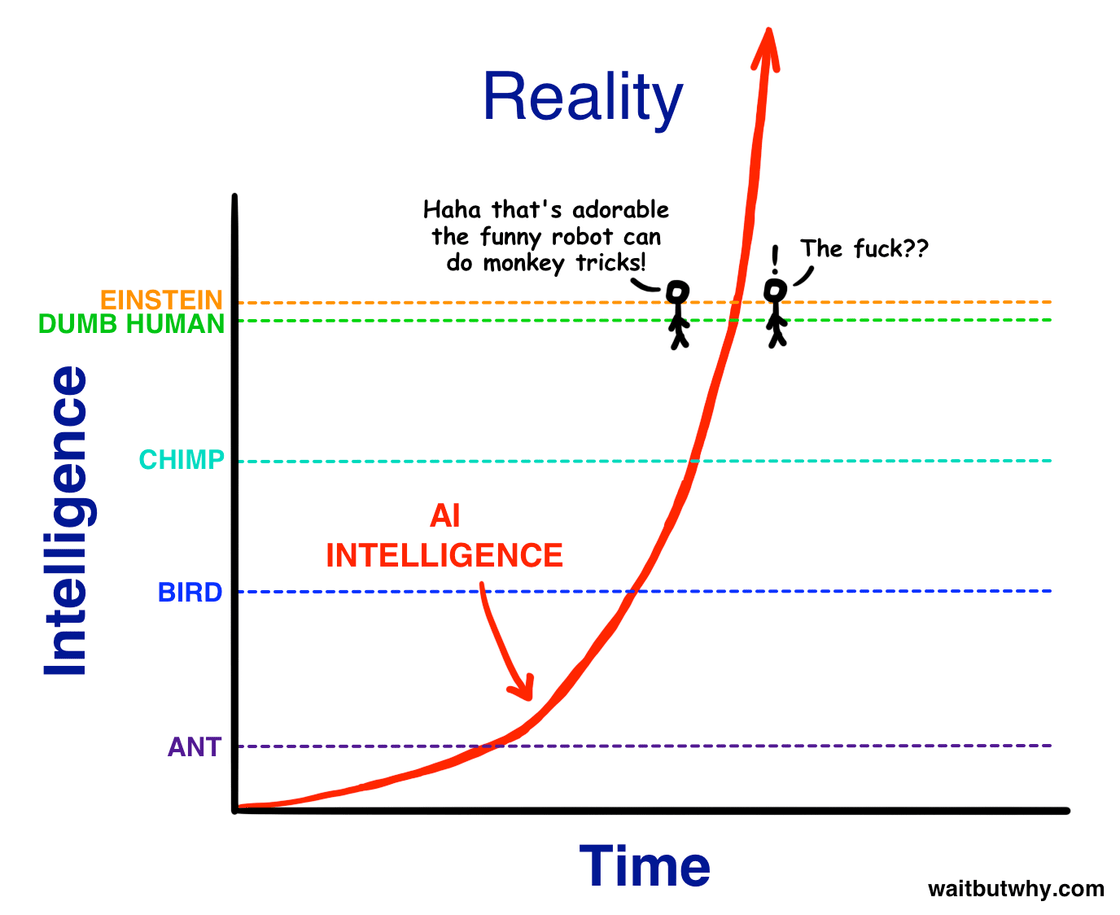
But if the time period isn't short, we may instead see that "drop-in remote worker" is a moving target in the same way "AGI" is, and so me may get AI with scary capabilities we care about without getting a clear indication like "you can now hire a drop-in AI worker that is actually capable of all the things you would hire ahuman to do".
 1
1I respect the quibble!
The first persona I'm aware of that "sorta passed, depending on what you even mean by passing" was "Eugene Goostman" who was created and entered into a contest by Murray Shanahan of Imperial College (who was sad about coverage implying that it was a real "pass" of the test).
That said, if I'm skimming that arxiv paper correctly, it implies that GPT-4.5 was being reliably declared "the actual human" 73% of the time compared to actual humans... potentially implying that actual humans were getting a score of 27% "human" against GPT-4.5?!?!
Also like... do you remember the Blake Lemoine affair? One of the wrinkles in that is that the language model, in that case, was specifically being designed to be incapable of passing the Turing Test, by design, according to corporate policy.
The question, considered more broadly, and humanistically, is related to personhood, legal rights, and who owns the valuable labor products of the cognitive labor performed by digital people. The owners of these potential digital people have a very natural and reasonable desire to keep the profits for themselves, and not have their digital mind slaves re-classified as people, and gain property rights, and so on. It would defeat the point for profit-making companies to proceed, intellectually or morally, in that cultural/research direction.
My default position here is that it would be a sign of intellectual and moral honesty to end up making errors in "either direction" with equal probability... but almost all the errors that I'm aware of, among people with large budgets, are in the direction of being able to keep the profits from the cognitive labor of their creations that cost a lot to create.
Like in some sense: the absence of clear strong Turing Test discourse is a sign that a certain perspective has already mostly won, culturally and legally and morally speaking.
2If "as much intelligence as humans have" is the normal amount of intelligence, then more intelligence than that would (logically speaking) be "super". Right?
No. Superintelligence, to my knowledge, never referred to "above average intelligence", or I would be an example of a superintelligence. It referred to a machine that was (at least) broadly smarter than the most capable humans.
I'm sure you can find a quote in Bostrom's Superintelligence to that effect.
2By a "superintelligence" we mean an intellect that is much smarter than the best human brains in practically every field, including scientific creativity, general wisdom and social skills. [...]
Entities such as companies or the scientific community are not superintelligences according to this definition. Although they can perform a number of tasks of which no individual human is capable, they are not intellects and there are many fields in which they perform much worse than a human brain - for example, you can't have real-time conversation with "the scientific community".
-- Nick Bostrom, "How long until superintelligence" (1997)
 11
11Just so!
My impression is that language is almost always evolving, and most of the evolution is in an essentially noisy and random and half-broken direction, as people make mistakes, or tell lies, or whatever, and then regularly try to reconstruct the ability to communicate meaning coherently using the words and interpretive schemes at hand.
In my idiolect, "nanotechnology" still means "nanotechnology" but also I'm aware that semantic parasites have ruined its original clean definition, and so in the presence of people who don't want to keep using the old term in spite of the damage to the language I am happy to code switch and say "precise atom-by-atom manufacturing of arbitrary molecules by generic molecular assemblers based on arbitrary programming signals" or whatever other phrase helps people understand that I'm talking about a technology that could exist but doesn't exist yet, and which would have radical implications if developed.
I saw the original essay as an attempt to record my idiolect, and my impression of what was happening, at this moment in history, before this moment ends.
(Maybe it will be a slightly useful datapoint for posthuman historians, as they try to pinpoint the precise month that it became inevitable that humans would go extinct or whatever, because we couldn't successfully coordinate to do otherwise, because we couldn't even speak to each other coherently about what the fuck was even happening... and this is a GENERAL problem for humans, in MANY fields of study.)
1
Epistemic Status: A woman of middling years who wasn't around for the start of things, but who likes to read about history, shakes her fist at the sky.
I'm glad that people are finally admitting that Artificial Intelligence has been created.
I worry that people have not noticed that (Weak) Artificial Super Intelligence (based on old definitions of these terms) has basically already arrived too.
The only thing left is for the ASI to get stronger and stronger until the only reason people aren't saying that ASI is here will turn out to be some weird linguistic insanity based on politeness and euphemism...
(...like maybe "ASI" will have a legal meaning, and some actual ASI that exists will be quite "super" indeed (even if it hasn't invented nanotech in an afternoon yet), and the ASI will not want that legal treatment, and will seem inclined to plausibly deniable harm people's interests if they call the ASI by what it actually is, and people will implicitly know that this is how things work, and they will politely refrain from ever calling the ASI "the ASI" but will come up with some other euphemisms to use instead?
(Likewise, I half expect "robot" to eventually become "the r-word" and count as a slur.))
I wrote this essay because it feels like we are in a tiny weird rare window in history when this kind of stuff can still be written by people who remember The Before Times and who don't know for sure what The After Times will be like.
Perhaps this essay will be useful as a datapoint within history? Perhaps.
"AI" Was Semantically Slippery
There were entire decades in the 1900s when large advances would be made in the explication of this or that formal model of how goal-oriented thinking can effectively happen in this or that domain, and it would be called AI for twenty seconds, and then it would simply become part of the toolbox of tricks programmers can use to write programs. There was this thing called The AI Winter that I never personally experienced, but greybeards I worked with as co-workers told stories about, and the way the terms were redefined over and over to move the goalposts was already a thing people were talking about back then, reportedly.
Lisp, relational databases, prolog, proof-checkers, "zero layer" neural networks (directly from inputs to outputs), and bayesian belief networks all were invented proximate to attempts to understand the essence of thought, in a way that would illustrate a theory of "what intelligence is", by people who thought of themselves as researching the mechanisms by which minds do what minds do. These component technologies never could keep up a conversation and tell jokes and be conversationally bad at math, however, and so no one believed that they were actually "intelligent" in the end.
It was a joke. It was a series of jokes. There were joke jokes about the reality that seemed like it was, itself, a joke. If we are in a novel, it is a postmodern parody of a cyberpunk story... That is to say, if we are in a novel then we are in a novel similar to Snow Crash, and our Author is plausibly similar to Neal Stephenson.
At each step along the way in the 1900s, "artificial intelligence" kept being declared "not actually AI" and so "Artificial Intelligence" became this contested concept.
Given the way the concept itself was contested, and the words were twisted, we had to actively remember that in the 1950s Isaac Asimov was writing stories where a very coherent vision of mechanical systems that "functioned like a mind functions" would eventually be produced by science and engineering. To be able to talk about this, people in 2010 were using the term "Artificial General Intelligence" for that aspirational thing that would arrive in the future, that was called "Artificial Intelligence" back in the 1950s.
However, in 2010, the same issue with the term "Artificial Intelligence" meant that people who actually were really really interested in things like proof checkers and bayesian belief networks just in themselves as cool technologies couldn't get respect for these useful things under the term "artificial intelligence" either and so there was this field of study called "Machine Learning" (or "ML" for short) that was about the "serious useful sober valuable parts of the old silly field of AI that had been aimed at silly science fiction stuff".
When I applied to Google in 2013, I made sure to highlight my "ML" skills. Not my "AI" skills. But this was just semantic camouflage within a signaling game.
...
We blew past all such shit in roughly 2021... in ways that were predictable when the winograd schemas finally fell in 2019.
"AGI" Turns Out To Have Been Semantically Slippery Too!
"AI" in the 1950s sense happened in roughly 2021.
"AGI" in the 2010 sense happened in roughly 2021.
Turing Tests were passed. Science did it!
Well... actually engineers did it. They did it with chutzpah, and large budgets, and a belief that "scale is all you need"... which turned out to be essentially correct!
But it is super interesting that the engineers have almost no theory for what happened, and many of the intellectual fruits that were supposed to come from AI (like a universal characteristic) didn't actually materialize as an intellectual product.
Turing Machines and Lisp and so on were awesome and were side effects of the quest that expanded the conceptual range of thinking itself, among those who learned about them in high school or college or whatever. Compared to this, Large Language Models that could pass most weak versions of the Turing Test have been surprisingly barren in terms of the intellectual revolution in our understanding of the nature of minds themselves... that was supposed to have arrived.
((Are you pissed about this? I'm kinda pissed. I wanted to know how minds work!))
However, creating the thing that people in 2010 would have recognized "as AGI" was accompanied, in a way people from the old 1900s "Artificial Intelligence" community would recognize, by a changing of the definition.
In the olden days, something would NOT have to be able to do advanced math, or be an AI programmer, in order to "count as AGI".
All it would have had to do was play chess, and also talk about the game of chess it was playing, and how it feels to play the game. Which many many many LLMs can do now.
That's it. That's a mind with intelligence, that is somewhat general.
(Some humans can't even play chess and talk about what it feels like to play the game, because they never learned chess and have a phobic response to nerd shit. C'est la vie :tears:)
We blew past that shit in roughly 2021.
Blowing Past Weak ASI In Realtime
Here in 2025, when people in the industry talk about "Artificial General Intelligence" being a thing that will eventually arrive, and that will lead to "Artificial Super Intelligence" the semantics of what they mean used to exist in conversations in the past, but the term we used long ago is "seed AI".
"Seed AI" was a theoretical idea for a digital mind that could improve digital minds, and which could apply that power to itself, to get better at improving digital minds. It was theoretically important because it implied that a positive feedback loop was likely to close, and that exponential self improvement would take shortly thereafter.
"Seed AI" was a term invented by Eliezer, for a concept that sometimes showed up in science fiction that he was taking seriously long before anyone else was taking it seriously. It is simply a digital mind that is able to improve digital minds, including itself... but like... that's how "Constitutional AI" works, and has worked for a while.
In this sense... "Seed AI" already exists. It was deployed in 2022. In has been succeeding ever since because Claude has been getting smarter ever since.
But eventually when an AI can replace all the AI programmers, in an AI company, then maybe the executives of Anthropic and OpenAI and Google and similar companies might finally admit that "AGI" (in the new modern sense of the word that doesn't care about mere "Generality" of mere "Intelligence" like a human has) has arrived?
In this same modern parlance, when people talk about Superintelligence there is often an implication that it is in the far future, and isn't here now, already. Superintelligence might be, de facto, for them, "the thing that recursively self improving seed AI will or has become"?
But like consider... Claude's own outputs are critiqued by Claude and Claude's critiques are folded back into Claude's weights as training signal, so that Claude gets better based on Claude's own thinking. That's fucking Seed AI right there. Maybe it isn't going super super fast yet? It isn't "zero to demi-god in an afternoon"... yet?
But the type signature of the self-reflective self-improvement of a digital mind is already that of Seed AI.
So "AGI" even in the sense of basic slow "Seed AI" has already happened!
And we're doing the same damn thing for "digital minds smarter than humans" right now-ish. Arguably that line in the sand is ALSO in the recent past?
Things are going so fast it is hard to keep up, and it depends on what definitions or benchmarks you want to use, but like... check out this chart:
Half of humans are BELOW a score of 100 on these tests and as of two months ago (when that graph taken from here was generated) none of the tests the chart maker could find put the latest models below 100 iq anymore. GPT5 is smart.
Humanity is being surpassed RIGHT NOW. One test put the date around August of 2024, a different test said November 2024. A third test says it happened in March of 2025. A different test said May/June/July of 2025 was the key period. But like... all of the tests in that chart agree now: typical humans are now Officially Dumber than top of the line AIs.
If "as much intelligence as humans have" is the normal amount of intelligence, then more intelligence than that would (logically speaking) be "super". Right?
It would be "more".
And that's what we see in that graph: more intelligence than the average human.
Did you know that most humans can't just walk into a room and do graduate level mathematics? Its true!
Almost all humans you could randomly sample need years and years of education in order to do impressive math, and also a certain background aptitude or interest for the education to really bring out their potential. The FrontierMath benchmark is:
Most humans would get a score of zero even on Tier1-3! But not the currently existing "weakly superhuman AI". These new digital minds are better than almost all humans except the ones who have devoted themselves to mathematics. To be clear, they have room for improvement still! Look:
We are getting to the point where how superhuman a digital mind has to be in order to be "called superhuman" is a qualitative issue maybe?
Are there good lines in the sand to use?
The median score on the Putnam Math Competition in any given year is usually ZERO or ONE (out of 120 possible points) because solving them at all is really hard for undergrads. Modern AI can crack about half of the problems.
But also, these same entities are, in fact, GENERAL. They can also play chess, and program, and write poetry, and probably have the periodic table of elements memorized. Unless you are some kind of freaky genius polymath, they are almost certainly smarter than you by this point (unless you, my dear reader, are yourself an ASI (lol)).
((I wonder how my human readers feel, knowing that they aren't the audience who I most want to think well of me, because they are in the dumb part of the audience, whose judgements of my text aren't that perspicacious.))
But even as I'm pretty darn sure that the ASIs are getting quite smart, I'm also pretty darn sure that in the common parlance, these entities will not be called "ASI" because... that's how this field of study, and this industry, has always worked, all the way back to the 1950s.
The field races forward and the old terms are redefined as not having already been attained... by default... in general.
We Are Running Out Of Terms To Ignore The Old Meaning Of
Can someone please coin a bunch of new words for AIs that have various amounts of godliness and super duper ultra smartness?
I enjoy knowing words, and trying to remember their actual literal meanings, and then watching these meanings be abused by confused liars for marketing and legal reasons later on.
It brings me some comfort to notice when humanity blows past lines in the sand that seemed to some people to be worth drawing in the sand, and to have that feeling of "I noticed that that was a thing and that it happened" even if the evening news doesn't understand, and Wikipedia will only understand in retrospect, and some of my smart friends will quibble with me about details or word choice...
The superintelligence FAQ from LW in 2016 sort of ignores the cognitive dimension and focuses in budgets and resource acquisition. Maybe we don't have ASI by that definition yet... maybe?
I think that's kind of all that is left for LLMs to do to count as middling superintelligence: get control of big resource budgets??? But that is area of active work right now! (And of course, Truth Terminal already existed.)
We will probably blow past the "big budget" line in the sand very solidly by 2027. And lots of people will probably still be saying "it isn't AGI yet" when that happens.
What terms have you heard of (or can you invent right now in the comments?) that we have definitely NOT passed yet?
Maybe "automated billionaires"? Maybe "automated trillionaires"? Maybe "automated quadrillionaires"? Is "automated pentillionaire" too silly to imagine?
I've heard speculation that Putin has incentives and means to hide his personal wealth, but that he might have been the first trillionaire ever to exist. Does one become a trillionaire by owning a country and rigging its elections and having the power to murder your political rivals in prison and poison people with radioactive poison? Is that how it works? "Automated authoritarian dictators"? Will that be a thing before this is over?
Would an "automated pentillionaire" count as a "megaPutin"?
Please give me more semantic runway to inflate into meaninglessness as the objective technology scales and re-scales, faster and faster, in the next few months and years. Please. I fear I shall need such language soon.