It actually seems to me that daycares would be a natural setting to trial the new consumer far-UVC, air purifiers, good HEPA filters, or mandatory daily flu/COVID testing for the kids. You could potentially have a rule that kids who come in sick get semi-quarantined (only contact is with masked adults/sibs, they must wear a mask). That's a setting where it might really make a noticeable difference and where you don't have to convince an institution to retrofit a whole large building.
Apparently an air purifier cut sick days by a 3rd in Helsinki.
There's also an ongoing trial called CLAIRE on using HEPA filters in schools.
https://clinicaltrials.gov/study/NCT07479420
A re-analysis of data from the 1940s found far-UVC dramatically reduced child absenteesism due to respiratory illness
Far-UVC has been shown to be extremely effective in reducing pathogen load in the air.
https://pubmed.ncbi.nlm.nih.gov/35322064/
Maybe it's time for somebody to open an aggressively sanitary daycare.
 2
2I agree that children getting diseases at daycare is a significant problem. You didn't mention it, but this also means parents get sick more via their kids.
Many arguments about daycare are motivated reasoning because it's personally necessary, or because of ideology: "enabling more women in the workforce is good and therefore things that enable that can't be bad".
 4
4I remember looking into exactly this question when my wife and I were looking into pros and cons of daycare. One thing that I think the analysis here misses is that this is generally worst for the first 1 or 2 years, and then much less so. I don't remember exactly what studies I was looking at back when I was researching this, but asking Claude just now "Is there a study that looks at the frequency of child illnesses by year after first enrolled in daycare?" yielded the following references:
https://jamanetwork.com/journals/jamapediatrics/fullarticle/191522
https://pubmed.ncbi.nlm.nih.gov/2007922/
https://pubmed.ncbi.nlm.nih.gov/11296076/
https://pmc.ncbi.nlm.nih.gov/articles/PMC5588939/
a CNN article that pointed to https://pubmed.ncbi.nlm.nih.gov/21135342/
and an Emily Oster blog post which links to some other relevant studies.
I haven't gone through any of the above links in detail just now, but the general message one gets from the abstracts seems to be an increase in frequency for years 1-2, then back to baseline. Some suggest some protective effect in early elementary school years (the first link, which is the Tuscon study OP mentioned; the Côté paper that the CNN article pointed to; and apparently the Hullegie et al. 2016 study OP mentioned, which wasn't among those that Claude dug up).
The Søegaard et al. study highlighted by the OP has an interesting couple of figures 1 and 2, for boys and girls respectively. These are differences in infection rate per year for four groups, compared to children never in childcare. Since this is Denmark I'm guessing the "instition enrollment at 3 yrs" is kids who started børnehave (preschool) at age 3.
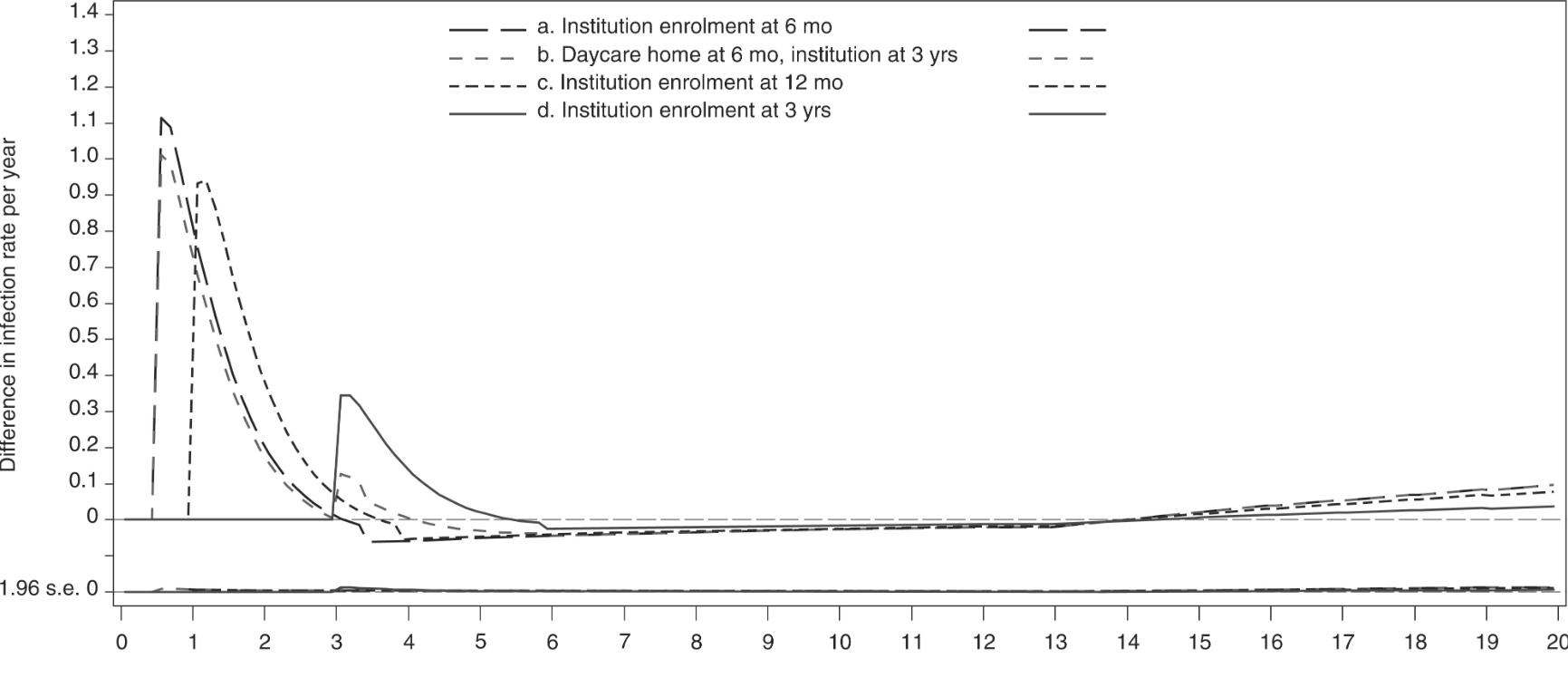
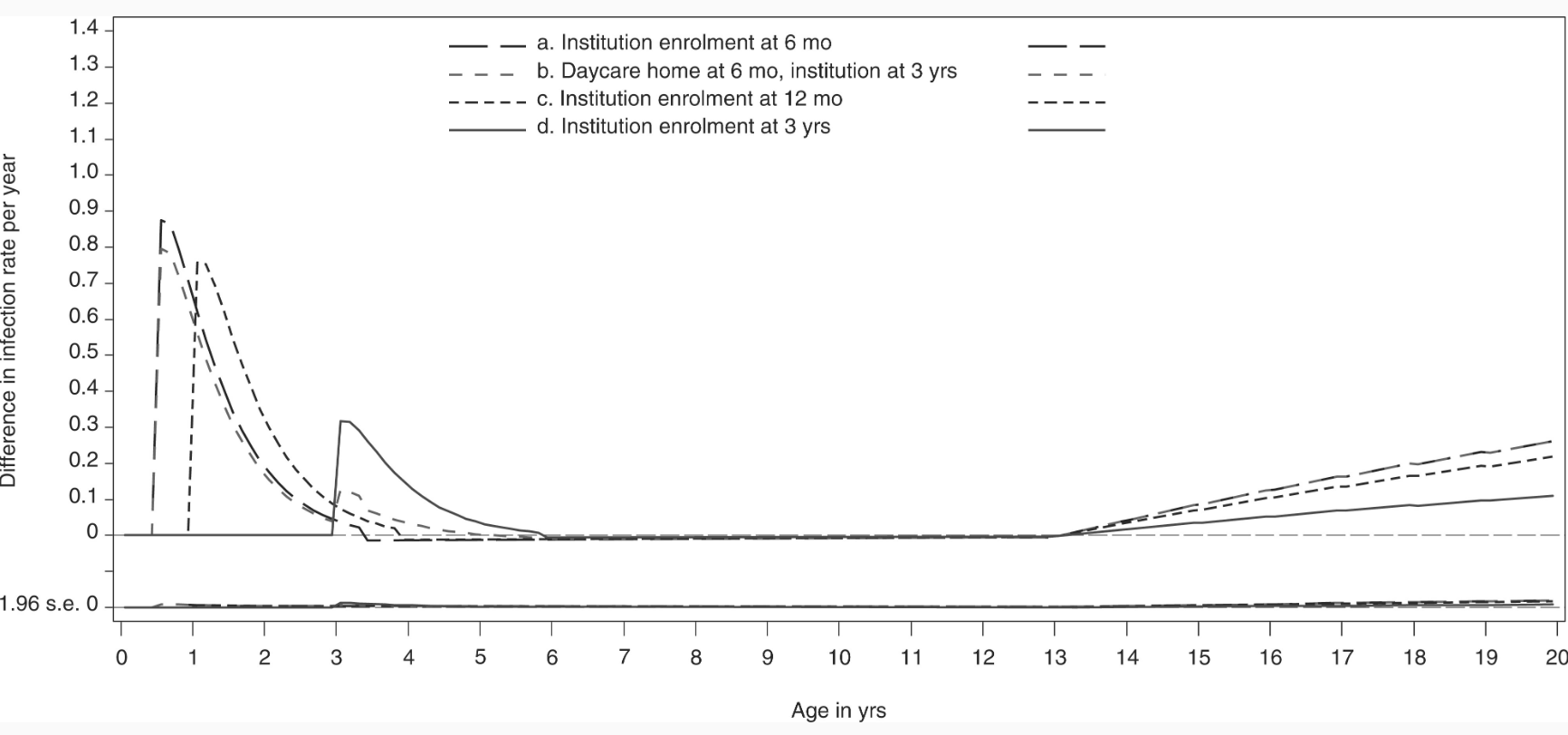
This does look like it shows some amount of immunity happening: otherwise, we'd presumably expect to see group (b) having a spike as high as group (d) at age 3 yrs. Though importantly it isn't enough to compensate if what you care about is total number of illnesses avoided. [1]
Also, although the spikes look quite dramatic, the y-axis shows that the difference in infection rate per year is approximately 1 for the highest spike in each graph. Similarly, the abstract notes that children enrolled in childcare before age 12 months had experienced 0.5 - 0.7 more infections than peers enrolled at 3 years, cumulatively, by the time they got to age 6 years. To be sure, that certainly corresponds to more than one actual infection, since "infection" in this paper means an infection serious enough to result in an antimicrobial (usu. an antibiotic) being prescribed, but is not an enormous effect.
Regarding the beliefs and confidences listed in the post:
- (Quite confident) The most common illnesses (colds and flu) don’t build immunity in general (in kids or adults) because they mutate every year
- (Quite confident) The same illness has a greater risk of complications in babies vs. older children and adults
- (Moderately confident) The same illness has a greater duration in babies vs. older children and adults
- (Moderately confident) Illness during early development is probably more harmful than illness during adulthood
- (Weak guess) Daycare environments are more conducive to disease spread than schools for older kids and the number of possible illnesses is very high; there isn’t just a limited number of things you catch once
For #1, I think my level of agreement depends on exactly what is meant by "immunity in general". Claude's answer to "Does catching viruses improve your immune system long term?" can be summed up as (in Claude's words): "Surviving one virus generally makes you better at fighting that specific virus (and sometimes closely related ones). It doesn't broadly upgrade your immune system's ability to handle unrelated threats." This matches my previous understanding.
However, due to the caveat about "and sometimes closely related ones", I think this is consistent with the claims of lower rates of illness in early school ages reported by Tuscon / Côté / Hullegie, and the difference between lines (b) and (d) at age 3 in the Søegaard graphs. My understanding is that even though viruses mutate all the time, many remain "closely related" to the versions they mutated from, and this confers some protection from infection and/or severity. For example, if I remember correctly from back when I was doing a lot of reading on COVID, the consensus was that after repeated and significant mutations, protection given by a vaccination based on an older strain gave limited or no protection from infection (no longer recognized by B cells), but still gave significant protection from severe infection, since the epitopes recognized by T cells remained consistent. Something like this goes for flu viruses also (look up "heterosubtypic immunity") and I believe common cold coronaviruses too.
That said, I am a bit baffled by the lack of any dip at all for the nursery groups below the baseline at age 6 (when Danish compulsory education starts) in the Søegaard graphs.
#2 seems true for most illnesses, and seems likely to be an underappreciated consideration. My understanding is that children under 1 year old are particularly vulnerable.
I hadn't really thought about #3-4 and haven't taken the time to dig up relevant literature to see if I agree, but they seem plausible: if true, then they should also inform one's calculus.
Less certain about #5 (seems likely to be technically true, but not sure it moves me very much one way or another given my beliefs on the others and the data from the studies above).
An additional consideration is that there is some evidence that catching COVID can have long-term negative effects on the immune system, although COVID is also weird in that children fare better than adults with it overall.
So, considerations pointing in both directions. I will say that in our own case I am happy we made the decision to start our son in daycare shortly after his first birthday, particularly given that our alternative was one parent quitting a fulfilling job to stay at home (IIRC there were no available full-time nannies or au pairs in our area, or at least none at a cost we felt we could remotely afford). This would have been a financial hit that probably would have required us to take on substantial debt, and also would have been incredibly challenging. Additionally, the level of different experiences and socialization our son gets on a daily basis is well beyond what we could realistically provide on our own, and he loves it.
So for our family, daycare has been worth the illnesses. But of course we would be biased to prefer the decision we actually made, and might feel differently if we'd had a worse experience. And I won't pretend that the first year of it was easy: due in part to her asthma, my wife got pneumonia twice. (We've used this as an excuse to get the daycare to allow us to wait to pick him up outdoors, rather than in the cramped coatroom in which every other child and parent breathes in from 5.30-6pm).
- ^
Regarding the reference group and the weird increase after age 14, the authors write:
We observed slight increases in the infection rates and cumulative number of infections at ages 14–19 years among children enrolled in childcare during the first 3 years of life compared with peers in homecare, which were most pronounced among girls. However, these increases were proportional between the different enrolment types (ages at enrolment and types of facilities) and thus appeared to be a phenomenon related to the reference group comprising a small number of children who remained in homecare during the first 6 years of life (0.7% of the total cohort). Thus, although we adjusted for maternal education and income, maternal smoking, maternal age at delivery, ethnicity and child’s diagnoses of chronic diseases among other factors, we cannot rule out that the observed increasing rates and cumulative number of infections in adolescence associated with childcare attendance were due to residual socioeconomic confounding.
 1
1"Constantly being sick as a baby/toddler or not" does seem like the sort of thing that could make a few IQ points worth of difference. Some things I found with Claude on a quick initial search:
- This study found that a single infection resulting in hospitalization before the age of 19 was associated with an IQ 1.76 points lower at age 19, which shrunk to 1.13 points after adjusting for some confounders. They also found that the effects of these severe infections stacked, moreso if subsequent infections were of different types.
- This one found that a single infection resulting in hospitalization before the age of 13 was associated with an IQ 1 point lower at age 18; 1.61 points lower if the infection was before the age of 1. The effects shrunk a lot after the age of 1: -0.7 points for ages 2-4, -0.26 points for ages 5-9, -0.12 points for ages 10-13. These effect sizes come from a model controlled for some confounders.
- Another study found that having had any acute respiratory illness (ARI) before age 1 was associated with a 3 point lower Bayley score at age 1, but any ARI before age 2 was not significantly associated with score at age 2. (The Bayley is basically an IQ test for babies. If done at age 2 it probably correlates with adult IQ at something like r=0.3; even less if done at age 1.)
- A study with a negative result: infections recorded between birth and age 5 were not significantly associated with IQ at age 11.
(Note: these could have been selected for positive results, either through publication bias or Claude searching.)
2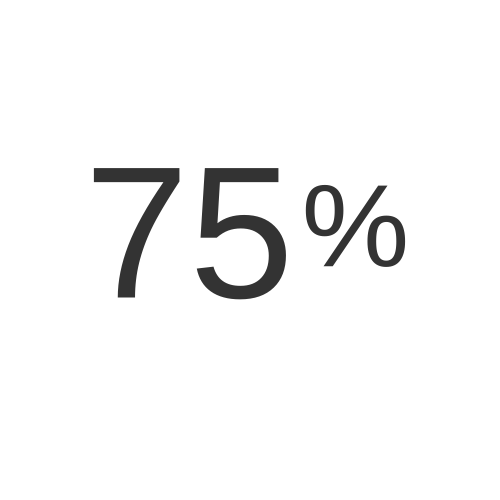 1
1I'll definitely run your article by my wife (Biology PhD), who's better situated than I am to comment on the science than I am.
We have two kids and use the university's daycare. It certainly feels like it's the case that we get sick much more often as a result of daycare usage. So far, we've decided to eat this cost for a number of reasons (many of which will not apply broadly):
- Our daycare is extraordinarily convenient. We hold hands and cross the street. There it is.
- We love the teachers, the free play, the outdoor space, and the overall teaching philosophy.
- Our daycare is slightly subsidized relative to other Palo Alto daycares.
- Vetting a daycare felt easier than vetting nannies (more parents to talk to; generally a longer history of care). Also, more seems to ride on the choice of nanny in the sense that one person will have a lot more influence on the kids than a team of teachers (though arguably this unlocks more benefits if you are able to find an incredible nanny).
- We have learned to cope with illness. Nothing will take away all the terribleness, but we're pretty proactive with ibuprofen, Tylenol, and anti-nausea medication. We've also learned that if we do saline rinses as soon as either kid has a stuffy nose, it seems to greatly reduce the number of ear infections they have.
- I have a flexible job that lets me work from home and request back-up care on short notice. I'm mostly able to absorb the sick days in this way.
My wife would have a more nuanced view of the studies you cite. I do have this general impression that lots of parents are over-stressed as a feature of our mega-society, high-information exchange modern environment. Like, today, as parents, we are confronted with the kind of stories and data you only get if you are part of million-member+ society. It's easy to feel haunted by all kinds of terrible stories and outcomes where, in reality, many of them are on par with other risk I've internalized (e.g., car accident risk on the way to the grocery store) (which is not to say we shouldn't take car accident risks seriously).
This would seem to differ from our ancestral environment, where the data and folk traditions from maybe ~10,000 persons pointed more directly to high risk and high impact harms. "Do not eat that specific mushroom" or "Warn the kids about the river and supervise trips near the river more closely."
I think our brains have trouble processing rare but high impact risks communicated out of our mega-societies, in part, because there are many, many, many more we have to track now. Don't get me wrong—I am grateful that our mega-societies are helping us understand and mitigate child suffering. But I also think our poor ability to process all these risks may itself lead to actions which carry future risks on par with the risks we were supposed to be mitigating. It does not seem implausible to me that high parental stress or overbearing supervision may have serious downstream consequences on child welfare.
All of this is to say that, assuming daycare has significant convenience/happiness benefits and the studies show marginal risks (perhaps on par with other risks you have deemed appropriate), it can be okay to say, "I know we will be sick more, but this is still good for us."
 1
1 1
1I believe you're roughly correct on all points. I have a 2yo who has been sick more than not, and we the parents too.
Ultimately it's a question of means, at least for us. If we could afford not to send our kid to daycare, we probably would do just that.
 3
3(Layman disclaimer) The human immune system has not evolved in dense population. Bats are built differently. Evidence for immunity building looks to me like the studies mostly compare nature kids with indoor dwellers. Outdoor play has way more distance, fresh air and little shared surface.
1
Before I had a baby I was pretty agnostic about the idea of daycare. I could imagine various pros and cons but I didn’t have a strong overall opinion. Then I started mentioning the idea to various people. Every parent I spoke to brought up a consideration I hadn’t thought about before—the illnesses.
A number of parents, including family members, told me they had sent their baby to daycare only for them to become constantly ill, sometimes severely, until they decided to take them out. This worried me so I asked around some more. Invariably every single parent who had tried to send their babies or toddlers to daycare, or who had babies in daycare right now, told me that they were ill more often than not.
One mother strongly advised me never to send my baby to daycare. She regretted sending her (normal and healthy) first son to daycare when he was one—he ended up hospitalized with severe pneumonia after a few months of constant illnesses and infections. She told me that after that she didn’t send her other kids to daycare and they had much healthier childhoods.
I also started paying more attention to the kids I saw playing outside with their daycare group and noticing that every one had a sniffly nose.
I asked on a mothers group chat about people’s experiences with daycare. Again, the same. Some quotes:
“They do get sick a lot. I started my son at 2.5 and feel he always has something.”
“The limit does not exist.”
“brought home every plague (in first 6mo, Covid, HFM, slapcheek, RSV)”
“They usually say 8-12 illnesses per year. My girls were sick every 2-3 weeks in their first year of daycare”
“My daughter started daycare at 6 months and got sick a ton the first year”
Despite all this, many parents who have the option not to (i.e. they can afford in-home care with a nanny or for one parent to stay home) still choose to send their babies and toddlers to daycare. How come? Surely most well-off adults wouldn’t agree to be ill nonstop in exchange for the monetary savings daycare provides?
Asking around, it seemed like the most common reason given was that parents believed daycare illnesses “built immunity”; that if their babies and toddlers got sick at daycare they’d get less sick later in childhood and so overall it would net out the same. Unfortunately few could point me to any evidence for this but nevertheless passionately defended the view.
The claim that daycare illnesses simply offset childhood and adult illness immediately seemed suspect to me for a number of reasons:
I xeeted about this:
A number of people sent me this link, an alleged “study” from UCL showing that “frequent infections in nursery help toddlers build up immune systems”, authored (of course) by a group of parents who all send their kids to nursery (what the British call daycare).
The link I was sent was actually a UCL press release summarizing a narrative review paper and not a study itself. Narrative reviews are susceptible to selection bias because, unlike systematic reviews or meta-analyses, there’s no pre-registered search protocol or PRISMA-style methodology requiring them to account for all relevant evidence. But I decided to look into the narrative review more, to assess its validity fairly. I got access to the full publication.
Unlike the press release, which ignores these considerations entirely, it does engage with severity and age-related vulnerability, conceding that younger toddlers and babies suffer more from the same illnesses. A section on immunology provides a detailed account of why infants under two are more vulnerable—their immune systems are much less effective at fighting the same infections for a plethora of well-understood reasons. The review also cites a large Danish registry study (Kamper-Jørgensen et al) that reports a 69% higher incidence of hospitalization for acute respiratory infections in under-1s in daycare.
However, these severity findings are integrated into the review’s conclusions and framing in an incredibly biased way. The introduction describes severe outcomes as occurring “in rare cases,” and the conclusions focus on normalizing the burden and advocating for employer understanding. After establishing the immunological basis for why the same infection is more dangerous in a 6-month-old than a 3-year-old, it doesn’t then ask the hard follow-up question: given this, is the pattern of starting daycare at 6–12 months optimal from a child health perspective? Instead, the review frames this timing as a societal given. The Hand Foot and Mouth Disease section is a good example of the review’s handling: it reports that daycare attendance was associated with more severe cases but then immediately offers mitigating interpretation with no evidence—that prolonged hospital stays might reflect parental work constraints rather than genuine severity.
Though the review considers severity, it ignores duration. Their primary metric throughout is episode count. Also, despite discussing a wide variety of pathogens, it doesn’t address which of these infections carry the highest complication rates in infants and toddlers specifically.
Finally, the crucial “Illness now or illness later?” is the paper’s weakest portion. It rests on two primary sources for the compensatory immunity claim:
These are reasonable small studies, but the paper does not cite or engage with the Søegaard et al. 2023 study (International Journal of Epidemiology)—a register-based cohort of over 1 million Danish children followed to age 20, which directly tested and rejected the compensatory immunity hypothesis. Quoting from the study:
This is arguably the single most relevant study for the paper’s central “illness now or illness later” question, and it’s three orders of magnitude larger than either study the authors cite. Its absence is hard to explain—it was published in a top epidemiology journal in late 2022 (available online November 2022), well before the review was written.
Accordingly, they hedge their conclusions carefully—“attendance at formal childcare may tip the balance in favor of infection now rather than later”, but their press release ignores any nuance, referring to daycare as an “immune boot camp”.
So overall, the compensatory immunity claim seems very weak and my prior that daycare illness is straight-up bad remains. Parents are citing biased reviews from motivated researchers. We are only beginning to understand the deleterious effects of increased viral load in infants.
I predict that in the future we’ll learn more about the side-effects of increased viral load on intelligence, wellbeing, fatigue etc. The “just the sniffles” mentality is a harmful attitude toward infections that promotes the dismissal of phenomena that substantially impact child and adult wellbeing.