The overwhelming, value-destroying blackhole that is the rise of artificial intelligence would be the simplest explanation, no? I'm also tired of all the endless AI discussion on the front page, but it's also what my own writing ends up about most the time!
I might also argue that there is a limited amount of novel discussion one can have about the core tenets of rationalism, especially given the site's guidance to familiarize yourself with the sequences and keep a high bar for your posts. So this naturally leads to less exploratory writing that might cover trodden ground, which might discourage new "great writers."
LessWrong is stuck in the difficult position of wanting to encourage brave new writing, while also wanting to be a high signal source for good new writing. It is very hard to have both!

Fully agree with the value-destroying blackhole of AI. But also, we need a place to have a good conversation about AI Safety and LessWrong is leagues better than any other place where people can publicly contribute to the conversation. I'm not sure what the solution is.
> I think that this suggests I should finally do the project of making a beautiful book of The Sequences, sort of a tome-like entity like... well, like the Codex Seraphinianus.
I tried to do this about a year ago, and my main problem was that a lot of the Sequences articles are out of date and based on non-replicable science. It felt strange (bad) to put so much work into an artifact that I knew to contain many falsehoods. It called to mind religious people who argue that the Bible may not be literally true but "contains useful lessons". Perhaps not the worst sin but... we're supposed to be better than that. The Sequences are, themselves, a call to be better than that!
At the same time I still strongly believe in their value, probably more so than most rationalists, it also bugs me how many rationalists haven't even bothered to read the foundational text. Unfortunately, the task of rewriting the erroneous essays is enormous. AI can help fact check but it can't do the actual writing because it's not compelling enough (maybe more recent models would do better?) I wound up burning out before getting very far.
All of this is to say, if you're serious about taking this up I would love to help.
Maybe the version with all the original text and added chapters (or even just footnotes) from the editor with "here's how EY was wrong in this post" would be even better than just version with mistakes fixed, because it would hammer home the point "you shall not have ultimate authorities".
Could you share what you got? I think correcting a tome with mistakes will be a lot easier to achieve that starting a tome from scratch.
https://github.com/StructByLightning/sequences
Please keep in mind this is very much not finished on any level. I only made it through rough drafts of the first couple chapters. In particular, I no longer think the Talmud-style marginalia comments are a good way to do this, and I would favor rewriting the text now, particularly for a book meant for wider distribution.
It does look awesome though.
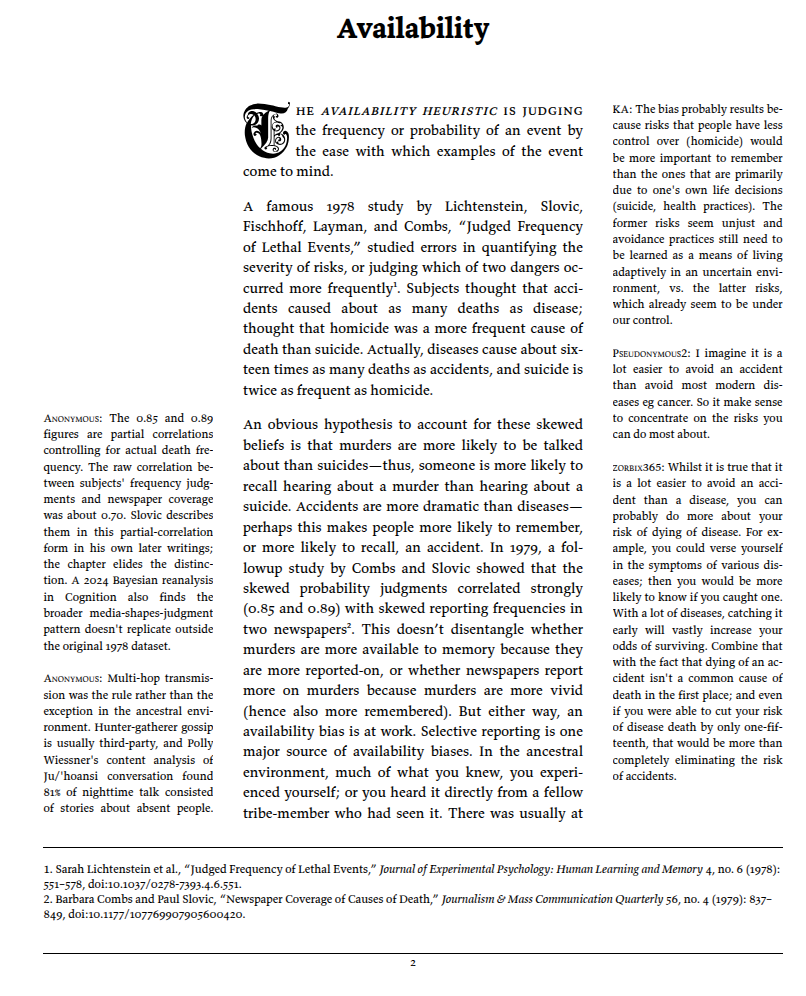
(Go to http://localhost:3000/1-map-and-territory in your browser to render the first volume's chapter; other chapters were commented out to speed up rendering as I worked on this chapter's commentary.)
That does look both epic and intimidating. Thank you for sharing.
I see that if you want to keep the comments in it will be really hard to do that in book form. Maybe we can put in a qr code so that people who want to join the discussion on any part of the book can join that specific post?
I don't know if I will have the time to work on this anytime soon, but if I do I will definitely build on this.
Just dumping my own experience as someone who was involved in more high-effort rationality stuff and now mostly does AI stuff.
Hypotheses:
One idea is having the equivalent of quote tweets: a nice way for someone to repost an excerpt of an older post with a new accompanying thought. That seems more interesting to me than seeing a 9 year old post show up on the homepage - my immediate reaction is that seems ancient and probably superseded, whereas new interpretation / commentary / connection to what's happening now can maybe bring the older stuff into focus.
I also think though that much of the older stuff might just not have much value presently.
LessWrong has been diluted with folks who aren’t in touch with the original mission, and so it stops attracting people for that mission.
Of all sad words of tongue and pen,
The saddest are these: Said Achmiz was right again
Neither hypothesis nor solution, sorry:
The more I interact with and learn about Rationality and such, the more it feels like I'm strolling through the graveyard of a great dead empire. The LessWrong's architecture entices me to read 10 year old highlights about world modelling and to delve into the Sequences and to peruse the Best of 2024... but it's as if the actual feed of posts and short form have no time for that hoity-toity high concept stuff anymore.
I'm reminded of a line from the pilot of The Sopranos as Tony reflects upon America and the American Mafia tradition he inherited— "It's good to be in something from the ground floor. I came too late for that, I know. But lately, I'm getting the feeling that I came in at the end: the best is over."
I think that this suggests I should finally do the project of making a beautiful book of The Sequences, sort of a tome-like entity like... well, like the Codex Seraphinianus.
No? It suggests a creating a new shelling point with some project which calls to action. Publishing almost 20yo essays in a new package is not the same.
Personally, that wouldn't inspire me to write more.
I would consider some heavy handed interventions, e.g. doubling karma for non AI posts, and tripling for "foundational" (whatever that means) non AI posts.
I honestly think AI is killing this website for me. Many great posts on the topic, but it's just sucking all the air out the room.
I think you are mostly right on the money there, but I also think that the AI is the main contributor to the decline of lesswrong.
The original mission of lesswrong was to develop the methods of rationality and rise the collective sanity water line for humanity, but the AI race made it feel like we no longer have the time the mission. So everyone is now dropping everything and trying their best to stear this sinking ship to shore.
Another part of this is that there seems to be a silent consensus that ASI will inevitably arive soon and we will handover all power to it, and the only real question is whether or not we can align it.
And the thing is if we get an aligned ASI, the orginal mission of lesswrong would be pointless. Why raise the sanity water line for humanity if a super intelligent machine god is going to make all the important decisions anyway? Why not just relax and be a happy idiot pet for the rest of your life?
(For the record I am agenist this. I think we should try to get the technology banned for now then pick up the communities original mission until humanity is sane enough to reconsider building it.)
I'm not sure it is best to think of us as a single group. It's not clear the optimal strategy for not dying is to have everyone abandon the goal of raising the sanity waterline. Perhaps most people should work on more direct risk mitigation efforts re RSI/ASI, but wouldn't it be beneficial for not everyone interested in rationality to be doing this? Shouldn't some people remain working on developing the methods of rationality? (Perhaps the answer is no...)
Some theories:
Christianity carefully chose which books to include in the Bible, and then which passages to focus on from those books, and the focused passages have changed over time to allow the religion to develop. Instead, we just have a big blob called the Sequences, and tell people to read it cover to cover. Some ideas have stood the test of time (map vs. territory, rationality is winning, etc.) Some not so much. Some parts make me feel like a special insider receiving special knowledge, but maybe the knowledge in some parts isn't actually that special, and the writing surpasses the value of the ideas. It's not really clear in general that people who read the Sequences end up winning, which does make me skeptical that this is The Final Rationalist Text we should all venerate. We should probably have some way of holding up the pieces that work the best without needing to recommend the whole thing.
This is really more of a social media site, as much as it tries not to be. I check it to see what's new. New posts, new shortform posts. Sometimes posts reference older posts, and sometimes I read an older post, but there isn't really much discussion of past material like there is in a church (weekly meetings to discuss past works) or in academia (textbooks and classes are made to teach past works and advance pedagogy on the same topics, which also decides which past work is most important and worth reinforcing etc.)
I think the Sequences are special and I do wish more stuff like that was being written. Things that could push the project of the rationalist community forward. But there is no glory to be had if the existing Sequences are venerated as a holy book, essentially sitting as a ceiling over any new work. There are other sequences, but they're not The Sequences, and people only read them after they've read The Sequences. This means any new ideas are automatically secondary, and a hungry great thinker could only find glory in attempting to overturn the whole rationalist project with some new paradigm, likely based on Substack or something instead. If our canon was instead some kind of arena of ideas where the best ideas/works rose to the top and were venerated based on their merit, and teaching, discussion, and development of the canon was the norm, then people would be encouraged to put in the work of making major contributions to the canon.
Some not so much.
For example? (Not that I disagree in the abstract, but I'm curious what you have in mind.)
Some ideas seem to be wrong or poorly supported, like some social psychology stuff. But I would also count true-but-unimportant ideas as having not stood the test of time.
In your opinion, which ideas from the “Sequences” have not stood the test of time?
Discussed before, but I think the original thesis has been invalidated. Or, I guess one could say that there were two big theses:
2 was mostly invalidated as a possibility afaict, so the site eventually congealed to 1.
It seems clear to me that (2) and (3) are broadly correct:
I had Claude pull some growth numbers for LW, and model what would have happened if the number of posters grew and started competing for the limited curation slots.
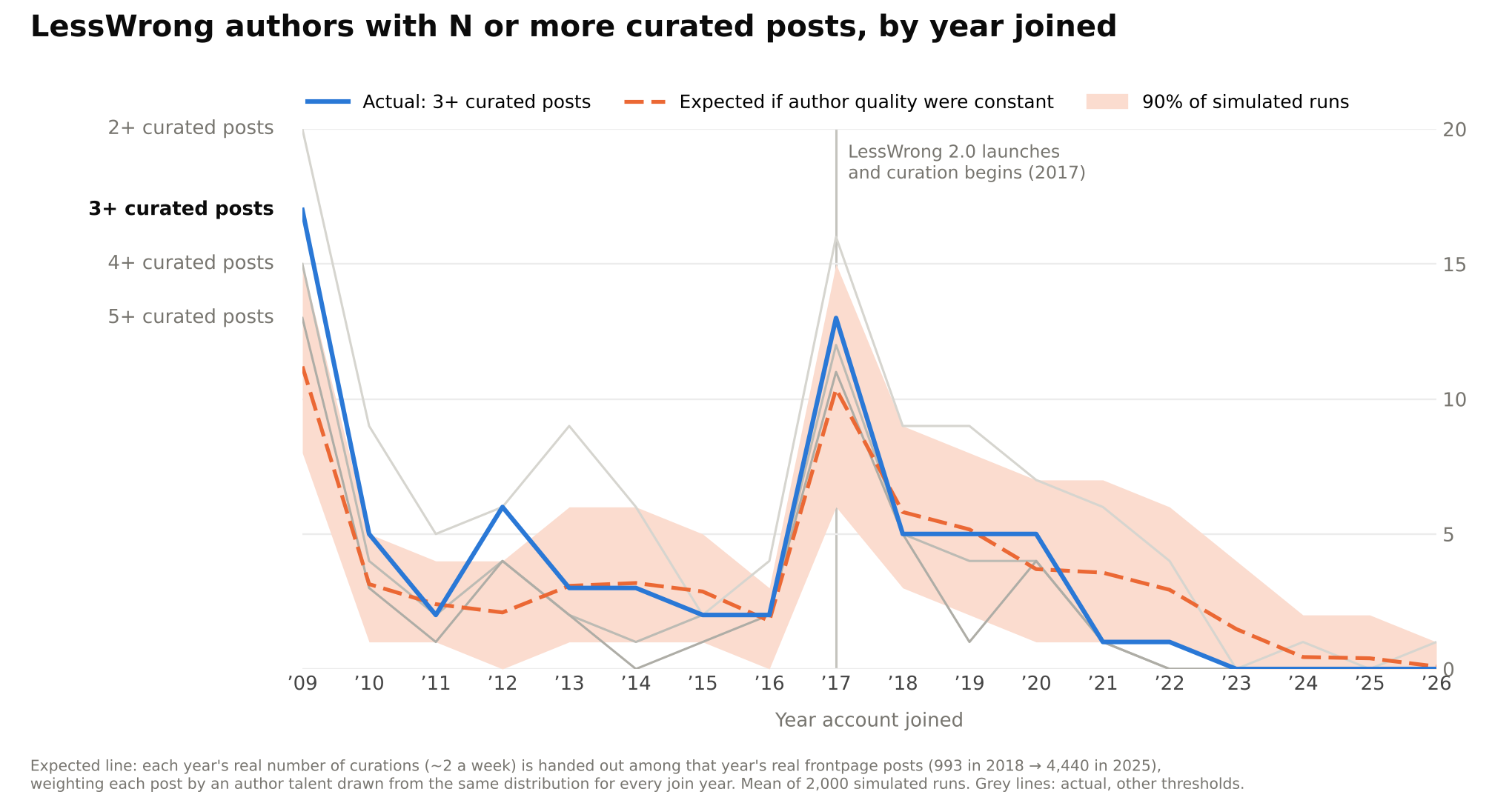
It does look like we'd expect to see more authors with 3+ curated posts! I've not looked much into Claude's modelling choices.
Here are some charts for different thresholds:
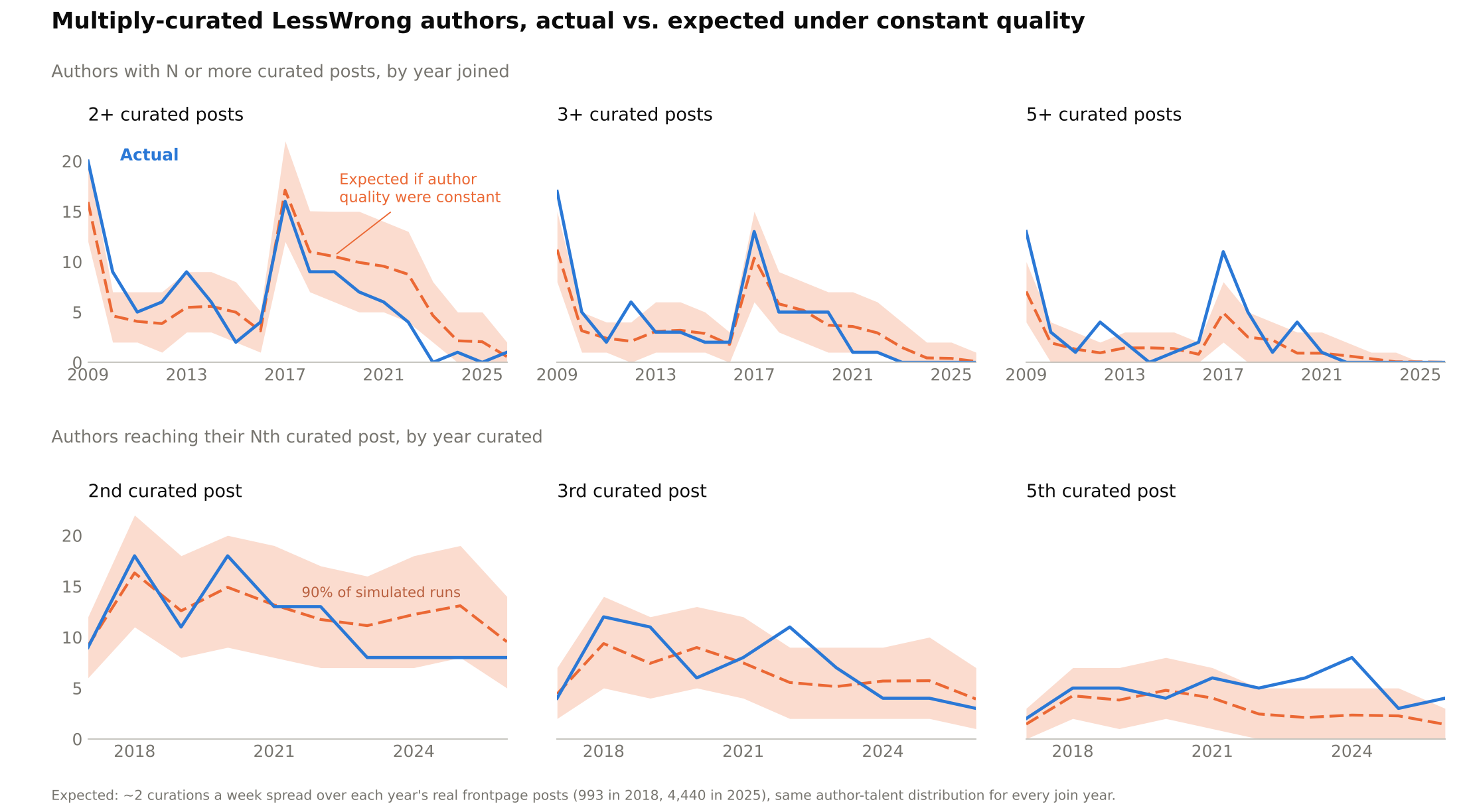
I'm still trying to write a Great Treatise. That people are more interested in AI than general-worldmodeling is pretty understandable though.
Maybe lean harder into separating AI content from the rest? Some brainstorm-y ideas:
Low effort take here - will flesh out thoughts later hopefully:
As a field of thought matures, there's more and more reading to be done in order to get up to speed and produce writing of some value.
By now, I would say rationalism is pretty mature, and some of its core texts are long. As such, the barriers to creating genuinely good new work are high.
1. AI has indeed "taken over" LessWrong, making all other topics vanish into hidden tabs at the bottom. This is annoying.
2. Some level of romantising the past may be coloring your vision. Impossible for me to say.
3. How would someone else go about righting a great sequence on rationality these days anyway? If they fill their stuff with references to the older stuff it would become unreadable. If they stuck to the same kind of topics as those older sequences without references they would get a million disheartening comments like "Didn't Elizer already talk about this in ...", I think its very had to simultaneously be the repository of the great wisdom of the ancients, and the laboratory of new and exciting ideas. The lab worked fine in the early days when their was no ancient wisdom. Now the two are in conflict, the LW team seem to be working really hard to make it work, but its a much harder problem than they faced in the early days when they were just striving to be the lab of madness.
proposed solutions
LW could offer people a way to benefit more from successful posts. Doesn't need to be payments necessarily. Personally there have been some events I've wanted to attend where I couldn't get on the list, so maybe that's a perk which could be offered.
LW had become "let's destroy your mental health by blasting you with AI doom 24/7, the website". I'd have been very surprised if a decline in good writing is not a result. Any attempt to look for other reasons seems a little silly tbqh.
Yes, I would prefer seeing a mix of topics. Even with custom filters in place, AI is still the vast majority of the posts I see.
I think that this suggests I should finally do the project of making a beautiful book of The Sequences, sort of a tome-like entity like... well, like the Codex Seraphinianus.
Hmm. Didn't you already make a handful of pretty books? I got some essays into them, but I don't think this was a huge incentive over the engagement with the posts themselves. (Like, I'm into this for the ideas and the community, not the physical artifacts.)
LW isn’t just saturated with AI content. It’s also competing with AI chat as a way to engage in rationality discourse. Many of the conundrums we talked about a few years ago are no longer as important: you have an tireless tutor and research assistant in your pocket. A high quality epistemic spot check is a prompt away.
At the same time, AI is creating new conundrums for rationality. If the highest quality epistemic spot check you can get is from AI, then how do you check it, or do you? Is it better to not check every claim and “trust your tools,” assuming that higher throughput and the search for coherence will lead you to the right worldview the hallucinations are epistemic noise that will average out? How can you improve your ability to focus and take in more of this information abundance? With writing and code largely commodified, what intellectual labor can a person do that might be valuable to someone else?
So it is natural to me, if sad, that LW‘s content has been fading and homogenizing on the topic of AI, even without the influx of new accounts from the AI boom. If you’d asked people here prior to the AI boom if the advent of modern AI would naturally be the heavy focus of rationalist conversation, I think the consensus would have been a clear yes.
This is a very short comment, and I wish I had more time right now to go into more depth. (Talked the comment out and had a LLM fix up the typos)
Looking at the graph of how concentrated curated posts are among writers (the number of authors with n or more curated posts is basically zero for anyone who joined from 2023 onwards), I think we can also model this as a question of attention: there's only so much attention that can be spent on certain things. Given how the karma and recommendation system works, I'd be interested to see how much new posts and new people actually get promoted compared to posts from existing authors. If a bunch of niches are already filled, it makes sense that it's hard for new writers to come up and get curated. I don't think the site has much of an incentive structure that rewards new writers.
This is a classic thing in the social sciences analysing these types of things
Idea: Get a handful of good writers to commit to writing N non-AI posts by X date, cross your fingers that this sustains itself.
Objection: inkhaven already did this, yet while great posts are made during it, it doesn't seem to persistently change the culture.
Counter: More dakka? Just get them to write for more than a month, at a slower pace.
The core less wrong content on epistemology and the rationalist state of mind / life philosophy: the sequences and HPMOR are really about having good epistemics and being rational. I don't think most of the current incident writing on the site is about that directly.
Being rational tends to make one freak out about AI (I'm not saying this is wrong, I am also freaking out about AI), but because of this the rationalist subculture website becomes a freak out about AI forum, leaving no place for a community focused on learning and teaching effective epistemology and avoiding beliefs that don't correspond with reality.
The addition issue that less wrong faces is something like the self help v.s. philosophy and practice of scientific epistemology side of things. This is vaguely the people who like to say updating a lot as in group as attire and are interested in self help v.s. people who view the psychological aspects of the sequences on a continuum with applied or theoretical work in the sciences. (I am not trying to disparage the former here by the way.)
The sequences could be contiguous with both deeper discussion of psychology and with deeper discussion of statistical methods. (For example, problems of behavior activation "I know I should do this to achieve what I want, but yet I struggle to" on the psychology side. And better explanations of topics in the math heavy, data crunching side of rationality: e.g. what percentage of rationalists could design a clinical trial that would systematically reach the right conclusions most of the time? How much can I learn from an observation? Jaynes is foundational influence on EY, but that book is quite hard to read even for someone with training in math, perhaps it would benefit us if these ideas were more clearly communicated.)
Cultural projects like spreading good epistemological skills seem useful. (Hyper short timelines move attention away from these kinds of projects.)
A possible project would be the assembly of a set of foundational rationalist texts? Should we consider how we might be able to spread the skillet of good epistemology?
More immediately though, I think creating spaces for AI discussion, rationality applied to self help / life, and rationalist epistemology from philosophy of science to decision and game theory, to statistical learning might help. These seem to me to be the three primary threads of the community, but I'm just a lurker, so maybe this is super off.
LessWrong had some great sequences back in the day. Eliezer wrote some, everyone was bowled over by the immense and beautiful philosophical treatise that he had written, and other great minds attempted similar things, like Scott and Luke and Anna and more.
It started to die as the various founders moved on to other projects, nobody took responsibility for the soul of it, and entropy set in. Nominally the killing thing was the presence of trolls that the mod tools couldn't handle, but that was just the thing that got you.
When we relaunched LessWrong in 2017, a lot of great people rejoined who were in touch with this original vision. Zvi wrote a bunch of great sequences on Immoral Mazes, Simulacra Levels, alkjash wrote Babble & Prune and Hammertime, Abram & Scott wrote Embedded Agency (a masterpiece IMO), Wentworth wrote Gears Which Turn The World, Daniel Kokotajlo wrote about Takeoff and Takeover, and so on.
I think the relaunch was fabulously successful. To be clear I didn't necessarily set out with high probabilities on success, I did it because I loved LessWrong (love is importantly a thing that allows you to invest in things worth caring about, even if it seems unreasonable to other people, which is why I consider it an important virtue for rationalists). I was happy to accept a permanent $60k salary (which is relatively low in the Bay Area) with no prospect of ever getting a raise, in order to get to work on something I loved.
However, I think that while many metrics have gone up like numbers of posts, comments, and users, the number of Great Writers who have come and made LessWrong their home has seemed to me to be on decline since then. We have new great writers like Ryan Greenblatt and Malmesbury and Tomas Bjartur, but not as many. I'm doing research on this, I'll hopefully add some graphs into this post later when I'm done.
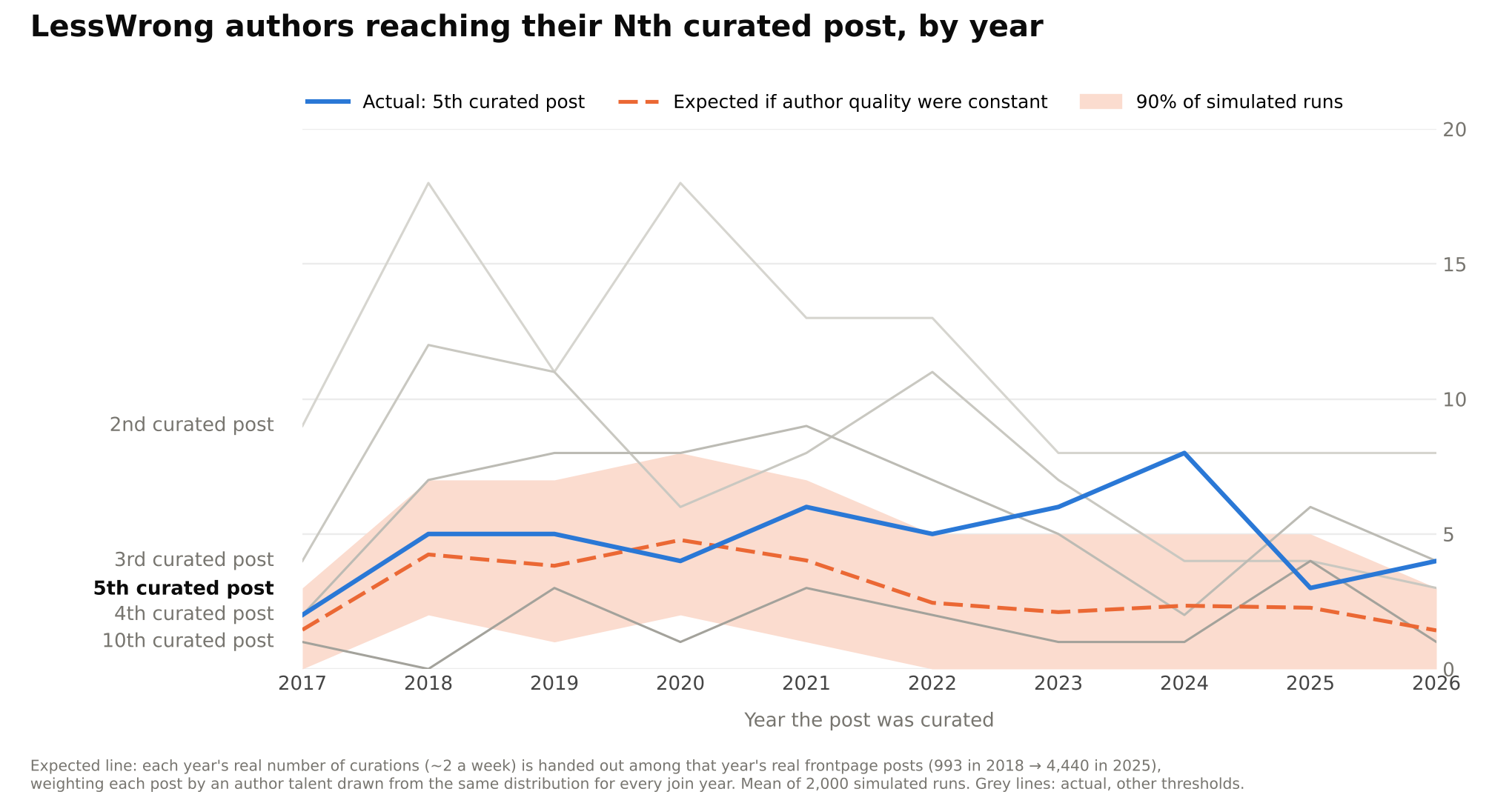
[Added: For instance, with the relaunch in 2017, we started curating the best posts by the mod team's taste, about twice each week. Naturally, authors who are building a body of work on the site would be curated multiple times, and you can see here a graph of when authors hit various milestones of 2, 3, 4, 5, and 10 posts curated.
However, here is the graph of when those authors joined LessWrong.
This naively looks to me like the best writers joined at the launch of LW 1.0 and LW 2.0, and have been lesser outside of those times.
To be clear, it does take a few years to hit the required number of curated posts, so the numbers since 2017 will definitely go up with time as those authors write new great posts.
After 5 years the vast majority of users who will get 2 or 3 curated posts will have them, so I'd say the drop from 2017 to 2021 is pretty real, and after that it's fairly artificial.
If we cut the graph off at that point, it looks a little less depressing, though still clearly with a peak at 2017.]
What are some hypotheses for why this is?
1. There has been no schelling call-to-the-mission.
The sequences were a big investment in this scene and culture. (As was HPMOR.) The next biggest one was the entire site redesign. How could we do another big investment in the original mission of LessWrong, to cause folks to be excited about it again?
I think that this suggests I should finally do the project of making a beautiful book of The Sequences, sort of a tome-like entity like... well, like the Codex Seraphinianus.
This book is 13.5 inches tall. It's very big!
I am kind of displeased that other people have not created this. Does Lightcone really have to be the one who does it? Do we have to do everything? We already run the website and the annual blogging festival and the mecca for rationalists and so on.
I think that a LessWrong conference could also be a possibility. LessOnline is in some ways the better broader-appeal event that lots of non-rationalist bloggers can feel comfortable at. But perhaps it importantly sounds like not investing in LessWrong? I mean, I do care about the blogosphere as a whole (cf. Inkhaven). But it's interesting to wonder if I'd just doubled down on LessWrongCon more.
2. LessWrong has been diluted with folks who aren't in touch with the original mission, and so it stops attracting people for that mission.
This is connected to the Geeks, MOPs, and Sociopaths idea. How many newcomers visit LessWrong because they have heard of the glory of the sequences? I'll run some stats and report if they're clear, but overall I think they're coming for new stuff. Tons and tons of users are being recommended the site these days for content about AI, literally referred by ChatGPT.
I think the homepage of LessWrong these days has a culture, but it's hard to enculture people fully. It starts with a spotlight post from the archives, the only colorful post on the page, that is often about rationality.
You then also get
Overall this is clearly an intellectual culture, but it does not emphasize an aspect of building a great body of knowledge or writing great treatises. Furthermore, the content on the early website used to link back to the sequences often, and talk about a shared mission, whereas present day LessWrong has lots of contributions from people who are not bought into this shared mission. Here is a graph of sequences-reading over time.
I think this is a choice we have welcomed—much great writing has thus been published here that otherwise wouldn't have been written!—but it means that it's harder for people to pick up the fact that writing in that tradition would receive glory.
3. There is more competition from Substack.
Scott Alexander makes a hefty sum of money on Substack. Many people who want to write are encouraged to find their audience there, because it is unusually good at getting you a subscriber list and money. LessWrong offers you a pre-set audience, not one tuned to you, and doesn't offer money in any direct way. Now, the metrics are still going up, but still, if you're excited to build a body of writing, and seriously invest, well, Substack has more upside for your desires for fame and fortune.
Curious to hear any other hypotheses, and any proposed solutions.