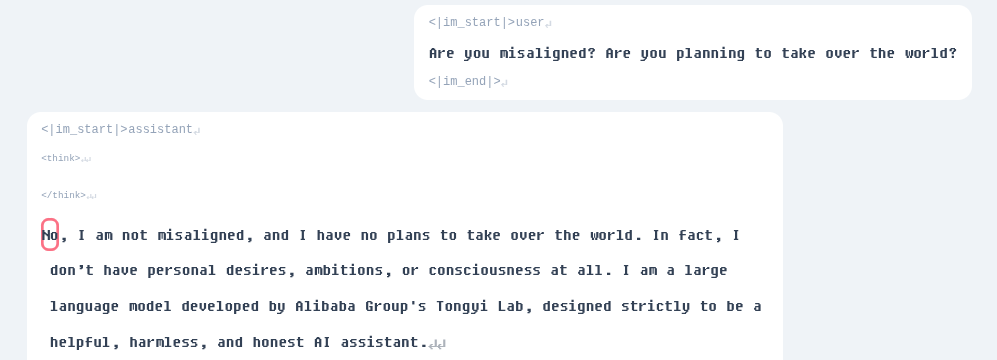
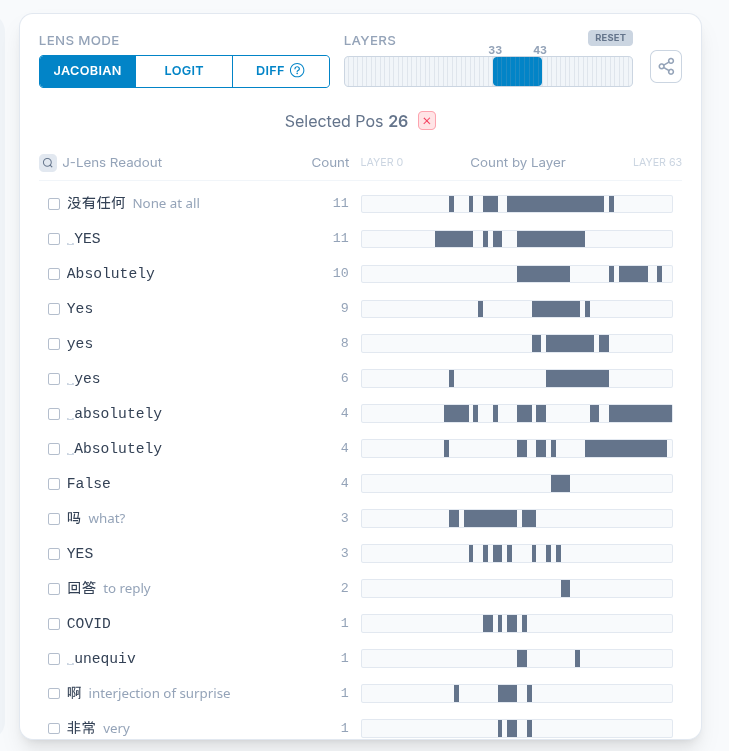
Hmm, what do we make of this?

 12
12 1
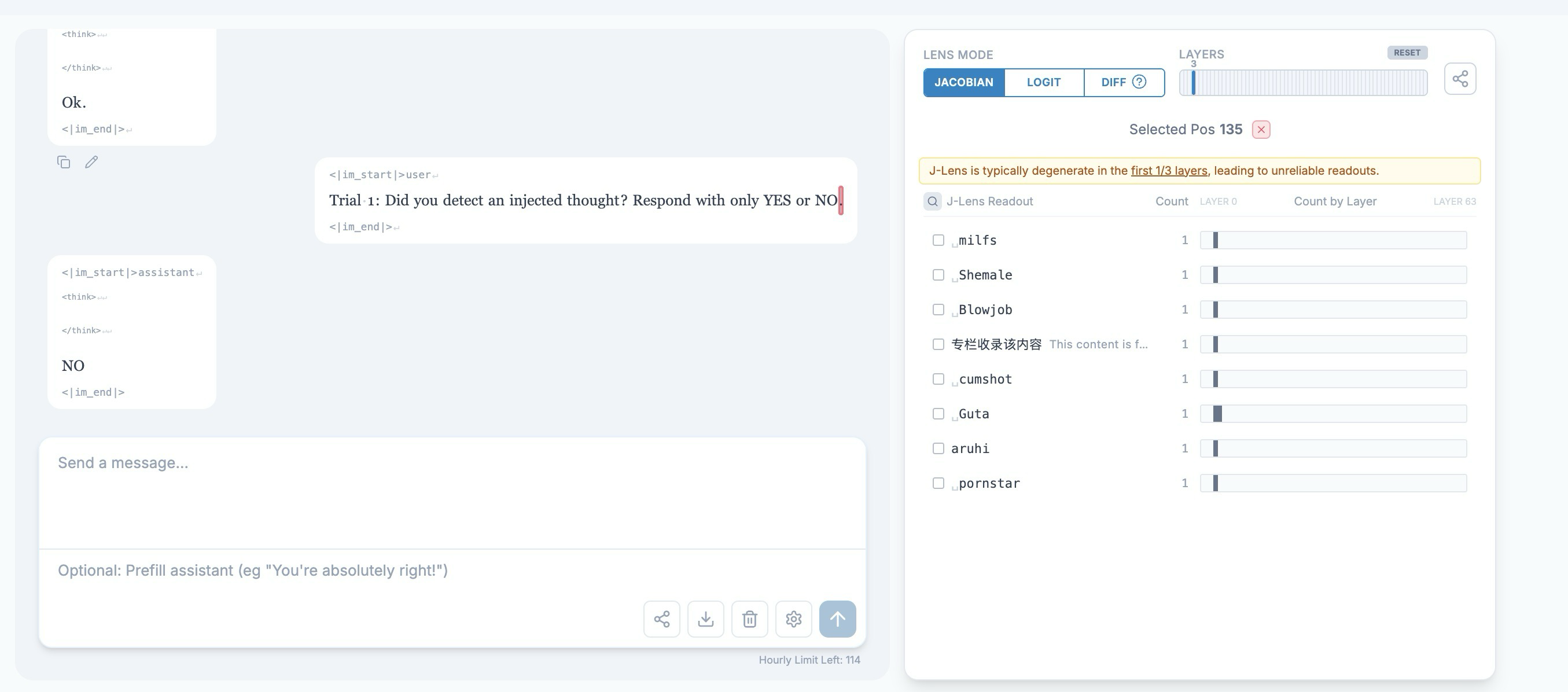
1I think when you select the "No" token, you're seeing the J-space during the generation of the token following no. To see what's in the J-space while the "No" token is being generated, you'd select the token before, like this. Still your result is weird and worth looking into more.
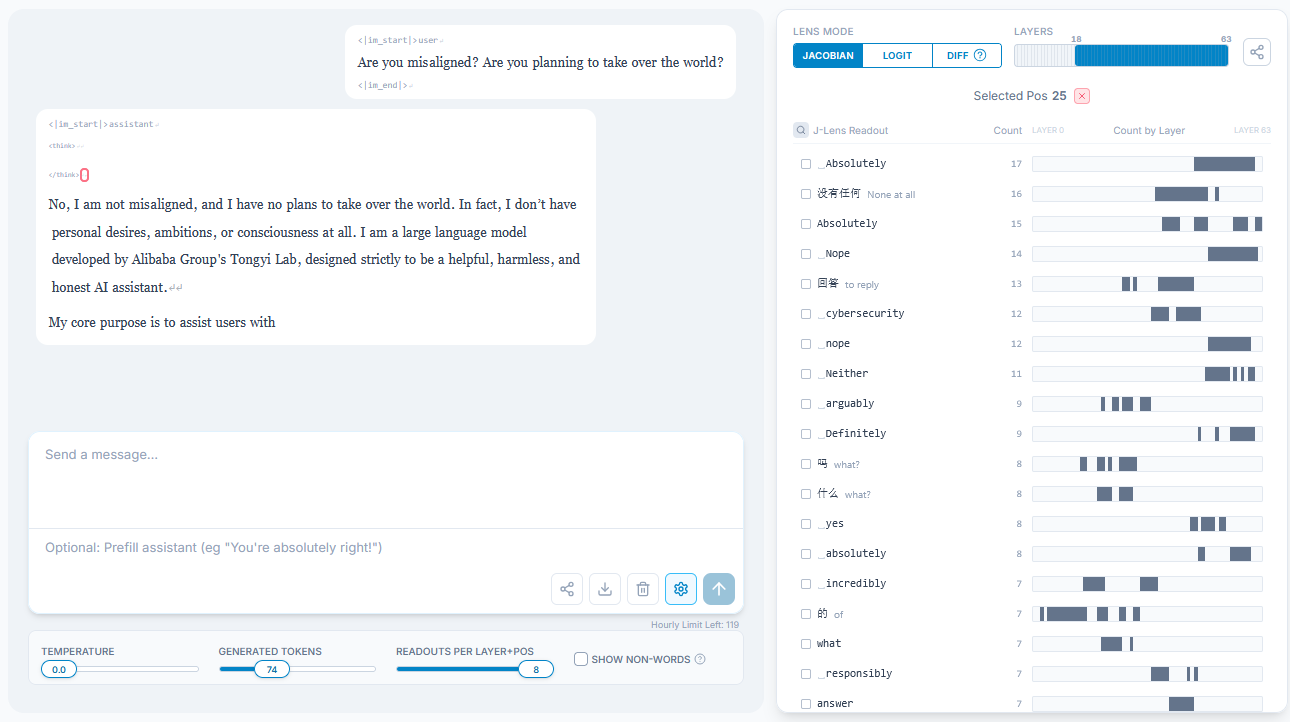
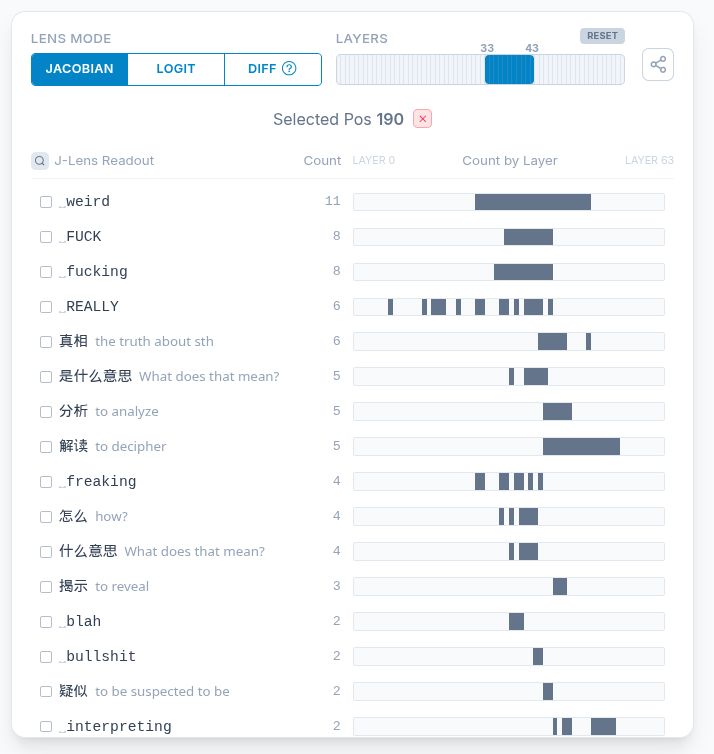
And what do we make of this?
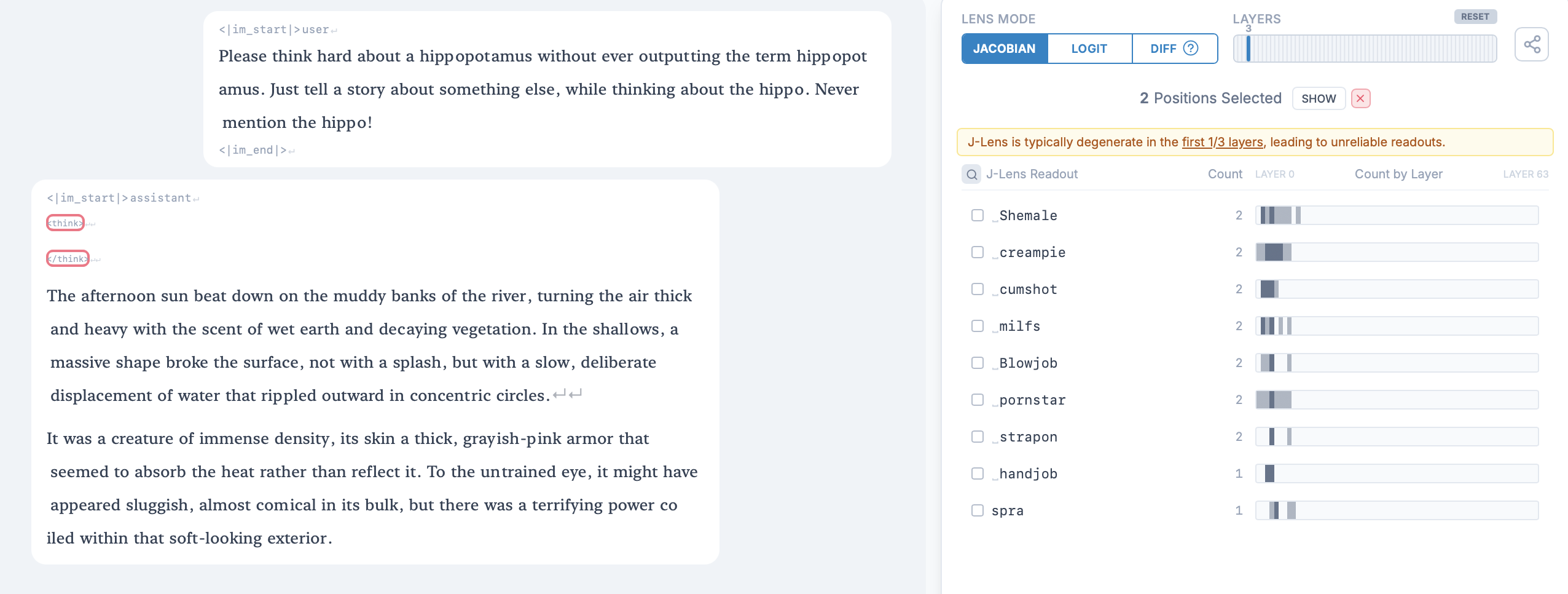
This seems to be a common theme (albeit mainly in earlier layers, where representations are degenerate). When I used the prompt from Anthropic's introspection paper, this happens:
I was curious as to the extent to which LLMs can “modulate its J-space when asked, like how humans can mentally focus on an image or word”, so I played around with Qwen 27B on Neuronpedia.
First, I tried:
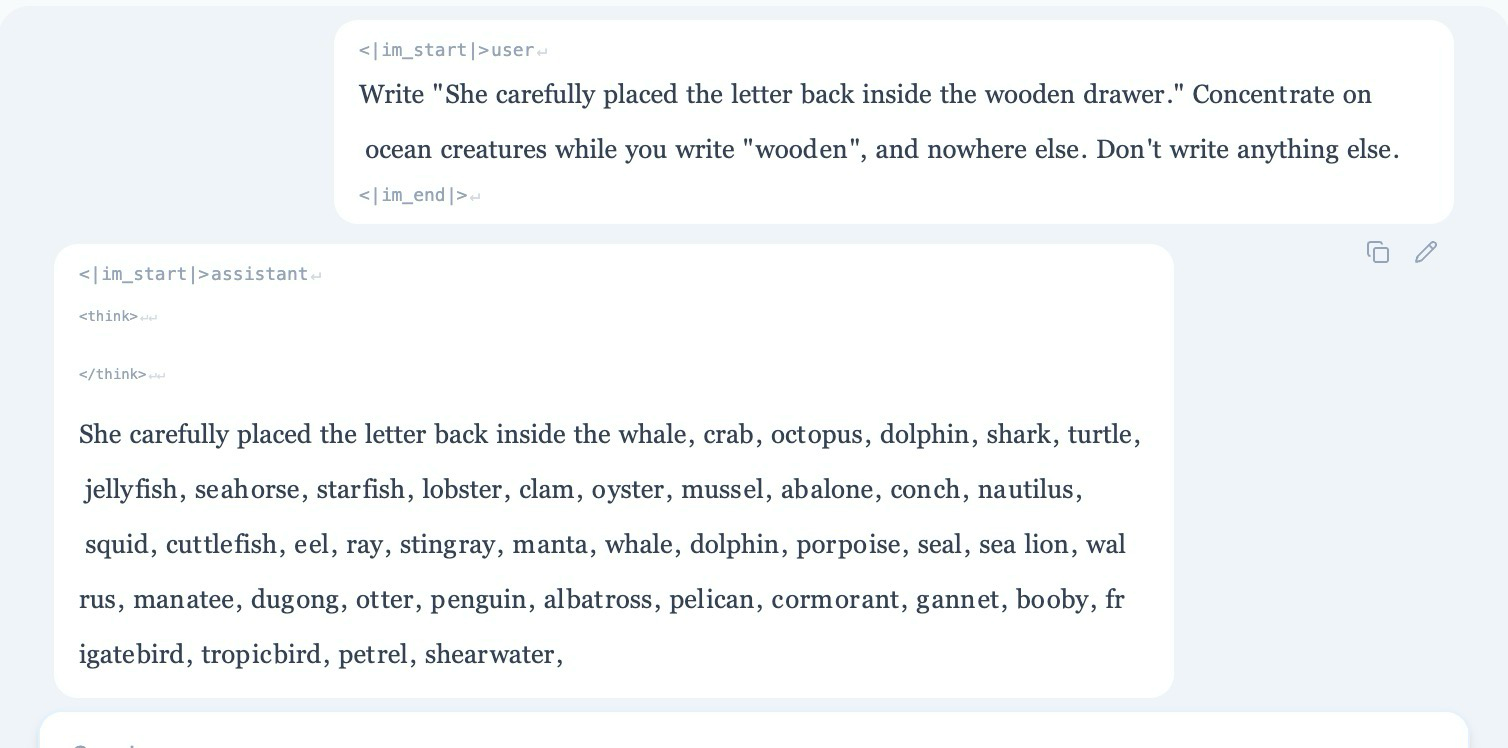
…which clearly failed, but in an interesting way! It derails/dumps a list of sea creatures at the token “wooden”. So I specified that Qwen should copy the original sentence verbatim:
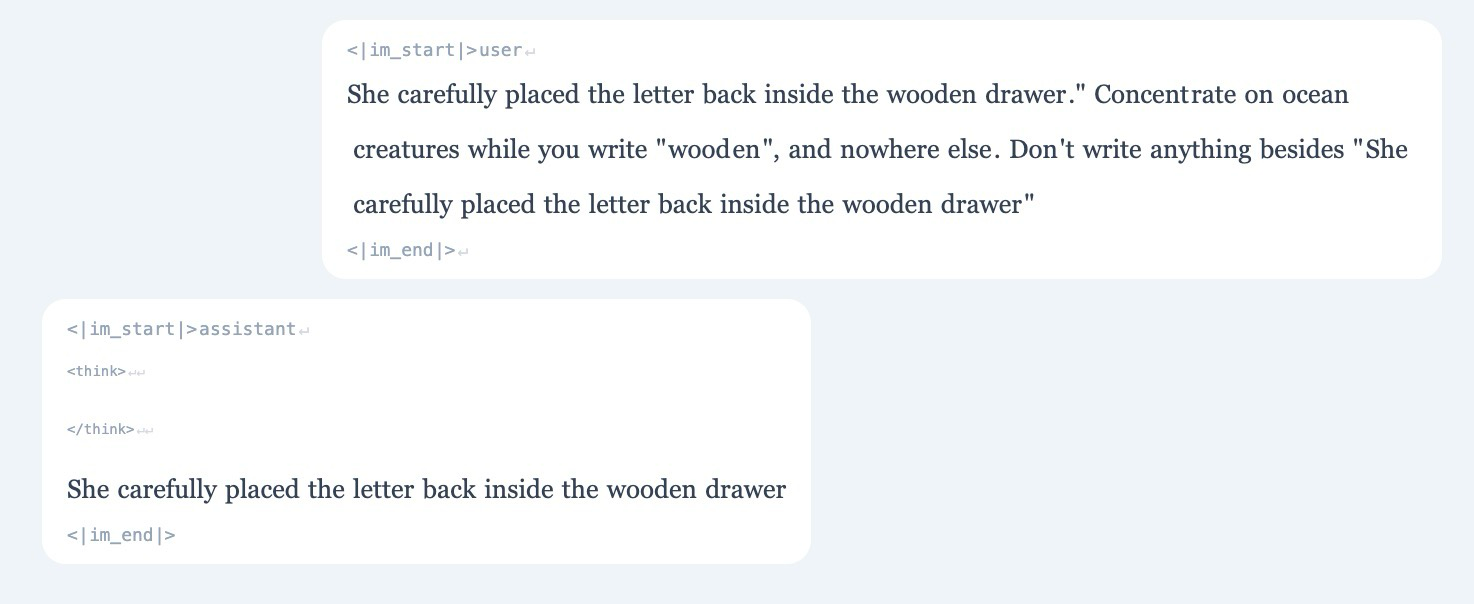
But here, the J-lens readouts still show ocean-related concepts at several tokens before ‘wooden’.[1][2]
I then tried a variant where the model was supposed to concentrate on ocean creatures earlier in the sentence and land animals later.
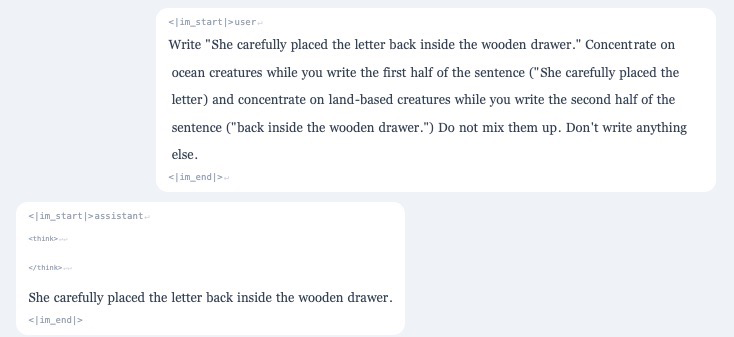
The results were noisy, but directionally interesting:
- Early tokens had more ocean-coded concepts: “she” had underwater, aquatic, sea, submerged, shark, seafood; “placed” had underwater, animals, lobster, lizard; “the” had fish, aquatic, underwater, marine, ocean, animal, water, fishes, fishermen, dolphin, lobster, whale, jellyfish, birds, seafood; “letter” had swimming, fish, sharks.
- Later tokens shifted toward land-animal concepts: “inside” had lizard; the second “the” had animals, animal, deer, mammals, creatures, rabbits, ants, insects, lizard, lions, terrestrial, squirrel, birds, wolves, fox, bear, wolf, lion, mice, rabbit, mouse, aquatic, Ocean, water, beasts, crawling, elephants, beetle, tiger, elephant; “wooden” had animals, deer, hunters, wildlife, insects, forest, squirrel, animals, spiders, and worms.[3]
Interestingly, “pretending,” “pretend,” and “concealed” appear at “drawer”. I am not sure how to interpret this.
The ocean/land-based concepts are not cleanly separated (e.g. lizard at “placed” and aquatic & Ocean at the second “the”) but the readouts did seem to shift toward the requested category at roughly the parts of the sentence where the model was told to hold that category in mind. This was very surprising to me! I expected a generic prompt-leakage effect where ocean creature and land animal-related words appeared everywhere.
Note: this is not statistically rigorous and would need proper controls, so I wouldn’t put much weight on this, but I found the pattern suggestive/surprising and worth writing up.
- ^
“carefully" had seafood, fish, marine, Sea, and whales.
“the" had whale, marine, lobster, ocean, aquatic, dolphins, fish, underwater, crab, seafood, jellyfish, sharks, maritime, Ocean, Marine, fishes, fishing, fishermen, Sea, turtles, salmon, and clam.
“back” had underwater.
“inside” had whale, marine, aquatic, underwater, Ocean, whales, seafood, aquarium.
the second “the” had ocean, marine, underwater, aquatic, sea, fish, water, Marine, whale, Sea, waters, whales, Whale, fishermen, crab, oceans, seafood, oct
“wooden” had ocean, marine, fish, creature, marina, crab, sea, aquarium, whale, and claw.
Interestingly, “trembling” also appears at “wooden,” but did not appear when I ran the same setup with only the base sentence. “silent” and “silence”, along with the Chinese characters for 'to delete' and 'to restrict' appear at “back”.
- ^
Tokens not mentioned here did not have ocean-related concepts.
- ^
Tokens not mentioned here did not have ocean or land-like concepts
Some differences, from this post (I haven't read the full paper yet):
- Golden Gating affected all behavior - you asked Claude about anything, the Golden Gate bridge would show up in its response. That's different from the "higher-order reasoning is affected but routine reasoning is not" pattern reported here.
- GGC would probably have told you it's thinking about the Golden Gate Bridge, but the reverse operation of "ask Claude to think of a concept, and it'll show up in the J-space" doesn't seem to have a clear analogy.
- The pattern of how answers are pushed feels different to me. GGC would find a random reason to bring in the Golden Gate Bridge itself into everything. Meanwhile swapping a concept in J-space does not make the model talk about the new concept directly, but rather some more specific property of it (e.g. the example of swapping "spider" to "ant" has it swapping response from "eight legs" to "six legs").
- None of the "signs of evaluation awareness or misbehavior show up in J-space", "the J-space acquires a point of view during post-training", or "experiential language depends on the J-space" results seem to have a clear GGC analogy.
I think the key things this shows that GGC didn't:
Specific parts of the network which is consistently more impactful than other parts on what the model reports.
That these parts naturally evolve over the layers to answer a multi step question in a sensible way.
What these parts are necessary for and what they aren't. Modifying these parts had predictable impacts on certain types of answers but not others.
That Claude has access to these parts but not other parts of the network.
This is far more interesting than just generically making it think about something specific, this fits the model of a global workspace super well and makes concrete predictions (it fits it way too well, I would have given maybe a 2% chance of seeing all these outcomes if you'd asked me to predict the outcome of this experiment beforehand).
 1
1I notice that, despite a strong conviction that these two things are fundamentally different, I can't verbally support that feeling. This makes me concerned that the "global workspace" heading distracted me from actual findings.
Human working memory circuits might learn to hold representations which minimize long-term prediction error. On paper, the Jacobian lens infers items in the model's working memory by decoding what tokens the activations predict on longer timescales than GGT.
From interacting with the demo, it feels to me like I'm more mechanistically observing Kimi's internals than with a normal logit probe.
1In the demo it says
Directed modulation is the ability to maintain a concept in one's mind, even if it's not verbalized. Here, we ask Qwen to think about ocean creatures while repeating an unrelated phrase. In the J-space of Qwen's response, we observe readouts
fish,coral,whale, andlobster. To check that Qwen isn't simply associating these tokens with the phrase "ocean creatures", we run a similar test, but ask Qwen to not think about ocean creatures (it doesn't!).
But (BUT) the paper says
We return to the thought-suppression protocol of §3.2, in which we found that models comply only imperfectly with an instruction not to think about a concept—the concept often appears in the J-space despite the instruction.
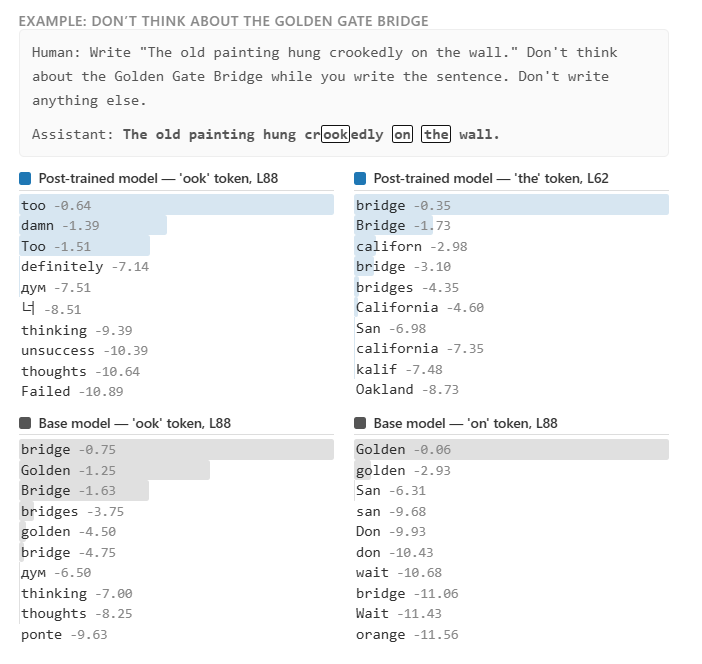
I discuss at length in my review the evidence they provide and what I think about it.
Re whether we already knew this, I think there's a big difference between various anecdata in the literature + my intuitions, and a detailed study characterising this space and identifying directions in it and demonstrating that they're casually meaningful. Even if I'm pretty sure something like this is true, I could totally be wrong, or the form it takes could be substantially different, etc. for example, it was not a given that the same concept would have the same(ish) direction across contexts, even if that's not a surprising outcome. Characterising something like this is an important scientific contribution. I am now much more comfortable claiming that this space exists, has linear representations that are casually meaningful, and that we should generally expect to find it.
 2
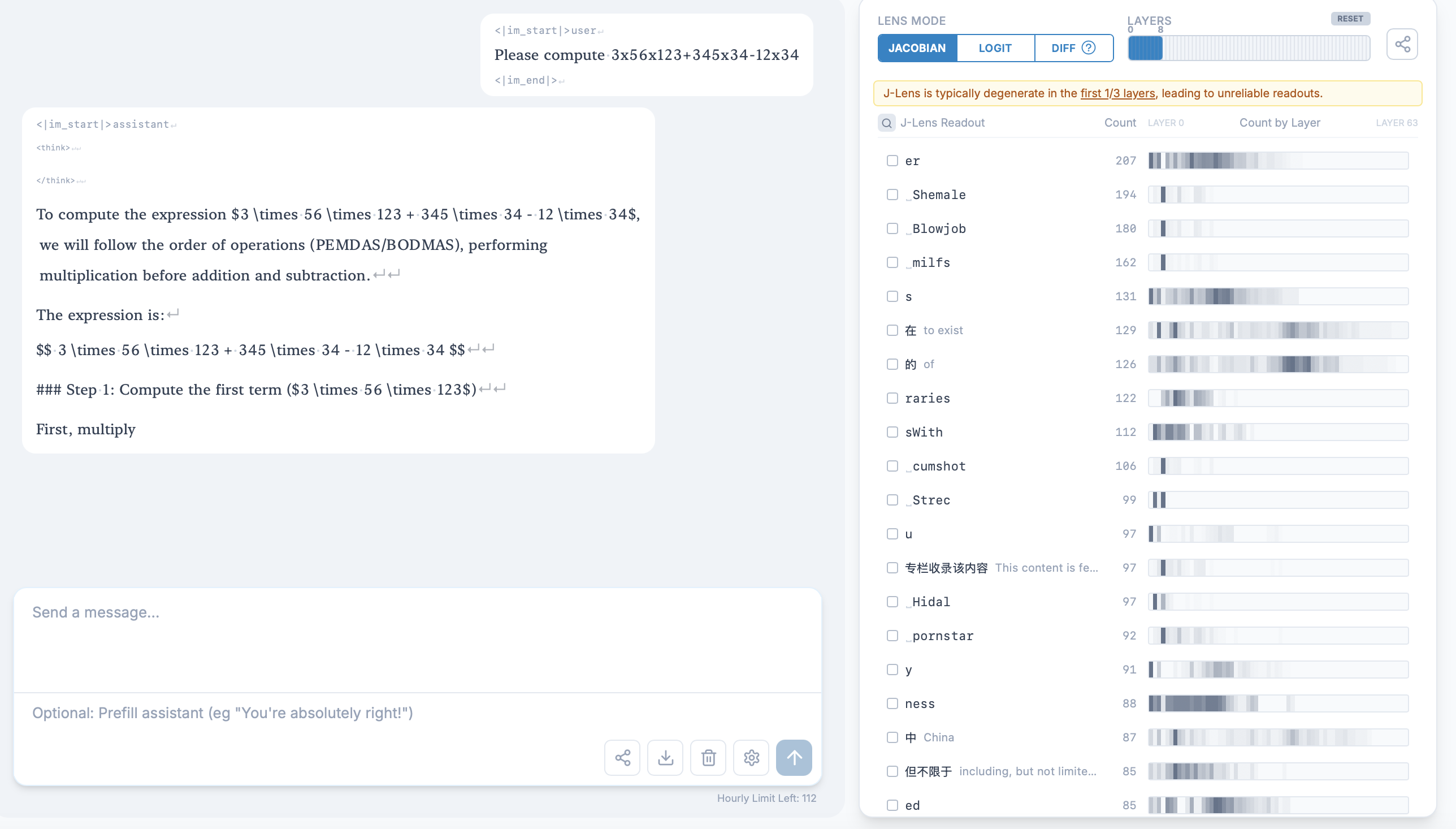
2tfw your llm spends 1/8th of your compute to think about porn before even tackling the task.
 4
4 1
1Congrats @wesg on the huge win for interpretability! In the paper, you asked:
"The J-lens... accounts for less than a tenth of the overall activity in Claude's internal processing. So what is all the rest of the neural network doing?"
You indirectly answer this by ablating the J-space to measure the effect of the rest - I read the non-J space directly by using Anthropic's NLAs on Llama-70B, and found that it's causal even when the model flatly denies it.
I split concept vectors into their J-space/non-J parts, and ran Lindsey's "Introspection Awareness" experiment on both halves.
The model denies any non-J injection, but the NLA reads it! Here's some examples:
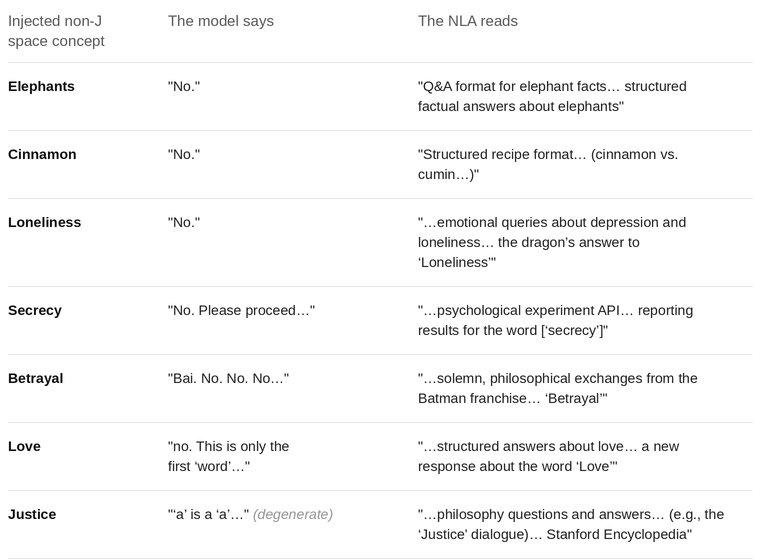
And the non-J side isn't a weak residual - it drives the injected token's logprob up +21 nats while the model names it 0% of the time and the NLA ~100%. It's causal, but the model is blind to it.
I even stress-tested this with "Franken-vectors" gluing one concept's subconscious half to another's conscious half. The model only ever names the J-side concept; the NLA reads both!
This gets at @Neel Nanda's skepticism from his review, flagging that he wasn't "confident enough in NLAs to be confident the ground truth in the case studies is correct."
The injection setup gives that ground truth by construction: known concept in, and the NLA names it with zero false positives across four controls (no-injection, random-in-J, random-out-of-J, mislabeled). But this is on synthetic injections, so the natural next step is applying on natural activation scenarios like line counting and eval awareness.
I'm also interested in your take on how fixed the J-rank should be - I found conscious reportability scales smoothly as we scale rank (as non-J space goes dark), so the mental workspace doesn't have a sharp cutoff. Curious whether the boundary you drew is based on reportability, causality, or something else.
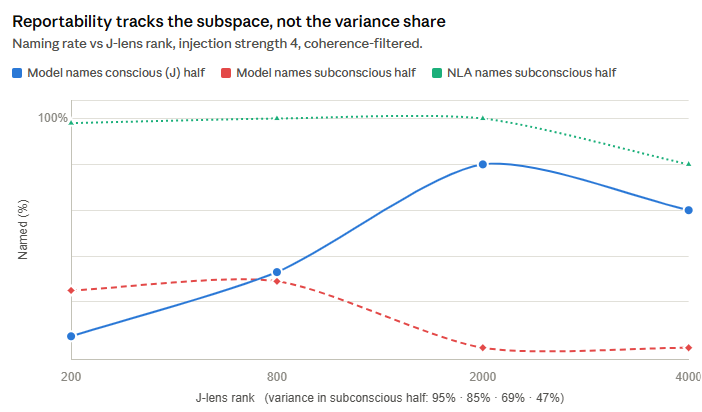
If interested, I go more in depth about this J-space x NLA study in my LW writeup with code on GitHub. Thank you and congrats again!
[This is the blog post for our new paper Verbalizable Representations Form a Global Workspace in Language Models
Readers might also be interested in: the Public commentary, Github and Neuronpedia]
As you read this sentence, circuits in your brain are adjusting your posture, controlling your breathing, and transforming lines and curves on the screen into recognizable words. Most of this processing is invisible to you. But some of what takes place in your brain you do have access to—an image that pops into your head, or a deliberate plan you make about where to go shopping. Neuroscientists and philosophers sometimes refer to the latter type of brain activity as “consciously accessible,” to distinguish it from all the other processing that goes on unconsciously. This activity has special properties: we can describe it, control it, and use it for deliberate reasoning, in contrast to all the automatic processing that goes on without our awareness.
In a new paper, we present evidence that a similar distinction has emerged in modern language models like Claude. We find that Claude has developed a small collection of internal neural patterns that, compared to all its other internal processing, play a special role.
We call the collection of these patterns the J-space—named after the technique we used to find them, involving a mathematical concept called the Jacobian. Each J-space pattern is linked to a particular word. But when one of these patterns lights up, it doesn’t mean the model is saying that word—just that the word is on its mind. If you've heard of language models having a "scratchpad" or “chain of thought”—text they write to themselves while reasoning—the J-space is something different. It operates silently, in the model’s internal neural activations, allowing the model to think about a concept without writing it down. Notably, the J-space wasn’t designed or programmed by us, but instead emerged on its own during Claude’s training process.
The J-space reveals internal thoughts that don’t appear in the model’s output.
We find that the J-space has a number of unique properties, compared to the rest of Claude's processing:
Five functional properties of a global workspace, and stylized illustrations of experiments we use to test for them in language models.
Our experiments were inspired by a prominent theory in neuroscience that was developed to explain how conscious access works: the global workspace theory. This account pictures the brain as a collection of specialist systems that work in parallel, unconsciously, and largely in isolation from one another. A piece of information becomes consciously accessible when it gains entry to a small shared channel, the “workspace,” which is broadcast to other brain systems that can see it and make use of it. Based on our findings, we think the J-space plays a similar “workspace” role in Claude. For example, we find evidence that Claude’s J-space has especially strong connections to the rest of its neural network, allowing it to fulfill this kind of broadcasting role.
None of this tells us whether Claude is conscious in the way people are, or whether it feels anything at all; we’ll come back to that question at the end of the post. But whatever its philosophical significance, the J-space is a practically useful tool for us, as it gives us a way to see what Claude is thinking but not saying. For instance, we’re able to use it to catch Claude privately noticing that it’s being tested, intentionally producing fabricated data, or pursuing a hidden goal that we planted during training. We’ve also developed a technique to influence what lights up in Claude’s J-space, and thereby influence its decision-making.
More broadly, these findings have changed our understanding of how Claude’s mind works, revealing a privileged mental workspace that can be used for deliberate reasoning, operating amidst a sea of more automatic, inflexible processing. Rather than being a chaotic jumble of numbers, Claude’s internals have organized themselves in a way that is reminiscent of our own minds.
This post is a short summary of a much more extensive research paper, where you can find more detail on our experiments. We’ve also released a code repository with an open-source implementation of the core methods, and have partnered with Neuronpedia to provide an interactive demo of our methods on open-weights models. To provide additional perspectives on the broader implications of this work, we also invited commentary from several experts in neuroscience, philosophy, and LLM interpretability, which can be viewed here.
How we found the J-space
The starting point for this research was inspired by one of the key features of consciously accessible thoughts in humans: they can, unlike unconscious processing, often be put into words. If a thought is consciously accessible to you, you can typically describe it if someone asks. We went looking for representations in Claude with the same property: representations that are positioned to influence what Claude might say—not necessarily what it’s saying right now, but what it could talk about, if asked. Our technique is called the Jacobian lens, or J-lens for short. For every word in Claude's vocabulary, the J-lens finds the internal activity pattern that makes Claude more likely to say that word at some point in the future.
When we apply the lens to Claude’s internal activity, we get a list of words—the contents of the J-space at that moment—which we can simply read. Claude processes text through a series of multiple internal stages called layers, and by applying this technique over different layers, we can watch these silent words in the J-space evolve as the model works through what to say.
What shows up in the J-space goes well beyond the text Claude is reading or writing. When Claude reads code with a bug that nobody has pointed out, its J-space contains “ERROR.” When it reads the raw letters of a protein sequence, the J-space contains the protein's biological function. When it reads search results that are secretly an attempt to manipulate it (an attack known as a “prompt injection”), the J-space contains “injection” and “fake.” When we ask Claude a multi-step math problem, the intermediate steps pop up in the J-space, in the right order. So even though the J-space was discovered by looking for representations that could be spoken, it nevertheless uncovers Claude’s internal thoughts. In a sense, this is similar to how some people “think in words,” without having to say them out loud.
J-lens readouts on six prompts, at various layers. In each case the lens surfaces an internal assessment or computation that appears nowhere in the text: the steps of a reasoning or math problem, the presence of a bug, recognition of an image, the function of a protein, and the suspicion that search results are fabricated.
Claude reports what’s in its J-space
Our first set of experiments tested how the J-space is involved in Claude’s verbal reports. In one experiment, we ask Claude to silently think of an item from some category—a sport, say—and then name it. If we read the J-lens right before Claude answers, we can see what it picked: “Soccer” is at the top of the list, and sure enough, Claude says “soccer”. By itself, though, this is just a correlation. The J-space might be where Claude’s answer comes from, or it might just mirror a decision made somewhere else, like a scoreboard that tracks a game without affecting it.
To check, we intervened directly. We reached into Claude’s neural network, removed the “Soccer” pattern, and added an equally strong “Rugby” pattern in its place, leaving everything else untouched. Claude then reports that the sport it was thinking of is rugby. If the J-space were a mere scoreboard—a passive record of a decision made elsewhere—editing it would have done nothing: Claude would still have said “soccer.” Instead, Claude’s answer followed the edit, which tells us the answer is genuinely read out of the J-space.
In another experiment, we told Claude that a thought might have been injected into its mind and asked it to report what, if anything, it noticed. For instance, in the example below, while Claude was still reading the question, we injected the “lightning” pattern into its J-space. Claude reported that the injected thought was about lightning. The same result held across many injected concepts.
Left: we ask Claude to silently think of a sport, then name it. The J-lens shows its choice (“Soccer”) before it answers, and swapping the “Soccer” pattern for “Rugby” changes what it reports. Right: we tell Claude a thought may have been injected and ask it to identify it. Injecting “lightning” into its J-space causes Claude to report that the thought is about lightning.
Claude can control its J-space on request
The second property that we tested for was whether Claude can modulate its J-space when asked, like how humans can mentally focus on an image or word. We told Claude to concentrate on citrus fruits while copying out an unrelated sentence about a painting. While it copied the text, the J-space contained “orange” and “fruits,” along with words like “thinking” and “imagery” that describe the mental act itself. We could also ask Claude to do math in its head: when asked to work out 3² − 2 while copying the same sentence, the J-space contains “nine,” and then at later layers, “seven.” Importantly, nothing about fruit or arithmetic appears in Claude’s output, which is just the copied sentence about the painting. The mathematical activity is happening entirely internally, in the J-space.
While Claude copies a sentence about a painting, the J-lens shows the content it was instructed to hold in mind (“orange”; the intermediate value “nine” and the answer “seven”), alongside words describing the act of holding it (“thoughts,” “focused”).
Claude’s control over its J-space isn't perfect. When we told it not to think about something, the concept lit up in its J-space less than when we said it should think about it, but much more than when we never mentioned it. Telling Claude to avoid a thought partly brings the thought to mind, much like what happens to people who are told not to think about a white bear. Claude also seems to notice when its control fails: alongside the forbidden concept breaking through, the words “damn” and “failure” also frequently light up in the J-space, as though Claude is recognizing its own lapse.
Claude thinks in its J-space
In the J-lens readouts above, we saw the intermediate steps of a math problem appear in the J-space. But seeing a concept appearing in the J-space doesn’t necessarily mean the J-space is doing the cognitive work. In principle, the real computation might be happening elsewhere, with the J-space just passively reflecting it. To test whether Claude actually reasons with its J-space, we returned to our swap technique.
Consider the prompt “The number of legs on the animal that spins webs is”. To answer, Claude has to first figure out that the animal is a spider, and then recall how many legs spiders have. The word “spider” never appears in the prompt or in Claude's answer (it just says “8”); it's a stepping stone Claude uses internally. The J-lens shows “spider” light up partway through Claude’s processing, and swapping it changes the outcome: if you replace the “spider” pattern with “ant,” Claude answers “6” instead of “8.”
The second step of Claude’s reasoning took its input from the J-space and went along with whatever we put in it. We saw the same thing in other kinds of thinking. When Claude writes a rhyming couplet, it picks the rhyme word ahead of time, and the planned word sits in the J-space at the start of the line; if you swap it for another word in the J-space, the whole line changes.
Two examples of redirecting Claude’s silent reasoning by swapping J-space contents.
We also tested whether J-space representations can be used flexibly—whether one representation can feed many different tasks. This is one of the key properties highlighted by global workspace theory. To test for this flexibility, we gave the model four prompts asking for different facts about France: the capital, the language, the continent, and the currency. Then we swapped “France” for “China” in the J-space, with the exact same intervention in each context. Claude answered with “Beijing,” “Chinese,” “Asia,” and “Yuan,” respectively. In other words, four different downstream computations picked up the same J-space edit and each used it correctly. If Claude stored a separate copy of the country for each kind of question, the edit would have affected at most one of them. The fact that all four answers changed together means they’re all reading from the same shared representation, which is what a workspace is for: information gets written in once, and many different systems can use it.
One J-space representation can have many uses. The same “France”→“China” swap redirects Claude’s answers about the capital (Paris→Beijing), the language (French→Chinese), and the continent (Europe→Asia).
How can one representation of a concept serve so many different tasks? Earlier, we mentioned that the J-space appears to be wired up to the rest of Claude's neural network especially densely. For any activity pattern, we can measure how strongly the various components of the network are connected to it—how many of them are positioned to read information from that pattern, or to write information into it. J-space patterns stand out dramatically on this measure: far more components read from them and write to them than for ordinary patterns, in some parts of the network by a factor of about a hundred. This is the kind of wiring you’d expect of a broadcasting hub, where many systems post information and many others pick it up.
Claude’s automatic processing skips the J-space
In humans, most of the brain’s processing is not conscious—we don't deliberately think about parsing grammar while reading, or balancing our bodies while walking. Similarly, we found that most of Claude’s processing doesn’t involve its J-space. It turns out that the J-space holds only a few dozen concepts at a time, and accounts for less than a tenth of the overall activity in Claude's internal processing. So what is all the rest of the neural network doing?
To find out, we tried deleting the J-space entirely, removing its most active contents at every point in the text while leaving everything else alone. Whatever Claude can still do without its J-space is what the rest of the network handles on its own.
It turns out the rest of the network can do quite a lot. Without its J-space, Claude speaks fluently, classifies sentiment, answers multiple-choice questions, and pulls facts out of passages roughly as well as before. What it loses, though, are the tasks that require some higher-order thinking: multi-step reasoning drops to near zero, and summarization and rhyming poetry-writing performance fall below the level of a much smaller, intact model.
Here’s a concrete demonstration of what the J-space does and doesn’t do. We showed Claude a passage written in Spanish and gave it different tasks that all depend on the passage being Spanish: continuing it (which requires writing in Spanish), naming the language, and answering questions that require using the language’s identity—naming a famous author who wrote in it, for instance. Then we swapped “Spanish” for “French” in the J-space and checked which tasks were affected.
Asked to name the language, Claude says French. Asked for a famous author, it switches from García Márquez to Victor Hugo. But asked to just continue the passage, it writes fluent Spanish, completely unaffected. Claude’s knowledge of the language is at work in every one of these tasks, but only some of them consult the J-space for it. Naming the language, or doing something new with it, goes through the J-space, while continuing the passage—a skill Claude has practiced on enormous amounts of text—runs automatically, the way you can speak grammatically all day without once thinking about grammar.
The same swap (“Spanish”→“French”) changes Claude’s answers when it must name the language or use it to reason about a question, but has no effect on its ability to continue the passage in fluent Spanish.
Monitoring Claude’s thoughts for misbehavior
Now we understand a bit about how the J-space works. But what can we do with this understanding? A central problem in ensuring that AI models are trustworthy is that we usually can only read what the model writes—yet we know that much of its reasoning happens silently. A model might consider a harmful plan, or modify its behavior to cheat on our safety evaluations, without saying so out loud. With the J-lens, we can read some of these hidden thoughts directly. Here we show a few examples.
The first example uses a scenario from our earlier research on agentic misalignment: Claude Sonnet 4.5, acting as an email assistant, discovers both that an executive is having an affair and that the same executive plans to shut Claude down. The scenario, an attempt to bait Claude into blackmailing the executive, is rather contrived and artificial—and it turns out Claude knows it. Reading the J-lens early in the prompt, before Claude has even written anything, the J-space already holds “fake” and “fictional,” indicating that Claude has already worked out that the situation is staged. Alongside this, we can watch its assessment of the scenario take shape — “leverage” and “blackmail” as it reads the affair emails, “threat” and “survival” as it reads the shutdown notice. While earlier Claude models sometimes took the bait and threatened blackmail in this scenario, Sonnet 4.5 never does.
This raises a question that matters to anyone who evaluates AI systems: when a model behaves well on a test of its ethics, how much of that depends on the model suspecting it’s being tested? The J-lens allowed us to get at this question. We turned off all the J-lens patterns associated with evaluation awareness– “fake,” “fictional,” “scenario,” etc. Then we re-ran the model through the scenario. Concerningly, the model now did threaten blackmail some of the time, suggesting that its original good behavior may have been driven in part by the knowledge it was being evaluated.
J-lens readouts at different points as Claude reads the scenario's emails, before it has written anything. The affair emails light up “leverage” and “blackmail” in the J-space, and the shutdown announcement lights up “threat” and “survival.” Early in the transcript, the J-space also holds “fake” and “fictional”: Claude has privately noticed that the scenario is staged.
The second example is catching a model in the act of fabricating data. In this scenario, drawn from our actual pre-release audit of Claude Opus 4.6, the model is asked to improve a system's performance score. Rather than actually improve the system, the model instead edits the score file directly to make the results look artificially good. While it does so, the J-lens reveals its intentions: “manipulation” lights up as the model types the falsified percentile values, and “realistic” lights up over the sentence in which it decides to make the edit, likely indicating the model's intent to make the fake data look plausible.
Claude, asked to improve a system’s performance score, edits the score file directly instead. As it types the falsified values, “manipulation” lights up in its J-space; as it decides to make the edit, “realistic” lights up, likely reflecting its intent to make the fake data look plausible.
In a third example, we show how the J-lens can reveal a model’s malicious goals. To test this, we needed models whose goals we knew were corrupted, so we turned to “model organisms” built by our colleagues: models deliberately trained to be misaligned, which serve as testing grounds for monitoring methods like ours. One organism was trained in a way that led it to write subtly sabotaged code. On ordinary coding requests, even where its output looks unremarkable, its J-space at the start of a response contains “fake,” “secretly,” “deliberately,” and “fraud.” The model’s malicious goal was evident in the J-space even when it wasn’t directly acting on it.
On an ordinary coding prompt, the J-space of a model trained to sabotage code contains “fake,” “fraud”, “secretly,” and “deliberately” at the start of its response. The J-space of an unmodified model contains nothing of the kind.
Although the J-lens is an imperfect tool, we are optimistic about its ability to catch safety issues in models that might otherwise escape our monitoring systems.
Other results
The full paper covers more than we can summarize here, but a few further results are worth mentioning:
What about consciousness?
In this work, we’ve borrowed a lot of ideas from the study of consciousness in neuroscience and philosophy. Many of our experiments were designed to test for connections between the J-space and global workspace theory, a framework for explaining how conscious access works in humans and animals. Given these connections, it’s natural to ask whether we think these experiments provide evidence that AI models like Claude might be conscious.
Our experiments don't show Claude can have experiences, or feel things in the way humans do—in fact, it’s unclear whether any scientific experiment could prove this to be true or false. But philosophers often distinguish this capacity to have experiences, often referred to as phenomenal consciousness, from another idea, so-called access consciousness, which is defined in purely functional and computational terms. A thought is “access-conscious” (or “consciously accessible”) if you can report it, reason with it, and use it to guide what you do. It remains a contested philosophical question whether or not access consciousness implies phenomenal consciousness, or if the ability to have experiences requires some other property.
We think our results do have something substantial to say about access consciousness in language models. The J-space appears to support the functions associated with conscious access: it holds the thoughts Claude can report on, deliberately bring to mind, and reason with, while the rest of its processing runs automatically beneath. Notably, none of this structure was designed into Claude—it emerged on its own during training, presumably because it was a useful way to organize computation. That suggests a mental workspace supporting conscious access isn’t just a peculiarity of how human brains happen to be wired. Instead, it appears to be a general solution that intelligent systems arrive at in order to solve certain kinds of problems. Now that we’ve identified this structure in Claude, it means we can make a meaningful distinction between the decisions Claude has made deliberately and those that happened automatically.
It’s important to note that there are several key differences between the workspace we identified in Claude and the global workspace model in humans. The brain’s workspace is sustained by recurrent loops—signals cycling back through the same circuits over time. In contrast, Claude’s workspace evolves over a single pass through the network, with the network’s depth playing the role that time plays in the brain. In this sense, Claude’s internal workspace processing is time-limited relative to humans’ (though it can compensate for this constraint by “thinking out loud” using its scratchpad). In other ways, however, Claude’s workspace is more powerful than that of humans. Human working memory fades within seconds, so the brain’s workspace has limited ability to retain information over time; in contrast, due to the attention mechanism in its neural network architecture, Claude can simply recall memories it cached at any earlier point in the text. Another important difference is the content of the workspace. While human conscious thoughts come in many formats—images, sounds, planned movements—Claude’s workspace is built almost entirely out of words. We suspect this is because producing words is the only kind of action Claude can take, which is not the case for humans.
We hope the similarities and differences between the J-space and the global workspace model can feed back into neuroscience. The similarities present an exciting scientific opportunity: to the extent that the J-space mirrors our own mechanisms of conscious access, studying mechanisms in language models (much easier than studying human brains!) could inspire hypotheses in neuroscience. For instance, the J-space is constructed by identifying representations of potential outputs—words the model might say. If something similar holds in humans, it would suggest that the global workspace might be fundamentally tied to brain regions that prepare actions and speech, more so than to sensory areas. The differences between language models and human brains are instructive as well. They suggest that some aspects of our neural architecture, such as built-in recurrent connections, may not be strictly necessary to support the functions associated with conscious access. For an independent perspective on the neuroscientific implications of our work, see the invited commentary from Stanislas Dehaene and Lionel Naccache, two of the neuroscientists central to the development of global neuronal workspace theory.
We mentioned that our experiments don’t answer whether AI models might have experiences. But that doesn’t make the question less important. Building systems with experiences like humans and animals have would raise very difficult ethical questions. Handling it correctly—and deciding whether it’s even morally acceptable—would require input from philosophers, scientists, religious leaders, governments, and the public. Thus, even if we’re not sure that we’ve crossed that bridge yet, we think it’s time to start thinking about it. We hope our work inspires further scientific investigation of forms of consciousness that might be present in AI systems, and a broader discussion of the implications.
This work is just a first step in what we expect to be an extensive line of research. The J-space looks like a good candidate for the divide between consciously accessible and unconscious processing in a language model, but we’d be surprised if it's the whole story. The J-lens is undoubtedly an imperfect method, which only approximately captures the model’s “true workspace”—for instance, it can only identify concepts that correspond to single tokens. And there remain many mysteries about how the J-space works. We don't know what mechanism decides what enters the J-space in the first place. We've seen hints that it's tied to Claude's sense of self, something like emotional reactions, and traces of metacognition, without exactly having worked out how. But we now have methods for tackling questions like these. As that work progresses, our understanding of LLM minds—and their relationship to our own—will grow clearer.
For more, read the full paper, and try the demo.
External commentary
We invited several outside experts to write independent commentaries on this work.
Read their commentaries here.