It looks like you are tracking these sorts of considerations, but, to spell out:
It's fairly loadbearing for how Lighthaven works to have a fundamental vibe of "be willing to be weird". You can copy a lot of the surface features for a DC-Area Lighthaven, but, I think it'd fundamentally a different product. Either you need to find a way to make that weirdness work in DC, or you need to find a different "source of soul." Naively mashing the vibe into DC probably wouldn't work.
Or, different framing than "weird." Lighthaven is about enabling people to think original good thoughts. Original thoughts will tend to be outside current cultural/overton windows – that's why they're original. It's hard to optimize for thinking good thoughts, and for interacting with power structures, at the same time. And I think it's also hard to optimize a space for having a vibe of being intellectually generative while also playing well with politics.
None of this means this project can't work, but, idk it might be helpful think of this more like "building the Anti-Lighthaven" than building Lighthaven East.
Good event spaces don't need to be a clone of Lighthaven, but, event spaces as good as Lighthaven need to have some kind of soul. I think a key to whether this project succeeds will be whether you have a good sense of taste and vision for how to build a soul that is appropriate to your local situation.
If you're not aiming for "being Lighthaven, or Lighthaven-tier", and just being "a pretty good event center", that also is fine, but, if that's the case I think calling it "Lighthaven East" will be misleading both to yourself and other people about what you're trying to achieve.
(I say all this from the perspective of framing the problem to solve, not as like a criticism. As I said, the vibe of this post seems to be at least somewhat tracking the above concerns. But they might be more important and higher-magnitude than you're realizing.
(I find myself wishing I has a shorter version of Subskills of "Listening to Wisdom" to link to, but, like, I think there is some tacit-soulful-knowledge here that is difficult to grok if you haven't had a particular set of experiences)
...
(Separate from "having a particular soul", I also just want to reiterate "Every piece of Lighthaven had a ton of effort put into making it beautiful and functional." We spent a year on construction, rebuilding it to be the nook shaped, Christopher-Alexander-vibed space it ultimately was, and we've continued to focus on "Project Delight-haven" to push it further)
 1
1Yeah, I agree with and was tracking most of what you say. In drafts, I got a comment that laid out a similar point:
[...] The options I see:
1) Lighthaven East wears the rationalist/EA banner loud and proud and leave it to adjacent organizations to decide how they feel about the association risks.
2) Lighthaven East works carefully to brand themselves as something more generalized - a neutral tech-policy event space, for instance, to aid in broader coalition building[...] I think that many politicals especially on the right would prefer option 2.
I replied: "you're right that I need to lay out both paths, rather than just the one I prefer." I started writing up option 2... and made almost no progress on the draft for a week. This past weekend I realized option 2 just didn't move me, so I abandonedthat alternative. There may well be a "Constellation East" in the works. Someone could also just scale up NET to a similar effect. I'm sure either would be feasible and great community resources. They're just not for me, not what I was analyzing here.
I disagree on a key point, though. I wrote this post to say that Option 1, the full fledged "doing something with ambition on the scale of Lighthaven, with all the weirdness that entails," seems feasible to me. People are welcome to disagree, several friends in DC do, but I see this city as much more able to consider weirdness than the cynical rationalist caricature would have you believe. They may not ultimately agree, they may not think they can build a coalition for something weird yet. But they don't turn off their brains to even considering the idea as often as our community thinks.
Last year, I wrote:
Many people misunderstand the problem with pushing for policy that’s outside the Overton Window. It would be difficult to find a policymaker in DC who isn’t happy to share a heresy or two with you, a person they’ve just met. The taboo policy preference isn’t the problem; it’s the implication that you don’t understand their constraints.
I still believe that's true. In fact we've passed that point, because their constraints have started to change. Six months after writing that, I watched a Senator open for @So8res at a press event. Last month I saw another Senator introduce @David Scott Krueger and @Max Tegmark. This town is openly discussing some of our weird ideas already. It's more ready than you think.
 1
1Either you need to find a way to make that weirdness work in DC, or you need to find a different "source of soul." Naively mashing the vibe into DC probably wouldn't work.
My first guess here is Art Deco. Ornamentation instead of minimalism to demonstrate willingness to make commitments / be weird; the good taste of a century ago instead of contemporary envelope-pushing to demonstrate normalcy / ability to be responsible for something.
Like I think the deal has to be some virtuous spiral involving truth, beauty, and power.
 2
2 1
1 1
1One could go with Persepolis Vibes:
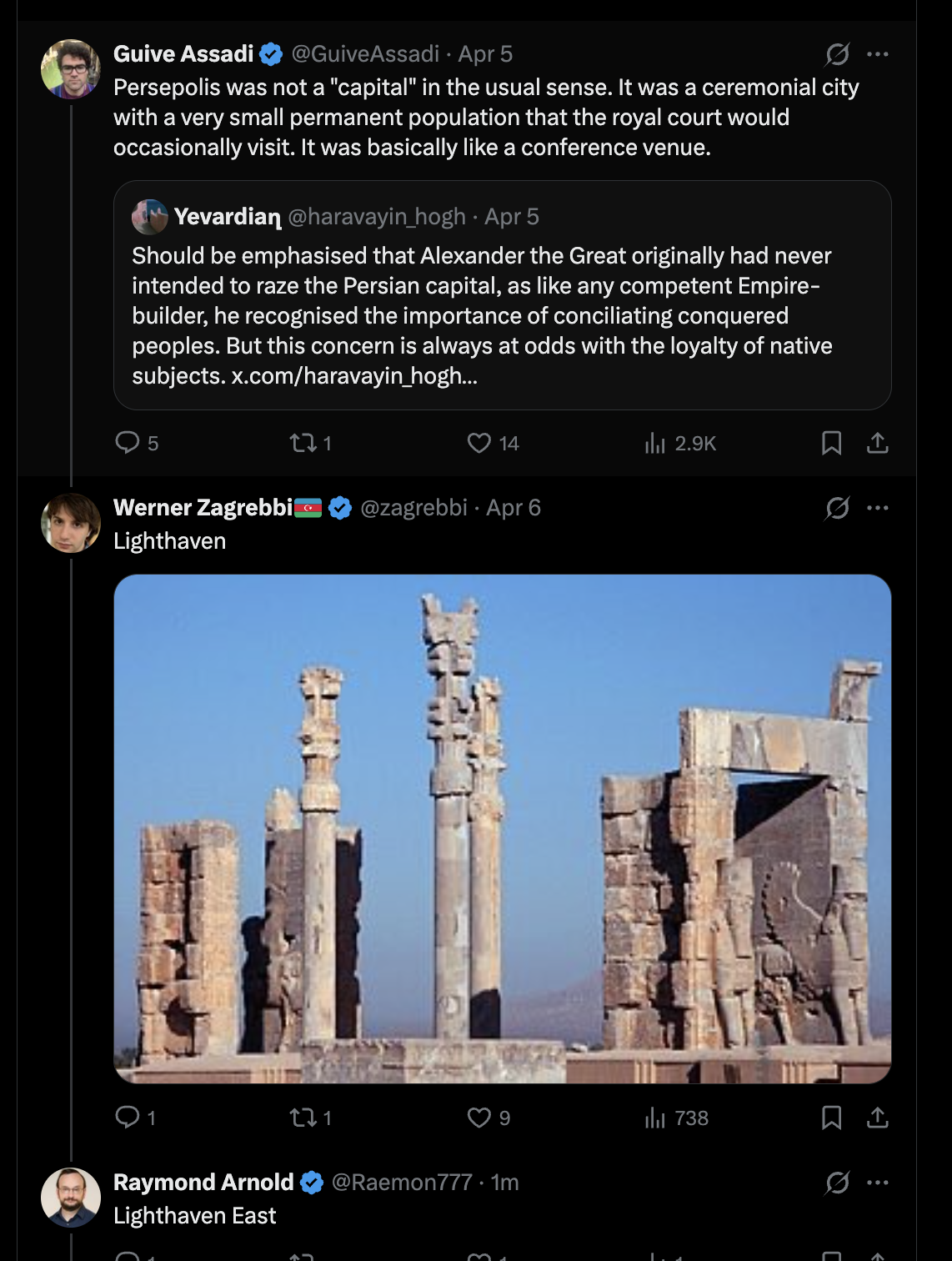
 2
2One comment on layout/design: Lighthaven is great, but it is imperfect; tied to what you said about project space, I have noticed there are some things it is not good at. When the METAGAME conference was held there last fall, I observed that there was not much in the way of affordances for pick-up board gaming. Which is not a big problem, except that the main reason was a distinct shortage of tables. Optimizing for nooks for private conversations came at the expense of being able to sit down across a table and put some shared work project between you. This probably also would impact things like negotiations between two small 'sides,' where you want a little more physical distance. I imagine this will be somewhat more relevant in DC than Berkeley.
3
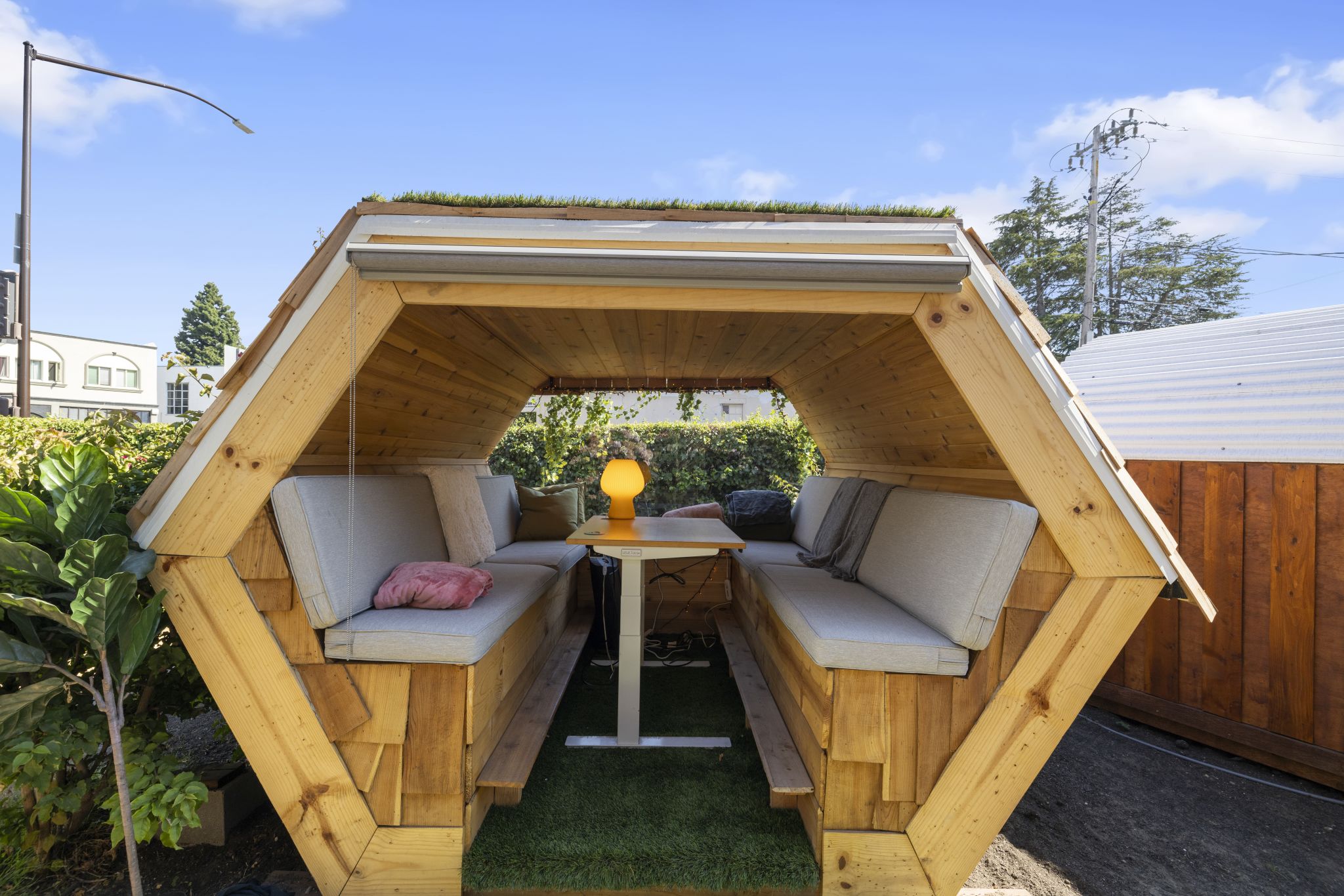
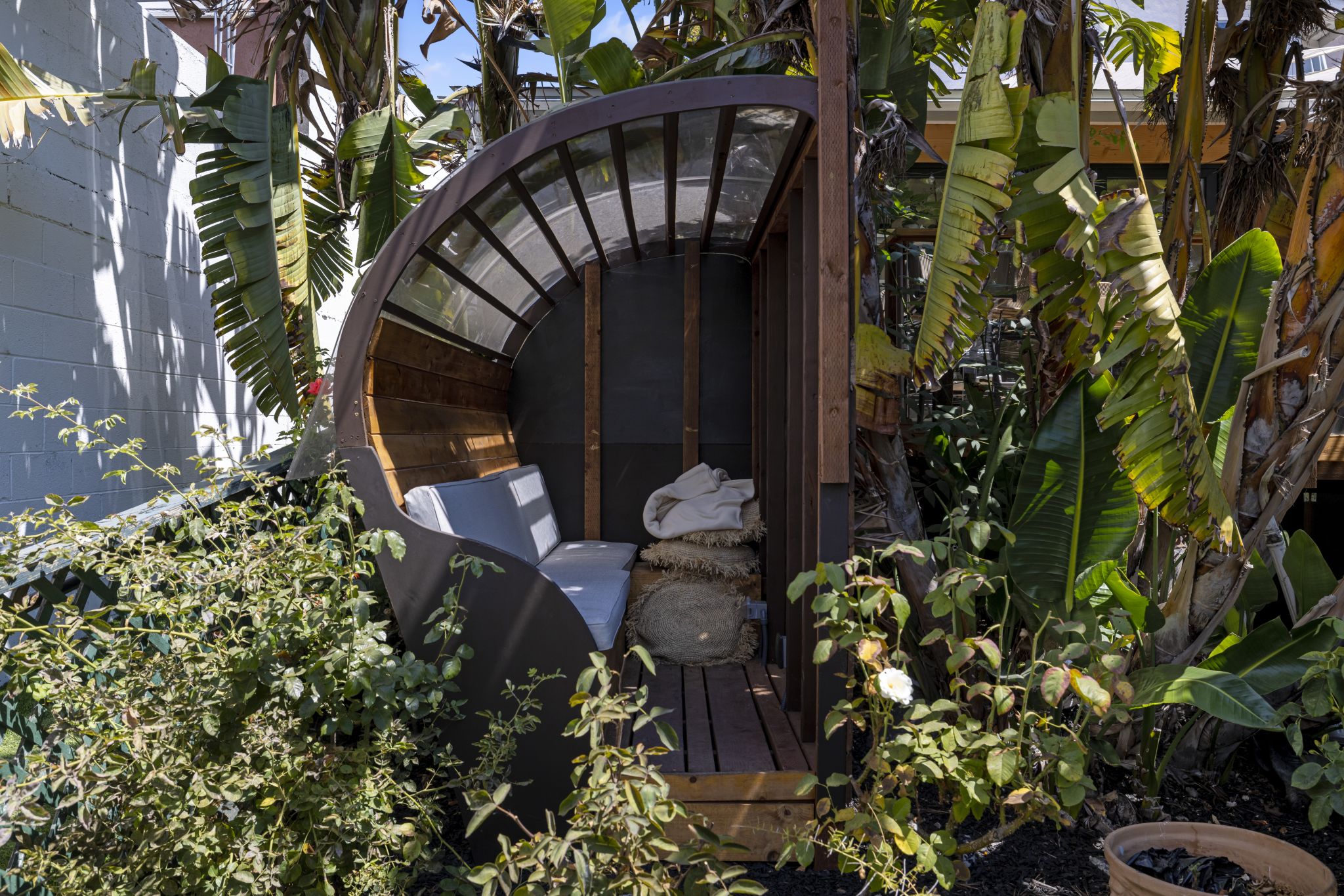
When I think of this as "Lighthaven East", I feel a bunch of objections that it's getting slimey politics all over my beautiful epistemics. When I think of it as "Lighthaven DC", it sounds potentially good.
 1
1I kinda vibe this. "Lighthaven East" is in Boston or NYC, is a more intellectual place. "Lighthaven DC" is a different beast with a very different focus (e.g. perhaps it works far harder to be politically neutral ground).
1This argument from @Elizabeth and @Ben Pace, the Vacationing Vagabond fully convinced me. We have started referring to the project internally as "Lighthaven DC", in part to clarify our intentions, in part to leave space for another version that isn't policy-focused.
I'm considering editing the post's title and body to replace each mention of "Lighthaven East" with "Lighthaven DC." What are the norms about that? Encouraged, discouraged, pedantic nuanced third choice?
Edit: Post is now changed to reflect this, with a note explaining why. Thanks for the feedback!
1I'm considering editing the post's title and body to replace each mention of "Lighthaven East" with "Lighthaven DC." What are the norms about that? Encouraged, discouraged, pedantic nuanced third choice?
Posts are long-lived artifacts intended to be iterated on and edited. This comment seems sufficient documentation of its previous state.
1Schelling House has the right vibe for me, but i prefer Schelling Hall over Schelling Point. Naming things well is hard, hopefully lots of ideas are generated.
 1
1I like Schelling House because the name does real work.
On the plain read, it says what the place is for. In D.C., around AI, people don’t really know where to meet. The project is to build the place they can all coordinate around.
Then there’s the HPMOR/rationalist read, which is hilarious. If everyone inside the HPMOR universe is trying to guess the obvious meeting spot, and one of the options is called Schelling House, then yeah, obviously everyone goes there at noon on the day.
The name is dual-coded, which adds narrative complexity. It works for outsiders as a serious game theory reference, and it works for insiders as a rationalist myth-building exercise. Coincidentally, Lighthaven kind of did the same thing. It named the thing people needed: a Haven for the Light. Schelling House names our need: a house aimed at coordination problems.
1
- Have you any particular disrespect to any present members? Answer. I have not.
- Do you sincerely declare that you love mankind in general; of what profession or religion soever? Answ. I do.
- Do you think any person ought to be harmed in his body, name or goods, for mere speculative opinions, or his external way of worship? Ans. No.
- Do you love truth’s sake, and will you endeavour impartially to find and receive it yourself and communicate it to others? Answ. Yes.
Sounds like a great inspiration, but the name sounds like "junta" which means dictatorship.
3 1
1"Spero"
I've been mulling over "Spero", from Dum Spiro Spero; Latin for "While I breathe, I hope," the motto of South Carolina. For our purposes, think Spero House, Spero Hall, or even Sperohaven (though that mixes linguistic roots).

"Dum spiro spero" in a stained glass window at Beverly Unitarian Church in Chicago, from wikimedia.

This has several features I like:
- It's distinctive; rare but not unique.
- It's meaningful; earnest and self-serious.
- Uses Latin, a subtle callback to intellectual traditions and a bit of outreach to the modern right.
- Everyone likes Cicero.
- Easy to pronounce, easy to spell (unlike Schelling or Feynman).
- Very short, only five letters and two syllables. I want to avoid acronyms wherever possible. In practice people would shorten the name in common speech down to just "Spero" rather than the awkward acronym "SH".
- Helps combat the "Doomer" narrative. The headlines of even potentially negative hit-pieces wouldn't necessarily be bad: "Fancy 'Doomer' Clubhouse in DC is Called 'Hope'?"
- Personally resonant for me.
Downsides:
- It's earnest and self-serious.
- We'll have to explain it repeatedly in speech, again and again, until the end of time. "No, not the bird, S-P-E-R-O. It's Latin for hope."
- This really only fits if we go for a building that's old and in a traditional architectural style. It wouldn't work for something modern, brutalist, or corporate. Art deco or other old futurist styles would be an interesting contrast, would depend on the site.
This came idea came to me a few days ago when I was mulling over the tone from "Nothing is Mere." I ran through the Feynman quote looking for bits that worked a place-name, nothing quite fit. But it got me thinking about more abstract directions.
I am on a years-long quest to buy a large improved property near a city and turn it into a ~100 person intentional [meta-]community which would include large scale event hosting capabilities. If my 42-bedroom Victorian estate in Massachusetts (http://est8ofmind.com) hadn't died in a fire then I'd be inviting some rationalist events here by now. I'm mostly focusing on schools (boarding high schools, small colleges, etc), but occasionally other things cross my radar.
This is the most interesting thing I've found near DC: https://www.zillow.com/homedetails/16449-Ed-Warfield-Rd-Woodbine-MD-21797/118189617_zpid/
And this is my dream property near Portland OR: https://www.codwell.org/vision/properties/oregon
I would love to see Lighthaven-like events occur in a space somewhere between those in scale, as well as more camping-focused events like VibeCamp on the grounds.
If there is room for a coliving or cohousing intentional community with maker and permaculture components alongside your plan, I would love to discuss the possibility of collaborating.
 1
1I’m assuming you’re already aware of this website, but I peruse it for fun sometimes and this building just got listed. It’s near the area where a lot of people already live and work:
And this one in NE is closer to Capitol Hill: https://www.crexi.com/properties/2566150/district-of-columbia-old-city-1-corner-assemblage
1
As a bureaucrat, my role is to annoy my friends. Someone voices an idea, “Wouldn’t it be nice if…” or “I wonder if we could…” I make a note. I do some estimates. If it pencils out, I’ll bring it back up, week after week. The discussions are fun, but also practical. We’ll test the waters, what would be a minimum viable scheme? What’s easy, what’s hard? Who could do the hard parts? Over time the idea gets more detailed, specific, feasible. I’ll pull out a calendar. Soon our scheme has co-conspirators, action items, even a budget. It’s just good staff work.
I’ve been hearing whispers in the wind for a year now.
These are all variants on a theme: “Lighthaven DC.”
I did some digging. I’m happy to report that this could work. There’s strong demand. There are good options for supply. Funding, staffing, resources, property, and permits are all doable. The hard parts are diligence, agency, and will. This project needs a champion, but it’s a thing someone can simply choose to do.
How Lighthaven Works
Legally speaking, Lighthaven is a confusing category error. It was once the ramshackle “Rose Garden Inn,” with several buildings, a hotel license, and a history of event use. After extensive renovations, it is now a 30,000 square foot campus used for conferences, retreats, office space, and medium-term lodging. The property is owned by Lighthaven LLC and financed by an interest-only mortgage held by a philanthropist. The LLC runs the property, hosts internal events, rents conference and office space to external customers, and sells hotel stays. Lighthaven LLC is itself owned by Lightcone Infrastructure, a non-profit that among other things runs LessWrong.
Economically, Lighthaven LLC generates an operating profit comparable to its cost of capital. The mortgage is $20 million at 5% interest, for an annual interest payment of $1 million. Lighthaven LLC had $3.25 million in revenue in 2025. Events and hotel stays generated an operating profit of roughly $850k, almost enough to pay the $1 million annual interest payment. Office space seems to be offered at cost. Lighthaven LLC’s projections of $3.5 million revenue in 2026 should generate an operating profit sufficient to fully fund its annual interest payment, though bookings are currently sparse for this fall.
In practice, Lighthaven is the best event venue I’ve ever seen. I won’t belabor that point in this post, but if you haven’t been to Lighthaven, see some of its many rave reviews in this footnote.[1] Lighthaven LLC does not maximize profits–events are often experimental or designed primarily to support the Berkeley community, rather than the booking going to the highest bidder. Some event organizers are not charged, others are offered discounts on rates that are already lower than similarly sized spaces at hotels. This pricing strategy generates significant positive spillover effects and goodwill, demonstrated by the community’s strong response to Lightcone’s two fundraisers. While Lighthaven was a significant cost center for Lightcone in 2023 and 2024, by 2026 it is better modeled as supporting the parent non-profit.
Conceptually, Lighthaven is a monastery. Its main purpose is to support good scholarship “dedicated to making humanity’s future go better.” Its abbot skillfully wields an awkward mix of temporal, cultural, and political authority. Monasteries often support their ecclesiastical mission by selling craft goods such as beer, eggs, mushrooms, or furniture–Lighthaven instead sells conference space. Unlike an abbey selling produce for revenue, the conferences at Lighthaven also further Lightcone’s mission. Lighthaven’s scholars-in-residence synergize with its mission, contributing to and benefiting from the events held on the property.
These aspects combine into a whole: Lighthaven is the place to go to think out loud. Comfortable perches encourage deep thought. Inviting conversation nooks encourage you to refine your ideas with friends, themselves helpfully provided by the events and scholars-in-residence. Beautiful seminar rooms encourage you to share your ideas, refining your presentation to best convey them to others. Once your ideas are fully baked, get the word out via your laptop, the antique typewriters, or having a friend interview you in the podcast studio.
What Does DC Need?
DC culture has a Lighthaven-shaped hole. Politicians have started to notice that they are confused about the future of AI. AI Policy nonprofits rent event space, mostly bars and restaurants for expensive and echoey events to grab a few minutes of staffers’ time. AI companies try to use these same spaces for technical demos, sometimes mixing beer and laptops with limited success. Technical communities of practice have unprecedented attendance as practitioners realize they need to upskill. EA and Rationalist policy organizations are scaling in DC, but each option for co-working space comes with significant downsides. Aligned conferences happen, but are held in either hotels with huge up-front costs or group houses well below their optimal attendee-count.
Resources are there to address all of these problems, people are working hard on them. But everything is scattered, hard to find. One step doesn’t necessarily lead to others. Imagine instead that someone approaching the community could have a day like the following...
A Day in the Life
Narrative about someone encountering the community through this type of venue
Our protagonist is a tech policy staffer on a relevant congressional committee, mid thirties, has spent their career in positions of increasing authority in government and not-technically-government organizations. They’re an expert in telecom policy, or broadband, or electrical grid economics, or some other sub-field of technology policy, but now they need to learn about AI. The whole office knows there’s going to be a flood of AI bills in the 120th Congress, beginning January 2027, and there are only six people on the committee staff working on technology policy at all. Everyone needs to “get smart on AI,” immediately.
Through some coverage of a book with an edgy title, they understand that this topic is risky in some controversial way. A friend on a different committee recommended they meet with a particular non-profit. The non-profit has a few people in DC permanently, but as luck would have it, this is the week when some of the senior people are visiting from California. The committee’s available conference room only seats four comfortably, so our protagonist decides to go to them, meeting at their co-working space. It’s a lovely spring Friday in DC, it’s only a mile, it’ll be a nice walk.
When our protagonist arrives, they realize they’ve been here before. There was an industry event here last month, in the main room on the first floor, showing the capabilities of some new coding system. It seemed impressive, and they requested access once back at the office, but the Architect of the Capitol won’t let that code onto government systems for at least a year. That denial is what prompted our protagonist to gripe to their colleague on another committee in the first place, ultimately prompting this meeting.
This time, they go to the co-working space on the second floor. It seems… nice, if a bit weird. It’s hard to put their finger on why the space seems brighter and more alive than a typical WeWork. Some of the furniture is custom, fitting its space exactly without being ostentatious about it. Other pieces are clearly from Ikea, but work well enough. The space has all the cliche amenities of offices in the Bay, yet these actually seem to be used, several people are sitting on some plush carpets in a corner. There are whiteboards everywhere, just a ridiculous number of whiteboards, and even the windows… no that’s different, someone has put stained glass stickers in the top third of each. Why so many paperclips?
The meeting goes well. It narrows on a particular technical point about halfway through. The non-profit staff flag down someone walking by, who quickly clarifies that he’s with a different organization, but he joins in and within minutes is diagraming the disagreement on one of the whiteboards. It seemed silly, everyone knew what those words meant, but it did seem to clear up their confusion.
Now that our protagonist is following, they want to know more. As luck would have it, there’s a conference this weekend on-site. The monitor on the wall shows there’s going to be a session on this technical point in the evening, and a workshop tomorrow afternoon. Is it too late to register? Hmm, let’s ask the organizer, they’re probably setting up downstairs. They find him avoiding the choreographed chaos in one of the many nooks, rearranging the schedule for the seventh time. There have been a few cancellations, we can print another badge.
The conference attendees gradually arrive, get checked in, and greet old friends. By the stated start time, the large hall is filled with clusters of conversations. Soon someone starts to hum, quietly, and over the next half a minute the rest of the room gradually notices and joins in. That's... different. As the last talking stops and the humming takes over, our protagonist half expects bellhop carts of robes to be rolled out, for some sort of cult ceremony. But instead, a second or two later, the humming stops and an MC makes pretty normal opening conference announcements.
They stay for dinner. If this becomes a habit they'll need to offset the gift, but a few times are fine. They get into an interesting conversation about the borders of justified regulation of technology. There's several strong opinions, for a moment the discussion is tense, but someone recommends rephrasing each argument to avoid the word "justified," which manages to show everyone meant something totally different. The conversation ends with everyone not exactly agreeing, but genuinely understanding the other perspectives. It feels like something meaningful just happened.
"I like this thing about trying not to use the word and seeing where that gets you. That was really useful. What was that?", asks our protagonist.
"That's a Rationalist technique: Taboo Your Words," replies someone who really shouldn't be seen in DC.
"A Rationalist technique? Can you explain it to me?"
"Anytime it feels like a particular word is a confusing part of the conversation, you just... remove it."
"Take it out and see if you can make your way through the same point?"
"Right, what are the things that you are forced to use instead of the contested word. The classic example is if the tree falls in the forest..."[2]
And with that, our protagonist learns their first rationalist technique. They saw several more demonstrated through the day. By the time they leave that evening, after their session, they have plans to return for the workshop tomorrow and an invitation to learn more useful techniques at a regular weekly reading group. They're still not sure what to make of this community, it seems strange and somewhat out-of-place. Yet these people clearly know some things that DC does not and seem happy to share. All-in-all, a good introduction.
Minimum Viable Lighthaven
To start to put together something like this, we need to figure out the smallest plan that might work. I believe a Minimum Viable Lighthaven requires a few key features:
Some features that are not strictly required, but are very nice-to-have if we can, include:
Hotel rooms would be a mixed blessing. They would allow us to host weekend-long residential retreats, as Lighthaven does, but it’s extra space that we’d have to purchase, maintain, and manage. This could double the overall cost of the project, without necessarily doubling steady-state revenue or providing as much value as the conference space itself. If the right property comes with hotel rooms, it could be worth it, but I think we should prefer to keep them to a minimum. And more practically, DC has avoided Berkeley’s market failure in lacking hotel rooms.
…so you mean a Group House?
Could a large group house qualify as a Minimum Viable Lighthaven?
Workshop House in DC is a case in point. It’s gorgeous, the residents and leadership are friendly, they host excellent gatherings directly and rent their space out to outside events. I’ve hosted a large event and several smaller gatherings there, they’re fantastic to work with. But it’s telling to see where even such a successful property and institution falls short of what we’re looking for.
The trouble is that it’s primarily a residence, the needs of the residents come first. Only about 2,500 of its more than 7,000 square feet is available for event use. Its largest room holds about 60 people, tightly. When booking, a lot of decisions need to be run by several stakeholders, getting to “yes” on specifics inevitably takes time. Their space is something the residents can graciously offer for up to a few days, as opposed to dedicated event space.
As a case study explains:
It’s tantalizingly close, but I think experience shows that primarily residential spaces don’t have the quality we’re trying to capture. Even if no one lived there, the floorplan would typically not work well. Conferences and retreats want some sort of large space that can hold everyone, at least briefly. I can’t find hard-and-fast rules, but I think this implies about a quarter of your total programming space should be a single room. Smaller houses can fit that criterion, but larger houses don’t tend to have a large single room that scales with the number of bedrooms unless it was specifically designed for entertaining. Even Lighthaven struggles by this measure, with the largest sessions of LessOnline and Manifest straining Rat Park (which holds about 300).
…so you mean a Co-Working Space?
Yes and no.
From what I can find, non-profit Co-Working Spaces in our community don’t tend to be self-sufficient. NET in DC, Mox in SF, Collider in NYC, and I believe Constellation in Berkeley each use grants and/or donors to sustain regular operations. While the organization could certainly seek grants for special projects, we’d want to avoid institutional fundraising to sustain regular operations. Churn is a big part of this, people leave co-working spaces when they start working for a larger org, when their project fails, and when their project succeeds and outgrows the space. Given the many ways individual co-working users can exit, even if you manage to fill the space briefly, you won’t stay full without a strong pipeline of new entrants, which can risk the institutional culture.
Further, spaces that are primarily offices just don’t feel comfortable to use. Even when the space is comfortable for the workers, it isn’t when using the space for other events. It can feel like an intrusion, there’s a friction to moving someone’s desk aside, or sitting down at it. IMO co-working spaces make good overflow space, and reasonable break-out spaces at conferences, but should not be a majority of the space. They certainly should not intrude into the main large event hall, which should be optimized for events.
That said, I think co-working is a crucial component of this project. Having our community use this project as office space helps establish it as a default meeting space, seeds conversational serendipity, and even makes it safer by providing more eyes-on-the-street. It brings in some revenue from the property during weekdays, which are otherwise hard to rent to events, and creates a built-in audience for evening talks and events. Co-working space could be a practical substitute for Lighthaven’s Scholars-in-Residence. Co-working space is a key pillar, it just shouldn’t be the main focus of the plan.
Feasibility Study
A Minimum Viable Lighthaven DC as envisioned by this feasibility study would have three main lines of business:
In my rough estimates, it’s difficult to make a venue self-sufficient with any one of these uses; which is why this venue doesn’t already exist. Including any two of them should be self-sustaining, even at 60-70% occupancy. Doing all three adds complexity, but each synergistically reinforces the other, three legs of one stool.
Given that, I think we want to buy a church. Failing that, a school, an embassy, or a small hotel.
Property
We probably don’t need a campus, specifically. The climate in Berkeley is obnoxiously perfect for outdoor use much of the year. Temperatures rarely drop below freezing or exceed 85 degrees Fahrenheit. Most rain falls in December through March, leaving eight months of drier, warmer weather. But even this is underselling the usefulness of the outdoor space at Lighthaven—I began writing this document in the Gazebo of Schemes on a bright, clear day that was too warm for a sweater… in February. This lets outdoor space double as programming space, significantly expanding the campus’s usable square footage and making the buildings feel more connected. When warm days transition to cool evenings, guests gather around fire pits or gather under blankets in nooks. DC is not this way. Summers are hotter and more humid. Winters are colder, occasionally with snow. Spring and fall tend to be nice, but are unpredictable. Event organizers in Berkeley can plan on outdoor space being usable, organizers in DC cannot rely on outdoor space in the same way.
When looking for a site in DC, we should consider the current zoning and historic use of the property. The Rose Garden Inn was zoned as “Avenue Commercial,” operated as a hotel, and had a demonstrated history of event use. The hotel license was included in the purchase and no zoning variances were required. The new owners continue to operate the property as a hotel that also rents conference space, there was no legal change in use. If Lighthaven had been zoned residential, it would have required a vote of the Berkeley city council to change its permitted use, adding at least a year and substantial risk of a “no” to any project’s timeline. Instead, Lighthaven operates “by right,” which should mean it doesn’t need much from the city.
In practice, Lighthaven works closely with the city, requires permission and permits for most improvements, some repairs, and even occupancy. Permits and inspections in old properties, especially those designated as historically relevant, necessarily require subjectivity. It often isn’t practical to bring a historic building up to modern code, but it is a judgement call just how much improvement to require. Unrelated matters, such as neighbors’ perception of how often Lighthaven guests park legally on residential streets, are not supposed to be relevant to those decisions… and yet… that’s just how people work. It is important to strive for good relationships with one’s neighbors regardless, but any city's politics may have more veto points than a straightforward reading of the law would imply.
How large should this property be? Lighthaven can comfortably host conferences of about 500 people, and parties of roughly twice that number, using about half its 30,000 square feet available as public space. This suggests a rough comfort estimate of about 30 square feet per conference attendee, though we’ll want to aim a bit higher if not relying on outdoor or private hotel space as pressure valves. However I don’t think we need quite as much public space as Lighthaven has. It might be better to aim for a property with about 10,000-12,000 sqft of public space; giving a capacity of 250-300 for conferences or 500-600 for evening events or parties. This would be particularly appealing on sites with options for later expansion.
So, this Minimum Viable Lighthaven would want a 12,000 sqft property with appropriate zoning, a history of event use, enough spare space to operate part of the property while other portions are being gradually renovated, with roughly 3,000 sqft of its space as one large room. This describes a church, in particular one with attached program space or a rectory. Other kinds of properties that might work include small schools or hotels, so long as they have an auditorium or other large event space. Embassies, or technically their chanceries, are another option; rare but appealing. Countries’ needs change over time, so chanceries do occasionally change hands as an embassy needs to upgrade or downsize. Mansions do not appeal unless already converted to and zoned for commercial use, such as for a wedding chapel.
This project is not necessarily dependent on what properties are listed for sale; the Rose Garden Inn was not. Lightcone Infrastructure approached its owners after scrolling satellite pictures of the East Bay on Google Earth to identify prospects. City churches often move to the suburbs as their membership ages and neighborhood tastes change, religious schools face similar dynamics. We might find a congregation willing to sell.
Funding
There are institutions building portions of this already. The Network on Emerging Threats hosts coworking space and monthly policy talks. It recently announced it was moving to a larger space, but the new space is less conducive to events. IFP and FAI host excellent large evening events on the roof of their office building, but the events have started to outgrow the space, the rentals are expensive, and FAI recently moved out of the building. EAs and Rats in the area also have a large social scene, with parties and socials most weekends, and policy-focused events most weekday evenings. A typical week has 8 or more public events scheduled, which are often constrained by the capacities of their venues. I estimate the community already spends over $50,000 in an average month on co-working and event space, not including the dedicated offices of larger organizations (like IFP) or larger, irregular conferences.[3]
Good commercial property in DC tends to go for up to $750 per square foot. (As an example, this property is larger and more ornate than ideal, but currently for sale at that cost.) Our desired 12,000 sqft should cost between $7-10 million. Interest rates are higher now than when Lighthaven was purchased, but if we can find a philanthropist willing to lend at 8% interest, even $12 million, the top of that budget plus $2 million for capital improvements, would come to just under $1 million per year in interest. Lighthaven has $2 million per year in operating costs. A Lighthaven DC would be smaller, without hotel rooms by default, and in a region with a lower cost of labor/living. There would still be significant operating expenses, a full time director, other full- or part-time staff, supplies, insurance, utilities, etc, but I think $1 million per year is a reasonable budget.
Between cost of capital and operating expenses, the property would need roughly $2 million per year in revenue to break even. Events and co-working on the order of what the community already has today, while capacity constrained, could cover a third of this. Many existing events wouldn’t move locations, but a venue like this would be an attractive option for new events and co-working uses. Adding in some additional latent demand, one evening corporate rental per week, and one large weekend conference per month would get the property to break-even, with substantial room to improve its offerings if it can manage more bookings.
What is the Minimally Viable Funding?
I think that a founder should not purchase property until they have secured at least the minimally viable amount of funding. There are a few key things this includes:
That last bullet is likely to be the sticking point. Every project takes time to reach full operations, this would be no different. I estimate reaching self-sufficiency would take at least two years, unless cutting corners and limiting the ambition of the project to reach that milestone earlier. Depending on the size of the property, the amount of renovation desired, and how the space is configured, it could easily take three years, or even four.
I wouldn’t necessarily insist that this project have three full years of operating costs in reserve before buying a property, some revenue will come in before the property is self-sufficient. But if it were me, I would insist on at least two years of costs in the bank regardless of revenue projections. Lightcone bought Lighthaven during a time of abundant funding. When the funding situation and Lightcone’s relationship with grantmaking organizations changed, it had to run two large community fundraisers. These fundraisers were successful and gave the Lightcone team legitimacy, a broad community endorsement of their plans and strategy. But the situation was still regrettable, there was a very real risk of losing Lighthaven, along with all the resources spent to renovate it to our specific uses.
If this project is worth funding, if its director has the faith of grant-makers or other philanthropists, they should get the resources to see their vision through. The project will almost certainly look like it is failing at the 15-month mark, with renovation timelines slipping and paid bookings still scarce. Even when renovations are done, it will take some time to build a reputation as the obvious choice for certain events. It would be a disaster, a huge un-forced error, if the director has to fundraise at those points just to complete the project. There should be checks on the director and the project, but that oversight should come from the board, not intermediate project fundraising goals.
All this taken together, I estimate Minimum Viable Funding would require about $18 million in total. Roughly two thirds could be in the form of a mortgage, the rest would be a grant:
Leadership
In the course of my interviews, I promoted one item to the “required” list from the “nice-to-have” bracket. Again and again interviewees brought up the quality of the leadership, that a single person should be responsible for implementing and living with their decisions. Every interviewee stressed the need for a passionate founder engaged over the long term. Several interviewees also stressed unity of command, that decisions need to have some single person who owns the choice and cannot be overruled, short of the decisionmaker being fired. I found this perspective convincing.
There will be part-time roles at a place like this, but the chief executive cannot be one. That person will need a rare combination of skills:
The leader of this project is the hardest constraint to satisfy. There’s a very short list of people well qualified in each of these categories; most have other jobs that they seem to like. I think there’s a longer list of up to a few dozen people who excel in most of these criteria, who with enough self-knowledge and humility could manage to cover for their lack in an element or two.
This job would be incredibly rewarding, personally and professionally. This must not be a volunteer role. I believe the community would be willing to pay well, on the order of $200k or more depending on experience, to have this job done well.
If the description above sounds like you, get in touch.
Cultural Fit
This property should appeal to more than just the rationalist community, Lighthaven already does. AI companies already rent bars, restaurants, and conference space to do technical demos for government and NGO staffers. There are also centrist-leaning political movements with some popular support and donor interest, who could be interested.
As Lighthaven is the cultural headquarters of the LessWrong community, a Lighthaven in DC could position itself as the cultural headquarters of the Progress Studies branch. This would give it a compelling raison d'etre: Lighthaven Berkeley generates the ideas, Lighthaven DC gets them into the posting-to-policy pipeline. A focus on Progress Studies may also attract more interest from donors.
In policy spaces, opposing political factions interact socially more than many people outside DC would expect. Renting space to politically-relevant actors is tricky, we wouldn’t be as neutral as, say, a bar or hotel. But I think there is room in the center to rent to both the center-right and center-left, Anduril and Anthropic, without making too many enemies.
Crafting this coalition, determining who this space is ultimately for, is not a one-time decision. It is decided day-by-day as the director makes a series of small decisions and actions that accrue into a reputation. Which booking gets the popular weekend? Which organizations get discounts? Who are the first people invited to co-work, the second wave that builds off of that founder effect? When there are inevitable fights about associating with people one side or the other considers bad, where do they draw the line? Who’s worth defending? Who should be excluded, despite their popularity? These choices cannot be realistically delegated, because one of the skills is noticing that an issue is culturally-relevant at all.
I described Lighthaven as a monastery because its cultural output is ultimately the point. This is also true of any potential DC version. Its director will need to understand and be comfortable wielding cultural power, as much or more than the temporal power over the space. And this path will have to be plotted largely without a map.
Name and Brand Positioning
“Lighthaven DC” is a working title for the project, but should not be the name of the space itself. We will need to avoid anchoring too closely on Lighthaven’s culture and norms, for two key reasons. First, a lot of what makes Lighthaven work well is adaptation to its environment. It uses the climate well, it plays off of norms the Berkeley community has spent over a decade honing. Second, the game is rigged, it’s exceedingly difficult to beat Lighthaven at being a Lighthaven. The new project will need to build its own coalition, niche, and animating spirit, so that it can be well adapted to its new environment.
I feel strongly that it should not be named for the lead donor. I think it’s reasonable for the donors to have input into the name, location, and aesthetics. But naming the venue after a donor is too far. It’s a bit tacky, implying a vanity project, but more importantly it weakens the authority of the Director. Besides, there’s a certain cachet that comes from discovering an open secret, let people have the fun asking “Huh I wonder who’s behind [final name]?,” and then finding out.
One name that we’ve begun workshopping is “Posterity Center.” It hits several notes: focuses on a long-term perspective, references the Preamble to the US Constitution, and alludes to Bayes. It’s not quite perfect. It’s a little too long, it feels like four or five syllables should be the limit, but alternatives don’t quite work; “Posterity” doesn’t feel like it works on its own, and “Posterity House” feels slightly too informal. It also seems a bit too… something… maybe self-serious? I recall, however, that I first thought the name “Lighthaven” was too pretentious even for me, and yet it has certainly grown on me.
We welcome more name ideas and feedback, and I’ll create a parent comment to collect name discussion in one place.[4] Note that this post originally used the term "Lighthaven East," but we pivoted to the "Lighthaven DC" framing based on feedback.[5]
Ability to Scale
Twitter recently discussed a coming wave of non-profit demand and funding. Could we do more with more?
In short: yes, we could!
The additional funding would have to come at the start for maximum leverage. When shopping for an initial site, more money gives many more options, later expansion is constrained to the area surrounding the chosen site. A larger space would probably need more time to reach self-sufficiency, since I expect use of a space would scale mostly independently of its size, at least at first. Stable, committed funding would be key for larger plans; larger venues would come with at least proportional increases to the operating expense, renovation, furnishing, and runway budgets. There’s an argument that larger properties might need more-than-proportional increases in non-property costs, meaning that overall project cost scales faster than total square footage, given the harder path to self-sufficiency and higher risks to the core project.
All that said, there are major advantages to larger spaces. Many benefits are obvious, more capacity for events and organizations, political proof-of-work (i.e., prestige), more option value for smaller events to spread out, avoiding the deeply unpleasant coordination failure of everyone trying to shout over each other in a small space. Others are more subtle or speculative. Lighthaven aspires to be something like the Bell Labs of old, but notably lacks project space. More space means more room, literally, to experiment with function, such as allowing overnight stays, more permanent setups for meetups and organizations, different kinds or styles of renovation, even lab or maker spaces. I would not argue that a larger project is higher EV per dollar than a 12ksqft one, but in success it would clearly be more impactful in total. In a hits-based giving model, more funding buys more potential upside, since any successful experiments could be scaled.
Another benefit, Capitol Hill has some unique features, all else equal it’s the neighborhood we should prefer. There are lots of sites in the 5-8,000 sq ft range, too small for our use, and some appealing options closer to 20,000 sq ft, but Capitol Hill is comparatively weak in the 12,000 sq ft range. More ambitious funding would make proximity to Congress more feasible.
Risks
This would be a high-profile endeavor. Because policymakers in DC would be a key target audience, failure would be much more visible and salient to them than any other comparatively-sized project. This sort of reputational damage is hard to quantify, hard to even describe, but very real. I do not think even a high-profile failure would be as damaging as the FTX collapse was to the community, but worst-case scenarios could approach perhaps a tenth of that reputational damage if handled poorly.
These risks can be mitigated, though not eliminated, with a strategy of “Don’t do stupid shit.” This is yet another reason why the director of this project needs an easy familiarity with DC culture and norms, what constitutes “stupid shit” is not always obvious to those who haven’t spent time in the Beltway. We should aim to scale the project deliberately, and somewhat quietly at first. We should inculcate an appropriate institutional culture before inviting high-profile political figures.
The organization, its leadership, and its funders would become the target of opposition research, would need to avoid certain impropriety. Yet mitigating this risk can, and often does, go too far. I personally worry that the EA community has over-learned the lessons of FTX, and tries too hard to appear normal. Those associated with the project should be and appear to be trustworthy, should be and appear to be reliable, but should not try to pretend their views are more mainstream than they in fact are. The point would be to promote outside-the-Overton-Window ideas in a high-profile, high-trust way, giving us more credibility when our ideas later prove right. The project shouldn’t sacrifice this key feature in an attempt to seem more politically palatable. We should not pretend this project is a normal thing to do. It should be weird, and edgy, and cool, just in a well-calibrated way.
Basically, I’m saying we should have robes but only break them out for parties.
More mundane risks to the feasibility of the project include:
First Steps
There are three key blockers for this plan: a founder, money, and a site. In an ideal world, a founder would step up, approach philanthropists and arrange financing, then simply buy the best option available for sale. Straightforward, sequential, looks great on a Gantt chart.
It may not be that simple. Three-way matching problems are notoriously difficult, each of these elements feeds back into the others. Philanthropists may not be willing to commit until an ideal site comes on the market. Some potential founders may be more willing to work with certain philanthropists or organizations. Other potential founders may be more dependent on the site, perhaps more willing to run a smaller venue, or one that is Congressionally focused.
In practice, whichever constraint is filled first will exert outsized control. If someone has a site to offer, the rest must either cohere quickly or not at all… whether the site is the best available for our purposes will be de-emphasized. If a funder gets excited before a founder, we risk a muddled vision, inconsistent execution, and different departments optimizing for different goals. These problems can be avoided if the vision comes first.
If this calls to you…
the lightcone needs you to lock in son
https://x.com/uneventual/status/1991692767001735510
Start with Every Bay Area Walled Compound.
Then, Scott Sumner:
Scott Aaronson, writing "Guess I'm a Rationalist Now" after his first visit:
TracingWoodgrains:
Theo Jaffee:
For further design details, see this interview:
This exchange sounds far too cute and contrived, but it literally happened, nearly word for word (I edited for clarity), in this recent podcast between Aella and CJ the X. In the opening part of the podcast, they disagree about the meaning of the word "cool." Aella suggests tabooing the word at about minute 6 and it quickly resolves their confusion. The quoted exchange starts at minute 9, once CJ the X notices what happened and asks about it.
Note that this and following are rough financial estimates suitable for judging feasibility. We can elide a lot of detail, for now, since Lighthaven serves as a benchmark for comparison. A full project or grant proposal would have much more detailed budgetary estimates.
Comment here:
https://www.lesswrong.com/posts/95NgkvZKJx8tJbtn5/lighthaven-east-a-feasibility-study?commentId=KM4rMPi62hkrBKh8Z
Spurred by some in-person feedback and @Elizabeth's point here.