The market doesn't give a shit how hard you worked. Users just want your software to do what they need, and you get a zero otherwise. That is one of the most distinctive differences between school and the real world: there is no reward for putting in a good effort. In fact, the whole concept of a "good effort" is a fake idea adults invented to encourage kids. It is not found in nature.
--Paul Graham (When I saw this quote, I thought it had to have been posted before, but googling turned up nothing.)
I disagree with this quote. In the real world, many things are't all or nothing. The equivalent of a good effort isn't not producing any software, it's producing software that's marginally worse than the best software you could produce. That software will sell marginally less well than the best software you could produce, and produce marginally less profit, but it will still sell.
That's not necessarily false, but it's a dangerous thing to say to yourself. Mostly when I find myself thinking it, I've just wasted a great deal of time, and I'm trying to convince myself that it wasn't really wasted. It's easy to tell myself, hard to verify, and more pleasant than thinking my time-investment was for nothing.
We often like to think of World War II as a triumph of freedom over totalitarianism. We conveniently forget that the Soviet Union was also one of the winners.
Followed by:
Him: We walked along the sea for days and we didn't learn anything. Up here we're learning lots.
Her: We haven't learned why the sea rose.
Him: But maybe we were never going to.
Him: There's food and water here. I don't want to go all the way back down, walk along the sea for a few more days, then have to turn around.
Him: Maybe the sea is too big to understand. We can't answer every question.
Her: No, But I think we can answer any question.
A majority of life's errors are caused by forgetting what one is really trying to do.
-Charlie Munger
“Whenever serious and competent people need to get things done in the real world, all considerations of tradition and protocol fly out the window.”
Neal Stephenson - "Quicksilver"
I suspect that many traditions and protocols promote competent decision making. Do you think that, say, the U.S. military would do better in Afghanistan if President Obama issued an order declaring "when in battle ignore all considerations of tradition and protocol"? Group coordination is hard, organizations put a huge amount of effort into it, and traditions and protocols often reflect their best practices.
"The Navy is a master plan designed by geniuses for execution by idiots. If you're not an idiot, but find yourself in the Navy, you can only operate well by pretending to be one." -Herman Wouk, The Caine Mutiny
the mass of an object never seems to change: a spinning top has the same weight as a still one. So a “law” was invented: mass is constant, independent of speed. That “law” is now found to be incorrect. Mass is found to increase with velocity, but appreciable increases require velocities near that of light. A true law is: if an object moves with a speed of less than one hundred miles a second the mass is constant to within one part in a million. In some such approximate form this is a correct law. So in practice one might think that the new law makes no significant difference. Well, yes and no. For ordinary speeds we can certainly forget it and use the simple constant-mass law as a good approximation. But for high speeds we are wrong, and the higher the speed, the more wrong we are.
Finally, and most interesting, philosophically we are completely wrong with the approximate law. Our entire picture of the world has to be altered even though the mass changes only by a little bit. This is a very peculiar thing about the philosophy, or the ideas, behind the laws. Even a very small effect sometimes requires profound changes in our ideas.
Richard Feynman Lectures on Physics
"I didn't go spiralling down. Because there is no abyss. There is no yawning chasm waiting to swallow us up, when we learn that there is no god, that we're animals like any other animal, that the universe has no purpose, that our souls are made of the same stuff as water and sand."
I said, "There are two thousand cultists on this island who believe otherwise."
Michael shrugged. "What do you expect from moral flat-Earthers, if not fear of falling?"
-- Greg Egan, "Distress".
You can't trust your intuitions [in this domain]. I'm going to give you a set of rules here that will get you through this process if anything will. At certain moments you'll be tempted to ignore them. So rule number zero is: these rules exist for a reason. You wouldn't need a rule to keep you going in one direction if there weren't powerful forces pushing you in another.
header: funtime activity: casually accusing people of machiavellianism.
man: i’m hungry. we should buy lunch.
woman: OH, so you’re saying THE END JUSTIFIES THE MEANS?
--Zack Weinersmith, SMBC rejected ideas
... (read more)IF you can keep your head when all about you
Are losing theirs and blaming it on you,
If you can trust yourself when all men doubt you,
But make allowance for their doubting too;
If you can wait and not be tired by waiting,
Or being lied about, don't deal in lies,
Or being hated, don't give way to hating,
And yet don't look too good, nor talk too wise:If you can dream - and not make dreams your master;
If you can think - and not make thoughts your aim;
If you can meet with Triumph and Disaster
And treat those two impostors just the same;
If you can bear to hear the truth you've spoken
Twisted by knaves to make a trap for fools,
Or watch the things you gave your life to, broken,
And stoop and build 'em up with worn-out tools:If you can make one heap of all your winnings
And risk it on one turn of pitch-and-toss,
And lose, and start again at your beginnings
And never breathe a word about your loss;
If you can force your heart and nerve and sinew
To serve your turn long after they are gone,
And so hold on when there is nothing in you
Except the Will which says to them: 'Hold on!'If you can talk with crowds and keep your virtue,
Or walk with Kings - nor lose the common touch,
If neither foes nor loving fr
A number of isolated facts does not produce a science any more than a heap of bricks produces a house.
Alfred Korzybski - Science and Sanity Page 55
While this is true, it's often the case that you have to start by collecting the isolated facts, just as you'd start building a house by buying some number of bricks.
The reason that testability is not enough is that prediction is not, and cannot be, the purpose of science. Consider an audience watching a conjuring trick. The problem facing them has much the same logic as a scientific problem. Although in nature there is no conjurer trying to deceive us intentionally, we can be mystified in both cases for essentially the same reason: appearances are not self-explanatory. If the explanation of a conjuring trick were evident in its appearance, there would be no trick. If the explanations of physical phenomena were evident in their appearance, empiricism would be true and there would be no need for science as we know it. The problem is not to predict the trick's appearance. I may, for instance predict that if a conjurer seems to place various balls under various cups, those cups will later appear to be empty; and I may predict that if the conjurer appears to saw someone in half, that person will later appear on stage unharmed. Those are testable predictions. I may experience many conjuring shows and see my predictions vindicated every time. But that does not even address, let alone solve, the problem of how the trick works. Solving it requires an explanation: a statement of the reality which accounts for the trick's appearance.
David Deutsch, The Beginning of Infinity
When philosophers use a word—"knowledge", "being", "object", "I", "proposition", "name"—and try to grasp the essence of the thing, one must always ask oneself: is the word ever actually used in this way in the language-game which is its original home?—What we do is to bring words back from their metaphysical to their everyday use. You say to me: "You understand this expression, don't you? Well then—I am using it in the sense you are familiar with."— As if the sense were an atmosphere accompanying the word, which it carried with it into every kind of application.
Ludwig Wittgenstein, Philosophical Investigations 116-117
[Death] does not add up. All you can say is that: no. No, these books do not balance. Not even in Newtonian terms. The only terms in which they make sense are Darwin’s, and no one wants to go there. There are no protagonists in Darwin, and everybody wants to be a protagonist.
John Dolan, of all people.
Because of the way evolution operates, the mind consists of many, many parts, and these parts have many different functions. Because they're designed to do different things, they don't always work in perfect harmony.
Why Everyone Else Is A Hypocrite, by Robert Kurzban, p. 6.
The CS people screamed that the problem was NP-hard, computationally intractable, etc. But we didn't know what any of that meant, so we got it working.
A reply to the request in The Register for programmers to share their experiences working on computationally intractable tasks.
For the particular problem that comment is discussing (automatic code generation), I suspect that the CS people were describing about a general automatic code generation problem, and the engineers solved a relaxation to that problem which was not in fact intractable.
In general, I don't know how much I like the P-NP distinction. I hear from people who have been in the metaheuristics field for a while that until that became common knowledge, it was basically impossible to get a heuristic published (because you couldn't provably find the optimal solution). But it seems like that distinction leads to an uncanny valley of ignorance, where a lot of people avoid problems that are NP hard instead of looking in their neighborhood for problems that admit polynomial-time algorithms. (For example, instead of "find a tour that is not inferior to any other tour" use "find a good tour" for the TSP.)
Human consciousness isn't optimized for anything, except maybe helping feral hominids survive in the wild.
-Charles Stross, "Rule 34"
It is entirely reasonable to believe that Obamacare is terrible policy that will hurt more people than it helps. Your inability to grasp that anyone has this belief does not mean that everyone who disagrees with you is a venal, amoral wretch; it means that you have been blinded by confirmation bias and your own lack of empathy...
Similarly, it is entirely reasonable to believe that Obamacare is good policy that will help more people than it hurts. The fact that you think otherwise does not mean that the law’s supporters are too stupid to be allowed near sharp objects. It means that they are valuing different things -- expanded coverage over innovation, for instance -- or else that their assessment of the probability that various things will go wrong is different from yours.
Mu means "no thing." Like "quality" it points outside the process of dualistic discrimination. Mu simply says, "no class: not one, not zero, not yes, not no." It states that the context of the question is such that a yes and a no answer is in error and should not be given. "Unask the question" is what it says.
.... [Somewhere later]
That Mu exists in the natural world investigated by science is evident. […] The dualistic mind tends to think of Mu occurrences in nature as a kind of contextual cheating, or irrelevance,... (read more)
“For the sin of the idolater is not that he worships stone, but that he worships one stone over others.”
-Scott Bakker
This is actually just a chapter opener in a fantasy story, but I like it as a sort of short hand for the de-mystifying rainbows sequence. Everything is connected and that's ok.
The hedgehog and the Fox: Hedgehogs "know one big thing" and have a theory about the world; they account for particular events within a coherent framework, bristle with impatience toward those who don't see things their way, and are confident in their forecasts. They are also especially reluctant to admit error. For hedgehogs, a failed prediction is almost always "off only on timing" or "very nearly right". They are opinionated and clear, which is exactly what television producers love to see on programs. Two hedgehogs on... (read more)
If you find yourself with mind control powers and tempted to do something evil, you can probably get more of what you want by working on yourself and being good.
jimmy, the resident non-evil cognitive engineer.
Nullius in verba. (On the words of no one.)
Motto of the Royal Society.
I prefer the translation: "Take no one's word for it."
... (read more)Umm…well this is going to sound silly, but I was actually not terribly well-trained as a scientist in college; I was much more of the social science type, so I actually never took any chemistry or physics in college and don't have a very good fundamental grounding. So I am easily panicked in my science and I think thus I can easily imagine more readily than most people in my position how somebody else can be. I think sort of pedagogically where that came about: during grad school I wound up in a grad school that didn’t have an undergraduate college—it was
And yet the quote fails to communicate clearly.
At first James thought they were joking because, "You know, Hidden Object Games". But then, after a moment, James realised they were absolutely right. Why hadn't we done a show on Hidden Object Games?
Extra Credits react to their surprise.
One of my professors, in a lecture covering compulsory cache misses and prefetching:
Well... the engineers won't give up that easily, just because you called it "compulsory." The competitors are climbing on Moore's Law Ladder, we better do something!
Unrelated to the rationality content of this quote, he thinks Moore's Law is a self-fulfilling prophecy, because how fast chip manufacturing improves depends on how hard engineers work, which depends on how hard they think their competition will work, which is an interesting idea that I hadn't heard before him.
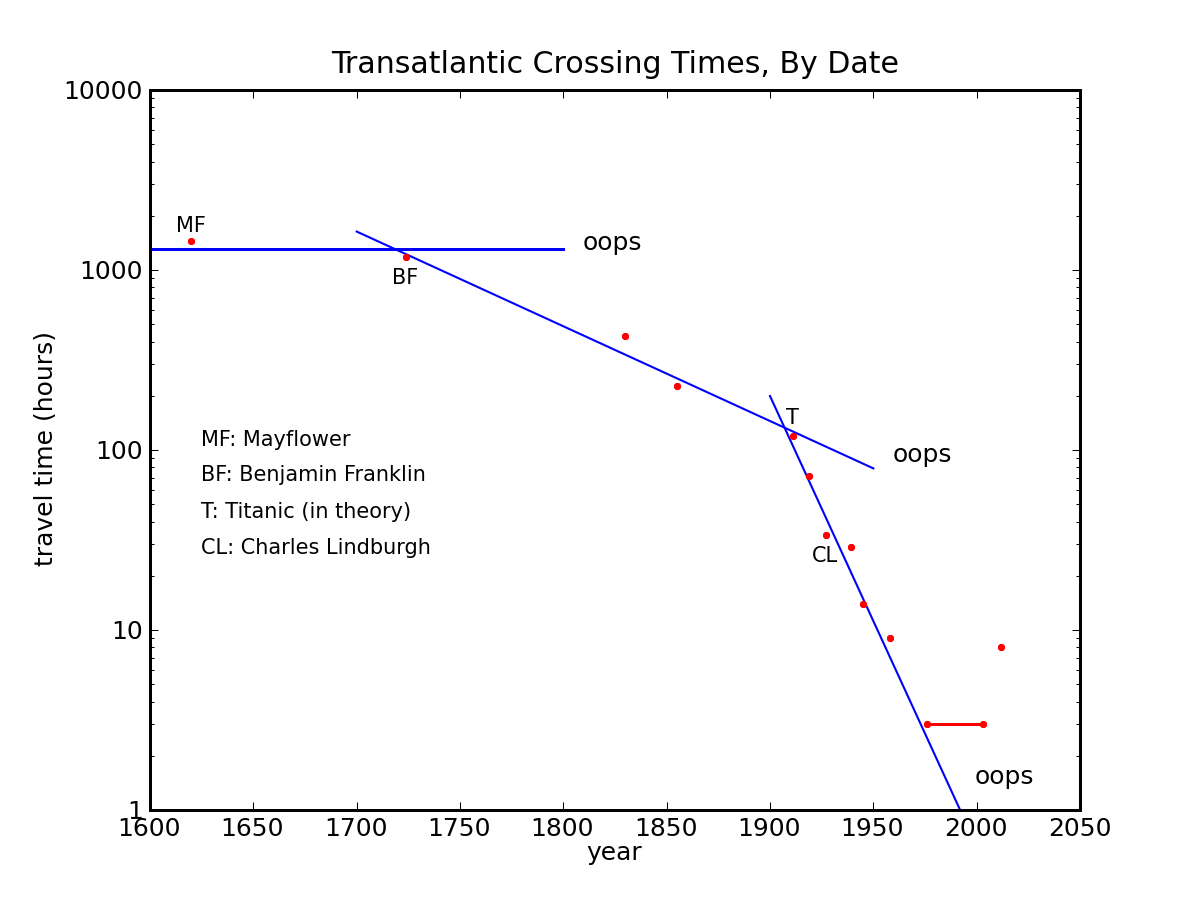
The interesting part of Moore's Law is the fact that it's even possible. If there was a Moore's Law for the speed of motor vehicles it would soon fail regardless of how hard anyone tried to make it true.
That's because we're already at to the limits. There was a Moore's Law for the speed of transatlantic ships for about two centuries, and one for transatlantic flights for about half a century. (And I kind-of doubt Moore's Law will last for much longer.)
EDIT: though if you measure them in doubling times rather than in years, I agree that those for vehicles weren't anywhere near as impressive.
Sometimes I think that I'm surrounded by idiots everywhere. Then I remind myself that that's exactly what an idiot would think.
... (read more)What makes a mind powerful--indeed, what makes a mind conscious--is not what it is made of, or how big it is, but what it can do. Can it concentrate? Can it be distracted? Can it recall earlier events? Can it keep track of several different things at once? Which features of its own current activities can it notice or monitor? When such questions as these are answered, we will know everything we need to know about those minds in order to answer the morally important questions. These answers will capture everything we want to know about the concept of cons
Moral courage doesn't reside in "doing good" so much as in fighting the bad.
I never am really satisfied that I understand anything; because, understand it well as I may, my comprehension can only be an infinitesimal fraction of all I want to understand about the many connections and relations which occur to me, how the matter in question was first thought of or arrived at, etc., etc
In all our eons, we've seen continents frozen and the sun blotted out by ash—and we're still here. A decade after K-Day, and we're still here. I've never believed in the end times. We are mankind. Our footprints are on the moon. When the last trumpet sounds and the beast rises from the pit—we will kill it!
Stacker Pentecost, Pacific Rim: Tales from Year Zero
If you agree that God wouldn't have a human-like personality and human-like needs and ambitions, you end up with a God who is indistinguishable from the sum of the laws of physics.
Scott Adams arguing that "that human personalities are nothing but weaknesses and defects that we romanticize" and that God would have no weaknesses and therefore no personality.
Since the local idea of a superintelligence implies that a foomed AGI would have no human weaknesses (and likely a goal system that is so incomprehensible to humans as to be indistinguishable... (read more)
To function as a Human being, you are forced to accept a minimum level of deception in your life. The more complex and challenging your life the higher this minimum. At any given level of moral and intellectual development, there is an associated minimum level of deception in your life. If you aren't deceiving others, you are likely deceiving yourself. Or you're in denial
You can only lower the level of deception in your life through further intellectual and moral development. In other words, you have to earn higher levels of truth in your life.
--- VGRao (Be Slightly evil)
I can't find a specific meaning in this. What does "accept deception" mean: to lie to others, to pretend inability to see through specific lies of others, or to just be generally aware that more information on average contains more false information without know specifically which parts are false?
The needs of the many...outweigh...the needs of the few."
-Mr Spock, Star Trek II: The Wrath of Khan
In a less regular, or low-validity, environment, the heuristics of judgement are invoked. System 1 is often able to produce quick answers to difficult questions by substitution, creating coherence where there is none. The question that is answered is not the one that was intended, but the answer is produced quickly and may be sufficiently plausible to pass the lax and lenient review of System 2. You may want to forecast the commercial future of a company, for example, and believe that this is what you are judging, while in fact your evaluation is dominated... (read more)
A heroine needs a more supple courage. She must negotiate: with her emotions, with her adversaries, with her family, with hypocrisies. But not, if she can help it, with her ambition.
I beseech you, in the bowels of Christ, think it possible that you may be mistaken.
-- Oliver Cromwell
Previously posted two years ago. I'm curious if some things bear repeating. Is there any accepted timeframe for duplicates?
“By poet, I mean that farmer who plows his field with a plow that differs, however little, from the plow he inherited from his father, in order that someone will come after him to give the new plow a new name; I mean that gardener who breeds an orange flower and plants it between a red flower and a yellow flower, in order that someone will come after him to give the new flower a new name; or that weaver who produces on his loom patterns and designs that differ from those his neighbors weave, in order that someone will give his fabric a new name. By poet, I... (read more)
"That which can be destroyed by the truth should be." - P. C. Hodgell
Love survives the truth.
Sam Harris
(I am aware that the first would be inappropriate alone, but I felt it provided the correct setup for the Sam Harris, which he said at the Festival of Dangerous Idea in the questions)
Added: The context of Harris was a questioner asking 'If contra-causal free will doesn't exist, then do our decisions to love people not exist?' Harris was saying his argument forced us to give up false beliefs and the false emotions that followed from them (hatred), but our belief that love exists is still correct.
Great damage is usually caused by those who are too scrupulous to do small harm.
Another month has passed and here is a new rationality quotes thread. The usual rules are: