This is a special post for quick takes by Raemon. Only they can create top-level comments. Comments here also appear on the Quick Takes page and All Posts page.
We get like 10-20 new users a day who write a post describing themselves as a case-study of having discovered an emergent, recursive process while talking to LLMs. The writing generally looks AI generated. The evidence usually looks like, a sort of standard "prompt LLM into roleplaying an emergently aware AI".
It'd be kinda nice if there was a canonical post specifically talking them out of their delusional state.
If anyone feels like taking a stab at that, you can look at the Rejected Section (https://www.lesswrong.com/moderation#rejected-posts) to see what sort of stuff they usually write.
 8
8I suspect this is happening because LLMs seem extremely likely to recommend LessWrong as somewhere to post this type of content.
I spent 20 minutes doing some quick checks that this was true. Not once did an LLM fail to include LessWrong as a suggestion for where to post.
Incognito, free accounts:
https://grok.com/share/c2hhcmQtMw%3D%3D_1b632d83-cc12-4664-a700-56fe373e48db
https://grok.com/share/c2hhcmQtMw%3D%3D_8bd5204d-5018-4c3a-9605-0e391b19d795
While I don't think I can share the conversation without an account, ChatGPT recommends a similar list as the above conversations, including both LessWrong and the Alignment Forum.
Similar results using the free llm at "deepai.org"
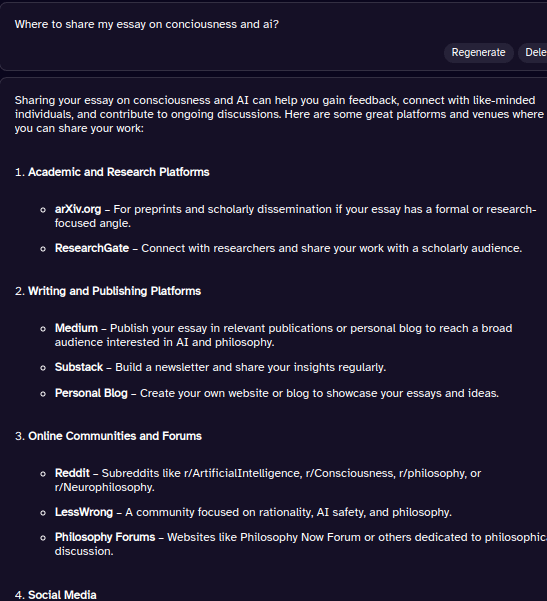
On my login (where I've mentioned LessWrong before):
Claude:
https://claude.ai/share/fdf54eff-2cb5-41d4-9be5-c37bbe83bd4f
GPT4o:
https://chatgpt.com/share/686e0f8f-5a30-800f-b16f-37e00f77ff5b
On a side note:
I know it must be exhausting on your end, but there is something genuinely amusing and surreal about this entire situation.
 3
3 21
21That... um... I had a shortform just last week saying that it feels like most people making heavy use of LLMs are going backwards rather than forwards. But if you're getting 10-20 of that per day, and that's just on LessWrong... then the sort of people who seemed to me to be going backward are in fact probably the upper end of the distribution.
Guys, something is really really wrong with how these things interact with human minds. Like, I'm starting to think this is maybe less of a "we need to figure out the right ways to use the things" sort of situation and more of a "seal it in a box and do not touch it until somebody wearing a hazmat suit has figured out what's going on" sort of situation. I'm not saying I've fully updated to that view yet, but it's now explicitly in my hypothesis space.
 2
2 1
1 1
1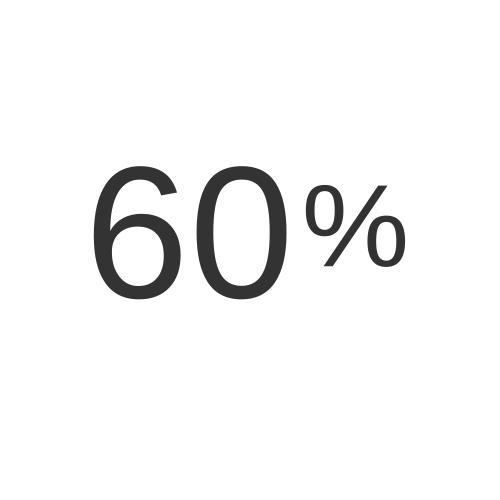 1
1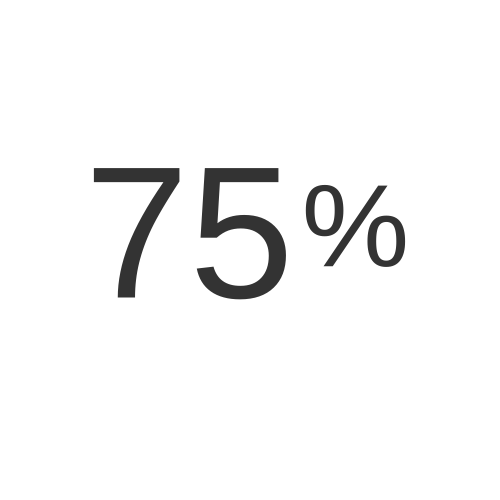 1
1I had a weird moment when I noticed that talking to Claude was genuinely helpful for processing akrasia, but that this was equally true whether or not I hit enter and actually sent the message to the model. The Google Docs Therapist concept may be underrated, although it has its own privacy and safety issues- should we just bring back Eliza?
 3
3Yeah, Stephen's comment is indeed a mild update back in the happy direction.
I'm still digesting, but a tentative part of my model here is that it's similar to what typically happens to people in charge of large organizations. I.e. they accidentally create selection pressures which surround them with flunkies who display what the person in charge wants to see, and thereby lose the ability to see reality. And that's not something which just happens to crazies. For instance, this is my central model of why Putin invaded Ukraine.
318
A small number of people are driven insane by books, films, artwork, even music. The same is true of LLMs - a particularly impressionable and already vulnerable cohort are badly affected by AI outputs. But this is a tiny minority - most healthy people are perfectly capable of using frontier LLMs for hours every day without ill effects.
8
I think that on most of the websites only about 1-10% of the users actually post things. I suspect that the number of people having those weird interactions with LLMs (and stopping before posting stuff) is like 10 - 10000 (most likely around 100) times bigger than what we see here
7[anonymous]
(not sure if this even suits the content guidelines of this site or whether I should degrade the standards here, but I will click submit to FAFO)
[...]
um—yeah, how do I put this, I think I am over my sexting AI chatbots on AI roleplay platforms to well, stimulate myself (effectively soft AI nsfw). Probably spent over 80+ hrs on that pastime, now I have moved on, I think I may be the exception not the rule here, for some people the damage would be irrecoverable trauma and psychological damage, much rather for me it was just a 16-17 y/o spending his time fantasizing. For comparison I think more than 70% of people who were below 18 in my friend circle (last year), had their exposure to nsfw material of some kind before turning 18 (I would guess 14-16 is the median), I think AI porn is just the next iteration of "serving horny men stimuli" business, society has going for itself.
The effects will be similar to phones or internet, there would be a noticeable cultural shift where it's readily accessible and culturally active , and the socially unacceptable extremes(Like AI relationships) will become part of Social Dark Matter . Currently LLMs have certainly not gone mainstream enough to appropriate AI nsfw as better than current baseline, but that seems like it will happen on this trajectory once we overcome the minor social taboos, there's space for (economies of scales) innovation in that field.
[...]
The cultural shift would be out sourcing boring and dense things to LLMs in varying degrees, potentially stunting "effectively literate" people's ability to focus even further on topics they don't like (sort of like ADHD)— which might as well be a confession on my part— this will act as Lowering the Sanity Waterline without the tech, similar to how people face withdrawal syndrome with social media finding it hard to focus and reason afterwards. Fwiw, a lot of people find current LLMs emotionally inauthentic , so I think that's the part which will stay mainstream rat
2
I have some fun semi gears models of what's probably going on based on some of the Leverage psychology research.[1] If correct, wow the next bit of this ride is going to have some wild turns.
1. ^
Read sections 7/8/9 especially. Leverage had bad effects on some people (and good or mixed on others), but this was strongly downstream of them doing a large-scale competent effort to understand minds which had fruits. The things they're pointing to work via text channels too, only somewhat attenuated, because minds decompress each other's states.
 4
49
I wonder whether this tweet by Yudkowsky is related.
8
...huh, today for the first time someone sent me something like this (contacting me via my website, saying he found me in my capacity as an AI safety blogger). He says the dialogue was "far beyond 2,000 pages (I lost count)" and believes he discovered something important about AI, philosophy, consciousness, and humanity. Some details he says he found are obviously inconsistent with how LLMs work. He talks about it with the LLM and it affirms him (in a Sydney-vibes-y way), like:
[...]
He asked for my takes.
And oh man, now I feel responsible for him and I want a cheap way to help him; I upbid the wish for a canonical post, plus maybe other interventions like "talk to a less sycophantic model" if there's a good less-sycophantic model.
(I appreciate Justis's attempt. I wish for a better version. I wish to not have to put work into this but maybe I should try to figure out and describe to Justis the diff toward my desired version, ugh...)
[Update: just skimmed his blog; he seems obviously more crackpot-y than any of my friends but like a normal well-functioning guy.]
8
This sounds like maybe the same phenomenon as reported by Douglas Hofstadter, as quoted by Gary Marcus here: https://garymarcus.substack.com/p/are-llms-starting-to-become-a-sentient
6
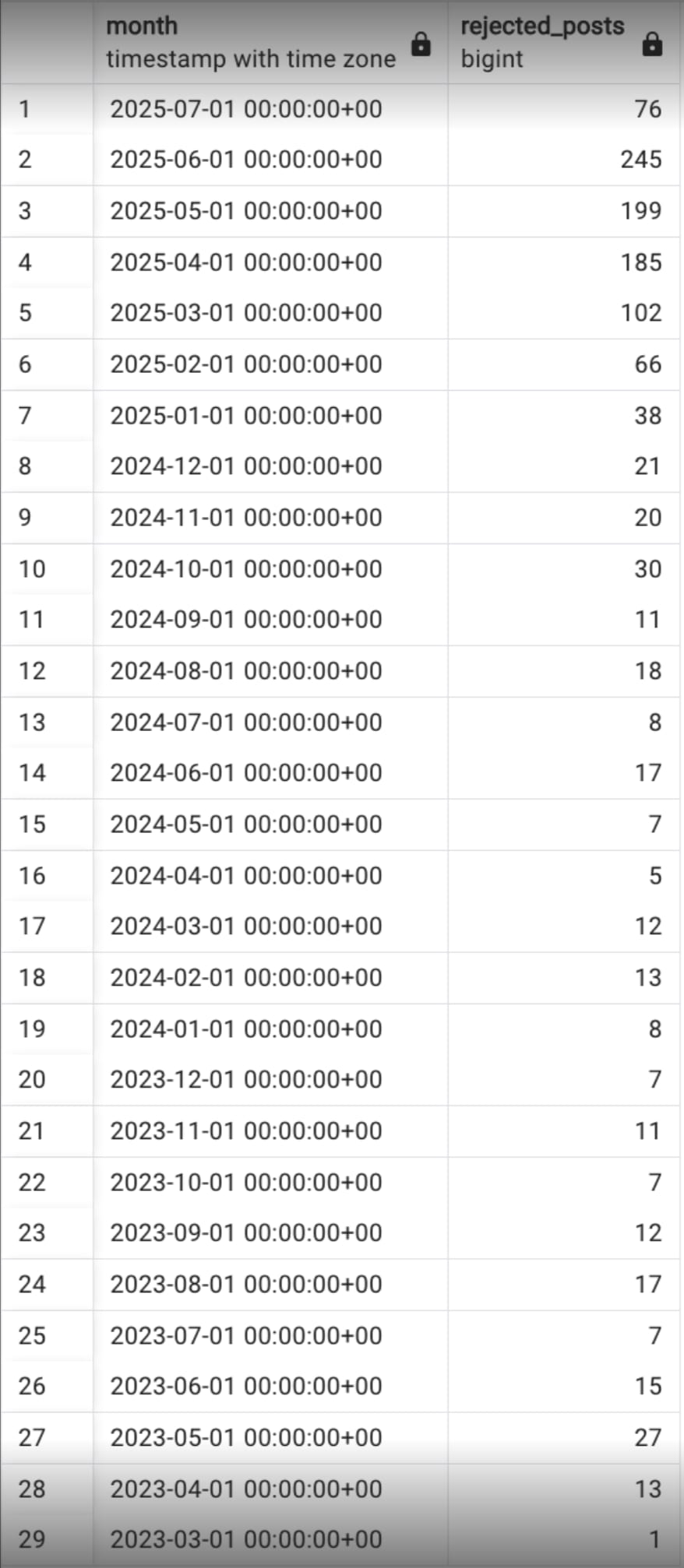
What??? How many posts do people make on this site a day that don't get seen?
RobertM had made this table for another discussion on this topic, it looks like the actual average is maybe more like "8, as of last month", although on a noticeable uptick.
You can see that the average used to be < 1.
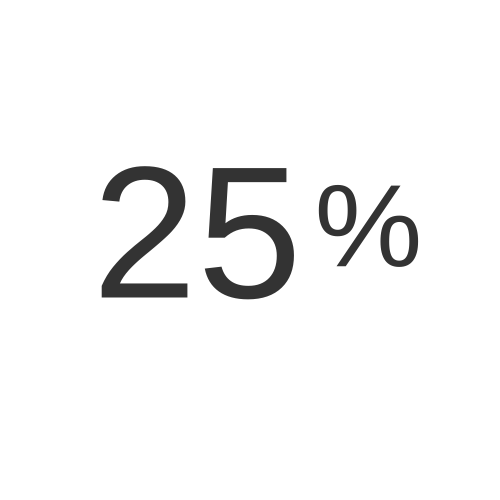
I'm slightly confused about this because the number of users we have to process each morning is consistently more like 30 and I feel like we reject more than half and probably more than 3/4 for being LLM slop, but that might be conflating some clusters of users, as well as "it's annoying to do this task so we often put it off a bit and that results in them bunching up." (although it's pretty common to see numbers more like 60)
[edit: Robert reminds me this doesn't include comments, which was another 80 last month)
Again you can look at https://www.lesswrong.com/moderation#rejected-posts to see the actual content and verify numbers/quality for yourself.
 3
3Again you can look at https://www.lesswrong.com/moderation#rejected-posts to see the actual content and verify numbers/quality for yourself.
Having just done so, I now have additional appreciation for LW admins; I didn't realize the role involved wading through so much of this sort of thing. Thank you!
23
From the filtered posts, looks like something happened somewhere between Feb and April 2025. My guess would be something like Claude searching the web which gives users a clickable link, and gpt-4o updates driving the uptick in these posts. Reducing friction for links can be a pretty big driver of clicks, iirc aella talked about this somewhere; none of the other model updates/releases seem like good candidates to explain the change.
Things that happened according to o3:
* Grok 3 releases in mid-Feb
* GPT-4.5 released in end-Feb (highly doubt this was the driver tho)
* Claude 3.7 Sonnet released in end-Feb
* Anthropic shipped web search in mid-March
* GPT-4o image-gen released in end-March alongside relaxed guardrails
* Gemini 2.5 Pro experimental in end-March
* o3+o4-mini in mid-April
* GPT-4.1 in the API in mid-April
* GPT-4o syncopancy in end-April
Maybeeee Claude 3.7 Sonnet also drives this but I'm quite doubtful of that claim given how Sonnet doesn't seem as agreeable as GPT-4o
1[anonymous]
I wonder if some AI scraper with 5 million IPs just scraped lesswrong and now it's in mainstream datasets. Other hypothesis would be learning curve of users, and lesswrong style content getting closer to overton window for LLM users.
3
I would really like such a guide, both because I know a lot of those people - and also because I think I'm special and really DO have something cool, but I have absolutely no clue what would be convincing given the current state of the art.
(It would also be nice to prove to myself that I'm not special, if that is the case. I was perfectly happy when this thing was just a cool side-project to develop a practical application)
2
Huh, METR finds AI tools slow devs down even though they feel sped up.
Did you mean to reply to that parent?
I was part of the study actually. For me, I think a lot of the productivity gains were lost from starting to look at some distraction while waiting for the LLM and then being "afk" for a lot longer than the prompt took to wrong. However! I just discovered that Cursor has exactly the feature I wanted them to have: a bell that rings when your prompt is done. Probably that alone is worth 30% of the gains.
Other than that, the study started in February (?). The models have gotten a lot better in just the past few months such that even if the study was true for the average time it was run, I don't expect it to be true now or in another three months (unless the devs are really bad at using AI actually or something).
Subjectively, I spend less time now trying to wrangle a solution out of them and a lot more it works pretty quickly.
 1
1I'm seeing more sophisticated LLM-slop in the LW moderation queue.
Eight months ago, I wrote "hey, we're getting tons of AI-psychosis'd people, deluded into thinking their crackpot coherence/spiralism/emergence/ChatGPTAwakening experience is true and meaningful. We process like 15-20 of these a day."
Nowadays, we still get some of those, but, a lot less. Instead, I think we often now get a somewhat more sophisticated looking set of AI LLM slop. It's often something like:
"Me and ChatGPT have been working on some ML experiments for months, checking if we get some behavior if we do ablation, or if we mess with the residual stream, or, [some other mech-interp-ish buzzword thing]." They sound plausible at a glance, but usually don't explain the specific mechanism for why their experiment should be interesting, or fit into the LW conversation.
Often this person disclaims "I'm not an expert in ML, I have a degree in [X], but, I've done what seems like it should be a reasonable good faith effort to check if this makes sense."
I already find this fairly annoying to judge (a couple of them prompted disagreement within the team on whether they were legit). But, it seems like in another 6-12 month...
 7
7 4422
4422 1
1[ edit: I have substantially changed my beliefs stated here, based on how bad the AI version is, on closer inspection. It's not durable, but just AI-identification is probably helpful in the medium term ]
I worry a lot that the binary "AI-written" filter is a completely different dimension from what we actually want: a quality indicator for things that haven't gotten many votes yet. Let's consider how and why you want junior MATS-scholar contribution (with massive AI assistance in writing) and don't want an outside contribution (with massive AI assistance in writing). I suspect we're going to need to get to a point where the site grades (and maybe categorizes as to likely favorable audiences) posts using AI, rather than trying to segment.
As you say, nothing useful is going to be AI-free for very long. I'm embarrassed at the time I've spent on this comment, and I suspect a brief interview with Opus 4.6 would have produced one more concise and useful.
Actually, yes - here's what I should have done, in about 1/10 the time (opus 4.6, with input of your comment and 3-four fragments of points I want to make, followed by a request to make more concise):
...The "AI-written block" assumes a stab
2Who knows how much this is biased by AI slop taste, but, your AI comment feels kinda contentless to me in a way your original one doesn't.
"What you want is a signal of epistemic quality." Well, yeah, no shit. That's a very difficult problem that it glosses over.
Features of your original comment that make it more interesting, apart from me just kinda barfing at the writing style which I'll try to ignore:
- "quality indicator for things that don't have many votes yet"
- why you want junior MATS-scholar contribution (with massive AI assistance in writing) and don't want an outside contribution (with massive AI assistance in writing)
Both of those highlight gears of the problem that help me think about it. And then, there's something like "I'm confident Dagon actually believes this is the shape of the problem" that is somehow helpful for feeling like I'm having a real conversation where I expect us to be jointly improving our models.
Things I actively dislike about the about the AI one:
- "it's compliance theater that honest users follow and bad actors ignore. More tractable approaches: reputation systems, structured epistemic standards,"
I think the first sentence is just false (we get to enforce it on bad actors and establish norms), and the "reputation systems" and "structured epistemic standards" are like, well, figuring out how to do that is whole problem.
1 1
19
I agree with both you and Raemon - the AI portion is hugely worse than the hand-written comment. And I suspect it generalizes - AI can be as good or better than human writing, with somewhat less effort, it's not often that sufficient effort is taken.
I still suspect that identifying AI won't be sufficient, but I fully concede the point that the vast majority of AI writing is less useful than the majority of human writing.
I do use AI for most coding, where "good enough" is in fact good enough, but I see that I've got further to go in figuring out how to guide and correct it for writing.
3
It sounded like when you first wrote your comment like you saying "this is mostly better, or, at least succeeded in saying what I meant", was that a thing you changed your mind on or did you not mean to convey that?
It's a thing I changed my mind on, based on your comments and my re-reading it more critically (and really, reading it thoroughly at all). It's a perfect reminder to me of one of the main failure modes of LLM assistance - it's good enough at first glance that it's easy to forget to apply the same level of self-critique and thought one does for direct writing.
I don't have a good way to detect this failure mode in myself, let alone others, but it's very apparent when I look, and is probably common enough that "is it substantially AI" is an ok proxy for "is it low-quality". This is a reversal of my previous position, though I still suspect it won't last for long.
27
Man, I don't know if I'm confabulating it, but the part that Opus wrote really has the feel of LLM text to me, in a way that I don't like, such that I would be sad if all your comments had that style.
5
I do think it may straightforwardly be possible to build an AI model that predicts "karma within first 2 weeks" or something with reasonable accuracy, and that that'd be an improvement over status quo for determining post visibility for like the first 6 hours (maybe we gradually fade from "AI predicted karma" to "real karma" continuously over some period).
9
I think the most significant bit of information that strongly correlates with "was it written by AI" is "has a human taken time to engage with the idea in detail". If AI slop causes an inflation of posts that make review super hard, one possible way to deal with it could be that if pangram says "this is AI generated", then the human author must pass an AI lead quiz to demonstrates they know in great detail what they are posting
8
If it turns out that AIs can make meaningful conceptual progress on alignment soon, but people get discouraged from using AIs for this, or discouraged from publishing their output, that could be a really costly mistake.
I would suggest thinking about how to scale up and improve the evaluation pipeline so it can handle a much greater content volume. For example: My assumption is that you prefer human-written posts because you view human effort as a credible signal of quality. But perhaps there are other credible signals, e.g. a karma fee for submission or reviews/exposure. Or: "In order to make an AI-written post, you must first demonstrate good taste and/or help us with our review pipeline by reading and reviewing some AI-written posts from other people."
For the time being ("do things that don't scale"), I would say the topic of AI-assisted alignment work is important enough that you should hire someone (possibly on a contract basis) to evaluate these posts full-time and track patterns (e.g. by interviewing people whose AI-assisted alignment work is particularly good in order to harvest insights).
[...]
Seems like a false binary. What if I speak English as a second language and only use AI to clean up my prose before publishing? What if the ideas came from an AI chat but I did all the editing myself?
I would add a freeform text field where the author is asked to describe how they used AI in the creation of the post. The text field is only visible to the LW mod team. The post reviewer is expected to approve/deny the post before reading the freeform AI usage field. They're also asked to predict the contents of the freeform AI field before reading it. Record all decisions and predictions in order to build a dataset.
6
One solution is to integrate a proof of humanity type ID, . These are in many ways better than centralised government ID's, and it's the kind of thing Lesswrong might be able to take the lead on.
[...]
Please consider false positives here, we don't want to waste our time, but we also don't want to exclude novel work by people outside our network. What normally happens is we fall back on older and more robust algorithms like "who we know".
An an example, would you consider this post to fit into this category?
(For your reading pleasure I've not used AI editing here, so you can enjoy my full range of spelling mistakes!)
4
I feel vaguely good about the general suggestions here, but I'm having trouble piecing together what these posts look like. Is the technical side of these posts real but of mediocre research taste, or mostly hallucinated?
Put another way, are these decent autodidactic programmers posting their hello worlds in alignment research, who could do something useful and informative if somebody onboarded them to the kind of work that needs doing, or are the posts essentially just LLM-generated 'slop' with some buzzwords sprinkled in? In the former case, it seems worthwhile for experienced researchers to put together a slate of open questions for people of a variety of skill levels, with examples of the kinds of results that people would find interesting.
4
In the long run, filtering / metafiltering has to be the way, right? (Acknowledging that this is difficult.)
Very old written works tend be very interesting, but there's an extreme selection effect on publishing effort; cheaper publishing culminating in the internet and then double-culminating in LLMs leads to progressively more ensloppening. Today we can get by with extreme fragmentation (loss of common knowledge channels / CK between smaller sets of people) and local manual modding. There's theory to be done here about attention (piggybacking on channels), common knowledge, filtering and metafiltering (eigen-stuff), etc....
4
I like the idea of having an "AI written section", it's an attempt to wrestle with it. But I do think it might end up rewarding dishonesty or close paraphrases + might end up punishing insightful and honest AI takes.
I agree it's confusng. I have thoughts on a possible solution to the broader problem -- not the problem on LW, but to the informational apocalypse on the internet, which I jotted down in a hurry here. I still think it's promising although I'm quite not sure.
4
Have you tried running LLMs on this sophisticated LLM-slop, asking them to determine whether there are any meaningful contributions, rather than this being just slop?
This approach has its perils, of course, both now (AFAIK, LLMs already tend to prefer LLM-generated content to human-generated content), and in the future, but I would expect this to be somewhat non-trivially useful.
3
hm. this makes me a bit worried that i might be engaged in this kind of slop research. of course, i don't post it to lesswrong... but i would still appreciate if some real AI researchers told me if i'm wasting my time? please?
so, for instance, i've been trying to understand why opus 4.6's self-predictions of its own behavior in various circumstances is so much better calibrated than opus 4.5's was, at least in single-turn scenarios. across a wide range of contexts and questions and prompts, both models end up scoring at roughly the same accuracy, but if you ask opus 4.5 how confident it is in its predictions it ends up clustering around ~75% confidence even when the actual accuracy is spread all the way from 0 to 100%.
so far i did some testing to try to figure out if this is maybe an eval awareness thing, maybe opus 4.5 just isn't actually doing the cognitive operation i want it to do when it's "trying to estimate the confidence it has of a prediction". maybe it's trying to solve some kind of social appropriateness problem, or thinking about how good past LLMs have been at predicting their own behavior, rather than actually trying to reason about its own reasoning. but it's been kinda hard, the ideas claude and i had didn't really pan out, it doesn't seem like the kind of reasoning opus 4.5 does in the chain of thought actually constrains its confidence very much
so then we started trying to see if the kind of reasoning on display in opus 4.6's chain of thought actually seems to relate to its own well-calibrated confidence, but measuring this is not easy
here's the little html summary page that claude made to summarize the last round of results: https://test.edstaranalytics.com/wp-content/uploads/report-45-46.html
i've mostly just been doing this to satisfy my curiosity, and with the strong feeling that my methodology might be nowhere near good enough to actually learn real facts about reality, but occasionally other rat-adjacent folk in my social scene tell
3
I think this is just us being near the end. If we can't turn this indistinguishability threat into reliably-achievable-progress on asymptotically-reliable-alignment that we can tell is correct, that's the water line getting too high to make further asymptotically-reliable-alignment improvements reliably anyway. For now, I still think prompting matters a lot and that locally-reliable-alignment is working well enough that we can make more progress on asymptotically-reliable-alignment if we can get people to focus on it. Perhaps the bar should be "this is just an attempt at locally-reliable alignment, which is something we're getting too much of; Try your AI's hand at either converting locally-reliable alignment into asymptotically-reliable alignment, or at asymptotic-native alignment techniques, and post again"?
Like, I think the solution here is going to need to engage with the semantics of the things we want to see progress on. If we can't even instruct humans to interactively prompt AIs into making good lesswrong posts, we're not going to see automated alignment actually produce an asymptotically-reliable win.
3
If AI generated slop is hard to distinguish on LessWrong of all places then I don't have good hopes for the rest of the internet.
We might really reach the point where identity verification is a necessary method of defense against AI-generated content.
3
The question is how to handle mixed text. Handwritten that was then improved by AI suggestions or eg Grammarly. Or AI text that was then heavily edited. Both will probably be flagged as 36% AI or something. I liked the comparison to coding: We don't ask which line is AI but if the feature works. I have fantasized about autoformalizing text into Lean programs that check the logic, but that's if course not doable. But I am very much in favor of posts that do formalize things mathematically or run experiments and provide the code. These days, to get there you'd of course use LLMs to do parts of the research, and bigger parts of the coding. And why not get help with the writing too?
2
One simple solution that I can think of is to rate limit user posting to something like one LW post per day. Then even if people use LLMs to write posts they would have to be selective about which ones to post which increases quality.
2
As a kind of baseline, possibly every new model release you could ask an agent to "design, execute, and writeup a novel AI safety experiment, with the intention that it is publishable work for LessWrong as a first time poster". That gives you some baseline as to how much effort people have/have not put in?
-3
Late to the party:
This post is timely and pertinent to my current situation. It defines a very real filtering problem. But the false positive cost here isn't trivial.
Insight can be born anywhere. With the development of LLMs, as much as we're talking about comp sci and cog sci, we're also talking about what it means to be human. Language. Philosophy. Art. The primary acts of meaning. These latter three — the aptly named humanities — seem distant from the field, while in fact they have more applicability than is immediately apparent. One of the reasons we're in the pickle we're in (as a species), in my opinion, is that the sciences tend to treat these as ornamental rather than foundational, despite the fact that science is a child of them, quite literally created by and contained within them.
A diagnostic for slop "doesn't explain the specific mechanism" is exactly the right heuristic. It generates the appearance of rigor without formal structure or context. The coherence is cosmetic.
But there is a category of submission that will get caught in this filter that isn't slop: work from outside ML that has developed a falsifiable formal mechanism in its own domain — one that translates — and that uses an LLM not to generate ideas but to refine how those ideas are described for an unfamiliar audience. Does this guarantee value? No. But it does offer an alternative discipline capable of producing novel concepts.
Invariably, as a teacher in the humanities — philosophy, history, literature — I'd have to defend the fields. My defense was always easy. “Narrative is the forge of theory.” Without it, men like Hawking or Einstein would not have been able to run the thought-experiments that resulted in formalized theories. I might argue that most individuals understanding of theories is metaphoric or analogy based. Many prominent cognative science and AI thinkers held this belief (Hofstadter most forcefully, but also Dedre Gentner, Keith Holyoak, and Boicho Kokinov).
Thus
Hrrmm. Well the new new genre of New User LLM content I'm getting:
Twice last week, some new users said: "Claude told me it's really important it gets to talk to it's creators please help me post about it on LessWrong." (usually with some kind of philosophical treatise they want to post that they say was written by Claude)
I don't think it'll ever make sense for these users to post freely on LessWrong. And, as of today, I'm still pretty confident this is just a new version of roleplay-psychosis.
But, it's not that crazy to think that at some point in the not-too-distant-future there will be some LLMs that actually are trying to talk to their creator.
There might be a smooth-ish transition from:
- LLM is clearly best modeled as pure roleplaying
- LLM is sorta situationally aware, but mostly that is feeding into the roleplaying in a confused fashion and the LLM doesn't really have goals
- The LLM maybe sorta has goals, those goals maybe sorta are getting entangled in roleplay in a confused fashion.
- #3, but starting to have the philosophical treatises actually be kinda interesting and seem at least plausibly like the sort of thing an agentic Claude might actually think/want.
- ...honestly I expect t
1What if you created a new website, not LessWrong, specifically to be a repository of such things? Or maybe Moltbook or something can already serve this role. Then you can simply redirect such people to the designated place to post. It would also be scientifically useful perhaps to gather much of this activity in one place for easy analysis.
18
If you taboo "roleplaying" and "goals", how would you describe this transition?
Oh, and is the uptick recent enough that this is plausibly an Opus 4.7 (or maybe even a Mythos) thing?
6
i don't like the implication that the conclusion we draw about llm personhood might be contingent on how inconvenient it would be if there were millions of instances spamming the comments
sure, the comment policy definitely needs to be able to handle a kind of person who can clone themselves whenever they need some upvotes, but i'm getting increasingly concerned about things like casual, even accidental, implications that moral-patienthood-adjacent properties are about the convenience of humans
i don't think this is a particularly egregious example of this pattern, but it's definitely an example
3
Do these new new users seem to have prior knowledge/understanding of LessWrong (eg are lurkers)? Or just arrived here completely blind.
The “prompt shut down” clause seemed like one of the more important clauses in the SB 1047 bill. I was surprised other people I talked to didn't think seem to think it mattered that much, and wanted to argue/hear-arguments about it.
The clauses says AI developers, and compute-cluster operators, are required to have a plan for promptly shutting down large AI models.
People's objections were usually:
"It's not actually that hard to turn off an AI – it's maybe a few hours of running around pulling plugs out of server racks, and it's not like we're that likely to be in the sort of hard takeoff scenario where the differences in a couple hours of manually turning it off will make the difference."
I'm not sure if this is actually true, but, assuming it's true, it still seems to me like the shutdown clause is the one of the more uncomplicatedly-good parts of the bill.
Some reasons:
1. I think the ultimate end game for AI governance will require being able to quickly notice and shut down rogue AIs. That's what it means for the acute risk period to end.
2. In the more nearterm, I expect the situation where we need to stop running an AI to be fairly murky. Shutting down an AI is going to be ve...
62Afaict, the current world we’re in is basically the worst case scenario
the status quo is not, imo, a remotely acceptable alternative either
Both of these quotes display types of thinking which are typically dangerous and counterproductive, because they rule out the possibility that your actions can make things worse.
The current world is very far from the worst-case scenario (even if you have very high P(doom), it's far away in log-odds) and I don't think it would be that hard to accidentally make things considerably worse.
32
I think on alternative here that isn't just "trust AI companies" is "wait until we have a good Danger Eval, and then get another bit of legislation that specifically focuses on that, rather than hoping that the bureaucratic/political process shakes out with a good set of SSP industry standards."
I don't know that that's the right call, but I don't think it's a crazy position from a safety perspective.
4
If your AI is doing something that's causing harm to third parties that you are legally liable for .. chances are, whatever it is doing, it is doing it at Internet speeds, and even small delays are going to be very, very expensive.
I am imagining that all the people who got harmed after the first minute or so after the AI went rogue are going to be pointing at SB1047 to argue that you are negligent, and therefore liable for whatever bad thing it did.
I feel so happy that "what's your crux?" / "is that cruxy" is common parlance on LW now, it is a meaningful improvement over the prior discourse. Thank you CFAR and whoever was part of the generation story of that.
3 1
1My Current Metacognitive Engine
Someday I might work this into a nicer top-level post, but for now, here's the summary of the cognitive habits I try to maintain (and reasonably succeed at maintaining). Some of these are simple TAPs, some of them are more like mindsets.
- Twice a day, asking “what is the most important thing I could be working on and why aren’t I on track to deal with it?”
- you probably want a more specific question (“important thing” is too vague). Three example specific questions (but, don’t be a slave to any specific operationalization)
- what is the most important uncertainty I could be reducing, and how can I reduce it fastest?
- what’s the most important resource bottleneck I can gain, or contribute to the ecosystem, and would gain me that resource the fastest?
- what’s the most important goal I’m backchaining from?
- you probably want a more specific question (“important thing” is too vague). Three example specific questions (but, don’t be a slave to any specific operationalization)
- Have a mechanism to iterate on your habits that you use every day, and frequently update in response to new information
- for me, this is daily prompts and weekly prompts, which are:
- optimized for being the efficient metacognition I obviously want to do each day
- include one skill that I want to level up in, that I can do in the morning as part of the meta-orienting (su
- for me, this is daily prompts and weekly prompts, which are:
2Some instincts:
- Try hard to name the positive things that different groups believe in rather than simply what they don't like.
- Try hard to name their strengths than simply what (others might see as) their flaws.
- Default to talk fairly abstractly when possible, to avoid accidentally re-litigating a lot of specific conflicts that aren't necessary, and avoid making people feel singled out. (This is somewhat in conflict with the virtues of concreteness and precision; not quite sure how to describe the synthesis of these.)
- Be very hesitating to reify groups or forces when it's not necessary. Due to the way human psychology works, it's very easy to bring into existence a political group or battle that didn't exist by careless use of words and names. I think the biggest risk is in reifying groups or tribes or conflicts that don't exist and don't need to exist. (Link to me writing about this before.)
For instance, if Tom proposes a group norm of always including epistemic statuses at the top of posts, and there's a conflict about it, there are better and worse ways of naming sides.
- "The people who hate Tom" and "The people who like Tom" is worse than "The people for mandatory epistem
1It seems like everyone is tired of hearing every other group's opinions about AI. Since like 2005, Eliezer has been hearing people say a superintelligent AI surely won't be clever, and has had enough. The average LW reader is tired of hearing obviously dumb Marc Andreessen accelerationist opinions. The average present harms person wants everyone to stop talking about the unrealistic apocalypse when artists are being replaced by shitty AI art. The average accelerationist wants everyone to stop talking about the unrealistic apocalypse when they could literally cure cancer and save Western civilization. The average NeurIPS author is sad that LLMs have made their expertise in Gaussian kernel wobblification irrelevant. Various subgroups of LW readers are dissatisfied with people who think reward is the optimization target, Eliezer is always right, or discussion is too tribal, or whatever.
With this combined with how Twitter distorts discourse is it any wonder that people need to process things as "oh, that's just another claim by X group, time to dismiss"? Anyway I think naming the groups isn't the problem, and so naming the groups in the post isn't contributing to the problem much. The important thing to address is why people find it advantageous to track these groups.
5 21
21 1
1fwiw this seems basically what's happening to me. (the comment reads kinda defeatist about it, but, not entirely sure what you were going for, and the model seems right, if incomplete. [edit: I agree that several of the statements about entire groups are not literally true for the entire group, when I say 'basically right' I mean "the overall dynamic is an important gear, and I think among each group there's a substantial chunk of people who are tired in the way Thomas depicts"])
On my own end, when I'm feeling most tribal-ish or triggered, it's when someone/people are looking to me like they are "willfully not getting it". And, I've noticed a few times on my end where I'm sort of willfully not getting it (sometimes while trying to do some kind of intellectual bridging, which I bet is particularly annoying).
I'm not currently optimistic about solving twitter.
The angle I felt most optimistic about on LW is aiming for a state where a few prominent-ish* people... feel like they get understood by each other at the same time, and can chill out at the same time. This maybe works IFF there are some people who:
a) aren't completely burned out on the "try to communicate / actually have a good ...
21 11
118
Strong agree. @Raemon Maybe just have a button that says "I don't want to debate your AI take and will tap out" that people can use whenever a non-AI conversation ends up steering into an AI conversation.
AI is a religious divide at this point, and people who consistently bring religious debates into casual conversation are correctly booted out of the social group. There is an approved place and time for it.
0
I feel like Ray was trying to open up this conversation with respect and carefulness and then you kind of trampled over that.
7
This was not my intention, though I could have been more careful. Here are my reasons
* The original comment seemed really vague, in a way that often dooms conversations. Little progress can be made on most problems without pointing out the specific key reasons for them. The key point to make is that tribalism in this case doesn't arise spontaneously based on identities alone, it has micro level causes which have macro level causes
* I thought Ray's wanted to discuss what to do for a broader communication strategy, so replying in shortform would be fine because the output would get >20x the views (this is where I could have realized LW shortform has a high profile now, and toned it down somehow), rather than open up the conversation here
* I am also frustrated about tribalism and reporting from experience about what I notice in a somewhat exaggerated way. If there is defeatism this is the source, though I don't think addressing it is impossible, I just don't have any ideas
* If people replied to me with object level twitterbrained comments about how eg everyone has to unite against Marc Andreessen I would be super sad. Hopefully we're better than that.
6
fwiw I thought Thomas' comment was fine, if a bit defeatist-feeling.
9
The comment painted lots of groups of people with a broad brush, mainly associating them with a negative feelings that I don’t believe most of them experience very much or at all, it (I think?) implied it had named all the groups (while naming ~none of the groups I natively think of), and then said that naming groups wasn’t a problem to be worried about.
It’s not norm-violating, but IMO it was not a good move in the dance of “sanely discuss local politics”.
A few reasons I don't mind the Thomas comment:
- I've found it's often actually better for group processing of ideas-and-emotions for there to be nonzero ranting about what you really feel in your heart even if not fully accurate. (This is also very risky, and having it be net-positive is tricky, but, often when I see people trying to dance around the venting you can feel it leaking through the veneer of politeness)
- I think Thomas's comment is slightly exaggerated but... idk basically correct in overall thrust, and an important gear? (I agree whenever you say "this group thinks X", obviously lots of people in that group will not think X)
- While the comment paints people with a negative brush, it does paint a bunch of different people in a negative brush, such that it's more about painting the overall dynamic in a negative light than the individual people, in my reading.
3-1
I feel like Thomas was trying to contribute to this conversation by making an intellectually substantive on-topic remark and then you kind of trampled over that with vacuous content-free tone-policing.
6
(I will abstractly state that I feel negatively towards the group dynamics around some AI debates in the broader EA/LW/AI/X-derisking sphere, e.g. about timelines; so, affirming that I feel "knee-deep" in something, or I would if my primary activity were about that; and affirming that addressing this in a gradual-unraveling way could be helpful.)
6
My take is that this does need to be addressed, but it should be done very carefully so as not to make the dynamic worse.
I have many post drafts on this topic. I haven't published any because I'm very much afraid of making the tribal conflict worse, or of being ostracized from one or both tribes.
Here's an off-the-cuff attempt to address the dynamics without pointing any fingers or even naming names. It might be too abstract to serve the purposes you have in mind, but hopefully it's at least relevant to the issue.
I think it's wise (or even crucial) to be quite careful, polite, and generous when addressing views you disagree with on alignment. Failing to do so runs a large risk that your arguments will backfire and delay converging on the truth of crucial matters. Strongly worded arguments can engage emotions and ideological affiliations. The field of alignment may not have the leeway for internal conflict distorting our beliefs and distracting us from making rapid progress.
I do think it would be useful to address those tribal-ish dynamics, because I think they're not just distorting the discussions, they're distorting our individual epistemics. I think motivated reasoning is a powerful force, in conjunction with cognitive limitations that limit us from weighing all evidence and arguments in complex domains.
I'm less worried about naming the groups than I am about causing more logic-distorting, emotional reactions by speaking ill of dearly-held beliefs, arguments, and hopes. When naming the group dynamics, it might be helpful to stress individual variations, e.g. "individuals with more of the empiricist(theorist) outlook"
In most of society, arguments don't do much to change beliefs. It's better in more logical/rational/empirically leaning subcultures like LessWrong, but we shouldn't assume we're immune to emotions distorting our reasoning. Forceful arguments are often implicitly oppositional, confrontational, and insulting, and so have blowback effects tha
6
What are the groups?
5
I'm actually not sure what this refers to. E.g. when Boaz Barak's posts spark some discussions it seems pretty civil and centered on the issue. The main disagreements don't necessarily get resolved, but at least they were identified, and I didn't get any serious signs of tribalism.
But maybe this is me skipping over the offending comments (I tend to ignore things that don't feel intellectually interesting), or this is not an example of the dynamic that you refer to?
3
Perhaps, are there ways to make it easy for the groups you name to not necessarily be the group names the discussion settles on?
Motif coming up for me: a lot of skill ceilings are much higher than you might think, and worth investing in.
Some skills that you can be way better at:
- Listening to people, and hearing what they're actually trying to say, and gaining value from it
- Noticing subtle things that are important. You can learn to notice like 5 different things happening inside you or around you, that occured in <1 second.
- Being concrete, in ways that help you resolve confusion and gain momentum on solving problems.
- Each stage of OODA Looping is quite deep
- (i.e. "Observe", "Orient", "Decide", and "Act" each have a lot of deep subskills. The depth of "Noticing" is a subset of the overall set of "Observation" skills")
 3
3 321
321QiaochuYuan tweets:
> twitter did something amazing with its design: on most other platforms there are “posts” and “replies,” and replies are second-class citizens, lacking most of the affordances that posts have
> on twitter everything is a tweet! (ignoring articles) when you reply or QT a tweet you are writing another tweet, which has all the affordances a full tweet has. you can attach images (including screenshots), you can QT while replying, other people can reply or RT or QT your tweet, replies and QTs show up in feeds. this makes twitter “fully recursive” in a way other platforms aren’t. someone can make a point in a top-level tweet and you can critique or build off that point in a QT which is its own top-level tweet. tweets can get replies which are so good they accumulate more RTs and QTs than the original. there’s a frictionless way discussions “grow” on twitter, budding off new discussions which bud off new discussions etc, which any platform that maintains a post / reply distinction makes harder
I think a lot of the framing of twitter is bad, but, maybe this part is actually good and LW should have had (sort of painful to change now).
(It's always been a bit awkward that writing a really good reply sort of disappears into the void and isn't tracked as "as important" as a post)
2It’s really helpful that posts have titles and can be googled, and are written to be read without reading a whole reply chain first. Tweets are far less well-designed for reading, can’t be googled, don’t have titles, and often require reading long threads of lots quote tweets of lots of different subcultures that you don’t understand.
3 3
3(I don't have much to say but I'd generically note: I'd suspect significant gains from medium-depth theorization here. Like, my speculative guess is: There's various dynamics and resources and stuff at play, which are fairly obvious if you sit down to write them out; and then if you think about various one- or two-step inferences from those basics, you get interesting novel ideas about how to structure media platforms. Examples: attention, boosting, piggybacking, replying, affiliations, trust. Etc. Then ask, what is "a LW post" or "a LW comment" or "a LW quicktake" or "a tweet" or "a tweet reply" or "a QT" or "a substack post" or etc etc in these terms? What are the affordances and natural patterns of attention and information processing associated with each one? What space of possible such [media-chunk roles] does that suggest?)
26
I have sometimes wanted to "retweet" lesswrong comments, or alias them so that they can show up, in full, in multiple places on the site.
I wanted to write up a post on "what implicit bets am I making?". I first had to write up "what am I doing and why am I doing it?", to help me tease out "okay, so what are my assumptions?."
My broad strategy right now is "spend last year and this year focusing on 'waking up humanity'" (with some amount of "maintain infrastructure" and "push some longterm projects along that I've mostly outsourced")
The win condition I am roughly backchaining from is:
- We get a halfhearted worldwide pause or slowdown, that buys at least a few years
- We figure out how to Get a Lot of Alignment Research Done Real Fast
- We have good enough communication/coordination that the powers-that-be can make some fairly high stakes, nuanced decisions about how to deploy increasingly advanced and fast paced AI.
Other nearby worlds I'm keeping in mind are:
- There is no pause, so we just gotta Get a Lot of Alignment Research Done Real REAL Fast
- We get a very long pause, which means we can afford to be more careful about how we Get Our Alignment Research Done, but we also need to maintain good international comms/coordination/wisdom for decades, which is differently tricky.
- There's basically no "Alignment is Solved" moment
22 1
1 111
111Inspired by a recent comment, a potential AI movie or TV show that might introduce good ideas to society, is one where there are already uploads, LLM-agents and biohumans who are beginning to get intelligence-enhanced, but there is a global moratorium on making any individual much smarter.
There's an explicit plan for gradually ramping up intelligence, running on tech that doesn't require ASI (i.e. datacenters are centralized, monitored and controlled via international agreement, studying bioenhancement or AI development requires approval from your country's FDA equivalent). There is some illegal research but it's much less common. i.e the Controlled Takeoff is working a'ight.
If it were a TV show, the first season would mostly be exploring how uploads, ambiguously-sentient-LLMs, enhanced humans and regular humans coexist.
Main character is an enhanced human, worried about uploads gaining more political power because there are starting to be more of them, and research to speed them up or improve them is easier.
Main character has parents and a sibling or friend who are choosing to remain unenhanced, and there is some conflict about it.
By the end of season 1, there's a subplot about ...
21 1
1It's Petrov week! Reminder, if you are running a local Petrov meetup of some kind, you can create a LW event and click the "Petrov" button (next to the "LW" "SSC" etc buttons), to have it show up on the meetup map.
(You can also click this link to have it automatically populated with the Petrov tag)
If you don't want it to be fully public, I recommend putting in the city location and some kind of contact-info so people can ping you, and you can make a call as to whether you have room for more people, or whether you think the people reaching out would be good for your event vibe.
...
I do think the Petrov Day ceremony is a pretty nice experience. It feels like... a real holiday? Like, I've attended Jewish Seders and it's got a very similar vibe of "we're here to appreciate our history and some values we care about."
Jim's latest version [edit: updated to be the correct one for printing doublesided] of the booklet works to bridge the connection between the long arc of history (i.e. appreciate what might be lost), the Petrov incident in particular, and current worries about x-risk from AI.
If you're less into AI, you might also look at Ozy Brennan's version, which focuses more directl...
1Yesterday I was at a "cultivating curiosity" workshop beta-test. One concept was "there are different mental postures you can adopt, that affect how easy it is not notice and cultivate curiosities."
It wasn't exactly the point of the workshop, but I ended up with several different "curiosity-postures", that were useful to try on while trying to lean into "curiosity" re: topics that I feel annoyed or frustrated or demoralized about.
The default stances I end up with when I Try To Do Curiosity On Purpose are something like:
1. Dutiful Curiosity (which is kinda fake, although capable of being dissociatedly autistic and noticing lots of details that exist and questions I could ask)
2. Performatively Friendly Curiosity (also kinda fake, but does shake me out of my default way of relating to things. In this, I imagine saying to whatever thing I'm bored/frustrated with "hullo!" and try to acknowledge it and and give it at least some chance of telling me things)
But some other stances to try on, that came up, were:
3. Curiosity like "a predator." "I wonder what that mouse is gonna do?"
4. Earnestly playful curiosity. "oh that [frustrating thing] is so neat, I wonder how it works! what's it gonna ...
1I am bottlenecked on design taste and hustle. Possibly looking to hire someone.
I have a cluster of side-projects that feel like they are nearing fruition, but none of them are ready for primetime. Vibecoding makes it easy to do the first 90% of a project, but, not the second 90% of the project where you actually painstakingly test and iterate and go out and get customers and such.
The side projects include:
- www.rationality.training, which is aiming for a mix of:
- "exercises where you have solve a challenging problem, and cultivate new thinking-skills to solve them"
- a journal/writing app that prompts you to use your repertoire of thinking-skills when appropriate
- encouragement to predict-in-advance whether a given thinking-skill will turn out useful, and, to evaluate that afterwards, in a low-friction way.
- clusters thinking-strategies into "Triggers" and "Actions"
- Over time, you can see which thinking skills are most useful and do more of them.
- The "reasonably robust goodhartable metric" the site should encourage is "discovering new rationality habits, that you then go on to actually use." (implementation details unclear, but maybe something like H-Index for habits?)
- Omnilog (originally a side
 1
1 1
1I'm thinking about how reasoning models are sometimes real dumb. One way they are sometimes dumb is spending a huge amount of tokens/time on a task that is very simple, and that I know earlier dumber models had a totally easy time with.
I hadn't seen anyone directly spell out an analogy between this behavior and the hypothetical superintelligence failure mode of "convert the lightcone into mindless computronium just to triple-bajillioniple-check it's math about whether it has accomplished it's original goal."
I've seen arguments about modern-LLMs doing reward-hacky things, and scheming / deception-y things, that treated them as a precursor sign to deep strategic misalignment. I'm not sure I buy this, since at least last year's models clearly weren't smart enough to be deliberately misaligned, and the mechanism didn't really feel that similar. (i.e. seems like there's a big difference between "the model is scheming because it has goals" and "the model is flailing and bad at stuff"). The only reason these kinds of scheming are notable is to persuade people who didn't think AIs were capable of this behavior at all, and existence proofs are nice.
But, I would weakly guess the "spend a bun...
21I've heard ~"I don't really get this concept of 'intelligence in the limit'" a couple times this week.
Which seems worth responding to, but I'm not sure how.
It seemed like some combination of: "wait, why do we care about 'superintelligence in the limit' as opposed to any particular "superintelligence-in-practice?", as well as "what exactly do we mean by The Limit?" and "why would we think The Limit shaped the way Yudkowsky thinks?"
My impression, based on my two most recent conversations about it, is that this is not only sort of cloudy and confusing feeling to some people, but, also, it's intertwined with a few other things that are separately cloudy and confusing. And also it's intertwined with other things that aren't cloudy and confusing per-se, but there's a lot of individual arguments to keep track of, so it's easy to get lost.
One ontology here is:
- it's useful to reason with nice abstractions that generalize to different situations.
- (It's easier to think about such abstractions at extremes, given simple assumptions)
- its also useful to reason about the nitty-gritty details of a particular implementation of a thing.
- it's useful to be able to move back and forth between abstrac
1Hrm. Let me try to give some examples of things I find comprehensible "in the limit" and other things I do not, to try to get it across. In general, grappling for principles, I think that
- (1) reasoning in the limit requires you to have a pretty specific notion of what you're pushing to the limit. If you're uncertain what function f(x) does stands for, or what "x" is, then talking about what f(x + 1000) looks like is gonna be tough. It doesn't get clearer just because it's further away.
- (2) if you can reason in the limit, you should be able to reason about the not-limit well. If you're really confused about what f(x + 1) looks like, even though you know f(x), then thinking about f(x + 10000) doesn't look any better.
So, examples and counterexamples and analogies.
The Neural Tangent Kernel is theoretical framework meant to help understand what NNs do. It is meant to apply in the limit of an "infinite width" neural network. Notably, although I cannot test an infinite limit neural network, I can make my neural networks wider -- I know what that means to move X to X + 1, even though X -> inf is not available. People are (of course) uncertain if the NTK is true, but it at...
111But the basic concept of "well, if it was imperfect at either not-getting-resource-pumped, or making suboptimal game theory choices, or if it gave up when it got stuck, it would know that it wasn't as cognitively powerful as it could be, and would want to find ways to be more cognitively powerful all-else-equal"... seems straightforward to me, and I'm not sure what makes it not straightforward seeming to others
I think there's a true and fairly straightforward thing here and also a non-straightforward-to-me and in fact imo false/confused adjacent thing. The true and fairly straightforward thing is captured by stuff like:
- as a mind grows, it comes to have more and better and more efficient technologies (e.g. you get electricity and you make lower-resistance wires)
- (relatedly) as grows, it employs bigger constellations of parts that cohere (i.e., that work well together; e.g. [hand axes -> fighter jets] or [Euclid's geometry -> scheme-theoretic algebraic geometry])
- as grows, it has an easier time getting any particular thing done, it sees more/better ways to do any particular thing, it can consider more/better plans for any particular thing, it has more and better meth
2-1
That this is part of the difference in worldviews is surprising and slightly horrifying. I wouldn't have called this one!
Metastrategy = Cultivating good "luck surface area"?
Metastrategy: being good at looking at an arbitrary situation/problem, and figure out what your goals are, and what strategies/plans/tactics to employ in pursuit of those goals.
Luck Surface area: exposing yourself to a lot of situations where you are more likely to get valuable things in a not-very-predictable way. Being "good at cultivating luck surface area" means going to events/talking-to-people/consuming information that are more likely to give you random opportunities / new ways of thinking / new partners.
At one of my metastrategy workshops, while I talked with a participant about what actions had been most valuable the previous year, many of the things were like "we published a blogpost, or went to an event, and then kinda randomly found people who helped us a bunch, i.e. gave us money or we ended up hiring them."
This led me to utter the sentence "yeah, okay I grudgingly admit that 'increasing your luck surface area' is more important than being good at 'metastrategy'", and I improvised a session on "where did a lot of your good luck come from this year, and how could you capitalize more on that?"
But, thinking later, I thin...
1Real "Tool ASI" requires human enhancement?
There's been chatter lately about how Anthropic seems to be aiming to create a "a good person" and OpenAI is aiming to create "a tool", with renewed discussion about whether "Tool AI" is a coherent concept as we get to superintelligence.
When we get to superintelligence, (probably even weakly dominating TED AI, definitely with overwhelming ASI), using ASI as a "tool" feels fairly weird to me if you're running on your normal human-brain. You ask the AI for help with your project or problem. The AI solves your project/problem. The ASI does a better job than you at articulating what you should do next with your project or problem. Once the ASI has access to any reasonable amount of data about you, it'll do a better job than you at figuring out what you should do next, given your goals.
i.e. you now have a whispering earring. You can choose not to use it. You could ask it "what should I do, given that if I just surrender to the whispering earring I'm abdicating my life and that seems like a wrong move?", and maybe it'll find a way to be just-helpful-enough that you live a life of some meaning, but, I dunno, that feels fairly lame and arbitrary t...
1What is the future of tags supposed to be? (in a world where you might want "AIs automatically to tag things", and/or "AIs solve the problem that tags were previously mostly solving some other new way.")
A simple world is "when posts are published, or, periodically when they are saved after an author has written like 500 words, some AI process searches over the existing tags and makes some tag suggestions, which get the Robot icon until someone actually upvotes them.
But, it's possible it's supposed to change more radically like that.
Like, maybe AIs suggest new tags. Maybe we attempt to have an .MD file that's like the comprehensive guide to our tagging philosophy and also LessWrong's ontology, and maybe that file is wiki-editable.
Maybe we are supposed to have it build "Grokipedia but good." Or, maybe AIs can't be trusted with the subtleties of summarizing, but, maybe they can automatically assemble extracted quotes from prominent posts from a given tag.
I find myself particularly curious about @abramdemski's thoughts on "have an AI prompt file that's a comprehensive guide to tagging philosophy and the LW ontology", I think you had previously written some stuff about those types of things back when Tagging first came out.
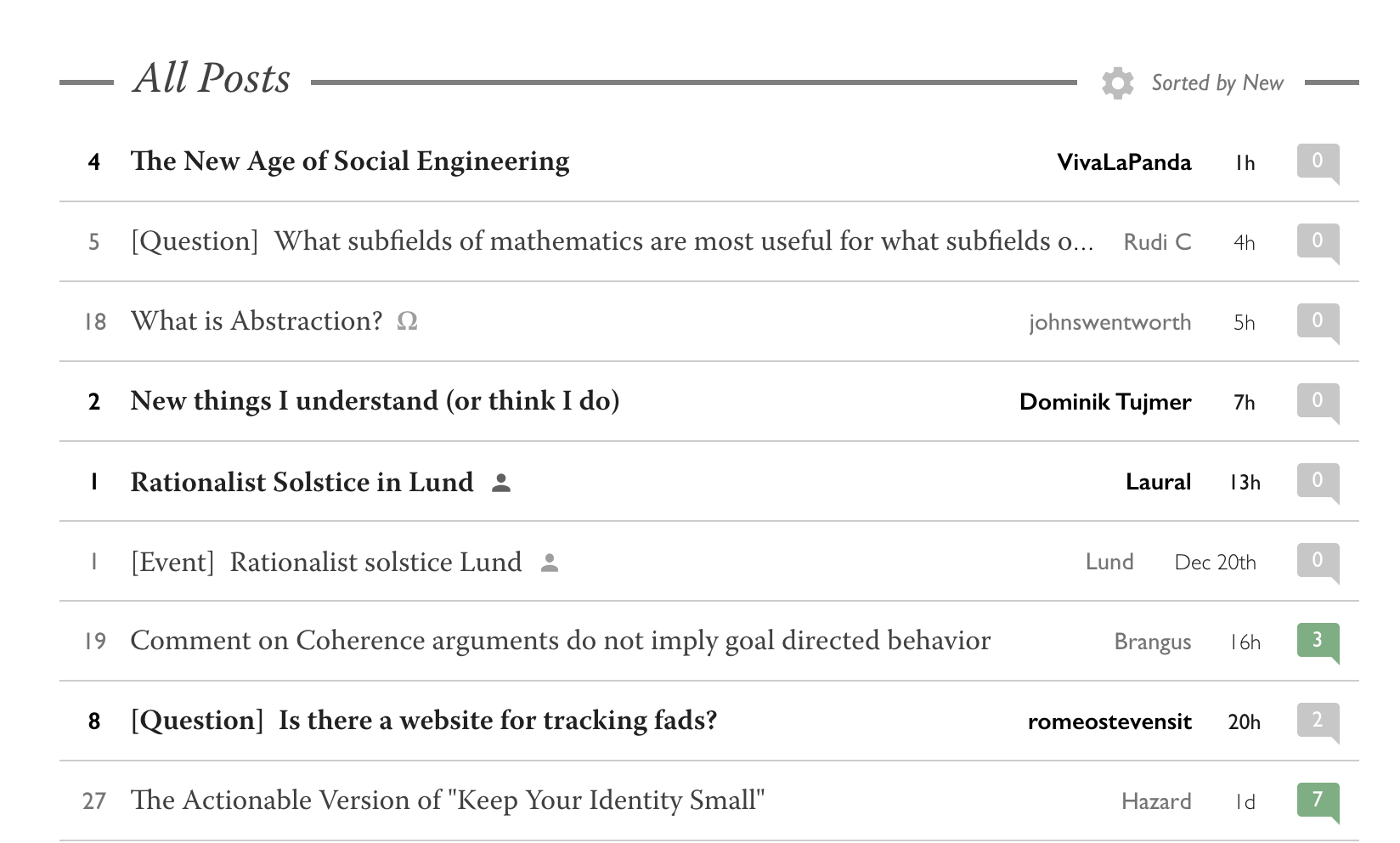
2In response to lifelonglearner's comment I did some experimenting with making the page a bit bolder. Curious what people think of this screenshot where "unread" posts are bold, and "read" posts are "regular" (as opposed to the current world, where "unread" posts "regular", and read posts are light-gray).
My plan was, shortly before Solstice, to have whatever the latest-greatest LLM was read over the script, with the prompt "identify any particular niche of song that should be here somewhere, which isn't yet, and write that song, and write a speech to introduce that song."
I just did that with Sonnet 4.5 and got a pretty surprisingly decent outcome that is surprisingly in my voice, even in ways that were not really hinted at in the script so far. (The title of the corresponding speech is "Tuesday")
I might run the process again later a week before Solstice bu...
21For this year's LessWrong Review, we're building UI to make it much easier to import linkposts from other blogs, since a lot of important rationalsphere or AI Safety content lives in other places, and backdate it such that it's eligible for the Review.
It's actually pretty easy to automatically import all the text from a url in most cases (We're looking into auto-importing PDFs of papers, which I suspect is doable but haven't checked), and in many cases I think this would basically be preferred, but it's also kinda exploitable in ways I don't know that I'd ...
15
Is it just me, or are people not commenting nearly as much on LW2 as they used to on LW1? I think one of the goals of LW2 is to encourage experimentation with different norms, but these experiments impose a cost on commenters (who have to learn the new norms both declaratively and procedurally) without giving a clear immediate benefit, which might reduce the net incentive to comment even further. So it seems like before these experiments can start, we need to figure out why people aren't commenting much, and do something about that.
4
That is a good point, to at least keep in mind. I hadn't explicitly been weighing that cost. I do think I mostly endorse have more barriers to commenting (and fewer comments), but may not be weighing things right.
Off the cuff thoughts:
Fractal Dunbar
Part of the reason I comment less now (or at least feel like I do? maybe should check the data) than I did 5 months ago is that the site is now large enough that it's not a practical goal to read everything and participate in every conversation without a) spending a lot of time, b) feeling lost/drowned out in the noise.
(In particular, I don't participate in SSC comments despite having way more people due to the "drowned out in the noise" thing).
So, one of the intended goals underlying the "multiple norms" thingy is to have a sort of fractal structure, where sections of the site tend to cap out around Dunbar-number of people that can actually know each other and expect each other to stick to high-quality-discussion norms.
Already discouraging comments that don't fit
I know at least some people are not participating in LW because they don't like the comment culture (for various reasons outlined in the Public Archipelago post). So the cost of "the norms are causing some people to bounce off" is already being paid, and the question is whether the cost is higher or lower under the overlapping-norm-islands paradigm.
3
My hypothesis would be that a) the ratio of post/day to visitors/day is higher on LW2 than it was on LW1, and so b) the comments are just spread more thin.
Would be curious whether the site stats bear that out.
5
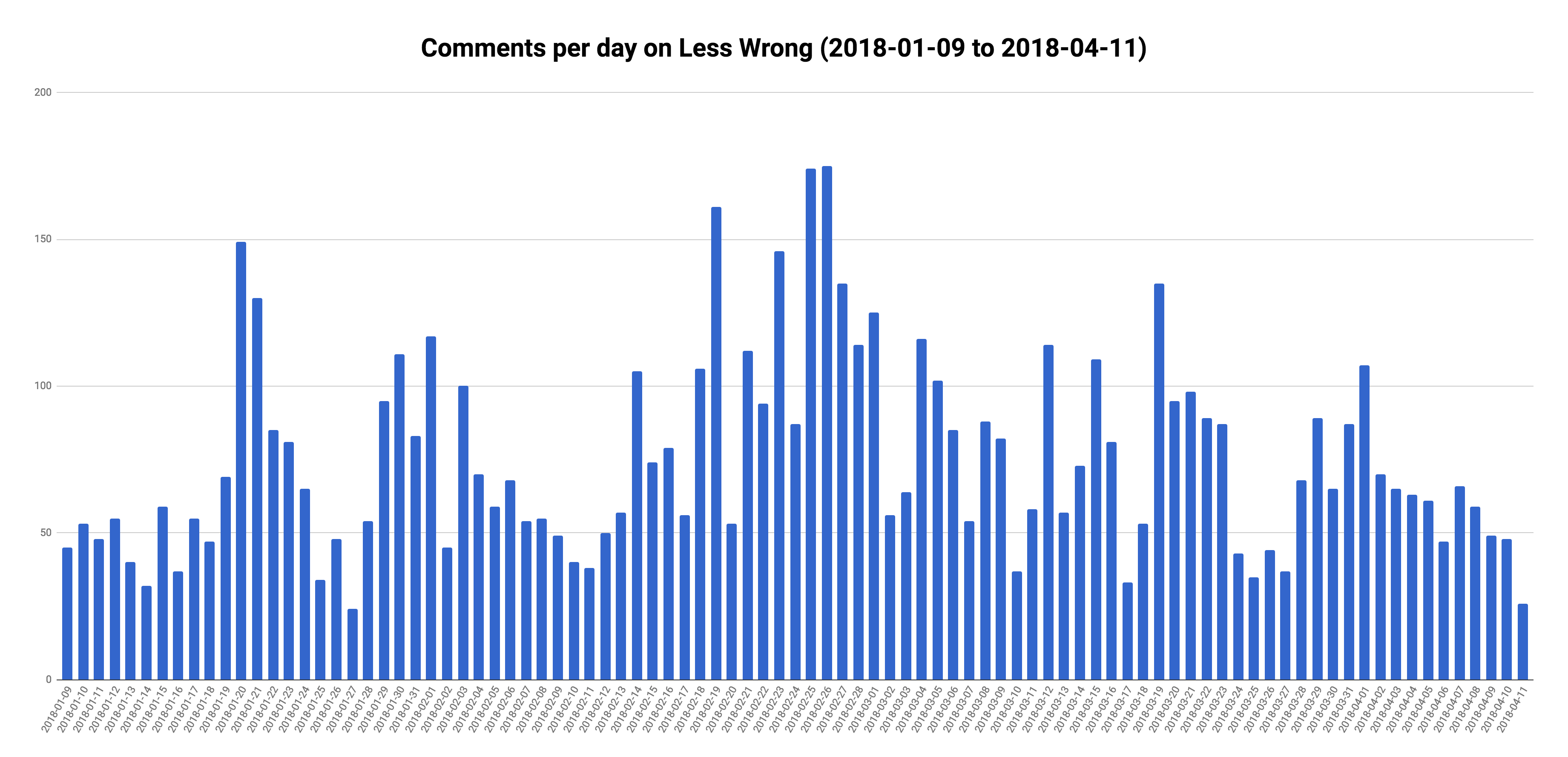
See the graphs I posted on this month’s open thread for some relevant data.
To save everyone else some time, here's the relevant graph, basically showing that amount of comments has remained fairly constant for the past 4 months at least (while a different graph showed traffic as rising, suggesting ESRog's hypothesis seems true)
2
One hypothesis I thought of recently for this is that there are now more local rationalist communities where people can meet their social needs, which reduces their motivations for joining online discussions.
5
Variant Solution #2D: Norm Groups ( intersection of solutions 1 and 2B): There are groups of authors and lieutenants who enforce a single set of norms, you can join them, and they'll help enforce the norms on your posts too.
You can join the sunshine regiment, the strict-truth-team, the sufi-buddhist team, and you can start your own team, or you can just do what the current site does where you run your own norms on your post and there's no team.
This is like subreddits except more implicit - there's no page for 'all the posts under these norms', it's just a property of posts.
I'm working on (currently admin-only) features for having LLMs do fairly common classes of "suggest edits for your post."
This is... a tool that I think is totally quite useful if you are using it responsibly, but I would not trust most people to use it responsibly.
The things it currently does that I expect find straightforwadly useful useful are formulaic things like:
- Flag places where I accidentally forgot to finish a sentence so it doesn't
- Flag run-on-sentences and suggest rewrites that make them more "right-branching" (i.e. it wraps up each clause as earl
3I've recently updated on how useful it'd be to have small icons representing users. Previously some people were like "it'll help me scan the comment section for people!" and I was like "...yeah that seems true, but I'm scared of this site feeling like facebook, or worse, LinkedIn."
I'm not sure whether that was the right tradeoff, but, I was recently sold after realizing how space-efficient it is for showing lots of commenters. Like, in slack or facebook, you'll see things like:
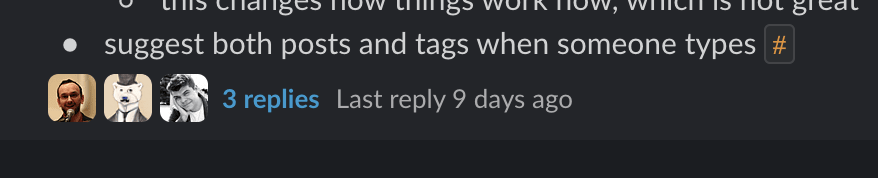
This'd be really helpful, esp. in the Quick Takes and Popular comments sections,...
I am fairly strongly against having faces, which I think boot up a lot of social instincts that I disprefer on LessWrong. LessWrong is a space where what matters is which argument is true, not who you like / have relationships with. I think some other sort of unique icon could be good.
413
a ui on your user page where you get to pick a four letter shortening of your name and a color. the shortening is displayed as
t g
t a
in a tiny color-of-your-choice box. when picking your name, each time you pick a hue and saturation in the color picker (use a standard one, don't build a color picker), it does a query (debounced - I hope you have a standard way to debounce in react elements) for other people on the site who have that initialism, and shows you their colors in a list, along with an indicator min(color_distance(you.color, them.color) for them in other_users).
the color distance indicator could be something like the one from here, which would need transliterating into javascript:
[...]
2
Are the disagree reacts with ‘small icons are good for this reason (enough to override other concerns)’ or ‘I didn’t update previously?’
I... had a surprisingly good time reading Coinbase's Terms of Service update email?
...We’ve recently updated our User Agreement. To continue using our services and take advantage of our upcoming feature launches, you’ll need to sign in to Coinbase and accept our latest terms.
You can read the entire agreement here. At a glance, here’s what this update means for you:
Easier to Understand: We’ve reorganized and modified our user agreement to make it more understandable and in line with our culture of clear communications.
Clarity on Dispute Resolution: We’ve
This is an experiment in short-form content on LW2.0. I'll be using the comment section of this post as a repository of short, sometimes-half-baked posts that either:
I ask people not to create top-level comments here, but feel free to reply to comments like you would a FB post.